Quack AI (Q) is an AI-native governance layer for Web3, launched in 2025 to solve fragmented governance processes and inefficient DAO decision-making. Operating across BNB Chain, Arbitrum, Base, Linea, and Polygon, it provides automated, transparent, and auditable governance workflows through blockchain technology and AI-driven proposal analysis. As of January 2026, Q has attracted 23,380 token holders and is listed on Gate.com and 14 exchanges, with a circulating market cap of $26.99 million. The token experienced peak price of $0.053205 in October 2025 and currently trades at $0.016706. This guide explores Quack AI's technical architecture leveraging smart contracts and cryptographic security, market performance metrics, ecosystem applications for DAO and RWA projects, community engagement on X platform, and challenges including technical complexity and adoption barriers. Understanding Quack AI's positioning as a decentralized governance solution helps participants navigate its role in transforming Web3 dec
Quack AI's Positioning and Significance
In 2025, the Quack AI team launched Quack AI (Q), aiming to address fragmented governance processes, inefficient decision-making in decentralized organizations, and lack of transparency in DAO operations.
As the AI-native governance layer for Web3, Quack AI plays a crucial role in decentralized governance, DAO operations, and RWA project management.
As of 2026, Quack AI has emerged as a notable governance solution in the Web3 space, with 23,380 holders and an active development community.
This article will provide an in-depth analysis of its technical architecture, market performance, and future potential.
Origin and Development History
Birth Background
Quack AI was created by its development team in 2025, aiming to solve fragmented governance workflows, inefficient proposal management, and compliance challenges in decentralized decision-making.
It emerged during the rapid expansion of DAO ecosystems and increasing demand for automated governance solutions, with the goal of transforming scattered governance into automated, auditable workflows through AI integration.
The launch of Quack AI brought new possibilities to DAOs, RWA projects, and Web3 communities seeking scalable governance.
Key Milestones
- September 2, 2025: Token launched with an initial price of $0.01, establishing market presence.
- October 7, 2025: Reached historical peak price of $0.053205, demonstrating strong market interest.
- January 2026: Listed on Gate.com and 14 exchanges, expanding accessibility with 23,380 holders.
- 2025-2026: Multi-chain support deployment across BNB Chain, Arbitrum, Base, Linea, and Polygon, enhancing interoperability.
With support from its community and development foundation, Quack AI continues to optimize its technology, security features, and real-world applications.
How Quack AI Works
No Central Control
Quack AI operates on multi-chain networks including BNB Chain, Arbitrum, Base, Linea, and Polygon, removing dependence on centralized governance structures.
These distributed networks collaborate to process governance data and execute automated workflows, ensuring transparency and resistance to single points of failure.
This architecture grants communities greater autonomy while enhancing system resilience.
Blockchain Foundation
Quack AI's infrastructure leverages public, immutable blockchain ledgers across multiple chains to record governance activities.
Governance transactions and automated workflows are processed through smart contracts, creating verifiable and transparent decision-making trails.
Anyone can audit governance records without intermediaries, establishing trust through cryptographic verification.
The platform's multi-chain architecture enables cross-chain governance capabilities and broader ecosystem integration.
Ensuring Fairness
Quack AI utilizes BEP-20 token standard on BNB Chain as its primary implementation, with cross-chain bridges enabling operations across supported networks.
Token holders participate in governance through voting, delegation, and automated policy controls, maintaining network integrity and decision-making processes.
Rewards and incentives align community interests with platform development goals.
The system's innovation includes AI-driven proposal drafting, automated impact analysis, and auditable workflow execution.
Secure Transactions
Quack AI employs public-private key cryptography to protect governance operations:
- Private keys enable authorized signing of governance actions and treasury operations
- Public keys verify ownership and voting rights within the system
This mechanism ensures secure fund management, with transactions maintaining transparency while protecting participant privacy.
Additional security features include policy-based access controls and multi-signature requirements for critical treasury actions.
Circulation Overview
As of January 22, 2026, Quack AI has a circulating supply of 1,616,000,000 Q tokens, with a total supply of 10,000,000,000 tokens. The maximum supply is capped at 10,000,000,000 tokens, representing a fixed supply model.
The current circulating supply represents approximately 16.16% of the total token supply. New tokens enter the market through structured distribution mechanisms that influence the token's supply and demand dynamics.
Price Volatility
Quack AI reached an all-time high of $0.053205 on October 7, 2025, reflecting strong market interest during its early trading period. The token experienced its lowest price point of $0.002 on September 2, 2025, representing the initial market discovery phase.
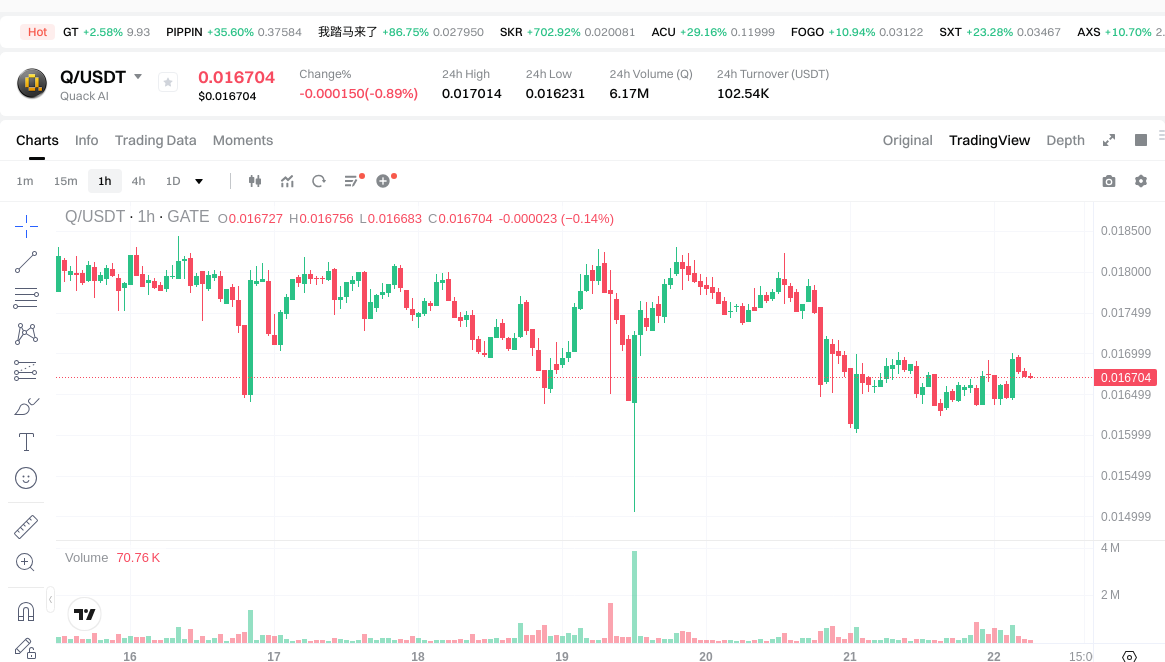
As of the latest data, Q is trading at $0.016706, demonstrating recovery from its initial lows. Over the past 24 hours, the token has shown a modest increase of 0.07%, while experiencing a -7.02% decline over the 7-day period. However, the 30-day performance indicates positive momentum with a gain of 14.59%.
The 24-hour trading range has been between $0.016231 and $0.017014, with a daily trading volume of $102,982.51, indicating moderate market activity.
Click to view the current Q market price
On-Chain Metrics
- Token Holders: The Q token has attracted 23,380 holders across its supported networks, indicating growing community adoption.
- Exchange Listings: Q is currently listed on 14 exchanges, providing multiple access points for traders and investors.
- Market Capitalization: With a circulating market cap of approximately $26.99 million and a fully diluted valuation of $167.06 million, Q maintains a market cap to FDV ratio of 16.16%.
Quack AI Ecosystem Applications and Partners
Core Use Cases
Quack AI's ecosystem supports multiple applications:
- DAO Governance: Projects utilizing automated governance workflows, providing AI-driven proposal drafting and analysis.
- RWA Projects: Real-world asset initiatives, promoting transparent and compliant decision-making processes.
Strategic Partnerships
Quack AI has established multi-chain support infrastructure with BNB Chain, Arbitrum, Base, Linea, and Polygon, enhancing its technical capabilities and market reach.
These partnerships provide a solid foundation for Quack AI's ecosystem expansion.
Controversies and Challenges
Quack AI faces the following challenges:
- Technical Complexity: Integration across multiple blockchain networks and maintaining automated workflow accuracy
- Market Competition: Other AI-governance solutions in the Web3 space
- Adoption Barriers: Educational requirements for DAO communities to effectively utilize AI-native governance tools
These issues have sparked discussions within the community and market, while also driving Quack AI's continuous innovation.
Quack AI's community shows active participation, with 23,380 token holders as of January 22, 2026.
On X platform, related posts and hashtags (such as #QuackAI) generate regular engagement.
The platform's AI-native governance features and multi-chain support have attracted community attention.
Sentiment on X presents varied perspectives:
- Supporters praise Quack AI's automated governance capabilities and multi-chain compatibility, viewing it as "the future of DAO decision-making".
- Critics focus on market volatility and adoption challenges in traditional governance structures.
Recent trends indicate interest in AI-driven governance solutions within the Web3 space.
Hot Topics
X users discuss Quack AI's governance automation, compliance features, and treasury management capabilities,
showcasing both its transformative potential and the path toward mainstream adoption.
- Official Website: Visit Quack AI Official Site for features, use cases, and latest updates.
- White Paper: Quack AI Documentation details its technical architecture, objectives, and vision.
- X Updates: On X platform, Quack AI actively engages using @QuackAI_AI,
with posts covering technical developments, community activities, and governance innovations.
Quack AI Future Roadmap
- Ongoing Development: Enhancement of AI-driven governance workflows and policy automation, improving decision-making efficiency and transparency
- Ecosystem Goals: Expansion of multi-chain governance support and integration with additional blockchain networks
- Long-term Vision: Becoming a standard infrastructure for AI-native governance in Web3
How to Participate in Quack AI?
- Purchase Channels: Buy Q tokens on Gate.com and other supporting exchanges
- Storage Solutions: Use compatible BSC wallets to securely store Q tokens
- Participate in Governance: Engage with governance processes through supported DAO platforms
- Build Ecosystem: Access developer documentation to contribute to governance tool development
Summary
Quack AI redefines DAO governance through AI-native blockchain technology, providing automated, transparent, and compliant decision-making processes.
Its active community, comprehensive documentation, and multi-chain support position it distinctively in the cryptocurrency space.
Despite facing adoption challenges and market competition, Quack AI's innovative approach and clear development direction secure its important position in the future of decentralized governance.
Whether you're a newcomer or experienced participant, Quack AI deserves attention and engagement.
FAQ
What is Crypto Q? What are its main features?
Crypto Q is a decentralized digital asset platform offering secure transactions, instant settlement, and low fees. Key features include blockchain-based transparency, 24/7 trading availability, multi-chain compatibility, and advanced smart contract functionality for DeFi applications.
What are the practical uses and application scenarios of Crypto Q?
Crypto Q serves as a decentralized utility token enabling smart contract interactions, governance participation, and ecosystem liquidity provision. It facilitates peer-to-peer transactions, decentralized finance protocols, and cross-chain value transfer within the Web3 infrastructure landscape.
How to buy and store Crypto Q? What security issues should I pay attention to?
Purchase Crypto Q through peer-to-peer transfers or direct acquisition. Store securely using hardware wallets or cold storage solutions. Enable two-factor authentication, use strong passwords, verify addresses carefully, and keep private keys offline to prevent unauthorized access.
What is the difference between Crypto Q and other mainstream cryptocurrencies like Bitcoin and Ethereum?
Crypto Q offers enhanced scalability, lower transaction fees, and faster settlement times compared to Bitcoin and Ethereum. It features innovative consensus mechanisms and superior energy efficiency, positioning it as a next-generation digital asset for modern blockchain applications.
Crypto Q carries market volatility risks, liquidity fluctuations, and regulatory uncertainties. Before investing, understand tokenomics, project fundamentals, market conditions, and your risk tolerance. Consider transaction volume, team background, and long-term vision.
What is the future development prospect of Crypto Q?
Crypto Q shows strong growth potential with increasing adoption, expanding use cases, and strengthening community support. As blockchain technology matures, Crypto Q is positioned for significant appreciation and market expansion in coming years.
* The information is not intended to be and does not constitute financial advice or any other recommendation of any sort offered or endorsed by Gate.