QuarkChain (QKC) is a sharding-based blockchain infrastructure solution launched in 2018 to address blockchain scalability and transaction throughput limitations. This comprehensive guide explores QKC's technical architecture, which enables over 100,000 transactions per second through innovative multi-layered sharding design, and examines its market performance with a circulating supply of 7.2 billion tokens and $29.14 million market capitalization as of January 2026. The article covers core use cases in high-throughput DeFi and cross-shard smart contracts, provides insights into the 10,053-member holder community, and details how to acquire and participate in the QuarkChain ecosystem through Gate and other trading platforms. Whether exploring scalable blockchain solutions or evaluating layer-1 alternatives, this guide offers essential information on QuarkChain's distinct technical approach and current market positioning.
QuarkChain's Positioning and Significance
In 2018, the QuarkChain team launched QuarkChain (QKC), aiming to address blockchain scalability limitations and low transaction throughput.
As a sharded blockchain infrastructure solution, QuarkChain plays a key role in high-performance decentralized applications and enterprise blockchain adoption.
As of 2026, QuarkChain has established itself within the blockchain infrastructure space, with over 10,000 token holders and an active development community.
This article will provide an in-depth analysis of its technical architecture, market performance, and future potential.
Origin and Development Journey
Birth Background
QuarkChain was created by its founding team in 2018, aiming to solve blockchain scalability issues and transaction processing bottlenecks.
It emerged during the blockchain technology expansion period, with the goal of enabling over 100,000 transactions per second through innovative sharding technology.
QuarkChain's launch brought new possibilities for developers and enterprises seeking high-throughput blockchain solutions.
Key Milestones
- 2018: Mainnet launch, achieving sharding-based architecture with high throughput capabilities.
- 2018: Token deployment on Ethereum network, establishing cross-chain compatibility.
- 2020: Market resilience demonstrated during volatile periods.
- 2026: Ecosystem continues operation with ongoing development on GitHub repositories.
With support from its community and development team, QuarkChain continues to refine its technology, security features, and real-world applications.
How QuarkChain Works
Decentralized Control
QuarkChain operates on a globally distributed network of computers (nodes), free from centralized control by banks or governments.
These nodes collaborate to validate transactions, ensuring system transparency and attack resistance, granting users greater autonomy and enhancing network resilience.
Blockchain Foundation
QuarkChain's blockchain is a public, immutable digital ledger recording every transaction.
Transactions are grouped into blocks and linked through cryptographic hashing to form a secure chain.
Anyone can view the records, establishing trust without intermediaries.
Its sharding technology further enhances performance by enabling parallel transaction processing.
Ensuring Fairness
QuarkChain employs a consensus mechanism based on sharding architecture to validate transactions and prevent fraud such as double-spending.
Network participants maintain security through node operation and transaction validation, receiving QKC rewards.
Its innovation includes horizontal scalability through multi-layered sharding design.
Secure Transactions
QuarkChain uses public-private key cryptography to protect transactions:
- Private keys (like secret passwords) are used to sign transactions
- Public keys (like account numbers) are used to verify ownership
This mechanism ensures fund security while transactions maintain pseudonymous characteristics.
The system's architecture provides additional security through distributed validation across shards.
Circulation Overview
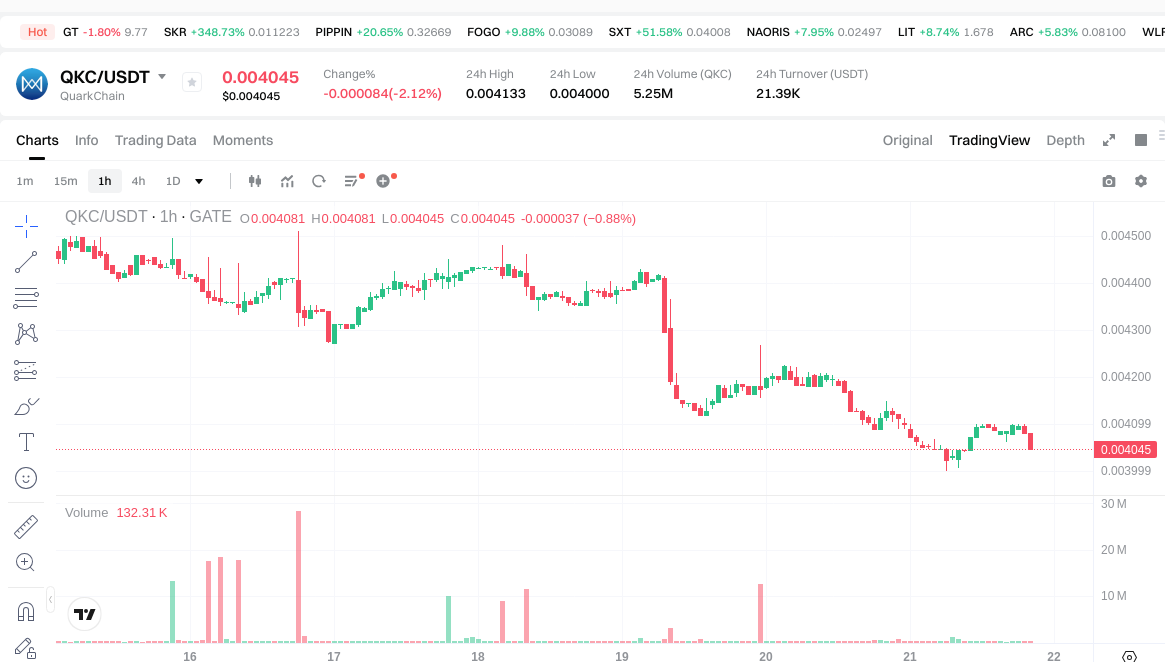
As of January 21, 2026, QuarkChain's circulating supply stands at 7,202,025,345 QKC tokens, with a total supply of 10,000,000,000 QKC and an unlimited maximum supply, indicating an inflationary token model.
The current circulation ratio represents approximately 72.02% of the total supply, with tokens distributed through the network's blockchain infrastructure.
The token deployment follows a distribution framework supporting network operations and ecosystem development.
Price Fluctuations
QuarkChain reached a notable price level of $0.338765 on June 5, 2018, during a period of heightened market interest in blockchain scalability solutions and sharding technology adoption.
Its lowest recorded price was $0.00137714, occurring on March 13, 2020, coinciding with broader market volatility and reduced trading activity across digital assets.
These price movements reflect changing market sentiment, technological adoption patterns, and external market conditions affecting the blockchain sector.
Click to view the current QKC market price
On-Chain Metrics
- Holder Count: Approximately 10,053 addresses hold QKC tokens, indicating the size of the token holder community
- 24-Hour Trading Volume: $21,445.46 in trading activity, reflecting current market liquidity levels
- Market Capitalization: $29,139,394.55, representing the circulating supply valuation at current market prices
QuarkChain Ecosystem Applications and Partners
Core Use Cases
QuarkChain's ecosystem is designed to support diverse applications through its sharding-based infrastructure:
- High-Throughput DeFi: The platform's capability to process over 100,000 transactions per second enables decentralized finance applications requiring rapid settlement and scalability.
- Cross-Shard Smart Contracts: QuarkChain facilitates decentralized applications that benefit from its multi-layered architecture, allowing developers to deploy smart contracts across different shards.
Strategic Collaborations
While specific partnership details are not extensively documented in available materials, QuarkChain's technical framework positions it to collaborate with projects requiring scalable blockchain solutions. The platform's open-source development on GitHub demonstrates ongoing community-driven innovation.
Challenges and Considerations
QuarkChain faces several challenges in the competitive blockchain landscape:
- Market Competition: The project operates in a crowded space with numerous layer-1 blockchain solutions competing for developer adoption and market share.
- Technical Complexity: Implementing and maintaining sharding technology requires continuous development efforts to ensure security and performance.
- Price Volatility: QKC has experienced significant fluctuations, with the current price representing a substantial decrease from its historical peak.
These factors continue to shape the project's development trajectory and community engagement.
QuarkChain maintains an active community across multiple platforms. As of January 21, 2026, the token has approximately 10,053 holders, demonstrating sustained interest in the project. The platform's social media presence spans Twitter, Reddit, and Facebook, providing channels for community interaction and updates.
Community discussions on platforms like X and Reddit reflect diverse perspectives:
- Supporters emphasize QuarkChain's technical approach to blockchain scalability, highlighting its sharding architecture and high throughput capabilities as innovative solutions to network congestion.
- Observers note the project's market performance challenges, with QKC experiencing price declines across various timeframes, including a 59.12% decrease over the past year.
Recent trends show mixed sentiment, with community members discussing both the platform's technological potential and market positioning.
Discussion Topics
Community conversations frequently address QuarkChain's scalability solutions, development progress on GitHub, and the project's competitive positioning within the broader blockchain ecosystem.
- Official Website: Visit QuarkChain's official site for comprehensive information on the platform's architecture, features, and development updates.
- Technical Resources: Explore QuarkChain's GitHub repositories at PyQuarkChain and QuarkChain Web3.js for technical documentation and code contributions.
- Social Media: Follow QuarkChain on Twitter for announcements and community engagement. The project also maintains presence on Reddit and Facebook.
- Blockchain Explorer: Monitor network activity through the QuarkChain mainnet explorer for real-time transaction data and network statistics.
How to Participate in QuarkChain?
- Purchase Options: QKC is available for trading on Gate.com and 14 other exchanges, providing multiple access points for acquiring the token.
- Storage Solutions: Store QKC tokens securely using compatible wallets that support the Ethereum network, as QKC operates as an ERC-20 token with contract address 0xea26c4ac16d4a5a106820bc8aee85fd0b7b2b664.
- Monitor Network: Track blockchain performance and transactions through the mainnet explorer to observe network activity.
- Developer Engagement: Access technical documentation and code repositories on GitHub to contribute to the platform's development or build applications leveraging QuarkChain's sharding technology.
Summary
QuarkChain represents an approach to blockchain scalability through its sharding-based architecture, designed to achieve high transaction throughput while maintaining decentralization. With a circulating supply of 7.2 billion QKC tokens and active development repositories, the project continues to pursue its vision of scalable blockchain infrastructure. The platform's market capitalization of approximately $29.14 million reflects its position in the competitive blockchain landscape. While facing challenges common to blockchain projects, including market volatility and technical complexity, QuarkChain's focus on sharding technology and open-source development provides a foundation for ongoing innovation. Whether you're interested in scalable blockchain solutions or exploring alternative layer-1 platforms, QuarkChain offers a distinct technical approach worth examining.
FAQ
What is QuarkChain (QKC) and what problem does it solve?
QuarkChain is a blockchain platform designed to solve scalability limitations. It uses a hierarchical sharding architecture to increase transaction throughput and reduce latency, enabling faster and cheaper transactions while maintaining security and decentralization.
What are the main features and technical characteristics of QKC?
QuarkChain (QKC) features a heterogeneous sharding architecture enabling high throughput and low latency. It supports cross-shard transactions, smart contracts, and maintains security through a two-tier blockchain consensus mechanism combining proof-of-work with Byzantine fault tolerance.
How can I buy, store, and use QKC tokens?
Purchase QKC on major crypto platforms using fiat or other cryptocurrencies. Store tokens in secure wallets like MetaMask or hardware wallets. Use QKC for transactions, staking, or trading on decentralized exchanges within the QuarkChain ecosystem.
What is the difference between QKC and other Layer 1 blockchain projects?
QuarkChain distinguishes itself through elastic scaling architecture, supporting both sharding and sidechains. It enables high throughput while maintaining decentralization, offering flexible account models and superior transaction capacity compared to traditional Layer 1 solutions.
What are the risks and considerations before investing in QKC?
QKC investment involves market volatility, regulatory uncertainty, and technology risks. Consider your risk tolerance, investment horizon, and only invest capital you can afford to lose. Conduct thorough research on QuarkChain's technology, team, and market conditions before committing funds.
* The information is not intended to be and does not constitute financial advice or any other recommendation of any sort offered or endorsed by Gate.