RAI Reflex Index is an innovative non-pegged stablecoin launched by Reflexer in 2021, addressing volatility and centralization risks inherent in traditional stablecoins. Backed by ETH collateral and deployed on Ethereum, RAI employs a unique reflexive mechanism with dynamic redemption rates to maintain stability without external pegging. As of February 2026, with 3,705 token holders and $1.79 million market capitalization, RAI demonstrates resilience through diverse market conditions. This comprehensive guide explores RAI's technical architecture, market dynamics ranging from $2.44 lows to $5.80 highs, ecosystem applications in DeFi protocols, and its position as a decentralized alternative within the cryptocurrency space. Discover how to trade RAI on Gate and participate in this emerging DeFi innovation.
RAI's Positioning and Significance
In 2021, the Reflexer team launched Rai Reflex Index (RAI), aiming to address the volatility and centralization risks inherent in traditional stablecoins.
As a non-pegged, ETH-backed stable asset, RAI plays a key role in DeFi protocols and decentralized finance ecosystems.
As of 2026, RAI has established itself within the DeFi space, with approximately 3,705 token holders and an active community focused on stability mechanisms.
This article will provide an in-depth analysis of its technical architecture, market performance, and future potential.
Origin and Development History
Birth Background
RAI was created by the Reflexer team in 2021, aiming to solve the inherent instability and peg dependency issues found in traditional stablecoins.
It emerged during the rapid expansion of DeFi protocols and growing concerns about algorithmic stablecoin failures, with the goal of providing a more resilient, market-driven stability mechanism through ETH collateralization to change the status quo.
The launch of RAI brought entirely new possibilities for DeFi users seeking stability without centralized pegs.
Important Milestones
- 2021: Mainnet launch on Ethereum, implementing a unique reflexive bonding mechanism that adjusts redemption rates based on market conditions.
- 2023: The project weathered significant market downturns, with RAI reaching its historical low price of $2.44 in October, demonstrating resilience in extreme market conditions.
- 2025: Price recovery led to an all-time high of $5.8 in August, reflecting renewed confidence in non-pegged stablecoin mechanisms.
- 2026: The ecosystem continues to evolve with steady holder growth and integration into various DeFi protocols.
With support from the decentralized community and ongoing protocol governance, RAI continues to refine its stability mechanism, security features, and real-world applications.
How RAI Works?
No Central Control
RAI operates on a decentralized network of computers (nodes) distributed globally across the Ethereum blockchain, free from control by banks or governments.
These nodes collaborate to validate transactions, ensuring system transparency and attack resistance, granting users greater autonomy and enhancing network resilience.
Blockchain Core
RAI's blockchain foundation leverages Ethereum's public, immutable digital ledger that records every transaction.
Transactions are grouped into blocks and linked through cryptographic hashes to form a secure chain.
Anyone can view the records, establishing trust without intermediaries.
As an ERC-20 token deployed on Ethereum, RAI benefits from the network's established security and composability within the DeFi ecosystem.
Ensuring Stability
RAI employs a unique reflexive mechanism rather than traditional pegging to maintain stability, using ETH as collateral.
Users deposit ETH into secure vaults to mint RAI, with the protocol automatically adjusting redemption rates based on market price deviations from the target.
This mechanism creates natural market forces that guide RAI toward stability without requiring direct pegging to external assets.
The innovation includes self-correcting incentives that respond dynamically to supply and demand pressures.
Secure Transactions
RAI utilizes public-private key cryptography to protect transactions:
- Private keys (similar to secret passwords) are used to sign transactions
- Public keys (similar to account numbers) are used to verify ownership
This mechanism ensures fund security while transactions maintain pseudonymous characteristics typical of Ethereum-based assets.
As an Ethereum token, RAI benefits from the network's established security infrastructure and smart contract audit practices.
Circulating Supply Overview
As of February 2, 2026, RAI Reflex Index has a circulating supply of 559,542.10 tokens, with a total supply of 559,542.10 tokens. The maximum supply is unlimited, indicating an inflationary model without a hard cap.
New tokens enter the market through the platform's issuance mechanism, which influences its supply-demand dynamics.
Price Volatility
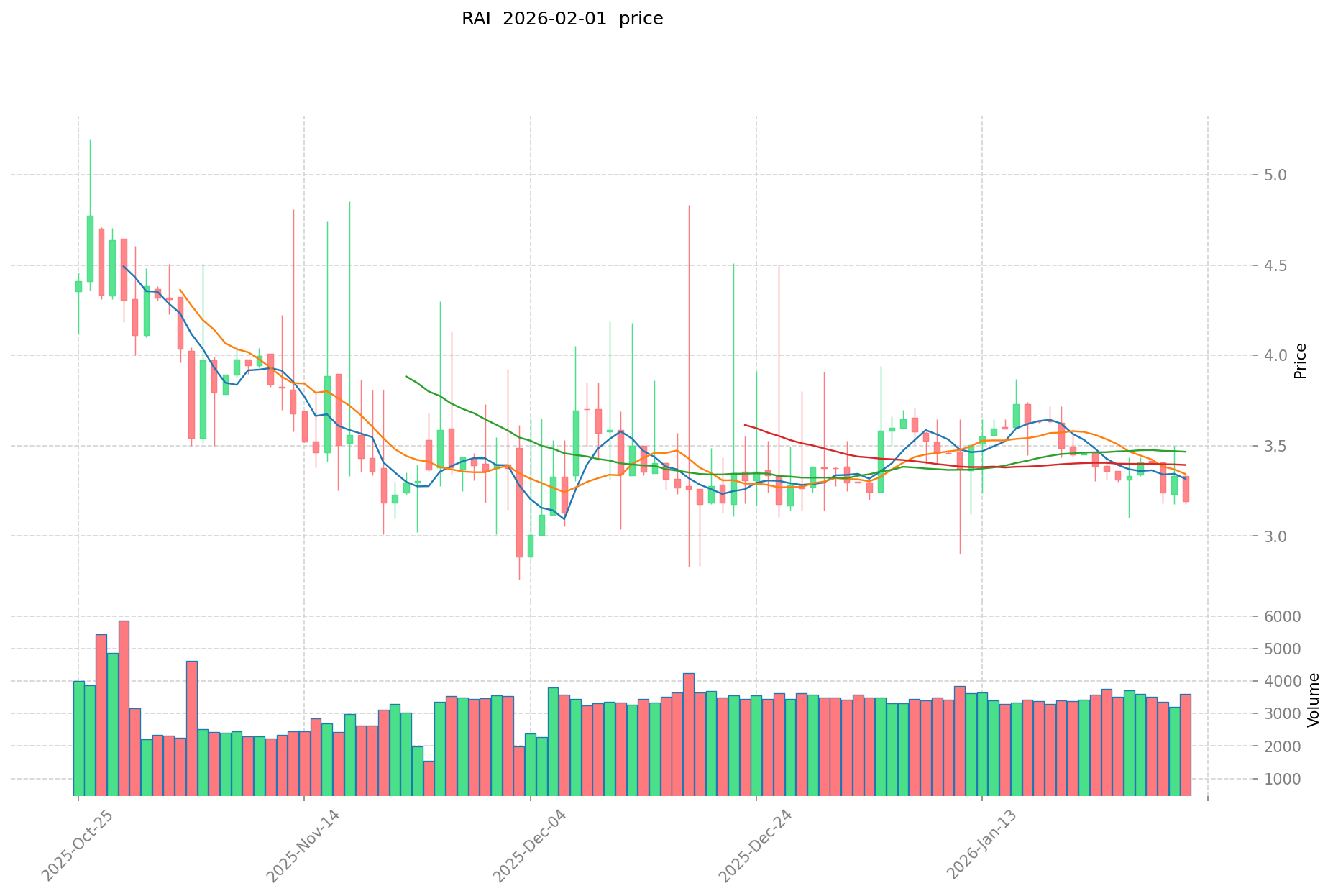
RAI Reflex Index reached its all-time high price of $5.80 on August 25, 2025, driven by increased market interest and broader adoption trends in the decentralized finance sector.
Its lowest price was $2.44, recorded on October 8, 2023, during a period of broader market downturn and reduced trading activity.
These fluctuations reflect market sentiment, adoption trends, and external factors affecting the cryptocurrency ecosystem.
Click to view the current RAI market price
On-Chain Metrics
- Holder Count: 3,705 addresses (reflecting user participation levels)
- 24-Hour Trading Volume: $11,457.69 (indicating current market activity)
- Market Capitalization: $1,786,058.37 (showing overall market valuation)
RAI Reflex Index Ecosystem Applications and Strategic Partners
Core Use Cases
RAI Reflex Index's ecosystem supports multiple applications:
- DeFi Protocol: As an ETH-backed stable asset, RAI provides decentralized stability mechanisms without pegging to any fiat currency or commodity.
- Collateral Asset: RAI serves as collateral in lending protocols, offering stability compared to volatile crypto assets while maintaining interest-bearing capabilities.
Strategic Partnerships
The Reflexer platform operates within the Ethereum ecosystem, leveraging its smart contract infrastructure and security model.
These foundational relationships provide a solid base for RAI's ecosystem expansion.
Challenges and Market Dynamics
RAI Reflex Index faces several challenges:
- Market Adoption: As a non-pegged stable asset with a unique mechanism, RAI requires user education to understand its stability model compared to traditional stablecoins.
- Competition Pressure: The stablecoin market includes established players with different peg mechanisms, creating competitive dynamics.
- Price Volatility: Recent data shows price fluctuations with a 7-day change of -5.27% and 30-day change of -3.57%.
These factors have sparked ongoing discussions within the community and markets, driving continuous innovation in the protocol.
RAI Reflex Index maintains an active community with 3,705 holders as of February 2026.
The project demonstrates market presence with a 24-hour trading volume of $11,457.69 and a market capitalization of approximately $1.79 million.
The project maintains official channels including:
- Twitter: Active presence through @reflexerfinance for updates on protocol developments and community engagement.
- Community Discussions: Conversations focus on RAI's unique non-pegged stability mechanism and its role in DeFi ecosystems.
Key Topics
Community members discuss RAI's innovative stability model, ETH collateralization mechanism, and interest-bearing characteristics,
showcasing both its potential for innovation and its position within the broader stablecoin landscape.
- Official Website: Visit Reflexer Finance for features, use cases, and latest updates.
- Social Media: Follow RAI on Twitter at @reflexerfinance for protocol updates, community activities, and ecosystem news.
- Blockchain Explorer: View on-chain data at Etherscan for transparency regarding transactions and smart contract interactions.
How to Participate in RAI Reflex Index?
- Purchase Options: RAI can be traded on Gate.com and decentralized exchanges.
- Storage Solutions: Store RAI securely using Ethereum-compatible wallets such as MetaMask or hardware solutions.
- Contract Address: RAI operates on Ethereum mainnet at
0x03ab458634910aad20ef5f1c8ee96f1d6ac54919.
- Ecosystem Participation: Users can mint RAI by depositing ETH as collateral through the Reflexer platform.
Summary
RAI Reflex Index introduces an innovative approach to stable assets through blockchain technology, offering non-pegged stability, ETH collateralization, and interest-bearing characteristics.
Its unique mechanism and presence within the Ethereum DeFi ecosystem position it distinctively in the cryptocurrency space.
Despite facing market adoption challenges and competitive dynamics, RAI's innovative stability model represents an alternative approach to traditional pegged stablecoins.
Whether you are new to crypto or an experienced participant, RAI Reflex Index offers a unique perspective on decentralized stable assets worth exploring.
FAQ
What is RAI and how does it work as a decentralized stablecoin?
RAI is a decentralized stablecoin backed by ETH collateral with a floating price, not pegged to fiat currency. It uses positive and negative interest rates to influence price stability. Users mint RAI through over-collateralized debt positions, while FLX token holders govern the protocol.
What is the difference between RAI and other stablecoins like USDC or DAI?
RAI is fully decentralized and algorithmically governed, requiring no central backing. Unlike USDC (centralized) and DAI (partially centralized), RAI operates autonomously, making it resistant to regulatory interference and censorship.
How can I mint, buy, or trade RAI tokens?
You can buy and trade RAI tokens through major cryptocurrency platforms. Select RAI trading pairs, typically against stablecoins like USDT. RAI cannot be minted directly by users. Compare prices across platforms and execute trades based on your preference.
What are the risks and safety considerations when using RAI?
RAI (Reflexer Automated Index) carries smart contract risks and collateral volatility exposure. Users should monitor debt positions, maintain adequate collateralization ratios, and understand liquidation mechanisms. Practice secure wallet management and only use official platforms for interactions.
How is RAI value maintained and what backs it?
RAI maintains its value through algorithmic supply adjustments and is backed by collateralized assets held in its protocol reserves. The system automatically rebalances to keep RAI stable independent of external market conditions.
What is Reflexer Protocol and its relationship with RAI?
Reflexer Protocol is a decentralized borrowing platform that uses RAI, its non-pegged stablecoin, for loans secured by Ether as collateral. RAI is the core asset of the protocol.
* The information is not intended to be and does not constitute financial advice or any other recommendation of any sort offered or endorsed by Gate.