This comprehensive guide explores Reef (REEF), a fast and affordable Layer 1 blockchain launched in 2020 to democratize Web3 access. Reef addresses key adoption barriers through transaction fees below $0.01, supporting over 107,000 holders across 11 exchanges on Gate and other platforms. The article examines Reef's decentralized architecture, consensus mechanisms, and cryptographic security, alongside its current market performance and ecosystem applications in DeFi and Web3 accessibility. Discover Reef's strategic positioning, community engagement, technical innovations, and practical guidance for purchasing and participating in its network. Whether you're new to blockchain or seeking cost-effective infrastructure, Reef provides an accessible entry point into decentralized technology and digital finance solutions.
Reef's Positioning and Significance
In 2020, the Reef team launched Reef (REEF), aiming to address accessibility barriers and high transaction costs in Web3 adoption.
As a fast, affordable, and efficient Layer 1 blockchain, Reef plays a key role in decentralized finance and Web3 applications.
As of 2026, Reef has established itself as an accessible blockchain infrastructure with over 107,000 holders, featuring transaction fees below $0.01 and widespread availability across multiple exchanges.
This article will provide an in-depth analysis of its technical architecture, market performance, and future potential.
Origins and Development History
Birth Background
Reef was created by its founding team in 2020, aiming to solve complexity and cost barriers preventing mainstream Web3 adoption.
It emerged during the rapid expansion of blockchain technology and DeFi, with the goal of making blockchain accessible to all users through low fees and simplified user experience.
Reef's launch brought new possibilities for retail users and developers seeking affordable blockchain infrastructure.
Important Milestones
- 2020: Project launched with the mission to create the most accessible Layer 1 blockchain.
- Ongoing: Maintained transaction fees below $0.01, establishing itself as one of the most cost-effective blockchain networks.
- 2026: Network has grown to support over 107,000 holders across 11 exchanges.
- Current: Continues to expand its ecosystem with focus on user accessibility and developer-friendly infrastructure.
Under the support of its community and development team, Reef continues to optimize its technology, security, and real-world applications.
How Does Reef Work?
No Central Control
Reef operates on a decentralized network of computers (nodes) distributed globally, free from control by banks or governments.
These nodes collaborate to validate transactions, ensuring system transparency and attack resistance, granting users greater autonomy and enhancing network resilience.
Blockchain Core
Reef's blockchain is a public, immutable digital ledger that records every transaction.
Transactions are grouped into blocks and linked through cryptographic hashes to form a secure chain.
Anyone can view the records, establishing trust without intermediaries.
The network's architecture is optimized for efficiency and affordability, enabling sub-cent transaction fees.
Ensuring Fairness
Reef employs a consensus mechanism to validate transactions and prevent fraud such as double-spending.
Network participants maintain security through validation activities and receive REEF rewards.
Its innovation includes extremely low transaction costs and fast processing speeds, making it accessible for everyday use.
Secure Transactions
Reef uses public-private key cryptography to protect transactions:
- Private keys (like secret passwords) are used to sign transactions
- Public keys (like account numbers) are used to verify ownership
This mechanism ensures fund security while transactions maintain pseudonymous privacy.
The network's design prioritizes both security and user-friendliness, enabling safe interactions without technical complexity.
Circulation Overview
As of February 01, 2026, Reef's circulating supply stands at 22,821,409,581 tokens, with a total supply of 45,015,472,308.33. The circulating supply represents 100% of the total supply, indicating full circulation in the market. The token distribution dynamics influence supply and demand patterns within the ecosystem.
Price Fluctuations
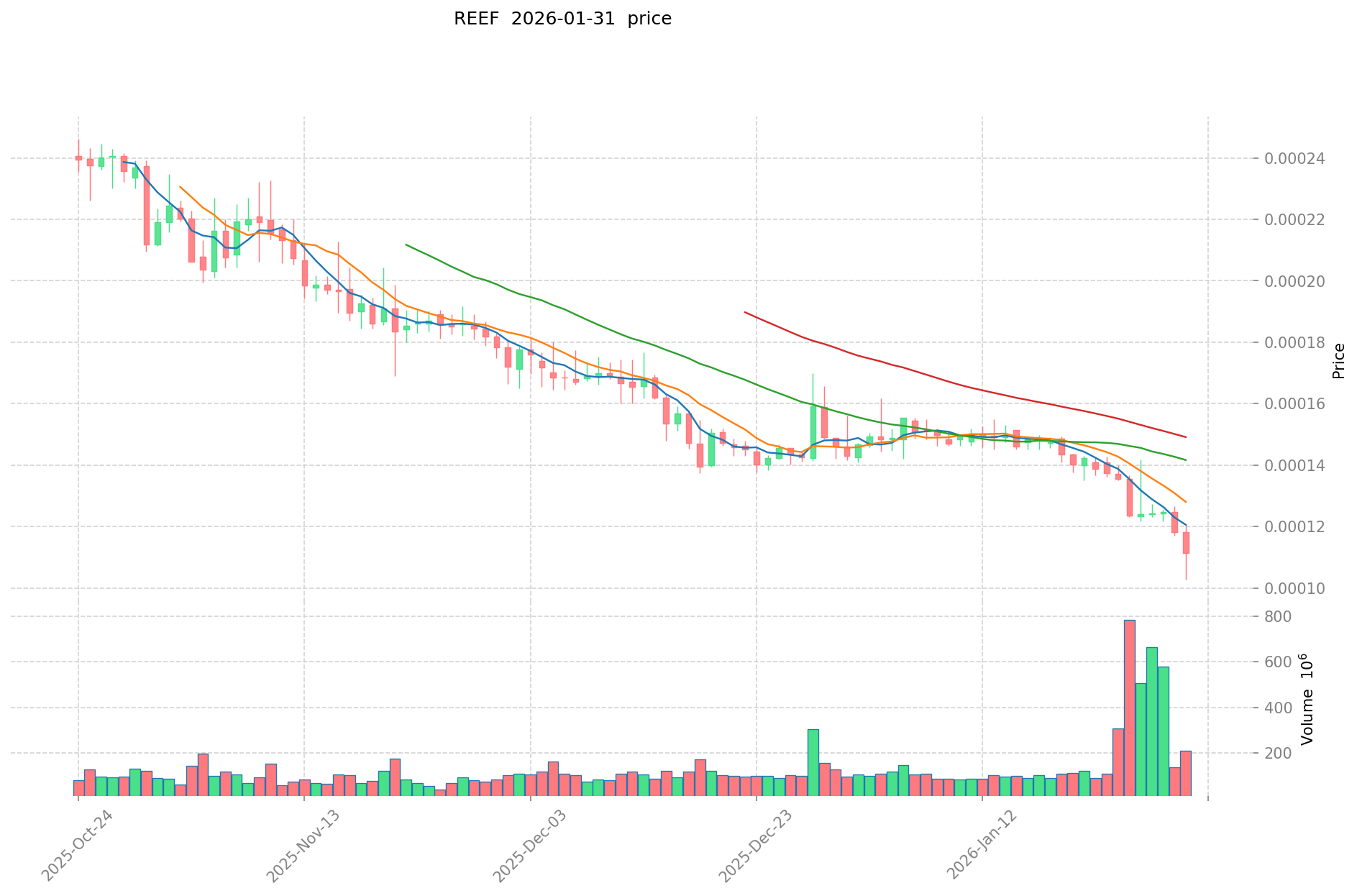
Reef reached its all-time high of $0.05746 on March 15, 2021, during a period of broader market momentum in the cryptocurrency space. The token experienced its lowest price of $0.00010358 on February 01, 2026, reflecting market adjustments and evolving trading conditions. These fluctuations demonstrate the impact of market sentiment, adoption trends, and external factors on token valuation.
Click to view current REEF market price
On-Chain Metrics
- Active Addresses: Approximately 107,316 holders (reflecting user participation levels)
- Transaction Fees: Less than $0.01 per transaction (demonstrating cost efficiency)
- Exchange Availability: Listed on 11 exchanges (indicating accessibility for users)
Reef Ecosystem Applications and Strategic Partners
Core Use Cases
Reef's ecosystem supports multiple applications as a layer 1 blockchain:
- DeFi Infrastructure: The platform provides decentralized finance solutions with transaction fees below $0.01, enabling cost-effective financial operations.
- Web3 Accessibility: Reef focuses on making blockchain technology accessible to all Web3 users through its user-friendly interface and efficient infrastructure.
Strategic Partnerships
Reef has established its presence through listings on multiple centralized and decentralized exchanges, enhancing token accessibility and market reach.
These partnerships provide a solid foundation for Reef's ecosystem expansion.
Challenges and Considerations
Reef faces several considerations in the competitive blockchain landscape:
- Market Volatility: Recent price movements show fluctuations, with a 24-hour change of -11.72% and a 7-day decline of -24.72%.
- Competitive Environment: Operating in a space with established layer 1 blockchains requires continuous innovation and differentiation.
- Market Position: With a market capitalization ranking of 1948, Reef continues to work on expanding its ecosystem and user base.
These factors drive ongoing discussions within the community and motivate continuous development efforts.
Reef maintains an active community with over 107,316 token holders.
The project maintains presence on X (Twitter) through its official account, where it shares updates and engages with the community.
Development activity is visible through its GitHub repository, demonstrating ongoing technical progress.
Discussions on X platform reflect diverse perspectives:
- Supporters appreciate Reef's focus on accessibility, low transaction fees, and efficient blockchain infrastructure.
- Observers monitor price performance and ecosystem development progress.
Community conversations often center around technological updates and platform improvements.
Key Discussion Topics
X users discuss Reef's positioning as an accessible layer 1 blockchain, its fee structure, and its approach to serving Web3 users,
reflecting both the platform's potential and the considerations inherent in blockchain adoption.
- Official Website: Visit Reef Official Website for features, use cases, and latest updates.
- Blockchain Explorer: Reefscan provides detailed on-chain data and transaction information.
- X Platform: Reef maintains an active presence on X through @Reef_Chain,
sharing updates about technical developments, community activities, and ecosystem news.
- Development: Visit Reef GitHub to explore the codebase and technical documentation.
- Community Discussion: Join the conversation at Reef Reddit for community discussions and updates.
How to Participate in Reef?
- Purchase Options: REEF tokens are available on Gate.com and 10 other exchanges for trading.
- Storage Solutions: Use compatible blockchain wallets that support Reef network for secure token storage.
- Explore Ecosystem: Visit the official website and blockchain explorer to understand the platform's capabilities.
- Developer Participation: Access technical resources through the GitHub repository to contribute to ecosystem development.
Summary
Reef positions itself as a fast, affordable, and efficient layer 1 blockchain, offering transaction fees below $0.01 and focusing on accessibility for Web3 users.
Its active community of over 107,000 holders, available resources, and multi-exchange presence demonstrate its engagement in the blockchain space.
While facing market dynamics and competitive pressures, Reef's focus on user accessibility and low-cost transactions defines its approach in the layer 1 blockchain landscape.
Whether you are new to blockchain or an experienced participant, Reef offers an accessible entry point into decentralized technology.
FAQ
What is REEF coin? What are its main functions and uses?
REEF is a blockchain-based cryptocurrency designed for decentralized finance services. Its primary function is to enable smart investment management and asset management across multiple blockchain networks, helping users optimize their crypto portfolios through intelligent DeFi solutions.
What are the core technical features and innovations of the REEF project?
REEF blockchain offers EVM compatibility, supporting Ethereum smart contracts for easy dApp migration. It features on-chain governance, enabling token holders to participate in network decisions through voting mechanisms.
How to buy and store REEF tokens? Which exchanges and wallets are supported?
Purchase REEF on major centralized exchanges supporting the token. Store REEF in secure crypto wallets or exchange wallets. Popular options include hardware wallets for long-term storage and hot wallets for convenient access and trading.
What are the differences and advantages of REEF compared to other DeFi projects like Uniswap and Aave?
REEF focuses on decentralized energy trading markets, while Uniswap specializes in token swaps and Aave in lending. REEF's unique advantage lies in its innovative energy sector solutions and market efficiency within the renewable energy ecosystem.
What are the main risks and challenges of investing in REEF?
REEF investment faces several risks including cryptocurrency market volatility, intense DeFi competition, and platform technology uncertainty. These factors may result in investment losses and require careful consideration before participating.
REEF项目的团队背景和发展路线图如何?
REEF项目由Wildurban Architects领导,团队专注于空间优化和文化保护。发展路线图涵盖高效利用资源、历史遗产保护,计划未来数年内完成建设,成为重要地标项目。
What is the economic model and supply of REEF tokens?
REEF has no fixed supply cap, with a target supply exceeding 20 billion tokens at launch. Current total supply is approximately 22.8 billion tokens. The token powers the Reef Chain ecosystem for DeFi and smart contracts.
* The information is not intended to be and does not constitute financial advice or any other recommendation of any sort offered or endorsed by Gate.