Ren is a decentralized protocol launched in 2018 enabling privacy-focused dark pool trading across multiple blockchains. This comprehensive guide explores Ren's technical architecture, market performance, and role in institutional-grade cryptocurrency trading. The article covers Ren's distributed node network, dark pool matching engine, and cross-chain liquidity solutions facilitating large-scale trades without market exposure. As of 2026, Ren has established itself as a specialized infrastructure for privacy-preserving DeFi transactions across BTC/ETH pairs. The guide analyzes REN token economics, current market metrics showing 1 billion total supply and dynamic price movements, community sentiment on X platform, and ecosystem applications. Additionally, it addresses technical challenges, competitive pressures, and operational requirements for Dark Node operators. Whether you're an institutional investor seeking privacy trading solutions or exploring cross-chain DeFi opportunities, this guide provides essent
Ren's Position and Significance
In 2018, the Republic Protocol team launched Ren (REN), aiming to solve the challenges of executing large-volume crypto asset trades without market exposure and the lack of interoperability between different blockchain ecosystems.
As a protocol enabling distributed dark pool trading for crypto assets between BTC/ETH, BTC/ERC20, and ETH/ERC20 pairs, Ren plays a key role in facilitating private, large-scale institutional trading and cross-chain asset transfers.
As of 2026, Ren has established itself as a specialized protocol in the cross-chain and privacy trading space, with a token contract deployed on the Ethereum network and tracked across multiple exchanges.
This article will provide an in-depth analysis of its technical architecture, market performance, and future potential.
Origin and Development History
Birth Background
Ren was created by the Republic Protocol team in 2018, aiming to address the problem of institutional investors being unable to execute large crypto asset trades without revealing their intentions to the broader market.
It emerged during the maturation phase of blockchain technology and growing institutional interest in crypto markets, with the goal of providing a distributed dark pool infrastructure that mirrors traditional financial dark pools while maintaining decentralization to reshape trading dynamics.
Ren's launch brought new possibilities to institutional investors and traders seeking privacy and reduced market impact in crypto asset transactions.
Important Milestones
- 2018: Project launch with the vision of creating distributed dark pool trading infrastructure for crypto assets.
- Token deployment on Ethereum network with ERC-20 standard at contract address 0x408e41876cCCDC0F92210600ef50372656052a38.
- Introduction of Dark Nodes mechanism requiring 100,000 REN tokens as collateral to prevent malicious attacks and ensure network security.
- Development of RenEx matching engine to facilitate dark pool operations across multiple pools, reducing counterparty risk.
With support from the Republic Protocol development team and node operators, Ren has continued to refine its technical infrastructure and security mechanisms.
How Ren Works
No Central Control
Ren operates on a decentralized network of computers (nodes) distributed globally, eliminating control by banks or governments.
These nodes collaborate to validate transactions, ensuring system transparency and attack resistance, granting users greater autonomy and enhancing network resilience.
Blockchain Foundation
Ren's infrastructure is built on the Ethereum blockchain, utilizing a public, immutable digital ledger that records transactions.
Transactions are grouped into blocks and linked through cryptographic hashes to form a secure chain.
Anyone can view the records, establishing trust without intermediaries.
The protocol employs Dark Nodes as a distributed matching engine layer to facilitate private order matching across crypto asset pairs.
Ensuring Fairness
Ren relies on Ethereum's Proof of Stake consensus mechanism for underlying transaction validation, preventing fraud such as double-spending.
Dark Node operators maintain network security by running nodes and staking 100,000 REN tokens as collateral, receiving REN rewards for their participation.
Its innovation includes implementing a distributed dark pool system that allows large trades to be executed without market exposure while maintaining decentralization.
Secure Transactions
Ren uses public-private key cryptography to protect transactions:
- Private keys (similar to secret passwords) are used to sign transactions
- Public keys (similar to account numbers) are used to verify ownership
This mechanism ensures fund security while transactions maintain pseudonymous privacy characteristics.
The Dark Node network design adds an additional layer of privacy by distributing order matching across multiple nodes, preventing any single entity from viewing complete order information.
Circulation Overview
As of January 29, 2026, Ren's circulating supply stands at 1,000,000,000 tokens, with a total supply of 1,000,000,000 tokens, representing a fixed supply model with 100% of tokens already in circulation.
The token operates under a predetermined supply structure, where no additional tokens will be minted, establishing a deflationary dynamic that influences its supply-demand relationship.
To participate in the Republic Protocol network as a Darknode operator, nodes are required to bond 100,000 REN tokens, creating a functional utility that affects the circulating supply available for trading.
Price Fluctuations
Ren reached a notable price level of $1.8 on February 20, 2021, during a period of broader market momentum in the cryptocurrency sector.
The token experienced its lower price point at $0.00506349 on December 31, 2025, reflecting market-wide adjustments and evolving trading conditions.
As of the current date, REN is trading at $0.005703, showing a 24-hour change of 4.14%, with recent price movements indicating a one-hour decrease of 0.77%, a seven-day increase of 0.49%, a 30-day decrease of 0.64%, and a one-year decline of 78.31%.
These fluctuations demonstrate the dynamic nature of market sentiment, adoption patterns, and various external factors affecting the token's valuation.
Click to view the current REN market price
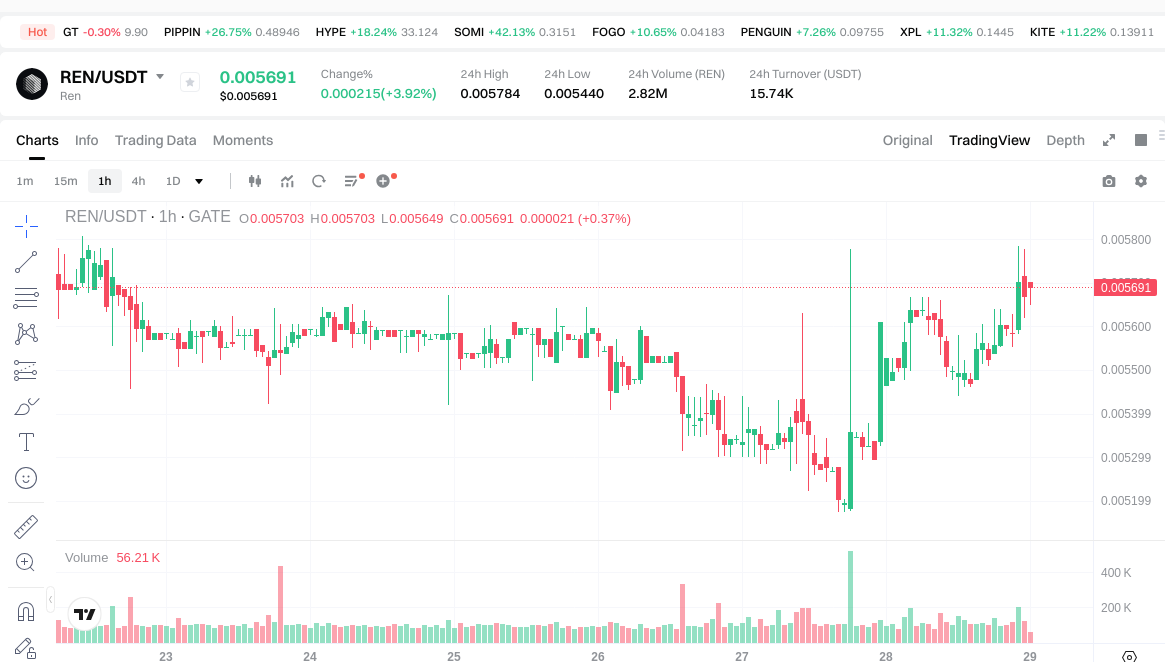
On-Chain Metrics
- Holder Count: 61,337 addresses (indicating community distribution and adoption breadth)
- 24-Hour Trading Volume: $15,734.98 (reflecting current market activity levels)
- Market Capitalization: $5,703,000 (representing the token's total market valuation)
- Exchange Availability: Listed on 6 exchanges (demonstrating accessibility for traders)
Ren Ecosystem Applications and Strategic Partners
Core Use Cases
Ren's ecosystem supports multiple applications:
- Cross-Chain DeFi: The Republic Protocol enables large-scale encrypted asset trading in distributed dark pools between BTC/ETH, BTC/ERC20, and ETH/ERC20 pairs, providing decentralized trading capabilities for institutional investors.
- Privacy Trading: Through the RenEx Dark Nodes matching engine, the platform delivers anonymous order matching services, allowing institutional investors to execute block trades without exposure.
Strategic Collaborations
Ren operates within the broader DeFi ecosystem, providing cross-chain liquidity solutions that enhance interoperability between different blockchain networks.
These partnerships and integrations provide a solid foundation for Ren's ecosystem expansion.
Controversies and Challenges
Ren faces the following challenges:
- Technical Issues: Managing distributed dark pool operations requires sophisticated infrastructure and continuous maintenance of Dark Nodes.
- Market Competition: The evolution of cross-chain bridge technologies and alternative privacy solutions presents ongoing competitive pressure.
- Operational Requirements: The requirement for Dark Nodes operators to stake 100,000 REN tokens creates high barriers to network participation.
These issues have sparked discussions within the community and market, while also driving Ren's continuous innovation.
Ren's community maintains active participation, with 61,337 holders as of the latest data.
On X platform, related posts and hashtags (such as #REN and #RenProtocol) generate regular engagement.
Discussions around dark pool trading innovations and cross-chain functionality fuel community enthusiasm.
Sentiment on X shows varied perspectives:
- Supporters praise Ren's unique distributed dark pool technology and privacy-focused trading infrastructure, viewing it as a crucial bridge for institutional-grade crypto trading.
- Critics focus on token price volatility and the high staking requirements for node operators.
Recent trends indicate mixed sentiment as the project navigates market conditions.
Hot Topics
X users actively discuss Ren's cross-chain capabilities, privacy features, and the role of Dark Nodes in maintaining network security,
showcasing both its transformative potential and the challenges in achieving mainstream institutional adoption.
- Official Website: Visit Ren's official website for features, use cases, and latest updates.
- Twitter Updates: On X platform, Ren maintains an active presence through @renprotocol,
with posts covering technical developments, community activities, and ecosystem updates.
- Blockchain Explorer: Track REN token transactions at Etherscan.
Ren Future Roadmap
- Ecosystem Goals: Expanding cross-chain liquidity solutions and supporting more blockchain networks for dark pool trading
- Long-term Vision: Establishing itself as a leading infrastructure for institutional-grade private cryptocurrency trading
How to Participate in Ren?
- Purchase Options: Buy REN on Gate.com and other supported exchanges
- Storage Solutions: Securely store REN using compatible ERC-20 wallets
- Network Participation: Operate Dark Nodes by staking 100,000 REN tokens to support the matching engine and earn rewards
- Ecosystem Building: Explore integration opportunities with the Republic Protocol for dark pool trading functionality
Summary
Ren redefines cryptocurrency trading through blockchain technology, providing privacy-focused, institutional-grade trading infrastructure and cross-chain liquidity solutions.
Its unique dark pool protocol, distributed node network, and innovative approach to anonymous block trading distinguish it in the cryptocurrency space.
Despite facing competitive pressures and high operational requirements, Ren's specialized focus on privacy trading and clear value proposition position it as a significant player in decentralized finance.
Whether you are a newcomer or an experienced participant, Ren offers unique opportunities in the privacy-focused trading sector.
FAQ
What is REN? What are the core functions of Ren Protocol?
REN is the native token of Ren Protocol, a cross-chain liquidity infrastructure. Its core functions include: paying transaction fees on RenVM, and staking as collateral for network validators. Ren enables decentralized asset wrapping and transfer across multiple blockchains.
What is the purpose of REN token and what role does it play in the Ren ecosystem?
REN token is the native currency of Ren protocol, used for transactions and payments on the platform. It powers the ecosystem operations, incentivizes network participants, and facilitates cross-chain asset transfers through RenVM, serving as the backbone of decentralized liquidity solutions.
How to buy and store REN tokens?
Purchase REN tokens using a Web3 wallet with stablecoins like USDT. For storage, transfer your tokens to a personal cold wallet to ensure security and full ownership of your assets.
What is the difference between REN and other cross-chain protocols such as Wrapped Bitcoin?
REN decentralizes custody through a network of Darknodes, allowing anyone to mint and burn tokens, while Wrapped Bitcoin relies on centralized institutions. REN offers greater decentralization, flexibility, and trustlessness compared to custodian-dependent wrapped assets.
How is REN's security and what risks should be noted?
REN maintains strong security through its decentralized infrastructure and cryptographic protocols. Key risks include smart contract vulnerabilities, market volatility, and regulatory uncertainty. Users should conduct thorough research and stay updated on protocol developments before investing.
What are REN's development prospects and application scenarios?
REN demonstrates strong potential in cross-chain interoperability and privacy-preserving computation. Key applications include decentralized finance (DeFi) infrastructure, secure data exchange, and enterprise blockchain solutions. As Web3 adoption accelerates, REN's role in enabling trustless asset wrapping and cross-chain liquidity positions it for significant growth in institutional and retail markets through 2026 and beyond.
* The information is not intended to be and does not constitute financial advice or any other recommendation of any sort offered or endorsed by Gate.