This article provides a comprehensive guide on Render Network, a decentralized platform reshaping GPU computing with blockchain technology. It details Render’s significance in 3D rendering and AI, outlines its historical milestones, technical architecture, and market performance, and discusses its challenges. The article is essential for 3D artists, developers, and enthusiasts looking to leverage GPU resources efficiently. Key topics include Render’s decentralized operations, blockchain integration, token circulation, and strategic collaborations. Discover more about participating in the ecosystem, accessing resources, and purchasing RENDER on Gate.
Render Network's Positioning and Significance
In 2020, Jules Urbach introduced Render Network (RENDER), aiming to address the growing demand for GPU computing power, particularly in 3D rendering and emerging applications.
As a decentralized GPU rendering platform, Render Network plays a crucial role in the fields of 3D graphics, visual effects, and AI-driven content creation.
As of 2025, Render Network has become a significant player in the decentralized computing market, with a market cap of $726,018,462 and an active community of GPU providers and content creators. This article will delve into its technical architecture, market performance, and future potential.
Origins and Development History
Background
Render Network was created by Jules Urbach in 2020 to solve the challenges of high-cost GPU rendering and inefficient resource allocation in the graphics industry.
It emerged during the rise of blockchain technology and the increasing demand for decentralized computing solutions, aiming to revolutionize the rendering process by leveraging idle GPU resources globally.
Render Network's launch brought new possibilities for 3D artists, game developers, and visual effects studios.
Key Milestones
- 2020: Mainnet launch, achieving near real-time rendering capabilities.
- 2022: Major upgrade introducing improved scalability and efficiency in GPU resource allocation.
- 2024: Adoption by major studios, pushing the price to its all-time high of $13.60.
- 2025: Ecosystem expansion, with the number of applications leveraging Render Network surpassing 100.
With support from the Render Foundation and a growing community of GPU providers, Render Network continues to optimize its technology, security, and real-world applications in the visual computing industry.
How Does Render Network Work?
Decentralized Control
Render Network operates on a globally distributed network of GPU providers, eliminating centralized control by traditional rendering farms or cloud services.
These nodes collaborate to process rendering tasks, ensuring system transparency and attack resistance, while empowering users with greater autonomy and improving network resilience.
Blockchain Core
Render Network's blockchain is a public, immutable digital ledger that records each rendering job and transaction.
Jobs are grouped into blocks and linked through cryptographic hashes, forming a secure chain.
Anyone can view the records, establishing trust without intermediaries.
The network leverages the Solana blockchain for high-speed transactions and efficient job allocation.
Ensuring Fairness
Render Network employs a Proof-of-Render consensus mechanism to validate rendering jobs and prevent fraudulent activities.
GPU providers maintain network security by contributing their computing power and are rewarded with RENDER tokens.
Its innovative approach includes more efficient resource allocation and faster rendering times compared to traditional methods.
Secure Transactions
Render Network uses public-key cryptography to secure transactions:
- Private keys are used to sign transactions and claim rendering rewards
- Public keys are used to verify ownership and job completion
This mechanism ensures the security of funds and maintains pseudonymous transactions.
Additional security features include smart contract-based job allocation and automated payment systems.
Circulation Overview
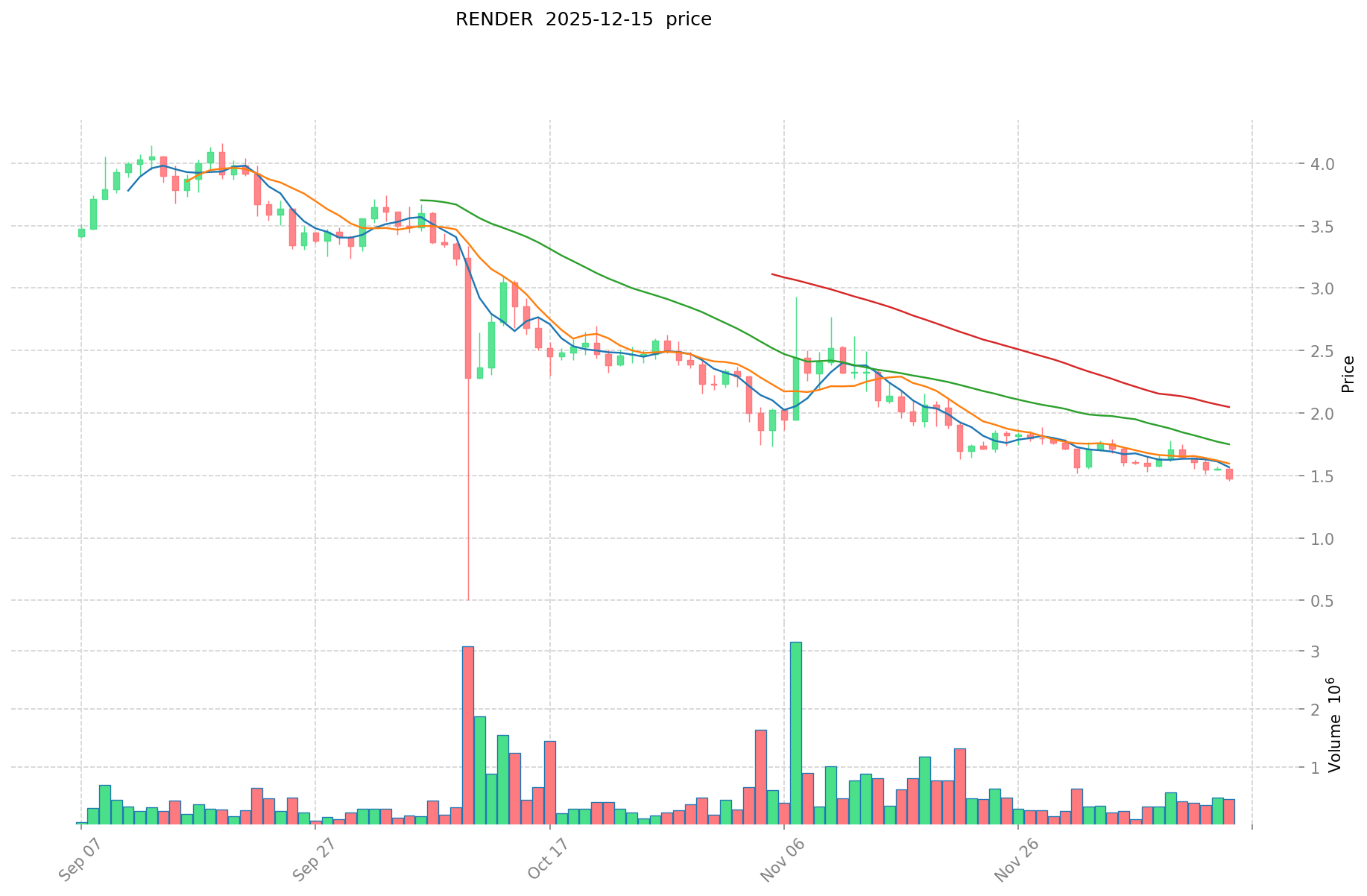
As of December 16, 2025, RENDER has a circulating supply of 518,584,616.1640741 tokens, with a total supply of 532,219,654 tokens. The circulating supply represents approximately 97.44% of the total supply, indicating a high percentage of tokens in circulation.
Price Fluctuations
RENDER reached its all-time high of $13.596115966188627 on March 18, 2024, likely driven by positive market sentiment and increased adoption of the Render Network.
Its lowest price was $0.036763626053, recorded on June 16, 2020, possibly due to broader market conditions or early-stage volatility.
These fluctuations reflect market sentiment, adoption trends, and external factors affecting the Render Network ecosystem.
Click to view the current market price of RENDER
On-chain Metrics
- Daily Transaction Volume: $1,309,052.49624 (indicates network activity)
- Active Addresses: 112,219 (reflects user engagement)
RENDER Ecosystem Applications and Partnerships
Core Use Cases
RENDER's ecosystem supports various applications:
- 3D Rendering: Provides near real-time rendering for 3D projects, meeting growing GPU demand.
- GPU Computing: Leverages idle GPU resources for emerging applications beyond rendering.
Strategic Collaborations
RENDER has established partnerships to enhance its technological capabilities and market influence. These partnerships provide a solid foundation for RENDER's ecosystem expansion.
Controversies and Challenges
RENDER faces the following challenges:
- Technical Issues: Scaling GPU resources to meet increasing demand.
- Regulatory Risks: Potential scrutiny of decentralized computing networks.
- Competitive Pressure: Emergence of other blockchain-based rendering solutions.
These issues have sparked discussions within the community and market, driving continuous innovation for RENDER.
Fan Enthusiasm
RENDER's community is vibrant, with key metrics such as growing wallet addresses and transaction volumes.
On X, posts and hashtags like #RENDER frequently trend, reflecting community engagement.
Factors such as price movements and new feature releases ignite community enthusiasm.
Sentiment on X shows a mix of opinions:
- Supporters praise RENDER's decentralized GPU computing model and its potential to revolutionize rendering.
- Critics focus on issues such as price volatility and scalability concerns.
Recent trends indicate varying sentiment based on market conditions and project developments.
Hot Topics
X users actively discuss RENDER's key issues, such as network expansion, GPU provider incentives, and integration with existing rendering software.
These discussions highlight both its transformative potential and the challenges in mainstream adoption.
- Official Website: Visit RENDER's official website for features, use cases, and latest updates.
- Whitepaper: RENDER whitepaper details its technical architecture, goals, and vision.
- X Updates: On X, RENDER uses @rendernetwork, covering topics such as technical upgrades, community events, and partnership news.
RENDER Future Roadmap
- Ecosystem Goals: Support more GPU-intensive applications and attract a broader user base.
- Long-term Vision: Become a leading decentralized infrastructure for GPU computing and rendering.
How to Participate in RENDER?
- Purchase Channels: Buy RENDER on Gate.com
- Storage Solutions: Use secure wallets for storing RENDER tokens
- Participate in Governance: Engage in community decisions through voting mechanisms
- Build the Ecosystem: Access developer documentation to contribute or develop applications
Summary
RENDER redefines decentralized GPU computing through blockchain technology, offering transparency, security, and efficient rendering services. Its active community, rich resources, and strong market performance make it stand out in the cryptocurrency field. Despite facing challenges such as scaling and market competition, RENDER's innovative spirit and clear roadmap position it as a significant player in the future of decentralized technology. Whether you're a newcomer or an experienced player, RENDER is worth watching and participating in.
FAQ
What do you mean by render?
Render refers to the process of creating or producing visual content, often in 3D graphics or video production. In the context of blockchain, it can mean processing transactions or executing smart contracts.
What is render on a house?
Render is a protective and decorative coating applied to exterior walls. It shields from weather damage and enhances appearance, offering durability and customizable finishes.
What does render mean in work?
In work, render means to provide or supply something useful or necessary. It can also refer to furnishing or equipping.
What is an example of render?
An example of render is creating 3D graphics for video games or movies. It involves processing digital data to produce a final image or animation.
* The information is not intended to be and does not constitute financial advice or any other recommendation of any sort offered or endorsed by Gate.










