ROA CORE is a Web3 lifestyle ecosystem built on Solana that transforms everyday activities into blockchain-driven rewards through AI-powered analytics. This comprehensive guide explores how ROA CORE connects real-world behaviors—such as walking, cultural experiences, and digital engagement—with on-chain asset creation, eliminating the disconnect between offline actions and digital value. The article covers ROA CORE's technical architecture utilizing Solana's Proof of History and Proof of Stake consensus, current market performance with 36,996 token holders and $0.006099 trading price as of 2026, and practical ecosystem applications including DOGDOG move-to-earn platform, MODA Gallery for NFT engagement, and ROA STORE for reward redemption. Discover how to participate, evaluate investment potential, and understand the project's role in decentralized technology innovation and mainstream adoption challenges.
ROA CORE's Position and Significance
In 2023, the team behind ROALAND launched ROA CORE (ROA), aiming to address the disconnection between real-world activities and digital value creation.
As a Web3 ecosystem that transforms everyday behavior into data-driven rewards, ROA CORE plays a key role in lifestyle-driven blockchain applications and AI-powered engagement platforms.
As of 2026, ROA CORE has established itself within the Solana ecosystem, with 36,996 holders and an active community.
This article will analyze its technical architecture, market performance, and future potential.
Origin and Development History
Birth Background
ROA CORE was created in 2023, aiming to solve the problem of unrewarded everyday activities such as walking, cultural experiences, and digital engagement.
It emerged during the expansion of Web3 ecosystems seeking real-world utility, with the goal of linking real-world actions with on-chain assets through AI analysis.
ROA CORE's launch brought new possibilities for users seeking tangible value from daily activities.
Key Milestones
- 2023: Mainnet launch on Solana, establishing the foundation for AI-driven activity analysis.
- 2023-2024: Development of core ecosystem components including DOGDOG, MODA Gallery, and ROA STORE.
- 2023: Initial token listing with a launch price of $2.19.
- 2025-2026: Ecosystem expansion with growing holder base reaching 36,996 users.
With support from the ROALAND Foundation and its community, ROA CORE continues to refine its technology, security features, and real-world applications.
How ROA CORE Works
Decentralized Control
ROA CORE operates on the Solana blockchain, a decentralized network of computers (nodes) distributed globally, free from control by banks or governments.
These nodes collaborate to validate transactions, ensuring system transparency and attack resistance, granting users greater autonomy and enhancing network resilience.
Blockchain Foundation
ROA CORE's blockchain is a public, immutable digital ledger that records every transaction.
Transactions are grouped into blocks and linked through cryptographic hashes to form a secure chain.
Anyone can view the records, establishing trust without intermediaries.
Leveraging Solana's high-performance infrastructure, the system supports efficient data processing for real-time activity tracking.
Ensuring Fairness
ROA CORE operates on Solana's Proof of History (PoH) combined with Proof of Stake (PoS) to validate transactions and prevent fraudulent activities such as double-spending.
Validators maintain network security through staking and transaction validation, earning rewards in the process.
Its innovation includes high-speed transaction processing and low fees, enabling seamless integration of real-world activities with blockchain technology.
Secure Transactions
ROA CORE uses public-private key cryptography to protect transactions:
- Private keys (similar to secret passwords) are used to sign transactions
- Public keys (similar to account numbers) are used to verify ownership
This mechanism ensures fund security while maintaining pseudonymous transactions.
The Solana-based infrastructure provides additional security through its consensus mechanism and network architecture.
Circulation Overview
As of January 30, 2026, ROA CORE has a circulating supply of 670,000,000 tokens, with a total supply of 949,999,869.89 tokens and a maximum supply capped at 1,000,000,000 tokens. The current circulation ratio stands at approximately 67% of the maximum supply. The token distribution model reflects a phased release mechanism, where tokens enter the market through various allocation channels. The difference between circulating and total supply suggests a controlled emission strategy that may influence supply-demand dynamics over time.
Price Volatility
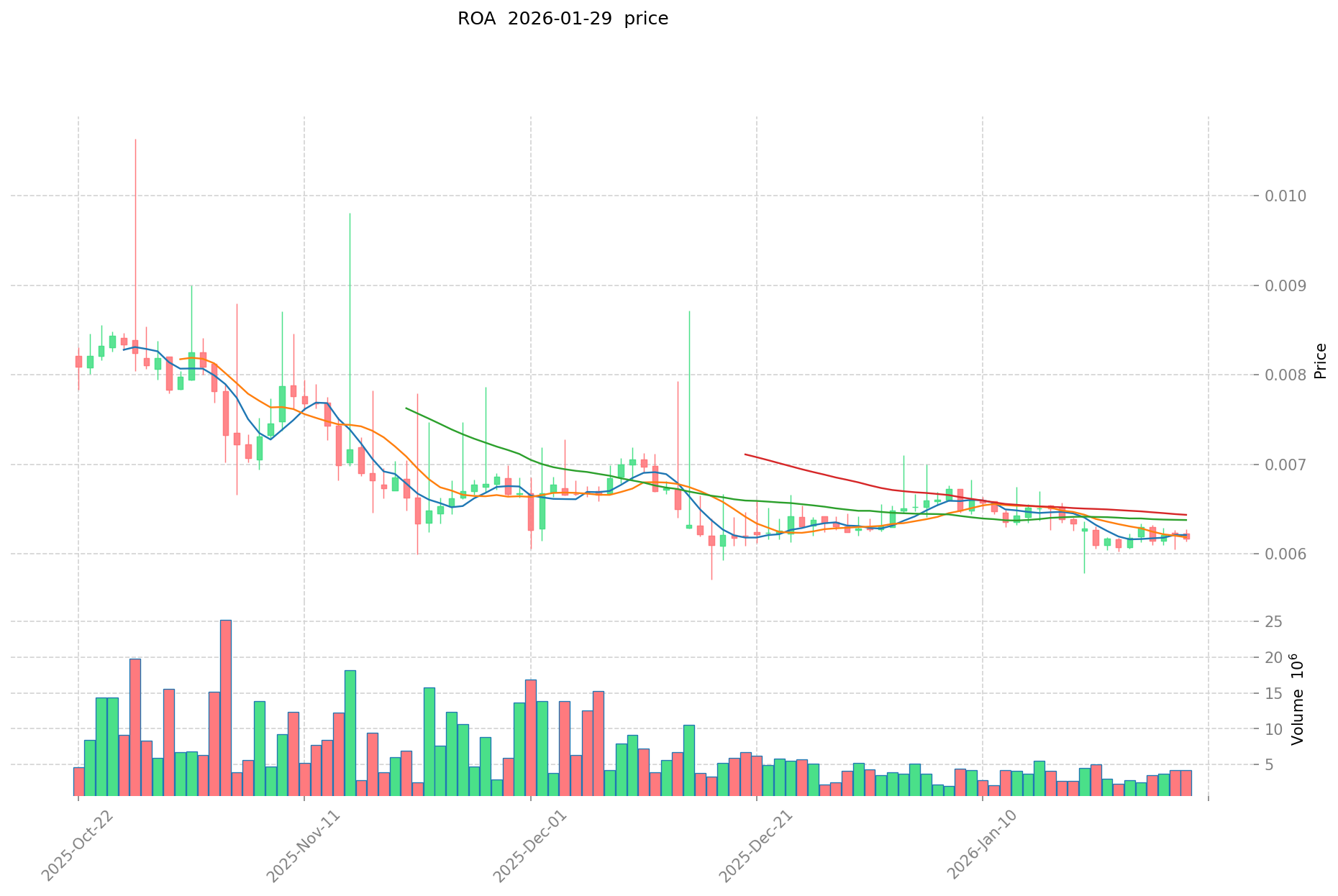
ROA CORE reached its all-time high of $0.1785 on December 22, 2023, during a period of heightened interest in Web3 lifestyle applications and move-to-earn ecosystems. The token experienced significant volatility throughout its trading history, with its all-time low of $0.005711 recorded on December 17, 2025. As of the latest data, ROA CORE trades at $0.006099, reflecting a 65.41% decline from its peak over the one-year period. Recent short-term performance shows a 2.57% decrease over 24 hours and a 3.04% decline over 30 days, while demonstrating a slight 0.43% recovery over the 7-day period. These fluctuations reflect broader market sentiment shifts, adoption trends, and the evolving landscape of blockchain-based lifestyle platforms.
Click to view current ROA market price
On-Chain Metrics
- 24-Hour Trading Volume: Approximately $19,789.83, indicating moderate trading activity within the ecosystem
- Token Holders: 36,996 addresses currently hold ROA CORE tokens, demonstrating a distributed ownership pattern
- Market Capitalization: $4,086,330, representing 0.00019% market dominance in the broader cryptocurrency landscape
- Market Cap to FDV Ratio: 67%, aligning with the current circulation ratio and suggesting significant token reserves remain to be released
ROA CORE Ecosystem Applications and Partners
Core Use Cases
ROA CORE's ecosystem supports multiple applications:
- Web3 Lifestyle Integration: DOGDOG, a move-to-earn platform, provides daily activity tracking and reward distribution.
- Cultural Experience & NFT: MODA Gallery, driving digital art collections and cultural engagement.
- Utility Commerce: ROA STORE enables users to redeem rewards for real-world products and services.
Strategic Partnerships
ROA CORE leverages AI-driven analytics to enhance its technical capabilities and user experience.
These technological foundations provide a solid base for ROA CORE's ecosystem expansion.
Controversies and Challenges
ROA CORE faces the following challenges:
- Technical Issues: Integration complexity between real-world activities and on-chain asset conversion
- Regulatory Risks: Web3 ecosystem regulatory uncertainties across different jurisdictions
- Competitive Pressure: Competition from other lifestyle-focused blockchain projects and traditional loyalty programs
These issues have sparked discussions within the community and market, while also driving ROA CORE's continuous innovation.
ROA CORE's community demonstrates growing engagement, with 36,996 token holders as of January 30, 2026.
On X platform, related posts and hashtags (such as #ROACORE) generate consistent attention.
New feature launches and real-utility implementations have ignited community enthusiasm.
Sentiment on X shows varied perspectives:
- Supporters praise ROA CORE's real-world utility integration and data-driven value creation, recognizing it as "a bridge between real life and blockchain value".
- Critics focus on price volatility and market adoption challenges.
Recent trends indicate cautious optimism regarding the project's real-utility approach.
Hot Topics
X users actively discuss ROA CORE's real-world application effectiveness, AI-driven personalization, and token utility expansion,
showcasing both its transformative potential and the obstacles toward mainstream adoption.
- Official Website: Visit ROA CORE Official Site for features, use cases, and latest updates.
- White Paper: ROA CORE White Paper details its technical architecture, objectives, and vision.
- X Updates: On X platform, ROA CORE actively engages using @SOLROALAND,
with posts covering technological upgrades, community events, and ecosystem developments, generating significant community engagement.
ROA CORE Future Roadmap
- Ongoing Development: Launch enhanced AI analytics and personalized reward mechanisms, improving user engagement and value distribution
- Ecosystem Goals: Expand application scenarios across DOGDOG, MODA Gallery, and ROA STORE platforms
- Long-term Vision: Establish a comprehensive Web3 ecosystem linking real-world activities with on-chain value
How to Participate in ROA CORE?
- Purchase Channels: Buy ROA on Gate.com and other supporting exchanges
- Storage Solutions: Use Solana-compatible wallets such as Phantom or Solflare for secure storage
- Participate in Ecosystem: Engage with DOGDOG, MODA Gallery, and ROA STORE to earn rewards and contribute to the community
- Build the Ecosystem: Visit official documentation to explore development opportunities and contribute to the platform
Summary
ROA CORE redefines Web3 lifestyle integration through blockchain technology, providing data-driven value creation, real-world utility, and personalized engagement.
Its growing community, comprehensive resources, and practical application focus distinguish it within the cryptocurrency space.
Despite facing regulatory uncertainties and market adoption challenges, ROA CORE's innovative approach and clear roadmap position it as a noteworthy project in the decentralized technology landscape.
Whether you're a newcomer or experienced participant, ROA CORE merits attention and engagement.
FAQ
What does Crypto ROA mean? How to calculate the return on assets for crypto assets?
Crypto ROA (Return on Assets) measures how efficiently crypto assets generate profits. Calculate it as: (Net Income / Total Assets) × 100%. Higher ROA indicates better asset utilization efficiency in cryptocurrency investments.
What is the practical application of ROA in evaluating cryptocurrency projects?
ROA measures return on assets, helping investors assess how effectively cryptocurrency projects generate returns from their assets. It evaluates profitability and operational efficiency, enabling informed investment decisions by comparing asset utilization and risk across different projects.
What is the difference between ROA in cryptocurrency and ROA in traditional finance?
Crypto ROA relies on blockchain technology with higher liquidity and volatility, while traditional finance ROA depends on regulated assets and legal frameworks. Crypto ROA is more decentralized and transparent, whereas traditional ROA is subject to strict regulatory controls.
How to use ROA metrics to evaluate the investment value of crypto assets?
ROA measures net profit relative to total assets, indicating operational efficiency. Higher ROA suggests better project performance. Investors use ROA to assess profitability, compare projects, and identify assets with stronger earning capacity for investment decisions.
What are the advantages and limitations of ROA compared to other crypto asset evaluation metrics such as APY and Sharpe ratio?
ROA measures return relative to assets, while APY and Sharpe ratio consider time-weighted returns and risk-adjusted performance. ROA lacks risk consideration, making it less comprehensive than APY and Sharpe ratio for evaluating crypto assets.
* The information is not intended to be and does not constitute financial advice or any other recommendation of any sort offered or endorsed by Gate.