This comprehensive guide explores Oasis Network (ROSE), a privacy-enabled Layer 1 blockchain launched in 2020 to address blockchain scalability, privacy protection, and data sovereignty challenges. The article examines ROSE's technical architecture featuring separated consensus and execution layers, Proof of Stake validation mechanism, and confidential computing capabilities. It covers market performance including current circulation of 7.5 billion tokens and market capitalization of $105.7 million, alongside key on-chain metrics reflecting 309,801 active holders. The guide highlights core use cases in privacy-preserving DeFi and confidential smart contracts, community engagement strategies, and practical participation methods including purchasing ROSE on Gate and other exchanges. Ideal for investors, developers, and crypto enthusiasts seeking to understand privacy-focused blockchain infrastructure and its applications.
Oasis Network's Position and Significance
In 2020, Oasis Labs launched Oasis Network (ROSE), aiming to address challenges in blockchain scalability, privacy protection, and data sovereignty.
As a decentralized cloud computing platform combining privacy and performance, Oasis Network plays a crucial role in confidential computing, DeFi, and AI applications.
As of 2026, Oasis Network has established itself as an innovative Layer 1 blockchain with over 309,801 holders and an active developer community.
This article will provide an in-depth analysis of its technical architecture, market performance, and future potential.
Origin and Development History
Birth Background
Oasis Network was created by Oasis Labs in 2020, aiming to solve the incompatibility between privacy protection, security, and performance in blockchain systems.
It emerged during the era of blockchain technology expansion, with the goal of enabling compute-intensive applications like artificial intelligence on blockchain while preserving data privacy.
Oasis Network's launch brought new possibilities for enterprises and developers seeking privacy-preserving blockchain solutions.
Important Milestones
- 2020: Mainnet launched on November 18, implementing a unique architecture separating consensus and execution layers.
- Ongoing development: Ecosystem expansion with DeFi protocols and privacy-enabled applications being built on the platform.
- Market presence: Listed on over 20 exchanges, demonstrating growing adoption and accessibility.
- Community growth: Accumulated 309,801 holders, reflecting increasing user engagement.
Under the support of Oasis Foundation and the developer community, Oasis Network continues to optimize its technology, security, and real-world applications.
How Does Oasis Network Operate?
No Central Control
Oasis Network operates on a decentralized network of computers (nodes) distributed globally, independent of banks or government control.
These nodes collaborate to validate transactions, ensuring system transparency and attack resistance, granting users greater autonomy and enhancing network resilience.
Blockchain Core
Oasis Network's blockchain is a public, immutable digital ledger that records every transaction.
Transactions are grouped into blocks and linked through cryptographic hashing to form a secure chain.
Anyone can view the records, establishing trust without intermediaries.
Its innovative architecture separates the consensus layer from the ParaTime layer (execution environment), enabling parallel processing and enhanced privacy features.
Ensuring Fairness
Oasis Network employs Proof of Stake (PoS) to validate transactions and prevent fraudulent activities like double-spending.
Validators maintain network security through staking ROSE tokens and operating nodes, earning ROSE rewards in return.
Its innovation includes support for confidential smart contracts and improved energy efficiency compared to Proof of Work systems.
Secure Transactions
Oasis Network uses public-private key cryptography to protect transactions:
- Private keys (similar to secret passwords) are used to sign transactions
- Public keys (similar to account numbers) are used to verify ownership
This mechanism ensures fund security while transactions maintain pseudonymous privacy.
The platform additionally features confidential computing capabilities through its ParaTime layer, enabling privacy-preserving smart contracts and secure data processing.
Circulation Overview
As of January 17, 2026, Oasis Network (ROSE) has a circulating supply of 7,509,182,083 tokens, with a total supply of 10,000,000,000 tokens and a maximum supply capped at 10,000,000,000 tokens, representing a fixed supply model.
The circulating supply accounts for approximately 75.09% of the total supply, influencing the token's supply-demand dynamics in the market.
Price Volatility
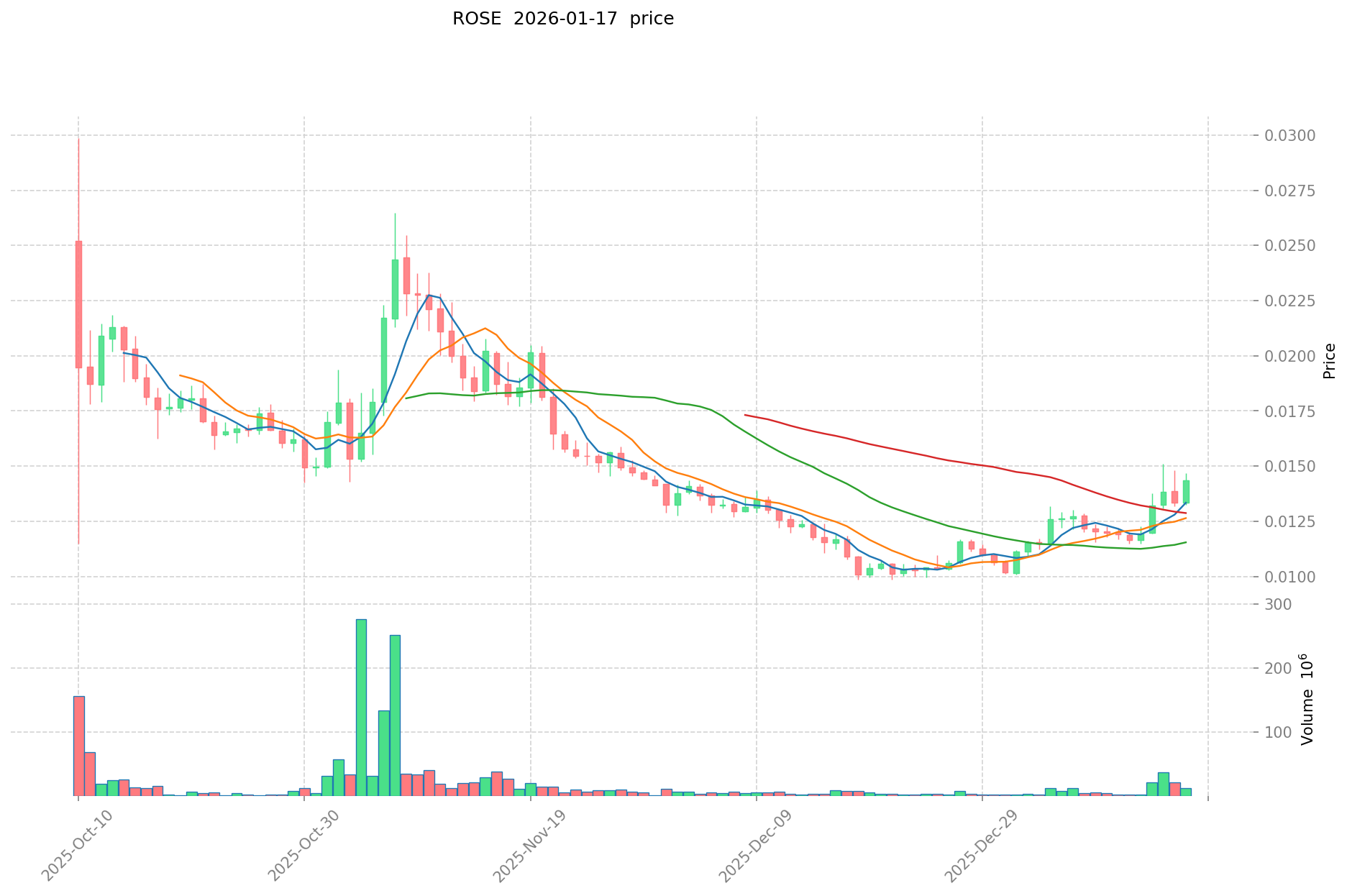
Oasis Network (ROSE) reached its all-time high of $0.597347 on January 15, 2022, during a period of broader market growth and increased institutional interest in privacy-focused blockchain solutions.
Its lowest price of $0.00988065 occurred on December 19, 2025, reflecting market-wide corrections and broader cryptocurrency sector challenges.
These fluctuations demonstrate the impact of market sentiment, adoption trends, and external macroeconomic factors on ROSE's valuation.
Click to view the current ROSE market price
On-Chain Metrics
- Holder Count: 309,801 addresses (indicating broad user distribution and community engagement)
- 24-Hour Trading Volume: $150,982.07 (reflecting current market activity)
- Market Capitalization: $105,729,283.73 (representing the current network valuation based on circulating supply)
Oasis Network Ecosystem Applications and Partners
Core Use Cases
Oasis Network's ecosystem supports multiple application scenarios:
- Privacy-Preserving DeFi: Projects leverage Oasis's confidential computing capabilities to provide privacy-protected decentralized financial services, enabling users to conduct transactions while maintaining data confidentiality.
- Confidential Smart Contracts: The platform enables privacy-focused computational applications, allowing developers to build applications that handle sensitive data such as healthcare records and financial information while maintaining blockchain transparency.
Strategic Partnerships
Oasis Network has established collaborations with technology partners and blockchain projects to enhance its technical capabilities and market presence.
These partnerships provide a solid foundation for Oasis Network's ecosystem expansion, particularly in privacy computing and cloud infrastructure integration.
Challenges and Considerations
Oasis Network faces several challenges:
- Technical Complexity: Balancing privacy protection with blockchain performance and scalability
- Market Competition: Competing with established blockchain platforms in the Layer 1 space
- Adoption Hurdles: Driving wider adoption of privacy-preserving decentralized applications
These issues have sparked discussions within the community and market, while also driving Oasis Network's continuous innovation efforts.
Oasis Network's community demonstrates notable activity, with over 309,801 token holders participating in the ecosystem.
On X platform, related posts and hashtags (such as #ROSE) generate regular engagement.
Factors such as protocol updates and technological advancements have contributed to community enthusiasm.
Sentiment on X shows varied perspectives:
- Supporters praise Oasis Network's privacy-preserving features and scalability solutions, viewing it as a platform for next-generation decentralized applications.
- Observers monitor price fluctuations and competitive positioning within the blockchain landscape.
Recent trends indicate mixed sentiment reflecting broader market conditions.
Discussion Topics
X users discuss Oasis Network's privacy technology implementation, ecosystem development, and market positioning,
showcasing both its innovative potential and the challenges of achieving mainstream adoption.
- Official Website: Visit Oasis Network's official site for features, use cases, and latest developments.
- X Updates: On X platform, Oasis Network maintains an active presence through @oasisprotocol,
with posts covering technical upgrades, community activities, and ecosystem developments.
- Community Resources: Access the Oasis Rose Garden Forum for community discussions and support.
- Development Resources: Visit Oasis Protocol GitHub for technical documentation and code repositories.
Oasis Network Development Roadmap
- Ongoing Development: Continued enhancement of privacy-preserving smart contract capabilities and network performance optimization
- Ecosystem Goals: Expanding the range of decentralized applications utilizing confidential computing
- Long-term Vision: Establishing itself as a leading platform for privacy-focused blockchain applications
How to Participate in Oasis Network?
- Purchase Options: Acquire ROSE on Gate.com and other supported exchanges
- Storage Solutions: Securely store ROSE using compatible cryptocurrency wallets
- Community Participation: Engage with the Oasis Network community through official forums and social channels
- Ecosystem Building: Access developer documentation to build applications or contribute to the network
Summary
Oasis Network is redefining privacy and scalability in blockchain technology, offering confidential computing capabilities, secure data handling, and performance optimization.
Its engaged community, comprehensive resources, and market presence position it as a notable project in the cryptocurrency space.
Despite facing adoption challenges and market competition, Oasis Network's focus on privacy-preserving technology and clear development trajectory give it a distinctive position in decentralized technology's evolution.
Whether you're new to cryptocurrency or an experienced participant, Oasis Network represents an interesting project worth monitoring and exploring.
FAQ
What is ROSE token and what is Oasis Network?
ROSE is the native utility token of Oasis Network, used for transaction fees, staking, and delegation. Oasis Network is a privacy-enabled blockchain platform supporting Rollups, designed for DeFi, GameFi, NFTs, and Web3 applications.
What are the main use cases and functions of ROSE cryptocurrency?
ROSE cryptocurrency powers transaction fees, enables staking for network security, and facilitates governance participation. It serves as the core utility token for the Oasis Network, allowing users to validate transactions and influence protocol decisions.
How can I buy and store ROSE tokens securely?
Purchase ROSE tokens on reputable exchanges, then transfer them to a hardware wallet or the official Oasis wallet for maximum security. Enable two-factor authentication and never share your private keys.
What is the total supply and tokenomics of ROSE?
ROSE has a hard-capped total supply of 10 billion tokens, ensuring scarcity and long-term value sustainability. The fixed supply model supports its deflationary mechanics and ecosystem growth.
What are the key differences between ROSE and other layer-1 blockchain tokens?
ROSE stands out as the first layer-1 blockchain natively supporting Rollups at Consensus Layer. It emphasizes privacy and scalability, enabling users to pay fees and participate in staking. ROSE powers diverse Web3 applications including DeFi, GameFi, NFTs, and Data DAOs with strong ecosystem backing.
What are the risks and benefits of investing in ROSE?
Benefits: ROSE offers staking rewards, delegation opportunities, and exposure to privacy-focused blockchain infrastructure. Risks: smart contract vulnerabilities, liquidation risks where ROSE converts to collateral, and market volatility. Investors should evaluate their risk tolerance carefully.
* The information is not intended to be and does not constitute financial advice or any other recommendation of any sort offered or endorsed by Gate.