Reserve Rights (RSR) is a governance token powering the Reserve Protocol ecosystem, launched in 2019 to address financial instability and hyperinflation through decentralized stablecoin infrastructure. This comprehensive guide explores RSR's dual-token mechanism, which maintains stablecoin price stability via supply adjustments and collateral management while enabling holders to participate in staking, arbitrage, and governance. With a circulating supply of 62.55 billion tokens and market cap of $168.3 million across 41 exchanges including Gate.com, RSR demonstrates sustained community engagement through 35,541 token holders. The article covers RSR's technical architecture, current market performance tracking recent price movements and on-chain metrics, ecosystem applications in DeFi and emerging markets, and community sentiment on social platforms. Additionally, it addresses regulatory challenges and competitive pressures while outlining participation methods through Gate.com purchases, wallet storage, and g
Reserve Rights (RSR) Positioning and Significance
In 2019, the Reserve Protocol team launched Reserve Rights (RSR), aiming to address financial instability and hyperinflation in regions with unreliable monetary systems.
As a dual-token stablecoin protocol, Reserve Rights plays a key role in decentralized finance and value preservation.
As of 2026, Reserve Rights has established itself as an innovative solution in the stablecoin ecosystem, supported by prominent investors including PayPal co-founder Peter Thiel and Y Combinator President Sam Altman.
This article will provide an in-depth analysis of its technical architecture, market performance, and future potential.
Origin and Development History
Background
Reserve Rights was created by the Reserve Protocol team in 2019, aiming to solve monetary instability and inflation challenges in developing economies.
It emerged during the evolution of blockchain technology and growing concerns about financial accessibility, with the goal of providing a stable, decentralized digital payment system to transform the current landscape.
Reserve Rights' launch brought new possibilities for users in regions with unreliable financial infrastructure.
Key Milestones
- 2019: Token launch with initial price of $0.0011, establishing the foundation for a dual-token stability mechanism.
- 2021: Significant price movement reaching $0.117424 on April 17, reflecting growing market interest in algorithmic stablecoins.
- 2026: The project maintains an active ecosystem with 35,541 holders and listings on 41 exchanges, demonstrating sustained community engagement.
With support from influential Silicon Valley investors and the crypto community, Reserve Rights continues to refine its technology, security, and real-world applications.
How Reserve Rights (RSR) Works
Decentralized Control
Reserve Rights operates on a distributed network of nodes worldwide, independent of traditional banking or governmental control.
These nodes collaborate to validate transactions, ensuring system transparency and attack resistance, granting users greater autonomy while enhancing network resilience.
Blockchain Foundation
Reserve Rights' blockchain is a public, immutable digital ledger recording every transaction.
Transactions are grouped into blocks, linked through cryptographic hashes to form a secure chain.
Anyone can view the records, establishing trust without intermediaries.
The protocol implements a dual-token system where RSR maintains the stability of Reserve stablecoins through supply adjustments and collateral management.
Maintaining Stability
Reserve Rights employs a unique dual-token mechanism to ensure stablecoin price stability and prevent deviations from peg values.
RSR holders participate in staking and arbitrage activities to maintain network security and price stability, earning rewards in the process.
The innovation includes self-regulating supply mechanisms combined with 100% or more on-chain collateral support.
Secure Transactions
Reserve Rights uses public-private key cryptography to protect transactions:
- Private keys (similar to secret passwords) are used to sign transactions
- Public keys (similar to account numbers) are used to verify ownership
This mechanism ensures fund security while transactions maintain pseudonymous characteristics.
The protocol incorporates additional security features through its collateral-backed stability mechanism and decentralized governance structure.
Circulating Supply Overview
As of January 16, 2026, ReserveRights (RSR) has a circulating supply of 62,553,174,091 tokens, with a total supply of 100,000,000,000 tokens and a maximum supply capped at 100,000,000,000 tokens. The circulating supply represents approximately 62.55% of the total supply, indicating a substantial portion of tokens are already in circulation. The token operates within the Reserve ecosystem, where RSR primarily functions to maintain the price stability of Reserve tokens through supply-demand mechanisms.
Price Fluctuations
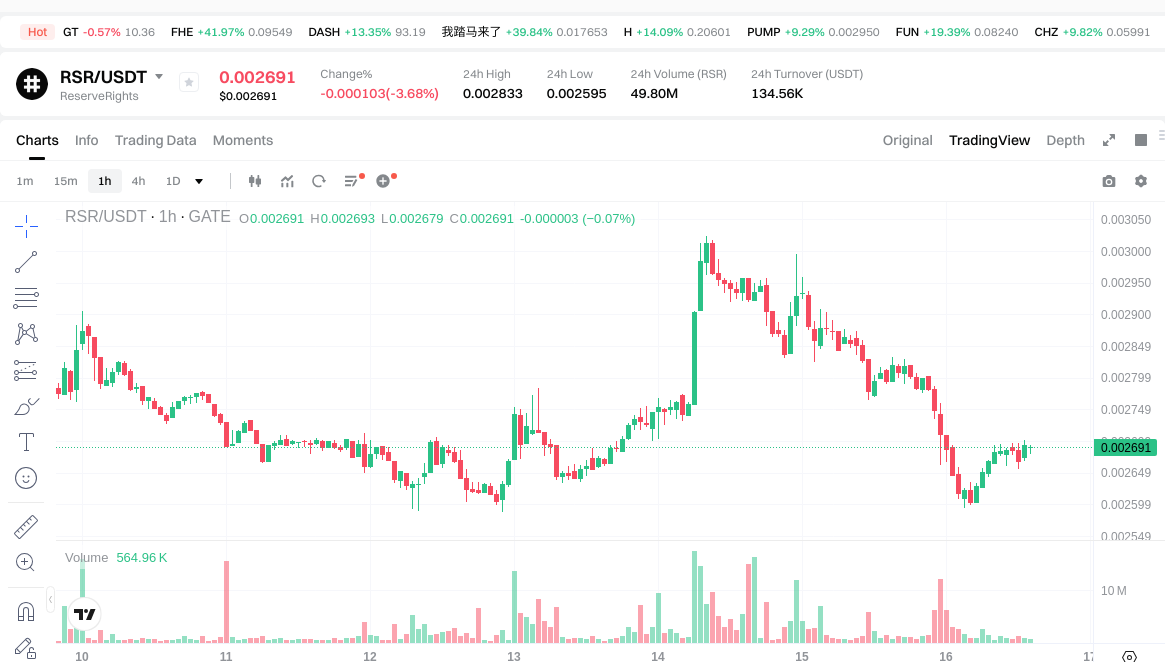
RSR reached its all-time high of $0.117424 on April 17, 2021, during a period of broader market growth and increased attention to stablecoin infrastructure projects. The token experienced its lowest recorded price of $0.00121354 on March 16, 2020, coinciding with significant volatility across cryptocurrency markets. As of the latest data, RSR is trading at $0.002691, showing a -3.72% change over the past 24 hours and a -81.3% decline over the past year. Recent price movements include:
- 1-hour change: +0.19%
- 7-day change: -4%
- 30-day change: +0.79%
The 24-hour trading range spans from $0.002595 to $0.002833, reflecting ongoing market dynamics and investor sentiment toward the Reserve protocol's stablecoin solutions.
Click to view current RSR market price
On-Chain Metrics
- Market Capitalization: $168,330,591 (ranking #268 globally)
- Fully Diluted Market Cap: $269,100,000
- 24-hour Trading Volume: $134,663
- Token Holders: Approximately 35,541 addresses hold RSR tokens, demonstrating community participation
- Market Dominance: 0.0079% of the total cryptocurrency market
- Listed Exchanges: Available on 41 different trading platforms, including Gate.com
Reserve Rights (RSR) Ecosystem Applications and Partners
Core Use Cases
Reserve Rights (RSR) ecosystem supports multiple applications:
- Stablecoin Infrastructure: Reserve Protocol, providing algorithmic stability mechanisms for the Reserve stablecoin (RSV).
- Decentralized Finance: Integration with DeFi protocols, enabling collateralized stablecoin issuance and value preservation.
Strategic Partnerships
Reserve Rights has established collaborations with influential investors and organizations in the blockchain space, enhancing its technical capabilities and market reach.
These partnerships provide a solid foundation for RSR's ecosystem expansion.
Controversies and Challenges
Reserve Rights faces the following challenges:
- Technical Hurdles: Maintaining stability mechanisms during extreme market volatility
- Regulatory Risks: Navigating global regulatory frameworks for stablecoin projects
- Competitive Pressure: Competition from established stablecoins and emerging blockchain platforms
These issues have sparked discussions within the community and market, while driving continuous innovation for RSR.
Reserve Rights' community demonstrates active participation, with over 35,541 holders as of January 2026.
On X platform, related posts and hashtags (such as #RSR) generate regular engagement.
Project developments and stablecoin adoption initiatives have energized community enthusiasm.
Sentiment on X shows diverse perspectives:
- Supporters praise RSR's decentralized stability mechanisms and inflation-resistant characteristics, viewing it as "a hedge against unstable fiat currencies".
- Critics focus on price volatility and market adoption challenges.
Recent trends indicate mixed sentiment correlating with broader market conditions.
Hot Topics
X users actively discuss RSR's stablecoin utility, global expansion potential, and role in regions with unreliable financial infrastructure,
showcasing both its transformative potential and obstacles toward mainstream adoption.
- Official Website: Visit Reserve Rights Official Site for features, use cases, and latest developments.
- X Updates: On X platform, Reserve Rights maintains an active presence at @reserveprotocol,
with posts covering protocol updates, community initiatives, and partnership announcements, generating engagement through likes and shares.
Reserve Rights (RSR) Future Roadmap
- Ongoing Development: Enhancement of Reserve Protocol's stability mechanisms, improving resilience and scalability
- Ecosystem Goals: Expanding stablecoin adoption in emerging markets and regions with high inflation
- Long-Term Vision: Establishing Reserve as a globally accessible store of value and medium of exchange
How to Participate in Reserve Rights (RSR)?
- Purchase Channels: Buy RSR on Gate.com and other supporting platforms
- Storage Solutions: Use compatible wallets such as MetaMask or hardware wallets for secure storage
- Participate in Governance: Engage with the Reserve Protocol community through official channels
- Build Ecosystem: Visit developer resources on GitHub to contribute to protocol development
Summary
Reserve Rights (RSR) leverages blockchain technology to redefine digital currency stability, offering transparency, decentralization, and inflation protection.
Its engaged community, robust resources, and clear mission position it distinctively in the cryptocurrency landscape.
Despite facing regulatory uncertainties and market competition, RSR's innovative approach and strategic vision secure its relevance in decentralized finance's future.
Whether you are a newcomer or experienced participant, Reserve Rights merits attention and engagement.
FAQ
What is RSR (Reserve) and what is its purpose in the Reserve Protocol ecosystem?
RSR is an ERC-20 token that governs the Reserve Protocol ecosystem. It manages risks, accrues value, and enables token holders to participate in protocol governance and decision-making processes.
How can I buy and store RSR tokens?
Purchase RSR tokens on major exchanges, then transfer them to a secure wallet. For long-term holding, use a hardware wallet like Ledger or Trezor for maximum security.
What is the difference between RSR and Reserve (RSV) tokens?
RSR is a governance token with supply reduction mechanisms, while RSV is a fully collateralized stablecoin pegged to the dollar. RSV maintains price stability, whereas RSR provides voting rights and incentive mechanisms for the Reserve ecosystem.
What are the risks and benefits of investing in RSR?
Benefits: RSR offers staking rewards, deflationary tokenomics through token burns, and exposure to Reserve Protocol's collateral basket. Risks: smart contract vulnerabilities, collateral default risk, and market volatility. RSR's utility in Reserve ecosystem provides long-term growth potential for strategic investors.
How does RSR staking work and what rewards can I earn?
RSR staking earns rewards based on your share of total staked RSR and revenue from insured stablecoins. Stakers receive additional RSR tokens as rewards, distributed according to governance decisions on revenue allocation.
* The information is not intended to be and does not constitute financial advice or any other recommendation of any sort offered or endorsed by Gate.