Ravencoin (RVN) is a specialized blockchain launched in 2018 to address inefficiencies in digital asset transfer and peer-to-peer ownership exchange. As an open-source project with a market cap exceeding $121 million and over 16 billion RVN in circulation, it leverages Proof of Work with the KAWPOW algorithm to enable secure, transparent asset tokenization without intermediaries. The platform supports custom token creation, restricted assets, and dividend payments directly on its blockchain, distinguishing itself from general-purpose blockchains. With trading available on Gate and other platforms, Ravencoin combines Bitcoin's security foundation with enhanced asset functionality, making it ideal for users seeking decentralized asset management. Despite market volatility and competitive pressures, its community-driven development model and specialized focus position it as a notable player in the asset tokenization space worth exploring.
Ravencoin's Positioning and Significance
In 2018, the Ravencoin community launched Ravencoin (RVN), aiming to address inefficiencies in asset transfer and the lack of specialized blockchain solutions for peer-to-peer asset exchange.
As a use case-specific blockchain focused on asset transfers, Ravencoin plays a key role in digital asset tokenization and peer-to-peer ownership transfer.
As of 2026, Ravencoin has established itself as an open-source project with a market cap exceeding $121 million, with over 16 billion RVN in circulation and an active development community.
This article will provide an in-depth analysis of its technical architecture, market performance, and future potential.
Origin and Development History
Birth Background
Ravencoin was created by its community on January 3, 2018, aiming to solve the need for efficient and specialized asset transfer mechanisms on a blockchain.
It emerged during the blockchain technology boom, with the goal of providing secure, direct asset transfers between parties without intermediaries to transform digital ownership.
The launch of Ravencoin brought new possibilities for individuals and businesses seeking to tokenize and transfer assets.
Major Milestones
- 2018: Mainnet launch, built as a fork of Bitcoin code with enhanced asset creation capabilities.
- 2019: Implementation of messaging and voting features, expanding utility beyond simple asset transfers.
- 2020: Introduction of restricted asset functionality, enabling compliance-friendly token issuance.
- 2021: Price surge to notable levels during the broader cryptocurrency market expansion.
Supported by a dedicated community and open-source contributors, Ravencoin continues to evolve its technology, security features, and real-world applications.
How Does Ravencoin Work?
No Central Control
Ravencoin operates on a decentralized network of computers (nodes) distributed globally, free from control by banks or governments.
These nodes collaborate to validate transactions, ensuring system transparency and attack resistance, granting users greater autonomy and enhancing network resilience.
Blockchain Core
Ravencoin's blockchain is a public, immutable digital ledger that records every transaction.
Transactions are grouped into blocks and linked through cryptographic hashing to form a secure chain.
Anyone can view the records, establishing trust without intermediaries.
The platform's specialized asset layer enables the creation, transfer, and management of digital assets directly on the blockchain.
Ensuring Fairness
Ravencoin employs Proof of Work (PoW) with the KAWPOW algorithm to validate transactions and prevent fraudulent activities such as double-spending.
Miners secure the network by performing computational work to solve cryptographic puzzles, earning RVN rewards for their contributions.
Its innovation includes ASIC resistance designed to promote more distributed mining participation.
Secure Transactions
Ravencoin uses public-private key cryptography to protect transactions:
- Private keys (similar to secret passwords) are used to sign transactions
- Public keys (similar to account numbers) are used to verify ownership
This mechanism ensures fund security while maintaining pseudonymous transaction privacy.
The asset layer adds additional functionality for creating unique tokens, restricted assets, and dividend payments directly on the blockchain.
Circulation Overview
As of January 17, 2026, Ravencoin's circulating supply stands at 16,028,665,807.35 RVN, with a total supply of 16,029,283,307.35 RVN and a maximum supply capped at 21,000,000,000 RVN, following a fixed supply model similar to Bitcoin.
New coins enter the market through proof-of-work mining, which influences its supply and demand dynamics.
Price Fluctuations
Ravencoin reached a notable price level of $0.285218 on February 20, 2021, during a period of broader cryptocurrency market expansion.
Its lowest recorded price was $0.00607508 on October 11, 2025, reflecting challenging market conditions.
These fluctuations demonstrate the impact of market sentiment, adoption trends, and external factors on the asset's valuation.
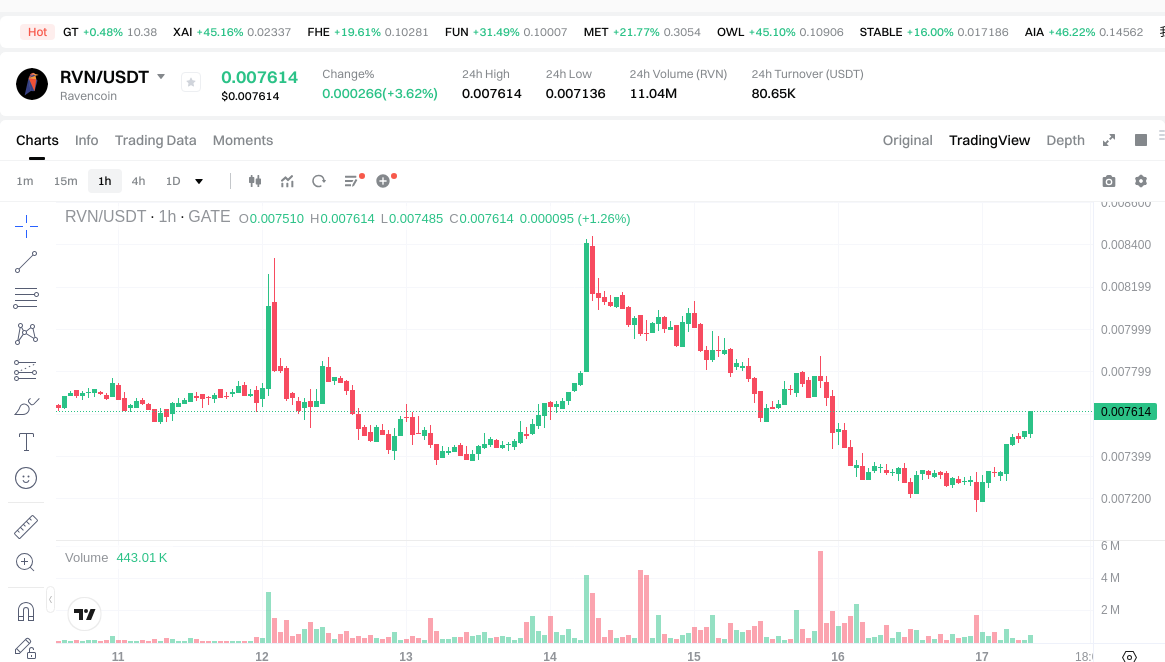
Click to view the current RVN market price
On-Chain Metrics
- Market Capitalization: $121,048,484.18 (indicating the network's current market valuation)
- 24-Hour Trading Volume: $83,862.70 (reflecting recent trading activity)
- Circulating Supply Ratio: 76.33% (representing the proportion of tokens currently in circulation relative to total supply)
Ravencoin Ecosystem Applications and Partners
Core Use Cases
Ravencoin's ecosystem supports multiple applications:
- Asset Transfer: Ravencoin network enables efficient peer-to-peer asset transfer, providing decentralized ownership tracking and token issuance capabilities.
- Digital Asset Creation: Users can create custom tokens representing various assets, driving innovation in tokenization of real-world and digital properties.
Strategic Partnerships
Ravencoin operates as an open-source community-driven project launched without ICO or masternodes. The project's development is supported by a strong and evolving community that contributes to its technological advancement.
Challenges and Controversies
Ravencoin faces several challenges:
- Market Competition: Competition from other blockchain platforms specializing in asset tokenization and transfer
- Price Volatility: The token has experienced significant price fluctuations, with a year-over-year decline of 63.22%
- Market Position: With a market capitalization ranking of 329 and market dominance of 0.0035%, Ravencoin faces visibility challenges in a crowded cryptocurrency market
These issues have sparked discussions within the community and drive ongoing development efforts.
Ravencoin's community demonstrates active participation, with the project maintaining presence across multiple platforms including X (Twitter), Reddit, and Facebook. The circulating supply of 16.03 billion RVN represents 76.33% of the total supply, indicating substantial token distribution among community members.
Sentiment on X displays mixed perspectives:
- Supporters praise Ravencoin's open-source nature, decentralized architecture, and specific focus on asset transfer functionality, viewing it as a specialized solution for tokenization needs.
- Critics focus on price performance challenges and competition from larger blockchain platforms.
Recent trends show the token trading at $0.007552 with 24-hour price movement of +2.76%.
Hot Topics
X users actively discuss Ravencoin's specialization in asset transfer, comparison with other tokenization platforms, and potential use cases in real-world asset digitization, highlighting both its niche positioning and mainstream adoption challenges.
- Official Website: Visit Ravencoin Official Site and GetRavencoin for features, use cases, and latest updates.
- Blockchain Explorer: Ravencoin Network Explorer provides transaction tracking and network statistics.
- X Updates: On X platform, Ravencoin maintains an active presence at @ravencoin, sharing updates on technical developments, community events, and network milestones.
- Community Platforms: Engage with the community on Reddit and Facebook.
- Development: Access the GitHub repository to view source code and contribute to development.
How to Participate in Ravencoin?
- Purchase Options: Acquire RVN on Gate.com and other supported exchanges
- Storage Solutions: Store your RVN securely using compatible cryptocurrency wallets
- Network Participation: Run a node or participate in mining to support the network
- Ecosystem Building: Visit the GitHub repository to contribute to development or build applications utilizing Ravencoin's asset transfer capabilities
Summary
Ravencoin leverages blockchain technology to specialize in digital asset transfer, offering transparency, security, and efficient peer-to-peer transactions. Its open-source foundation, dedicated community, and focused approach to asset tokenization distinguish it in the cryptocurrency landscape. Despite facing market competition and price volatility challenges, Ravencoin's specialized functionality and community-driven development model position it as a notable player in the asset tokenization space. Whether you're new to cryptocurrency or an experienced participant, Ravencoin's unique focus on asset transfer makes it worth exploring.
FAQ
What is Ravencoin (RVN) and how does it differ from Bitcoin?
Ravencoin is a Bitcoin fork designed for asset creation and mining. Unlike Bitcoin's 50 BTC initial reward, RVN starts with 5,000 RVN per block. It enables users to create custom tokens and NFTs on its blockchain, offering greater functionality than Bitcoin's primary focus on peer-to-peer payments.
How does RVN mining work and what are the hardware requirements?
RVN mining uses GPU-based proof-of-work algorithm. Miners need graphics cards with minimum 4GB memory. High-end GPUs provide better efficiency. ASICs are not supported, making it accessible to individual miners.
What are the main use cases and advantages of Ravencoin?
Ravencoin is optimized for efficient asset creation and transfer on a peer-to-peer blockchain. Built on Bitcoin's foundation with improvements, it offers faster block times and specialized asset messaging capabilities, making it ideal for token transfers and asset management.
Is Ravencoin a good investment and what are the risks?
Ravencoin offers growth potential with its asset issuance capabilities and active development. However, it faces market volatility and competition risks. Success depends on blockchain adoption and project execution. Conduct thorough research before investing.
How can I buy, store, and trade Ravencoin (RVN)?
Buy RVN on spot markets using crypto or fiat. Store it securely in a dedicated wallet or exchange account. Trade RVN against multiple digital assets on major platforms supporting the asset.
* The information is not intended to be and does not constitute financial advice or any other recommendation of any sort offered or endorsed by Gate.