This comprehensive guide explores Saga, a Layer 1 protocol revolutionizing blockchain scalability through its innovative Chainlets technology. Launched in 2022, Saga addresses scalability bottlenecks by enabling automated deployment of parallelized, VM-agnostic dedicated chains. The article examines Saga's technical architecture, including decentralized consensus mechanisms, public-private key cryptography, and shared security models that ensure transaction fairness and network resilience. With over 350 ecosystem projects—80% focused on gaming—Saga demonstrates strong market traction and developer adoption. Market analysis reveals current trading at $0.04805 with a $16.51 million circulating market cap. Strategic partnerships with Polygon, Avalanche, and Celestia enhance infrastructure capabilities. The guide covers ecosystem applications, community sentiment, participation methods via Gate.com, and challenges including market volatility and competitive pressures. Ideal for developers, investors, and blockcha
Saga's Position and Significance
In 2022, the Saga team launched Saga (SAGA), aiming to address scalability bottlenecks and the high complexity of deploying dedicated blockchain infrastructure.
As a Layer 1 protocol enabling automatic deployment of parallelized, VM-agnostic dedicated chains (Chainlets), Saga plays a crucial role in blockchain gaming, application-specific infrastructure, and horizontal scalability.
As of 2026, Saga has evolved into a protocol supporting over 350 projects in its ecosystem, with 80% focused on gaming, featuring an active developer community and strategic partnerships.
This article will provide an in-depth analysis of its technical architecture, market performance, and future potential.
Origin and Development History
Birth Background
Saga was created by its founding team in 2022, aiming to solve the challenges of blockchain scalability and the difficulty of launching dedicated chains for individual applications.
It emerged during the rapid expansion of blockchain gaming and DeFi ecosystems, with the goal of providing seamless horizontal scalability through automated deployment of interoperable, application-specific chains to transform the landscape.
The launch of Saga brought new possibilities for blockchain developers seeking customizable infrastructure without compromising security or interoperability.
Major Milestones
- 2022: Protocol development initiated, establishing the foundation for Chainlet architecture.
- 2024: Mainnet launch and rapid ecosystem expansion, with projects building on the protocol growing significantly.
- 2024: Strategic partnerships established with Polygon, Avalanche, MarbleX, Com2uS, and Celestia to scale infrastructure using Chainlets.
- 2025: Ecosystem growth reached 350 projects, with 80% concentrated in the gaming sector.
With support from its community, ecosystem partners, and development foundation, Saga continues to refine its technology, security features, and real-world applications.
How Does Saga Work?
No Central Control
Saga operates on a decentralized network of nodes distributed globally, free from control by banks or governments.
These nodes collaborate to validate transactions, ensuring transparency and attack resistance, granting users greater autonomy and enhancing network resilience.
Blockchain Core
Saga's blockchain serves as a public, immutable digital ledger recording every transaction.
Transactions are grouped into blocks and linked through cryptographic hashes to form a secure chain.
Anyone can view the records, establishing trust without intermediaries.
The protocol's unique architecture enables developers to launch dedicated chains (Chainlets) that run in parallel while maintaining interoperability, significantly improving performance and customization capabilities.
Ensuring Fairness
Saga employs a proof-of-stake consensus mechanism to validate transactions and prevent fraudulent activities such as double-spending.
Validators maintain network security through staking SAGA tokens and operating validator nodes, earning SAGA rewards in return.
Its innovation includes automated validator orchestration and standardized CI/CD deployment pipelines across different blockchain virtual machines, enabling one-click Chainlet launches.
Secure Transactions
Saga utilizes public-private key cryptography to protect transactions:
- Private keys (like secret passwords) are used to sign transactions
- Public keys (like account numbers) are used to verify ownership
This mechanism ensures fund security while transactions maintain pseudonymity.
The protocol features additional security through shared security models across Chainlets, allowing individual application chains to benefit from the collective security of the main Saga network.
Circulation Overview
As of January 24, 2026, Saga's circulating supply stands at 343,684,379 tokens, with a total supply of 1,088,630,613 tokens. The maximum supply is unlimited, indicating an inflationary token model.
The current circulating supply represents approximately 34.37% of the total supply, with tokens entering the market through the project's distribution mechanisms, influencing its supply-demand dynamics.
Price Fluctuations
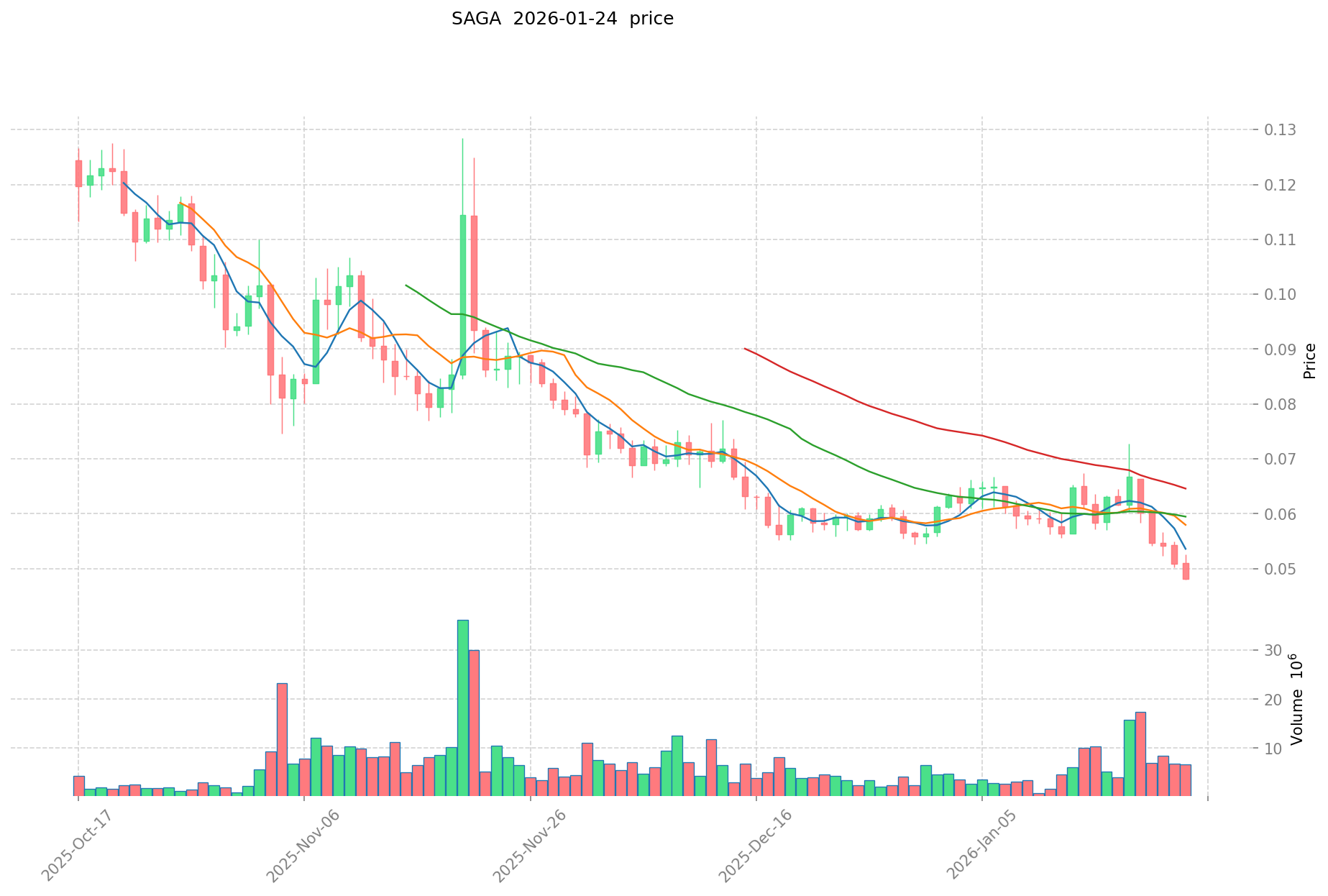
Saga reached its historical high price of $7.8609 on April 9, 2024, driven by strong market momentum following its initial launch and early ecosystem development. The token experienced significant interest during this period as the project gained traction with developers and gaming projects building on its Layer 1 protocol.
Its lowest price of $0.0438 occurred on October 10, 2025, reflecting broader market correction pressures and shifting sentiment in the cryptocurrency sector.
These fluctuations demonstrate the impact of market cycles, adoption trends, and external factors on token valuation. As of the current date, SAGA is trading at $0.04805, showing recent volatility with a 24-hour decline of 5.85% and a 7-day decrease of 23.83%.
Click to view current SAGA market price
On-Chain Metrics
- 24-Hour Trading Volume: Approximately $335,241 (indicating current network activity levels)
- Market Capitalization: $16.51 million in circulating market cap, with a fully diluted valuation of $52.31 million
- Market Dominance: 0.0016% of the total cryptocurrency market
Saga Ecosystem Applications and Partners
Core Use Cases
Saga's ecosystem supports multiple applications:
- GameFi: With 80% of the 350+ projects building on Saga being gaming-related, the protocol enables developers to launch dedicated chains for gaming applications, providing enhanced scalability and performance for blockchain games.
- Infrastructure Scaling: Through Chainlets technology, Saga offers automated deployment pipelines that support different blockchain virtual machines, enabling parallel processing and interoperable dedicated chains for various decentralized applications.
Strategic Partnerships
Saga has established collaborations with Polygon, Avalanche, MarbleX, Com2uS, and Celestia to enhance its technical capabilities and market reach.
These partnerships provide a solid foundation for Saga's ecosystem expansion, particularly in utilizing Chainlets to automatically scale infrastructure across multiple blockchain platforms.
Controversies and Challenges
Saga faces the following challenges:
- Market Volatility: The token has experienced substantial price fluctuations, with a significant decline from its historical peak.
- Competition Pressure: Operating in a competitive Layer 1 blockchain space with established players offering similar scaling solutions.
- Adoption Barriers: The relatively low market capitalization and circulating supply percentage may present challenges for broader market adoption.
These issues have sparked discussions within the community and market, while also driving Saga's continuous innovation.
Saga's community demonstrates growing activity, with the ecosystem expanding to over 350 projects in under 2 years.
On X platform, discussions around Saga and its Chainlets technology frequently appear, particularly among gaming and blockchain infrastructure communities.
Factors such as new partnership announcements and ecosystem milestones have energized community participation.
Sentiment on X displays diverse perspectives:
- Supporters praise Saga's innovative approach to blockchain scalability, VM-agnostic architecture, and automated deployment capabilities, viewing it as a solution for application-specific blockchain needs.
- Critics focus on price performance concerns and the challenges of competing in a crowded Layer 1 blockchain market.
Recent trends reflect mixed sentiment influenced by broader market conditions and ecosystem development progress.
Hot Topics
X users actively discuss Saga's technological innovations, particularly the Chainlets concept, shared security model, and partnerships with established blockchain platforms,
showcasing both its transformative potential and the obstacles toward mainstream adoption.
- Official Website: Visit Saga Official Website for features, use cases, and latest developments.
- Blockchain Explorer: Mintscan Explorer provides detailed on-chain data and transaction information.
- X Updates: On X platform, Saga maintains an active presence through @Sagaxyz__, sharing updates about technical upgrades, community activities, and partnership announcements.
Saga Future Roadmap
While specific dated milestones were not provided in the available materials, Saga's ongoing development focuses on:
- Enhancing the Chainlets infrastructure to support more blockchain virtual machines
- Expanding ecosystem partnerships to drive adoption across gaming and other application sectors
- Strengthening validator orchestration and shared security mechanisms
How to Participate in Saga?
- Purchase Channels: Saga (SAGA) is available on Gate.com and other supported exchanges
- Storage Solutions: Use compatible wallets that support Saga's Layer 1 protocol for secure storage
- Ecosystem Building: Visit developer documentation to explore building applications using Chainlets technology
- Community Engagement: Follow official channels to stay updated on ecosystem developments and opportunities
Summary
Saga redefines blockchain scalability through its innovative Chainlets technology, offering automated deployment, VM-agnostic architecture, and infinite horizontal scalability for decentralized applications.
Its active ecosystem, particularly strong in gaming with 80% of projects, and strategic partnerships with major blockchain platforms position it as a notable player in the Layer 1 space.
Despite facing challenges including market volatility and competitive pressures, Saga's innovative approach to application-specific blockchain infrastructure and clear focus on developer accessibility make it a project worth monitoring in the evolving decentralized technology landscape.
Whether you are a newcomer or experienced participant, Saga presents opportunities for engagement in next-generation blockchain infrastructure.
FAQ
What is Crypto SAGA and what is its main purpose?
Crypto SAGA is a blockchain-based gaming token designed to power immersive Web3 gaming experiences. Its main purpose is to serve as the native currency enabling in-game transactions, rewards, and governance participation within the SAGA ecosystem, creating a Play-to-Earn environment for players worldwide.
How do you buy and store SAGA tokens?
Purchase SAGA tokens through major cryptocurrency platforms using fiat or crypto. Store them securely in hardware wallets like Ledger or Trezor, or use reputable custodial wallets for convenience and accessibility.
What is the tokenomics and supply of SAGA cryptocurrency?
SAGA has a maximum supply of 1 billion tokens. The tokenomics feature community allocation, team vesting, and ecosystem incentives. Token distribution is designed to support long-term network development and user participation in the SAGA ecosystem.
What are the main features and use cases of the SAGA blockchain?
SAGA blockchain offers modular architecture enabling scalable dApp deployment, low transaction costs, and fast finality. Main use cases include DeFi protocols, NFT marketplaces, gaming applications, and cross-chain interoperability solutions for Web3 developers.
Is SAGA a safe investment and what are the risks involved?
SAGA offers strong fundamentals with active development and growing ecosystem adoption. While crypto carries inherent volatility and market risks, SAGA's technology and community support position it favorably. Like all digital assets, value fluctuates with market conditions. Conduct thorough research before investing.
How does SAGA compare to other Layer 1 or Layer 2 blockchain projects?
SAGA stands out with its modular architecture, enabling developers to deploy sovereign blockchains effortlessly. Unlike traditional L1/L2 solutions, SAGA offers superior scalability, lower costs, and flexible sovereignty while maintaining cross-chain interoperability and robust security standards.
* The information is not intended to be and does not constitute financial advice or any other recommendation of any sort offered or endorsed by Gate.