sBTC is a decentralized 1:1 Bitcoin-backed asset on the Stacks Layer 2 network, launched in 2025 to enable Bitcoin holders to access DeFi, lending, and programmable finance applications while maintaining Bitcoin's security guarantees. This comprehensive guide explores sBTC's technical architecture, market performance, and ecosystem impact, addressing the Bitcoin blockchain's limitations in supporting complex smart contracts and financial applications. With a market capitalization of approximately $429 million and over 9,159 holders, sBTC bridges Bitcoin's security with Layer 2 scalability through decentralized peg mechanisms and Proof of Transfer consensus. The article examines sBTC's use cases in AMMs and DeFi protocols, pricing dynamics, adoption challenges, and community sentiment surrounding this innovative Bitcoin Layer 2 solution. Whether you're a Bitcoin holder seeking DeFi exposure or a developer building on Stacks, this guide provides actionable insights into sBTC's role in expanding Bitcoin's utilit
sBTC's Positioning and Significance
In 2025, the Stacks community launched sBTC (SBTC), aiming to address the limitations of Bitcoin's Layer 1 network in supporting complex financial applications and smart contract functionality.
As a decentralized 1:1 Bitcoin-backed asset on the Stacks Layer 2 network, sBTC plays a crucial role in expanding Bitcoin's utility beyond store of value, enabling DeFi, lending, and programmable finance.
As of January 2026, sBTC has established itself as a bridge connecting Bitcoin's security with Layer 2 DeFi capabilities, with a market capitalization of approximately $429 million and 9,159 holders. The project continues to attract developers building decentralized applications that leverage Bitcoin's security model.
This article will provide an in-depth analysis of its technical architecture, market performance, and future potential.
Origin and Development History
Background
sBTC was created by the Stacks ecosystem in 2025, aiming to solve the challenge of enabling Bitcoin holders to access DeFi, smart contracts, and programmable finance without compromising Bitcoin's security or requiring trust in centralized intermediaries.
It emerged during the growing demand for Bitcoin Layer 2 solutions and the expansion of DeFi applications, with the goal of enabling BTC to be used productively in lending platforms, AMMs, and other financial protocols while maintaining decentralization.
The launch of sBTC brought new possibilities for Bitcoin holders and DeFi participants seeking to utilize BTC in programmable applications.
Important Milestones
- January 2025: sBTC launched on the Stacks mainnet, enabling users to peg BTC from Bitcoin Layer 1 to Stacks Layer 2
- 2025: Integration with DeFi protocols, lending platforms, and AMMs within the Stacks ecosystem
- 2025: Growing adoption with the holder base expanding to over 9,000 participants
With support from the Stacks community and ecosystem developers, sBTC continues to refine its bridge mechanism, security features, and integration with Bitcoin-native applications.
How sBTC Works
No Central Control
sBTC operates on the decentralized Stacks Layer 2 network, which settles transactions on Bitcoin's base layer without requiring centralized intermediaries.
The system uses a network of independent signers and validators to manage the peg-in and peg-out process, ensuring that the 1:1 backing with BTC is maintained transparently and securely.
Blockchain Core
sBTC leverages both the Bitcoin blockchain and the Stacks Layer 2 to create a trust-minimized bridge asset.
When users peg-in BTC, it is locked on the Bitcoin mainnet, and an equivalent amount of sBTC is minted on Stacks. This process is recorded on both chains, creating an auditable and transparent record.
The Stacks blockchain uses Clarity smart contracts to enable sBTC to interact with DeFi protocols, lending platforms, and AMMs while maintaining compatibility with Bitcoin's security model.
Ensuring Fairness
sBTC utilizes Proof of Transfer (PoX), Stacks' consensus mechanism that anchors transactions to Bitcoin's blockchain.
Stackers and miners secure the network by participating in the PoX mechanism, where STX tokens are used to mine blocks and settle transactions on Bitcoin Layer 1.
This innovative approach allows Stacks to inherit Bitcoin's security without modifying Bitcoin's base layer, while providing the programmability needed for DeFi applications.
Secure Transactions
sBTC uses public-private key cryptography to protect transactions:
- Private keys (like secret passwords) are used to authorize peg-in and peg-out operations
- Public keys (like account numbers) are used to verify ownership and transaction validity
This mechanism ensures fund security while maintaining pseudonymous transaction privacy.
The peg-in and peg-out process involves multiple signers using threshold signatures to minimize trust assumptions and prevent single points of failure in the bridging mechanism.
Circulating Supply Overview
As of January 15, 2026, sBTC's circulating supply stands at 4,404 tokens, with a total supply of 4,404 tokens. The maximum supply is indicated as unlimited (∞), suggesting a potential inflationary model framework. The circulating supply represents 100% of the current total supply, indicating that all issued tokens are actively available in the market. The token operates within the Stacks ecosystem as a 1:1 Bitcoin-backed asset, where new sBTC enters circulation through users pegging-in BTC from Bitcoin L1 to Stacks L2, creating a direct relationship between Bitcoin deposits and sBTC issuance.
Price Volatility
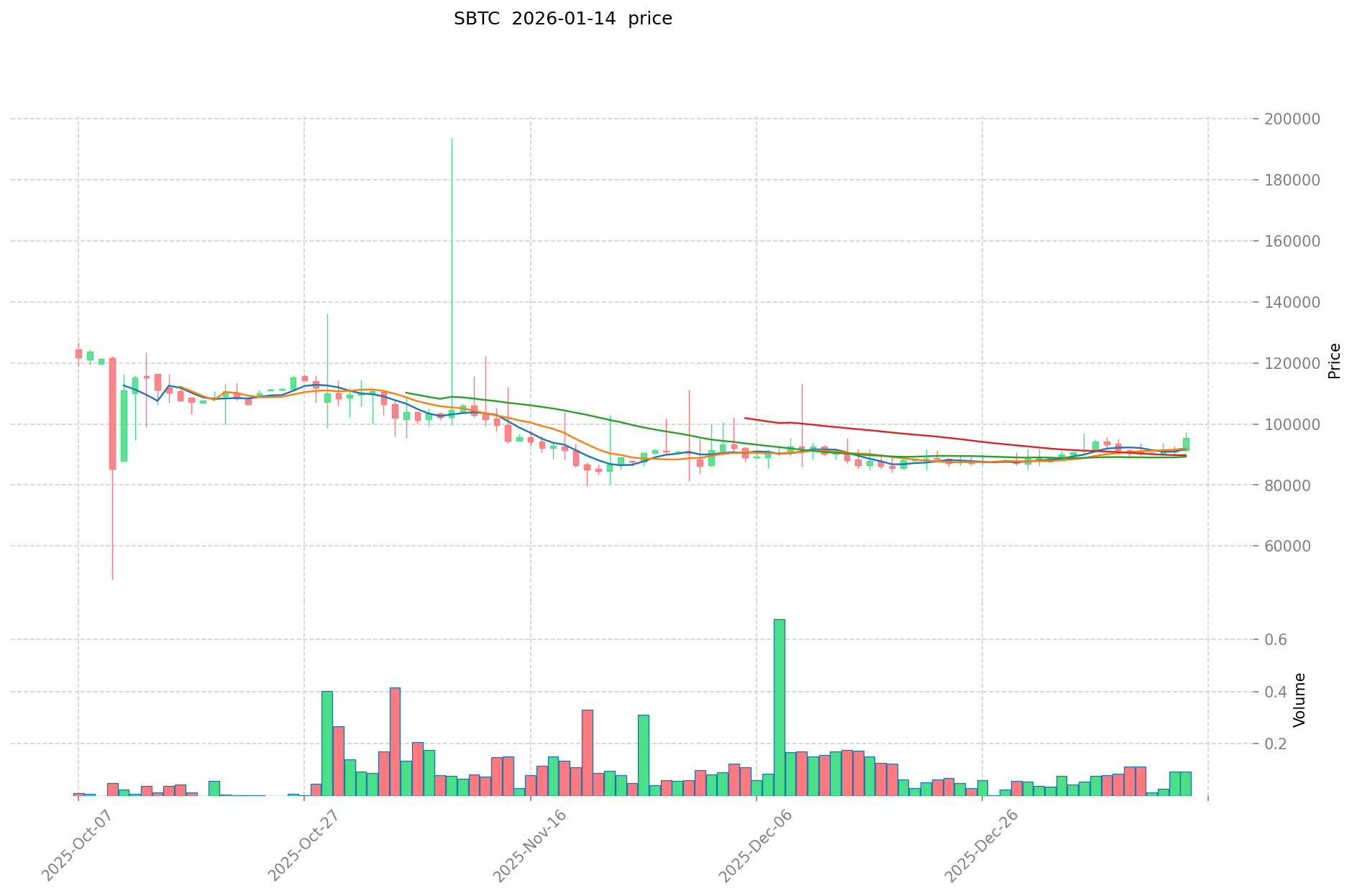
sBTC experienced significant price movements since its market introduction. The token reached a notable price level of $947,972.8 on September 26, 2025, driven by heightened market interest in Bitcoin Layer 2 solutions and the expansion of DeFi applications on the Stacks network. The lowest recorded price was $48,968.1 on October 10, 2025, reflecting market volatility and broader cryptocurrency sector adjustments during that period. As of the latest data, sBTC is trading at $97,455, showing a 24-hour increase of 3.44% and a 7-day gain of 6.80%. Over the past 30 days, the token has appreciated by 13.23%. These price movements reflect the dynamic nature of Bitcoin Layer 2 adoption, DeFi protocol integration, and evolving market sentiment toward Bitcoin-backed assets in smart contract ecosystems.
Click to view current SBTC market price
On-Chain Metrics
- 24-Hour Trading Volume: $9,502.50 (indicating active market participation and liquidity)
- Holder Addresses: 9,159 addresses (reflecting user adoption and distribution across the network)
- Market Capitalization: $429,191,820 (representing approximately 0.012% market dominance in the cryptocurrency sector)
sBTC Ecosystem Applications and Partners
Core Use Cases
sBTC's ecosystem supports multiple applications:
- DeFi Protocols: sBTC enables participation in decentralized finance activities on the Stacks network, providing decentralized lending, borrowing, and liquidity provision.
- Automated Market Makers (AMMs): sBTC can be utilized in AMM platforms, facilitating trustless trading and yield generation while maintaining Bitcoin's security guarantees.
Strategic Partnerships
sBTC operates as part of the Stacks ecosystem, which has established technical infrastructure to support Bitcoin Layer 2 applications.
These partnerships and integrations provide a foundation for sBTC's ecosystem expansion within the Bitcoin DeFi landscape.
Controversies and Challenges
sBTC faces several challenges:
- Technical Hurdles: Ensuring seamless peg-in and peg-out mechanisms between Bitcoin L1 and Stacks L2 while maintaining decentralization.
- Market Competition: Other Bitcoin-backed assets and Layer 2 solutions compete for market share in the Bitcoin DeFi space.
- Adoption Barriers: Building user awareness and developer adoption for Bitcoin-native smart contract applications.
These issues have sparked discussions within the community and continue to drive innovation in the sBTC protocol.
sBTC's community shows growing engagement, with 9,159 holders as of January 2026.
The project benefits from the broader Stacks ecosystem community, which actively discusses developments and use cases.
New integrations and DeFi protocol launches have generated community interest.
Sentiment on X presents varied perspectives:
- Supporters praise sBTC's decentralized 1:1 Bitcoin backing and trust-minimized design, viewing it as a bridge that extends Bitcoin's utility into DeFi without compromising security.
- Critics focus on adoption challenges and competition from other Bitcoin Layer 2 solutions.
Recent trends indicate growing interest in Bitcoin DeFi applications and Layer 2 scalability solutions.
Popular Topics
X users discuss sBTC's role in expanding Bitcoin's utility beyond store of value, security model, and integration with DeFi protocols,
showcasing both its transformative potential and the challenges in mainstream adoption.
- Official Website: Visit sBTC Official Site for features, use cases, and latest updates.
- White Paper: sBTC Documentation provides detailed information on technical architecture, goals, and vision.
- X Updates: The Stacks project maintains an active presence on X using @Stacks,
with posts covering technical upgrades, ecosystem developments, and partnership announcements.
sBTC Future Roadmap
- Ongoing Development: Enhancing peg mechanisms and cross-chain interoperability, improving transaction efficiency and user experience
- Ecosystem Goals: Expanding DeFi protocol integrations and developer tooling for Bitcoin-native applications
- Long-term Vision: Establishing a robust infrastructure for Bitcoin DeFi and programmable Bitcoin assets
How to Participate in sBTC?
- Purchase Options: Acquire sBTC through Gate.com
- Storage Solutions: Use compatible Stacks wallets for secure storage of sBTC assets
- DeFi Participation: Engage with Stacks-based DeFi protocols using sBTC for lending, borrowing, or liquidity provision
- Ecosystem Building: Visit Stacks developer documentation to build applications utilizing sBTC
Summary
sBTC leverages blockchain technology to extend Bitcoin's functionality, providing decentralized, trust-minimized access to DeFi applications while maintaining Bitcoin's security model.
Its integration with the Stacks ecosystem, growing holder base, and market performance position it as a notable player in Bitcoin Layer 2 solutions.
Despite facing adoption challenges and market competition, sBTC's innovative approach and clear focus on Bitcoin-native DeFi give it a meaningful role in the evolution of programmable Bitcoin assets.
Whether you're new to crypto or an experienced participant, sBTC represents an interesting development in expanding Bitcoin's utility beyond simple value transfer.
FAQ
What is SBTC? What is its relationship with Bitcoin?
SBTC is a 1:1 Bitcoin-backed token on the Stacks blockchain, enabling Bitcoin holders to participate in DeFi applications and smart contracts while maintaining value parity with BTC.
What is the main use of SBTC and what problems does it solve?
SBTC addresses Bitcoin's writing problem, enabling decentralized DeFi applications while maintaining security. It unlocks Bitcoin's economic potential by allowing programmable smart contract interactions, accelerating the Bitcoin economy with native, non-custodial solutions.
How to buy and hold SBTC? On which exchanges can I trade?
You can purchase SBTC through decentralized exchanges like Uniswap and PancakeSwap. Hold SBTC in a Web3 wallet by connecting to these DEX platforms. For centralized options, check major crypto exchanges. Always use secure wallets for long-term holding.
What is the technical principle of sBTC? How does it operate on the Stacks network?
sBTC uses a synthetic asset model on Stacks. Users exchange BTC for sBTC through smart contracts on the Stacks network without relying on centralized entities, enabling non-custodial native Bitcoin DeFi.
What are the risks of investing in SBTC and what should I pay attention to?
SBTC investment carries price volatility, security risks, and regulatory changes. Conduct thorough research, understand market dynamics, and seek professional guidance before investing to mitigate potential losses.
What is the difference between SBTC and other Bitcoin Layer 2 solutions?
SBTC offers a trust-minimized, bidirectional Bitcoin peg enabling 1:1 BTC conversion with smart contract support. Unlike Lightning Network focused on payments, SBTC maintains state and programmability as a complete Layer 2 chain.
* The information is not intended to be and does not constitute financial advice or any other recommendation of any sort offered or endorsed by Gate.