SCARCITY is a decentralized social media platform launched in 2024 to address centralized control, data privacy concerns, and content distribution limitations in traditional social networks. Built on BSC blockchain using BEP-20 token standard, SCARCITY empowers users with censorship-resistant content sharing and autonomous data ownership, serving over 13,000 token holders as of January 2026. The article examines SCARCITY's technical architecture, token economics with 889 million tokens in circulation from a 10 billion maximum supply, and market performance including an all-time high of $0.68 in April 2025. Key sections cover the platform's no-central-control design, blockchain foundation, ecosystem applications, and current challenges including market volatility and adoption barriers. Community engagement and trading opportunities on Gate demonstrate growing interest in this Web3 social infrastructure alternative.
SCARCITY's Positioning and Significance
In 2024, the Scarcity team launched SCARCITY (SCARCITY), aiming to address inherent issues in centralized social applications and media, such as lack of user control and centralized entity dominance.
As a decentralized social media platform (DESOC), SCARCITY plays a key role in Web3 social networking and decentralized content creation.
As of 2026, SCARCITY has established itself within the emerging decentralized social media ecosystem, with over 13,000 holders and an active development community.
This article will provide an in-depth analysis of its technical architecture, market performance, and future potential.
Origin and Development History
Birth Background
SCARCITY was created by the Scarcity development team in 2024, aiming to solve the problems inherent in existing centralized social applications and media, including lack of user autonomy, data privacy concerns, and centralized control over content distribution.
It emerged during the growing Web3 movement and increasing demand for decentralized alternatives to traditional social platforms, with the goal of empowering users through a social media platform without a centralized entity.
The launch of SCARCITY brought new possibilities for content creators, social media users, and advocates of digital sovereignty.
Important Milestones
- 2024: Token launch on August 9, 2024, with an initial offering price of 0.02 USD, establishing the foundation for the DESOC platform.
- 2025: Market growth period with price reaching a significant level of 0.68 USD on April 12, 2025, reflecting increased adoption and interest.
- 2026: Continued ecosystem development with the holder base expanding to over 13,000 participants by January 2026.
With support from the development team and growing community, SCARCITY continues to evolve its platform features, security measures, and real-world applications in the decentralized social media space.
How SCARCITY Works?
No Central Control
SCARCITY operates as a decentralized social media platform, removing dependence on centralized entities like traditional tech companies.
The platform architecture enables distributed participation, ensuring transparency and resistance to single-point failures, granting users greater autonomy over their content and interactions while enhancing network resilience.
Blockchain Foundation
SCARCITY is built on the BSC (Binance Smart Chain) using the BEP-20 token standard, providing a transparent and immutable foundation for social interactions.
The blockchain records platform activities in a public ledger that anyone can verify, eliminating the need for intermediary trust.
This infrastructure supports the decentralized nature of the social platform while maintaining efficiency.
Token Economics
SCARCITY has a maximum supply of 10 billion tokens, with approximately 889 million tokens currently in circulation, representing around 8.89% of the total supply.
The token serves as the native utility asset within the DESOC ecosystem, facilitating platform governance and incentivizing user participation.
The gradual release mechanism aims to support sustainable ecosystem growth.
Security and Access
SCARCITY implements standard cryptographic security measures inherent to blockchain technology:
- Private keys enable users to securely control their accounts and authorize transactions
- Public addresses serve as identifiers for receiving tokens and verifying ownership
This cryptographic framework ensures asset security while maintaining user pseudonymity within the decentralized social platform.
The BEP-20 standard provides compatibility with existing blockchain infrastructure and wallet solutions.
Circulating Supply Overview
As of January 25, 2026, SCARCITY's circulating supply stands at 889,166,650 tokens, with a total supply of 10,000,000,000 tokens. The maximum supply is capped at 10,000,000,000 tokens, following a fixed supply model.
The current circulating supply represents approximately 8.89% of the total supply, indicating significant room for token distribution in the market.
Price Fluctuations
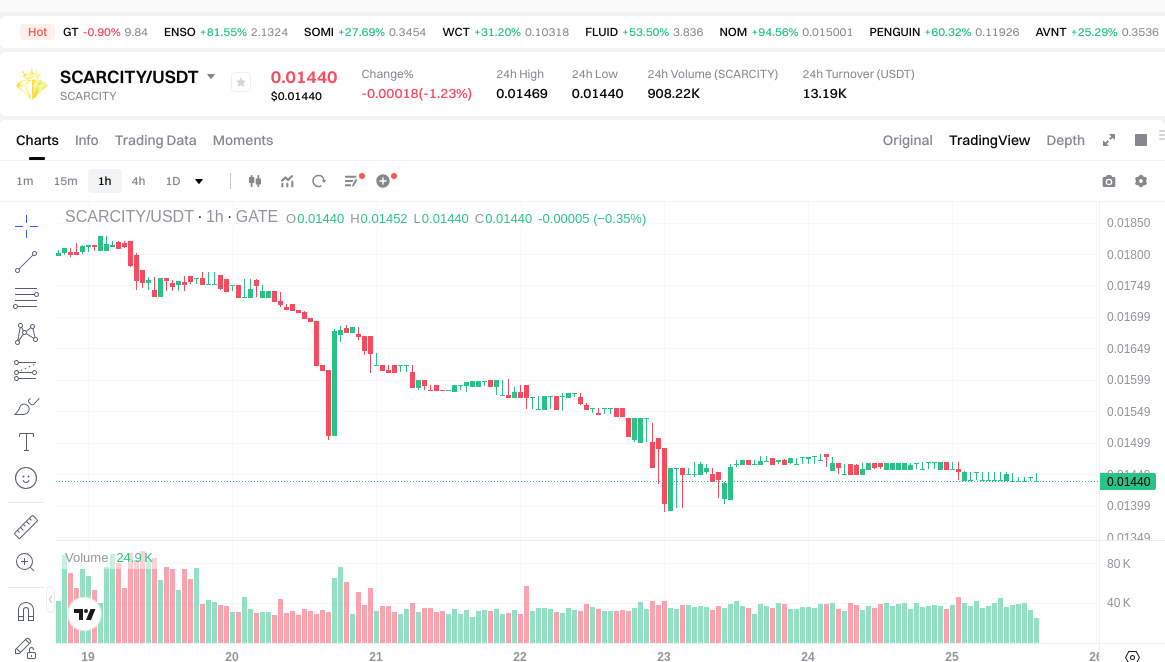
SCARCITY reached its all-time high of $0.68 on April 12, 2025, during a period of heightened market interest in decentralized social media platforms.
The token's all-time low of $0.0139 occurred on January 22, 2026, reflecting recent market adjustments and broader sector volatility.
Over the past year, SCARCITY has experienced a decline of 94.72%, while shorter-term movements show a 19.34% decrease over the past 7 days and a 16.18% decline over the past 30 days. These fluctuations reflect evolving market sentiment, adoption trends, and external factors affecting the decentralized social media sector.
Click to view the current SCARCITY market price
On-Chain Metrics
- Holder Count: 13,009 addresses (demonstrating community distribution)
- Market Capitalization: $12.80 million (reflecting current market valuation)
- Fully Diluted Valuation: $144.00 million (representing potential market cap at maximum supply)
SCARCITY Ecosystem Applications and Strategic Partners
Core Use Cases
SCARCITY's ecosystem centers on decentralized social media applications:
- Decentralized Social Networks: SCARCITY platform itself, providing censorship-resistant content sharing and community governance.
- Social Token Economy: Enabling creators and communities to monetize content through tokenized interactions.
Strategic Collaborations
As of January 25, 2026, specific strategic partnerships for SCARCITY have not been publicly disclosed in available materials. The project focuses on building its decentralized social media infrastructure independently, with community-driven development as a core principle.
Controversies and Challenges
SCARCITY faces several notable challenges:
- Technical Hurdles: Scaling decentralized social platforms while maintaining user experience comparable to centralized alternatives
- Market Volatility: The token experienced a notable price decline of 94.72% over the past year, with the price dropping from an all-time high of $0.68 in April 2025 to $0.0144 as of January 2026
- Competition Pressure: Competing with established decentralized social platforms and well-funded centralized social media giants
- Adoption Barriers: Attracting users from familiar centralized platforms to a new decentralized ecosystem
These challenges have sparked ongoing discussions within the community about sustainable growth strategies and platform development priorities.
SCARCITY's community shows growing participation, with 13,009 token holders as of January 2026.
The project maintains an active presence on X platform, where discussions around decentralized social media and the #SCARCITY tag generate regular engagement.
Recent developments and price movements have stimulated community discussions about the project's long-term vision.
Sentiment on X displays mixed perspectives:
- Supporters emphasize SCARCITY's commitment to censorship resistance and user data ownership, viewing it as a necessary alternative to centralized social platforms.
- Critics express concerns about price volatility and the challenges of achieving mainstream adoption in the competitive social media landscape.
Current trends reflect cautious optimism as the community focuses on platform development and user acquisition.
Trending Topics
X users actively discuss SCARCITY's approach to content moderation, token economics, and the balance between decentralization and usability,
highlighting both the transformative potential of decentralized social media and the practical obstacles to widespread adoption.
- Official Website: Visit SCARCITY Official Website for platform features, use cases, and latest updates.
- Whitepaper: SCARCITY Whitepaper details the technical architecture, objectives, and vision for decentralized social media.
- X Updates: SCARCITY maintains an active presence on X via @Scarcity_web3, sharing updates on platform development, community initiatives, and decentralized social media trends.
- Blockchain Explorer: Track SCARCITY transactions on BSCScan for transparency.
How to Participate in SCARCITY?
- Purchase Options: Acquire SCARCITY tokens on Gate.com and other supporting exchanges
- Storage Solutions: Securely store SCARCITY using BEP-20 compatible wallets such as MetaMask or Trust Wallet
- Platform Engagement: Participate in the SCARCITY decentralized social media platform and contribute to community discussions
- Ecosystem Building: Visit the official website to learn about development opportunities and platform contribution guidelines
Summary
SCARCITY addresses fundamental issues in social media through blockchain technology, offering decentralization, user data ownership, and censorship resistance.
Its BEP-20 token standard on BSC enables efficient transactions within the ecosystem, while the project's focus on solving centralized social media problems positions it as an innovative alternative.
Despite facing market volatility and adoption challenges, SCARCITY's commitment to decentralized social infrastructure and its growing community of over 13,000 holders demonstrate ongoing interest in the project.
With a circulating supply of approximately 889 million tokens out of a total supply of 10 billion, the project maintains room for ecosystem expansion.
Whether you're interested in decentralized social media or exploring alternative platforms, SCARCITY represents an evolving approach to digital social interaction.
FAQ
What is crypto scarcity and why does it matter?
Crypto scarcity refers to the limited supply of digital assets, designed through code. It matters because limited supply increases value and prevents inflation. Scarcity creates demand, drives adoption, and ensures long-term asset appreciation potential.
How does limited supply affect cryptocurrency value and price?
Limited supply creates scarcity, which typically drives up demand and value. When fewer coins are available and demand remains constant or increases, price tends to rise. This fundamental economic principle—supply and demand—makes scarce cryptocurrencies more valuable long-term.
What is the difference between fixed supply and deflationary cryptocurrencies?
Fixed supply has a maximum cap that never changes, while deflationary cryptocurrencies actively reduce their total supply over time through mechanisms like token burns or fees. Deflationary tokens increase scarcity and potentially enhance value appreciation.
How do blockchain protocols implement scarcity mechanisms?
Blockchain protocols implement scarcity through fixed supply caps, programmatic inflation schedules, and deflationary mechanisms like token burning. Bitcoin's 21 million coin limit and Ethereum's burn protocol are primary examples. These mechanisms ensure limited token availability, directly tied to network consensus rules that cannot be arbitrarily altered.
What role does halving play in maintaining Bitcoin's scarcity?
Bitcoin halving reduces the block reward every four years, cutting new coin supply in half. This programmatic reduction ensures Bitcoin's total supply never exceeds 21 million, making halving a critical mechanism for maintaining long-term scarcity and value preservation.
Can a cryptocurrency with unlimited supply still have value?
Yes. Value depends on utility, adoption, and demand rather than scarcity alone. Cryptocurrencies with unlimited supply can maintain value through strong use cases, network effects, and consistent transaction volume. However, unlimited supply typically creates inflationary pressure, potentially diluting long-term value compared to scarce assets.
How is crypto scarcity different from traditional commodity scarcity?
Crypto scarcity is programmed and immutable through blockchain code, ensuring fixed supply limits. Unlike physical commodities, digital scarcity cannot be physically diluted, making it cryptographically verifiable and transparent to all participants globally.
What happens to a cryptocurrency's price when scarcity decreases?
When scarcity decreases, supply increases, typically putting downward pressure on price. More available tokens generally reduce their relative value, potentially leading to price depreciation unless demand increases proportionally.
* The information is not intended to be and does not constitute financial advice or any other recommendation of any sort offered or endorsed by Gate.