This comprehensive guide explores SENSO, an ERC-20 token powering Sensorium, a global social VR media platform launched in 2020 to revolutionize immersive entertainment experiences. The article examines SENSO's blockchain infrastructure on Ethereum, market performance metrics including current circulation of 70.3M tokens, and core applications in virtual reality entertainment and digital content creation. Readers will understand the platform's technical architecture, partnership ecosystem, on-chain metrics, and community engagement across 3,571 token holders. The guide addresses market challenges, price volatility, and adoption barriers while detailing how users can acquire SENSO through Gate and other exchanges, store tokens securely, and participate in the Sensorium Galaxy ecosystem, making it essential for VR enthusiasts and crypto investors exploring decentralized virtual worlds.
Sensorium's Positioning and Significance
In 2020, the Sensorium team launched Sensorium (SENSO), aiming to address the lack of immersive social experiences in virtual reality and limited accessibility to high-quality VR entertainment.
As a global social VR media platform, Sensorium plays a key role in virtual reality entertainment and metaverse experiences.
As of 2026, Sensorium has established itself within the VR entertainment sector, with an active community of over 3,500 token holders and ongoing platform development.
This article will explore its technical architecture, market performance, and future potential.
Origin and Development History
Birth Background
Sensorium was created by the Sensorium Corporation team in 2020, aiming to solve the fragmentation of virtual entertainment experiences and barriers to accessing immersive VR content.
It emerged during the growing interest in virtual reality technology and metaverse concepts, with the goal of providing users with a comprehensive VR entertainment experience through the Sensorium Galaxy virtual world.
Sensorium's launch brought new possibilities for VR entertainment enthusiasts and digital content creators.
Important Milestones
- 2020: Token launch on Ethereum blockchain as an ERC-20 token, enabling platform transactions and governance.
- 2020-2021: Development of Sensorium Galaxy virtual world, starting with music-focused virtual environments.
- 2021: Partnership with major international music festival representatives to deliver immersive VR performance experiences.
- 2021: Price reached peak performance in November, reflecting market interest in metaverse projects.
With support from the Sensorium development team and its partner ecosystem, Sensorium continues to expand its virtual world offerings and enhance user experiences.
How Sensorium Works
No Central Control
Sensorium operates as an ERC-20 token on the Ethereum blockchain, a decentralized network of computers (nodes) distributed globally, free from control by banks or governments.
These nodes collaborate to validate transactions, ensuring system transparency and attack resistance, granting users greater autonomy and improving network resilience.
Blockchain Foundation
Sensorium's blockchain infrastructure leverages Ethereum's public, immutable digital ledger that records every transaction.
Transactions are grouped into blocks and linked through cryptographic hashes to form a secure chain.
Anyone can view these records, establishing trust without intermediaries.
The platform utilizes smart contracts to facilitate in-platform transactions, content access, and reward distribution within the Sensorium Galaxy ecosystem.
Ensuring Fairness
Sensorium relies on Ethereum's Proof of Stake (PoS) consensus mechanism to validate transactions and prevent fraudulent activities such as double spending.
Validators secure the network by staking ETH and processing transactions, maintaining blockchain integrity while earning rewards.
The transition to PoS has brought improved energy efficiency and enhanced network security.
Secure Transactions
Sensorium uses public-private key cryptography to protect transactions:
- Private keys (like secret passwords) are used to sign transactions
- Public keys (like account numbers) are used to verify ownership
This mechanism ensures fund security while transactions maintain pseudonymous privacy characteristics typical of Ethereum-based tokens.
The ERC-20 standard implementation provides compatibility with Ethereum wallets and smart contract interactions.
Circulation Overview
As of February 8, 2026, Sensorium's circulating supply stands at 70,269,127 SENSO tokens, with a total supply of 715,280,000 tokens and a maximum supply of 5,915,280,000 tokens. The circulating supply represents approximately 1.19% of the total supply, indicating a controlled token release mechanism. SENSO operates as an ERC-20 token within the Sensorium platform framework, supporting its virtual reality entertainment ecosystem.
Price Fluctuations
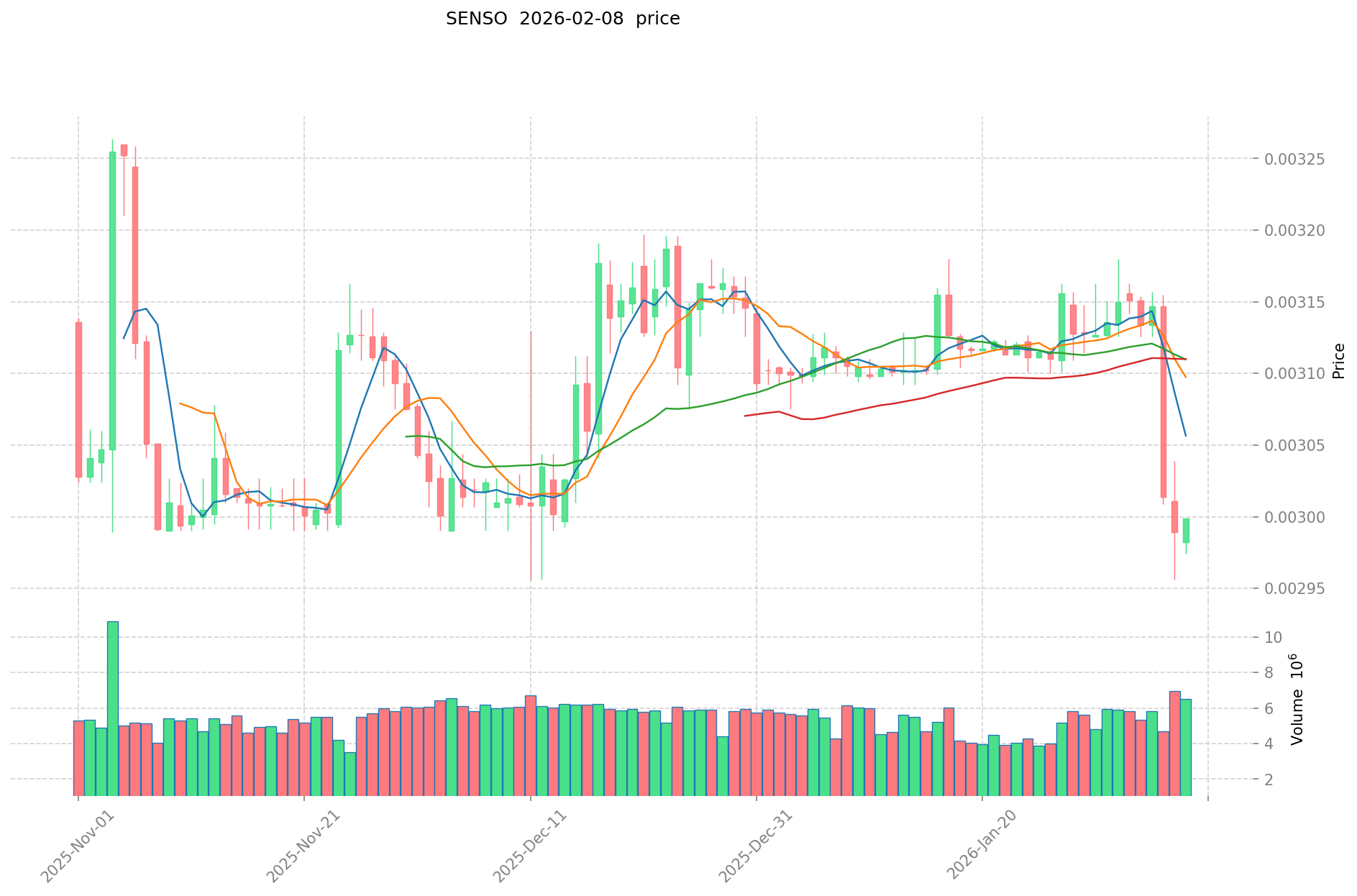
Sensorium reached its all-time high of $3.28 on November 21, 2021, during a period of heightened interest in metaverse and VR-related projects. The token experienced its lowest price of $0.000012 on August 28, 2025, reflecting broader market corrections and shifts in investor sentiment toward virtual reality platforms. Over the past year, SENSO has experienced significant volatility, with a 82.31% decline, demonstrating the impact of market dynamics and evolving adoption trends in the VR entertainment sector.
Click to view current SENSO market price
On-Chain Metrics
- Market Capitalization: $210,737 (reflecting current circulating supply valuation)
- 24-Hour Trading Volume: $13,956 (indicating current market activity levels)
- Token Holders: 3,571 addresses (demonstrating community distribution)
- Fully Diluted Valuation: $2,145,125 (representing potential maximum market capitalization)
Sensorium Ecosystem Applications and Partners
Core Use Cases
Sensorium's ecosystem supports multiple applications:
- Virtual Reality Entertainment: Sensorium Galaxy, providing immersive VR performance experiences and social interactions.
- Digital Content Creation: Through partnerships with international music festivals, enabling virtual concerts and multi-sensory entertainment.
Strategic Partnerships
Sensorium has established collaborations with major international music festival representatives, enhancing its content delivery capabilities and market reach.
These partnerships provide a solid foundation for Sensorium's ecosystem expansion in the virtual entertainment space.
Challenges and Controversies
Sensorium faces the following challenges:
- Market Competition: Competition from other VR and metaverse platforms in the entertainment sector
- Adoption Barriers: The need for VR hardware and technological familiarity among mainstream users
- Market Volatility: Significant price fluctuations, with current trading at $0.002999, representing a substantial decline from previous levels
These issues have sparked discussions within the community and market, while also driving Sensorium's continuous innovation.
Sensorium's ecosystem shows active participation, with 3,571 token holders supporting the platform.
The project maintains presence across multiple social channels, with regular updates on platform development and virtual world expansions.
Sentiment on social platforms presents mixed perspectives:
- Supporters praise Sensorium's innovative VR technology integration and immersive entertainment experiences, viewing it as a pioneer in virtual social entertainment.
- Critics focus on price performance challenges and market adoption rates.
Recent trends reflect the broader market conditions affecting VR and metaverse-focused projects.
Popular Topics
Social media users discuss Sensorium's virtual world development progress, VR technology integration, and entertainment content partnerships,
showcasing both its innovative potential and the challenges facing virtual reality adoption.
- Official Website: Visit Sensorium's official site and Sensorium Galaxy for features, use cases, and latest updates.
- Social Media: Follow Sensorium on X platform at @SensoToken for updates on technology developments, community events, and partnership announcements.
- Blockchain Explorer: View token details on Etherscan for transparent on-chain data.
- Community: Connect through Facebook for community interactions and platform news.
Future Roadmap for Sensorium
- Platform Expansion: Continued development of Sensorium Galaxy virtual worlds beyond the initial music-focused planets
- Ecosystem Goals: Expanding partnerships with entertainment industry leaders and content creators
- Long-term Vision: Establishing a comprehensive global social VR media platform with multi-sensory experiences
How to Participate in Sensorium?
- Purchase Options: Acquire SENSO tokens on supported exchanges including Gate.com
- Storage Solutions: Use Ethereum-compatible wallets such as MetaMask or hardware wallets for secure storage of ERC-20 tokens
- Platform Engagement: Explore Sensorium Galaxy virtual experiences and participate in VR entertainment events
- Ecosystem Building: Developers can explore opportunities to create content and applications within the Sensorium framework
Summary
Sensorium leverages blockchain and VR technology to redefine virtual entertainment, providing immersive social experiences, multi-sensory content, and innovative performance formats.
Its active development roadmap, strategic partnerships, and unique positioning in the VR entertainment space distinguish it within the cryptocurrency sector.
Despite facing market challenges and adoption barriers, Sensorium's focus on cutting-edge virtual reality integration and social entertainment experiences positions it as a noteworthy project in the intersection of blockchain and immersive technology.
Whether you're a VR enthusiast or crypto investor, Sensorium represents an interesting development in decentralized virtual worlds.
FAQ
What is SENSO cryptocurrency and what is its purpose?
SENSO is a cryptocurrency powering a global digital currency exchange platform. Its purpose is to enable seamless cryptocurrency trading, provide advanced trading tools, and offer staking opportunities for users of all experience levels.
How do I buy and store SENSO tokens?
Buy SENSO on decentralized exchanges or centralized platforms that list it. Store securely in self-custody wallets like MetaMask, Trust Wallet, or hardware wallets such as Ledger for optimal security and control.
What is the total supply and tokenomics of SENSO?
SENSO has a total supply of 715,280,000 tokens with a maximum supply cap of 715,280,000. The circulating supply is 70,269,130 SENSO. The tokenomics are designed with a fixed cap to ensure scarcity and sustainable distribution.
What blockchain network does SENSO operate on?
SENSO operates on the Ethereum blockchain as an ERC-20 token, enabling secure and efficient transactions within the Ethereum network ecosystem.
Is SENSO a safe and legitimate project? What are the risks?
SENSO demonstrates a medium trust score with low risk assessment. Risks include market volatility and regulatory changes. Conduct thorough due diligence before participation.
What are the main use cases and applications of SENSO?
SENSO transforms verified enterprise content into accurate, structured answers for generative AI tools. Main applications include enhancing AI decision-making capabilities, automating information retrieval processes, and providing reliable data infrastructure for businesses seeking to improve AI accuracy and operational efficiency.
Who are the team members and backers behind SENSO?
SENSO was founded in 2016 by Nick Seelert, Saroop Bharwani, and Kirill Pozdnyakov. The project raised $4.79M in Series A funding from notable investors including Y Combinator, Mendoza Ventures, and Breakaway Growth.
What is the future roadmap and development plan for SENSO?
SENSO's roadmap focuses on advancing magnetoresistive sensor technology through a three-year development plan coordinated by an international taskforce. Key objectives include enhancing sensor performance, expanding integration capabilities, and driving innovation in non-recording applications to strengthen market competitiveness.
* The information is not intended to be and does not constitute financial advice or any other recommendation of any sort offered or endorsed by Gate.