Sign is a global infrastructure provider for omni-chain attestation and token distribution, launched in 2025 to solve credential verification inefficiencies across blockchain ecosystems. This comprehensive guide covers Sign's decentralized architecture, dual-product ecosystem including Sign Protocol and TokenTable, and market performance with 1.2 billion circulating tokens listed on Gate and 30 other exchanges. Explore how Sign leverages smart contracts and public-private cryptography to enable secure, interoperable digital credential verification for governments and decentralized applications. The article analyzes Sign's technical foundations, real-world applications in digital public infrastructure, market metrics showing $46 million market capitalization, and the community sentiment driving its adoption. Discover Sign's strategic positioning in the competitive attestation space and practical pathways for participation through token acquisition and ecosystem engagement.
Sign's Positioning and Significance
In 2025, the Sign team launched Sign (SIGN), aiming to address challenges in credential verification and token distribution inefficiency.
As a global infrastructure provider for attestation and token management, Sign plays a key role in decentralized identity, digital public infrastructure, and token distribution.
As of 2026, Sign has become an emerging player in the attestation and token distribution space, with 31 exchanges listing the token and an active developer community.
This article will deeply analyze its technical architecture, market performance, and future potential.
Origin and Development History
Birth Background
Sign was created by the Sign team in 2025, aiming to solve inefficiencies in credential verification and token distribution across blockchain ecosystems.
It emerged during the growing adoption of blockchain technology for identity and governance, with the goal of providing secure, interoperable infrastructure for attestations and token management.
The launch of Sign brought new possibilities to governments, decentralized applications, and token projects.
Key Milestones
- 2025: Mainnet launch, achieving omni-chain attestation capabilities and smart contract-based token distribution.
- 2025: Token listing on Gate.com and 30 other exchanges, expanding market accessibility.
- 2025: Integration with digital public infrastructure projects, supporting government credential verification systems.
- 2025-2026: Ecosystem growth, with increasing adoption of Sign Protocol and TokenTable platform.
With the support of its development team and community, Sign continues to optimize its technology, security, and real-world applications.
How Sign Works
No Central Control
Sign operates on a decentralized network of nodes distributed globally, free from control by banks or governments.
These nodes collaborate to verify attestations and token distributions, ensuring system transparency and attack resistance, giving users greater autonomy and enhancing network resilience.
Blockchain Core
Sign's infrastructure is built on an open, immutable digital ledger that records all attestations and token distributions.
Transactions and attestations are grouped into blocks, linked through cryptographic hashes to form a secure chain.
Anyone can view the records, establishing trust without intermediaries.
The omni-chain architecture enables cross-chain interoperability, further enhancing performance and accessibility.
Ensuring Fairness
Sign Protocol utilizes smart contract-based verification mechanisms to validate attestations and prevent fraudulent credential claims.
Validators maintain network security through running nodes and processing attestations, contributing to the integrity of the credential system.
Its innovation includes cross-chain attestation compatibility and efficient token distribution management.
Secure Transactions
Sign employs public-private key cryptography to protect transactions and attestations:
- Private keys (similar to secret passwords) are used to sign attestations and authorize token distributions
- Public keys (similar to account numbers) are used to verify ownership and authenticity
This mechanism ensures fund security and maintains verifiable transparency in credential verification.
The platform supports multiple blockchain standards including ERC-20, BEP-20, and BASE, enabling flexible deployment across different ecosystems.
Circulating Supply Overview
As of January 20, 2026, Sign's circulating supply stands at 1.2 billion tokens, with a total supply of 10 billion tokens. The circulating supply represents 12% of the total supply, indicating a controlled release mechanism. The token operates across multiple blockchain networks including Ethereum, BNB Smart Chain, and Base, utilizing ERC-20, BEP-20, and BASE standards respectively.
Price Fluctuations
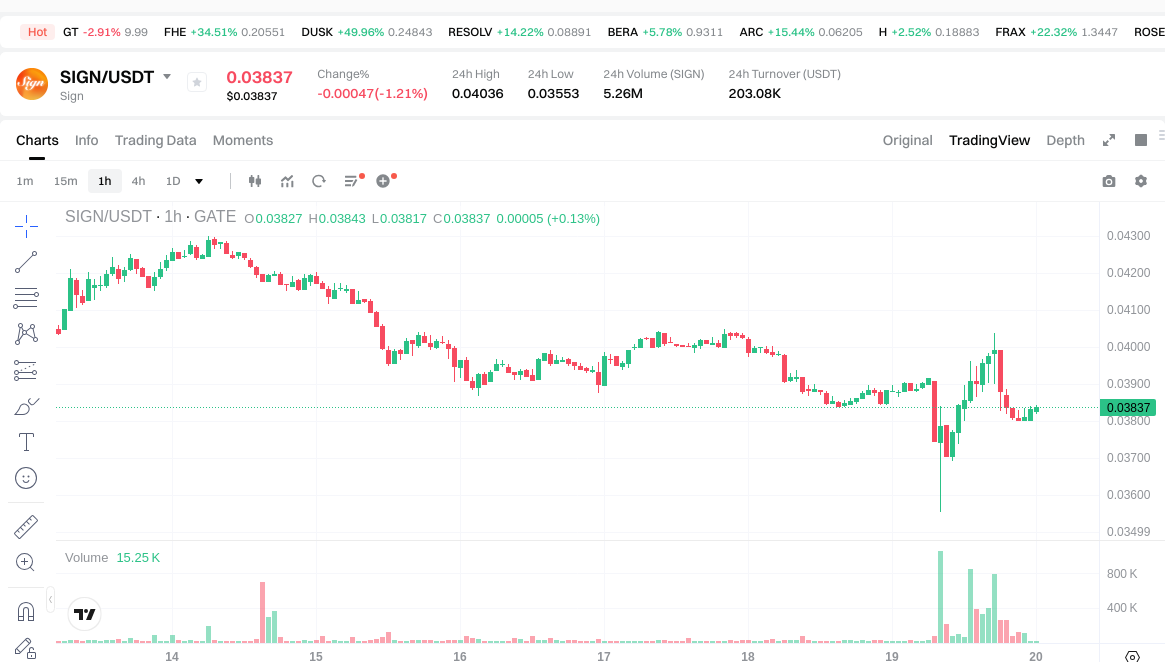
Sign reached its peak price of $0.14888 on April 29, 2025, during a period of heightened market interest in decentralized verification infrastructure. The token subsequently experienced a significant correction, hitting its lowest recorded price of $0.00611 on October 10, 2025. As of the latest data, Sign is trading at $0.03839, reflecting a 51.78% decline over the past year. Recent price movements show mixed signals, with a 10.92% increase over the past 30 days, while experiencing a 4.64% decrease over the past week and a 1.33% decline in the last 24 hours.
Click to view the current SIGN market price
On-Chain Metrics
- 24-Hour Trading Volume: Approximately $203,085 (indicating moderate trading activity)
- Active Holders: 560 addresses (reflecting the current user base)
- Market Capitalization: $46.068 million with a fully diluted valuation of $383.9 million
- Market Dominance: 0.011% of the total cryptocurrency market
Sign Ecosystem Applications and Partners
Core Use Cases
Sign's ecosystem supports multiple applications:
- Digital Public Infrastructure: Sign Protocol provides omni-chain attestation capabilities, enabling credential verification services for governments and decentralized applications.
- Token Distribution: TokenTable offers smart contract-based token distribution, facilitating airdrops, vesting schedules, and token unlocks.
Strategic Partnerships
As Sign continues to develop its infrastructure, strategic partnerships play a vital role in expanding its technical capabilities and market reach.
These collaborations provide a solid foundation for Sign's ecosystem expansion.
Challenges and Discussions
Sign faces several challenges in its development:
- Market Competition: The attestation and token distribution space includes various competing solutions.
- Adoption Hurdles: Building widespread adoption for credential verification infrastructure requires time and ecosystem development.
These issues have sparked discussions within the community and market, while also driving Sign's continuous innovation.
Sign's community shows active participation, with the token circulating among 560 holders.
On X platform, related posts and hashtags (such as #SIGN) generate engagement within the crypto community.
Developments in the Sign Protocol and TokenTable platform continue to attract community attention.
Sentiment on X demonstrates varied perspectives:
- Supporters praise Sign's infrastructure approach and dual-product strategy, viewing it as foundational technology for credential verification and token management.
- Observers monitor market performance and ecosystem development progress.
Trending Topics
X users discuss Sign's role in digital public infrastructure, token distribution mechanisms, and omni-chain interoperability,
reflecting both its innovative potential and the challenges of building foundational infrastructure.
- Official Website: Visit Sign's official website for features, use cases, and latest updates.
- Documentation: Sign's documentation provides detailed information on its technical architecture, goals, and vision.
- X Updates: On X platform, Sign maintains an active presence through @ethsign,
sharing content about technical developments, community activities, and ecosystem updates.
Sign's Future Roadmap
- Infrastructure Expansion: Continued development of Sign Protocol's attestation capabilities and TokenTable's distribution features
- Ecosystem Goals: Expanding adoption of credential verification infrastructure and token distribution services
- Long-term Vision: Establishing itself as foundational infrastructure for omni-chain attestation and token management
How to Participate in Sign?
- Purchase Options: Buy SIGN on Gate.com and other supporting exchanges
- Storage Solutions: Securely store tokens using compatible wallets that support ERC-20, BEP-20, or BASE standards
- Monitor Development: Follow official channels for updates on Sign Protocol and TokenTable platform developments
- Explore Use Cases: Visit the documentation to understand attestation and token distribution capabilities
Summary
Sign is building global infrastructure for credential verification and token distribution through blockchain technology, offering omni-chain attestation capabilities and smart contract-based distribution solutions.
Its dual-product approach, active development, and focus on foundational infrastructure position it as a noteworthy project in the decentralized technology space.
While facing adoption challenges and market competition, Sign's infrastructure focus and clear development direction give it relevance in the evolving landscape of digital credentials and token management.
Whether you're new to crypto or an experienced participant, Sign's infrastructure approach merits attention and exploration.
FAQ
What is SIGN crypto token and what is its main purpose?
SIGN is a utility token powering a blockchain-based notarization and digital signature ecosystem. Its main purpose is to securely certify documents on the blockchain, making them tamper-proof, transparent, and verifiable without third-party intermediaries.
How can I buy and store SIGN tokens?
Purchase SIGN tokens through cryptocurrency exchanges supporting the token. Store them in a secure wallet, either hardware wallets for maximum security or reputable software wallets. Always keep private keys safe and enable two-factor authentication.
What are the risks and security considerations when dealing with SIGN?
Key risks include smart contract vulnerabilities, private key loss, and market volatility. Security considerations involve using hardware wallets, enabling two-factor authentication, verifying contract addresses, and avoiding phishing attempts. Always conduct thorough due diligence before transactions.
What is the difference between SIGN and other similar cryptocurrency projects?
SIGN distinguishes itself through superior privacy and security architecture. Unlike competitors, SIGN prioritizes user data protection and transaction confidentiality while maintaining network efficiency. Its unique protocol design enables faster settlement and lower fees compared to similar projects in the market.
Who is the team behind SIGN and what is their roadmap?
SIGN is led by Aaron Green and the design team. The roadmap includes new design projects and platform updates. Details are available in their official roadmap review.
Is SIGN available on major cryptocurrency exchanges?
Yes, SIGN is available on over 27 major cryptocurrency exchanges. It can be traded with BRL, stablecoins USDT and USDC, and BNB, providing multiple trading options for users worldwide.
* The information is not intended to be and does not constitute financial advice or any other recommendation of any sort offered or endorsed by Gate.