Sign is a foundational blockchain infrastructure protocol launched in 2025, addressing credential verification fragmentation and token distribution inefficiencies across ecosystems. This comprehensive guide explores Sign's dual-product architecture: Sign Protocol for omni-chain attestation and TokenTable for smart contract-based token management. The article examines Sign's technical foundations using decentralized verification mechanisms and cryptographic security, covering market performance with current pricing at $0.03833 and market cap of $45.99 million across 28 exchanges including Gate. Key sections detail ecosystem applications in digital public infrastructure, community engagement with 560 active holders, and the project's roadmap focusing on cross-chain interoperability. Whether exploring digital identity solutions or token distribution mechanisms, this guide provides actionable insights for developers, governments, and cryptocurrency participants seeking reliable attestation infrastructure.
Sign's Positioning and Significance
In 2025, the Sign team launched Sign (SIGN), aiming to address the fragmentation of credential verification systems and inefficiencies in token distribution across blockchain ecosystems.
As a global infrastructure provider for attestation and token management, Sign plays a critical role in decentralized applications, digital public infrastructure, and token economics.
As of 2026, Sign has established itself as a foundational protocol serving both governmental digital infrastructure and decentralized applications, with over 28 exchanges listing the token and an active developer community.
This article will provide an in-depth analysis of its technical architecture, market performance, and future potential.
Origin and Development History
Background
Sign was created by its founding team in 2025, aiming to solve the lack of standardized, interoperable credential verification systems and complex token distribution processes across blockchain networks.
It emerged during the maturation phase of blockchain infrastructure, with the goal of providing seamless attestation services and streamlined token management solutions to transform existing workflows.
Sign's launch brought new possibilities to developers, governments, and projects requiring verifiable credential systems and efficient token distribution mechanisms.
Key Milestones
- 2025: Mainnet launch with the deployment of Sign Protocol, achieving omni-chain attestation capabilities.
- 2025: Introduction of TokenTable platform, enabling smart contract-based token distribution, including airdrops, vesting schedules, and unlock mechanisms.
- 2025: Integration with multiple blockchain networks including Ethereum, BSC, and Base, expanding cross-chain compatibility.
- 2025-2026: Growing adoption by decentralized applications and governmental entities seeking digital public infrastructure solutions.
With support from its development team and growing community, Sign continues to enhance its technical capabilities, security features, and real-world applications.
How Sign Works
Decentralized Architecture
Sign operates through a distributed network infrastructure that removes dependence on centralized authorities.
The protocol's nodes work collaboratively to validate attestations and manage token distributions, ensuring system transparency and resistance to single points of failure, granting users greater autonomy while enhancing network resilience.
Blockchain Foundation
Sign's infrastructure leverages public, immutable blockchain ledgers to record credential attestations and token distribution events.
Transactions are organized into blocks and cryptographically linked to form a secure chain.
Anyone can verify records without intermediaries, establishing trustless verification.
The protocol's omni-chain architecture enables cross-blockchain attestation, expanding interoperability across different networks.
Verification Mechanism
Sign Protocol implements decentralized attestation verification to ensure the authenticity and integrity of credentials.
Attesters and validators maintain network security through verification activities and consensus participation, creating a trustworthy credential ecosystem.
Its innovation includes cross-chain attestation capabilities and seamless integration with existing blockchain infrastructure.
Secure Operations
Sign employs cryptographic techniques to protect attestations and token distributions:
- Private keys (similar to secret passwords) are used to authorize attestations and transactions
- Public keys (similar to account identifiers) are used to verify ownership and authenticity
This mechanism ensures credential security while maintaining transparency in verification processes.
The platform's smart contract architecture provides additional security through programmable vesting schedules and automated distribution protocols.
Circulation Overview
As of January 19, 2026, Sign's circulating supply is 1,200,000,000 tokens, with a total supply of 10,000,000,000 tokens. The circulating supply represents 12% of the total supply, indicating a controlled release model with significant tokens yet to enter circulation. The token distribution mechanism through Sign Protocol and TokenTable infrastructure affects its supply-demand dynamics.
Price Volatility
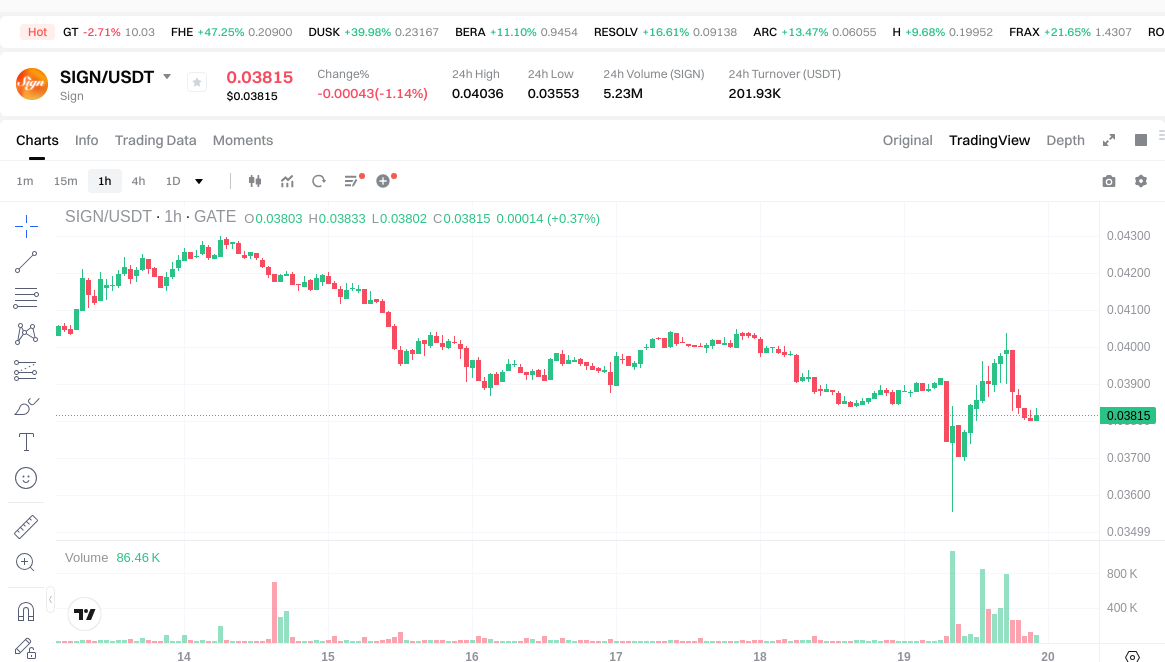
Sign reached its highest price of $0.14888 on April 29, 2025, driven by market momentum during the early phase of its trading lifecycle. The lowest price of $0.00611 occurred on October 10, 2025, reflecting a period of market adjustment. The current price stands at $0.03833, showing recovery from the low point with a 30-day increase of 9.59%. These fluctuations reflect changing market sentiment, adoption trends, and broader cryptocurrency market conditions.
Click to view the current SIGN market price
On-Chain Metrics
- 24-Hour Trading Volume: $201,556.10 (indicating active market participation)
- Holder Count: 560 addresses (reflecting current user base)
- Market Capitalization: $45,996,000 (representing circulating value)
- Fully Diluted Valuation: $383,300,000 (potential market cap if all tokens were in circulation)
Sign Ecosystem Applications and Partnerships
Core Use Cases
Sign's ecosystem supports multiple applications:
- Digital Public Infrastructure: Sign Protocol provides credential verification services for governments, offering omni-chain attestation capabilities.
- Token Distribution: TokenTable enables smart contract-based token management, including airdrops, vesting schedules, and unlock mechanisms.
Strategic Partnerships
Sign is building global infrastructure for credential verification and token distribution, which positions it as a foundational layer for decentralized applications.
These strategic directions provide a solid foundation for Sign's ecosystem expansion.
Challenges and Discussions
Sign faces several considerations in its development:
- Technical Evolution: As an omni-chain attestation protocol, continuous innovation is needed to maintain compatibility across multiple blockchain networks
- Market Competition: The credential verification and token distribution space includes various solutions, requiring Sign to demonstrate its unique value proposition
- Adoption Challenges: Building digital public infrastructure for governments requires navigating complex regulatory and institutional requirements
These factors continue to drive Sign's innovation and development efforts.
Sign maintains an active community presence with 560 holders as of the latest data.
On X platform, the project engages through its handle @ethsign, sharing updates about protocol developments and ecosystem growth.
Discussions on X present varied perspectives:
- Supporters appreciate Sign's dual-product approach combining attestation protocol and token distribution platform, viewing it as infrastructure for Web3 adoption.
- Observers monitor price movements and ecosystem development progress, noting the project's positioning in the credential verification space.
Recent trends reflect evolving market conditions and ecosystem developments.
Discussion Topics
X users discuss Sign's infrastructure applications, token distribution mechanisms, and omni-chain capabilities,
highlighting both its potential for digital identity solutions and the ongoing development of its ecosystem.
- Official Website: Visit Sign Official Website for features, use cases, and latest updates.
- Documentation: Sign Documentation details its technical architecture, goals, and vision.
- X Updates: On X platform, Sign uses @ethsign to share updates,
with posts covering protocol upgrades, community activities, and partnership announcements.
Sign Future Roadmap
- Ongoing Development: Enhancing attestation protocol capabilities and token distribution features, improving cross-chain interoperability and user experience
- Ecosystem Goals: Expanding applications in digital public infrastructure and decentralized applications
- Long-term Vision: Establishing itself as foundational infrastructure for credential verification and token management
How to Participate in Sign?
- Purchase Options: Sign (SIGN) is available on Gate.com and other supporting exchanges
- Storage Solutions: Store securely using compatible wallets that support ERC-20, BEP-20, or BASE standards
- Ecosystem Participation: Visit Sign Documentation to explore development opportunities and protocol integration
- Community Engagement: Follow updates through official channels to stay informed about ecosystem developments
Summary
Sign is building infrastructure for credential verification and token distribution through blockchain technology, offering attestation capabilities and smart contract-based distribution solutions.
Its dual-product approach, development resources, and market positioning establish its presence in the digital identity and token management space.
While navigating adoption challenges and competitive dynamics, Sign's infrastructure focus and development roadmap position it as a participant in decentralized technology evolution.
Whether you are exploring digital identity solutions or token distribution mechanisms, Sign offers relevant infrastructure to consider.
FAQ
What is SIGN? What is its specific definition and role in the cryptocurrency field?
SIGN is a protocol enabling users to create and verify digital credentials across multiple blockchains. It combines cryptographic technology with zero-knowledge proofs to ensure secure and verifiable claims regarding identity, ownership, and agreements across different networks.
What are the uses of SIGN tokens and what are its main application scenarios and functions?
SIGN tokens enable on-chain identity verification, ownership proof, and smart contract execution. They provide transparent and scalable verification frameworks for governments, enterprises, and developers to establish trust in decentralized networks.
How to buy and store SIGN tokens? Which exchanges offer SIGN trading?
Purchase SIGN tokens on major centralized exchanges through USDT or BUSD trading pairs. Transfer tokens to a secure personal wallet like MetaMask or hardware wallets for long-term storage. Ensure you use official platforms and enable two-factor authentication.
What is the security of the SIGN project? What risks should I pay attention to when investing in SIGN?
SIGN security relies on blockchain technology and smart contract audits. Investment risks include market volatility, liquidity fluctuations, and regulatory uncertainty. Investors should conduct thorough research and monitor market performance closely before investing.
What are the differences and advantages of SIGN compared to other cryptocurrencies or tokens?
SIGN distinguishes itself through an innovative soul-bound token system that rewards substantial contributions over surface participation. Its non-transferable token design ensures fair incentives, creating a unique mechanism that differentiates SIGN from traditional cryptocurrencies in the Web3 ecosystem.
What is the development prospect and future plan of the SIGN project?
SIGN demonstrates strong growth potential with a $12 million buyback initiative, signaling confidence in its future. The project plans continuous market expansion and user growth to drive revenue increases. Ongoing buyback programs and business development will strengthen token value and ecosystem sustainability.
* The information is not intended to be and does not constitute financial advice or any other recommendation of any sort offered or endorsed by Gate.