This comprehensive guide explores SOL, Solana's native cryptocurrency launched in 2017 to solve blockchain scalability challenges. As the 6th largest cryptocurrency by market cap with 2.7 million holders, Solana operates as a high-performance Layer 1 blockchain using Proof of History combined with Proof of Stake consensus. The article covers Solana's technical architecture, market performance including current price dynamics and on-chain metrics, ecosystem applications in DeFi and NFTs, and community engagement. It examines challenges like network stability and competitive pressures while highlighting Solana's advantages: processing over 50,000 transactions per second with minimal fees. Learn how to purchase SOL on Gate, participate in the ecosystem, and understand SOL's role in powering decentralized applications and governance.
Solana's Position and Significance
In 2017, former engineers from Qualcomm, Intel, and Dropbox launched Solana (SOL), aiming to address scalability limitations in blockchain technology without compromising decentralization or security.
As one of the fastest Layer 1 blockchain protocols, Solana plays a crucial role in decentralized finance (DeFi), NFTs, and high-frequency applications.
As of 2026, Solana has established itself as the 6th largest cryptocurrency by market capitalization, with over 2.7 million holders and an active developer community.
This article will provide an in-depth analysis of its technical architecture, market performance, and future potential.
Origin and Development History
Background
Solana was created by former engineers from Qualcomm, Intel, and Dropbox in late 2017, aiming to solve blockchain scalability challenges while maintaining decentralization and security.
It emerged during the blockchain technology boom, with the goal of providing high-throughput, low-cost transactions to transform the ecosystem.
Solana's launch brought new possibilities for developers seeking to build scalable decentralized applications.
Key Milestones
- 2020: Mainnet launch on March 16, implementing high-performance transaction processing capabilities.
- 2021: Ecosystem expansion with DeFi protocols and NFT platforms experiencing significant growth.
- 2025: Market presence strengthened, with trading availability across 79 exchanges.
- 2026: Continues to maintain position among top cryptocurrencies with 2.62% market dominance.
With community and foundation support, Solana continues to optimize its technology, security, and real-world applications.
How Does Solana Work?
No Central Control
Solana operates on a decentralized network of computers (nodes) distributed globally, free from control by banks or governments.
These nodes collaborate to validate transactions, ensuring the system remains transparent and resistant to attacks, granting users greater autonomy and enhancing network resilience.
Blockchain Core
Solana's blockchain is a public, immutable digital ledger that records every transaction.
Transactions are grouped into blocks and linked through cryptographic hashes to form a secure chain.
Anyone can view the records, establishing trust without intermediaries.
Its architecture incorporates innovative approaches to enhance performance and throughput.
Ensuring Fairness
Solana employs a hybrid consensus mechanism combining Proof of History (PoH) with Proof of Stake (PoS) to validate transactions and prevent fraud such as double-spending.
Validators secure the network through staking SOL tokens and running validator nodes, earning SOL rewards in return.
Its innovation includes significantly higher transaction throughput and lower latency compared to traditional blockchain protocols.
Secure Transactions
Solana uses public-private key cryptography to protect transactions:
- Private keys (similar to secret passwords) are used to sign transactions
- Public keys (similar to account numbers) are used to verify ownership
This mechanism ensures fund security while maintaining pseudonymous transactions.
The protocol implements additional security features to protect network integrity and user assets.
Circulation Overview
As of January 13, 2026, Solana's circulating supply stands at 565,202,239.08 SOL tokens, with a total supply of 618,228,766.96 SOL. The maximum supply is uncapped, indicating an inflationary token model that allows for continuous issuance over time.
New tokens enter the market through Solana's proof-of-stake consensus mechanism, where validators receive staking rewards for securing the network. This ongoing issuance affects the supply-demand dynamics of SOL tokens in the marketplace.
The current circulating supply represents approximately 91.42% of the total supply, suggesting a relatively high proportion of tokens already in active circulation.
Price Fluctuation
Solana reached a notable price level of $293.31 on January 19, 2025, driven by factors including increased institutional interest in high-performance blockchain platforms and growing adoption of Solana-based applications in the decentralized finance ecosystem.
Its lowest recorded price was $0.500801, occurring on May 12, 2020, during a period when the project was still in its early developmental stages and had yet to achieve widespread market recognition.
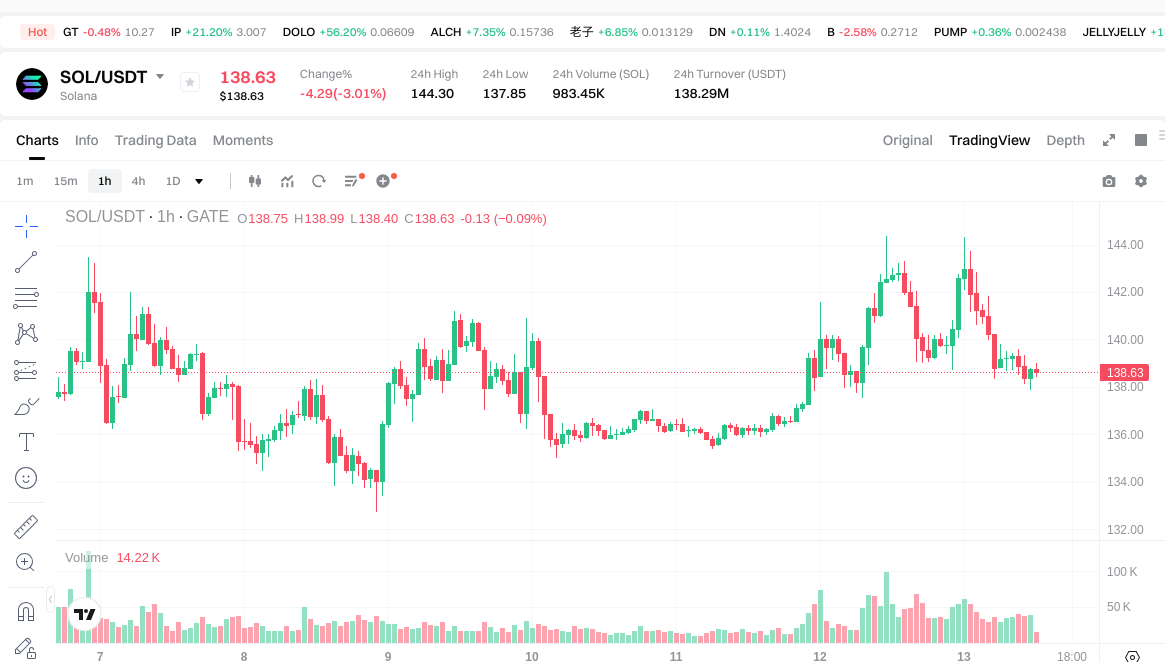
These fluctuations reflect market sentiment shifts, adoption trends, and broader cryptocurrency market conditions. Recent price movements show SOL trading at $138.52, with a 24-hour change of -2.94%, a 7-day change of +0.09%, and a 30-day change of +4.18%.
Click to view current SOL market price
On-Chain Metrics
- Holder Addresses: Approximately 2,747,053 addresses hold SOL tokens, reflecting broad user participation across the ecosystem
- Market Capitalization: $78.29 billion, representing 2.62% of the total cryptocurrency market
- 24-Hour Trading Volume: $138.50 million, indicating active market liquidity and trading activity
Solana Ecosystem Applications and Partners
Core Use Cases
Solana's ecosystem supports multiple applications:
- DeFi: Projects like Serum and Raydium provide decentralized trading and liquidity solutions.
- NFT and GameFi: Platforms such as Magic Eden and Star Atlas drive innovation in digital collectibles and blockchain gaming.
Strategic Partnerships
Solana has established collaborations with various technology providers and organizations to enhance its technical capabilities and market influence.
These partnerships provide a solid foundation for Solana's ecosystem expansion.
Controversies and Challenges
Solana faces the following challenges:
- Technical Issues: Network outages and performance stability concerns
- Regulatory Risks: Evolving regulatory frameworks in different jurisdictions
- Competitive Pressure: Competition from other high-performance blockchains
These issues have sparked discussions within the community and market, while also driving Solana's continuous innovation.
Solana's community demonstrates strong vitality, with over 2.7 million holders as of January 2026.
On X platform, related posts and hashtags such as #Solana frequently trend.
Factors including ecosystem developments and new partnerships have ignited community enthusiasm.
Sentiment on X shows diverse perspectives:
- Supporters praise Solana's high performance, low transaction costs, and growing ecosystem, viewing it as a leading smart contract platform.
- Critics focus on network stability concerns and competitive challenges.
Recent trends indicate varying sentiment based on market conditions and network performance.
Trending Topics
X users actively discuss Solana's scalability improvements, ecosystem growth, and technological developments,
showcasing both its transformative potential and the challenges in achieving mainstream adoption.
- Official Website: Visit Solana Official Website for features, use cases, and latest updates.
- Technical Documentation: Explore the Solana Documentation for technical architecture and development resources.
- X Updates: On X platform, Solana actively engages through @solana,
with posts covering technical upgrades, community events, and partnership announcements.
Solana Future Roadmap
- Ongoing Development: Continuous improvements to network stability and scalability
- Ecosystem Goals: Expanding DApp support and growing user adoption
- Long-term Vision: Establishing itself as a leading infrastructure for decentralized applications
How to Participate in Solana?
- Purchase Options: Buy SOL on Gate.com and other major cryptocurrency exchanges
- Storage Solutions: Securely store SOL using hardware wallets or software wallets
- Participate in Governance: Engage with community initiatives and ecosystem development
- Build on Ecosystem: Visit Solana Documentation to develop DApps or contribute code
Summary
Solana redefines blockchain technology through its high-performance architecture, offering fast transaction processing, low costs, and scalability.
Its active community, rich resources, and strong market presence distinguish it in the cryptocurrency landscape.
Despite facing technical and competitive challenges, Solana's innovative approach and clear development trajectory position it as a significant player in the future of decentralized technology.
Whether you are a newcomer or an experienced participant, Solana merits attention and engagement.
FAQ
What is SOL (Solana)? What are its basic characteristics and uses?
SOL is Solana's native token powering a high-performance blockchain. Key features include fast transaction speeds, low fees, and high throughput. It's used for network transactions, staking, and powering decentralized applications (dApps) and DeFi protocols.
What are the advantages and differences between SOL and Ethereum (ETH)?
SOL offers faster transaction speeds, lower fees, and greater scalability compared to ETH. While ETH is a comprehensive blockchain platform, SOL focuses on high-speed payments and applications, making it ideal for high-frequency trading and DeFi protocols.
How to buy and store SOL tokens? Is it safe?
Purchase SOL through crypto exchanges, then transfer to secure wallets like Bitget Wallet or cold storage solutions. Enable strong passwords and two-factor authentication for enhanced security protection.
What are the risks of investing in SOL? Is the price volatility high?
SOL carries market volatility, technical, regulatory, and competitive risks. Price fluctuations are significant. Diversify your portfolio and avoid concentrating all funds in a single asset for risk management.
What are the transaction speed and fees on the Solana blockchain?
Solana processes over 50,000 transactions per second with extremely low fees averaging just $0.00026 per transaction, making it one of the fastest and most cost-efficient blockchains available.
What role does SOL play in DeFi and NFT ecosystems?
SOL serves as the native token for transaction fees, staking, and governance. It's used as collateral in DeFi protocols and as payment in NFT and gaming applications across Solana's ecosystem.
* The information is not intended to be and does not constitute financial advice or any other recommendation of any sort offered or endorsed by Gate.