Sonic SVM is the first SVM network extension launched on Solana in 2024, designed to address scalability limitations and performance bottlenecks for blockchain gaming and high-throughput applications. As of 2026, it serves as an emerging infrastructure solution with over 44,000 token holders, leveraging the Sonic HyperGrid framework with optimistic rollup technology for enhanced transaction throughput. The SONIC token is listed on Gate.com and 30 exchanges globally, with a circulating supply of 360 million tokens and market capitalization of approximately $21.41 million. Sonic SVM's ecosystem supports Web3 gaming applications and decentralized applications through its innovative HyperGrid framework. Despite facing market volatility and competitive challenges from other Layer 2 solutions, Sonic SVM maintains active community engagement and continues advancing its technical capabilities for next-generation decentralized applications within the Solana ecosystem.
Sonic SVM's Position and Significance
In 2024, the Sonic team launched Sonic SVM (SONIC), aiming to address scalability limitations and performance bottlenecks in blockchain gaming and high-throughput applications.
As the first SVM (Solana Virtual Machine) network extension launched on Solana, Sonic SVM plays a critical role in gaming, social applications, and Web3 infrastructure.
As of 2026, Sonic SVM has established itself as an emerging infrastructure solution within the Solana ecosystem, with over 44,000 token holders and an active development community.
This article provides an in-depth analysis of its technical architecture, market performance, and future potential.
Origin and Development History
Background of Creation
Sonic SVM was created by the Sonic development team in 2024, aiming to solve performance constraints and scalability challenges faced by gaming and consumer-facing applications on blockchain platforms.
It emerged during the rapid expansion of the Solana ecosystem and growing demand for high-performance decentralized applications, with the goal of enabling seamless experiences for billions of users through optimized rollup technology.
The launch of Sonic SVM brought new possibilities for Web3 social platforms and gaming applications.
Major Milestones
- 2024: Mainnet launch, implementing the first SVM-based rollup framework on Solana.
- 2024: Introduction of Sonic HyperGrid, a framework for orchestrating optimistic Solana rollups to enhance scalability.
- 2025: Token listing on Gate.com, expanding accessibility to global traders.
- 2026: Ecosystem expansion with growing adoption among gaming and social application developers.
With support from the Sonic Foundation and community contributors, Sonic SVM continues to refine its technology, security measures, and real-world applications.
How Sonic SVM Works
Decentralized Infrastructure
Sonic SVM operates on a decentralized network built upon Solana's infrastructure, removing dependence on centralized intermediaries.
Network participants collaborate to validate transactions, ensuring system transparency and attack resistance, granting users greater autonomy while enhancing network resilience.
Blockchain Foundation
Sonic SVM's architecture leverages a public, immutable digital ledger that records every transaction.
Transactions are grouped into blocks and linked through cryptographic hashing to form a secure chain.
Anyone can view transaction records, establishing trust without intermediaries.
The Sonic HyperGrid framework with optimistic rollup technology significantly improves performance and throughput capacity.
Consensus and Validation
Sonic SVM utilizes Solana's Proof of History (PoH) combined with Proof of Stake (PoS) as its underlying consensus mechanism to validate transactions and prevent fraudulent activities such as double-spending.
Validators maintain network security by running nodes and staking tokens, earning rewards in return.
Its innovation includes optimistic rollup execution that enables higher transaction throughput while maintaining security.
Secure Transactions
Sonic SVM employs public-private key cryptography to protect transactions:
- Private keys (similar to secret passwords) are used to sign transactions
- Public keys (similar to account numbers) are used to verify ownership
This mechanism ensures fund security while maintaining pseudonymous transaction privacy.
The system inherits Solana's robust security features, providing additional protection for user assets.
Circulation Overview
As of January 23, 2026, the circulating supply of Sonic SVM (SONIC) is 360,000,000 tokens, with a total supply of 2,400,000,000 tokens. The current circulation ratio stands at approximately 15%, indicating a substantial portion of tokens remain to be released into the market. The maximum supply is capped at 2,400,000,000 tokens, establishing a fixed supply model that may influence long-term scarcity dynamics.
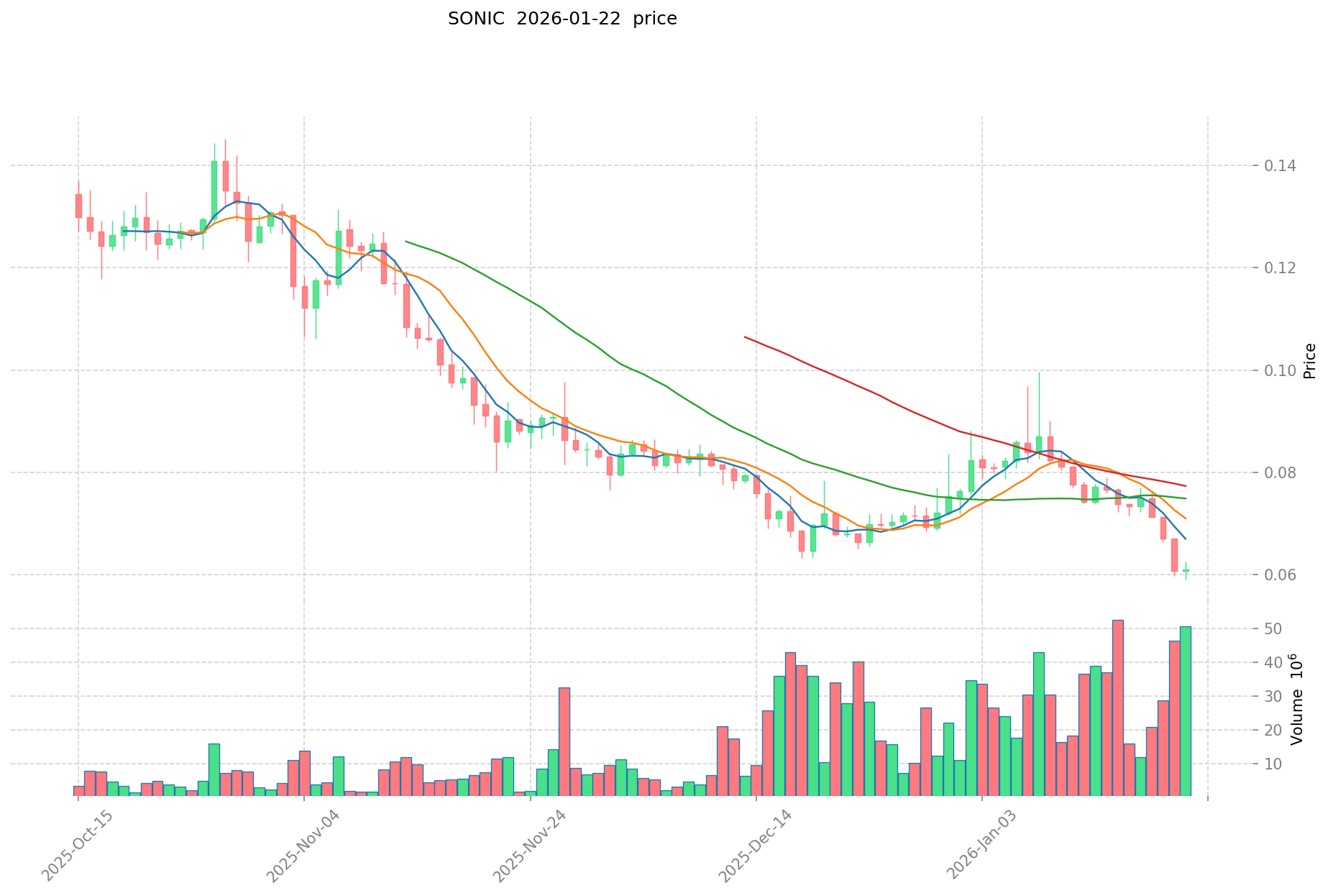
Price Fluctuations
Sonic SVM (SONIC) reached its all-time high of $1.225 on January 8, 2025, reflecting significant market interest during the period. The token subsequently experienced a notable decline, recording its lowest price of $0.03238 on October 10, 2025. As of the latest data, SONIC trades at approximately $0.05946, representing a 24-hour decrease of 2.46% and a 7-day decline of 18.37%. Over the past year, the token has experienced a substantial correction of 89.48% from its historical peak, illustrating the volatility inherent in emerging blockchain projects and shifting market sentiment.
Click to view the current SONIC market price
On-Chain Metrics
- Holder Distribution: The token currently has 44,302 holders, indicating a growing community base participating in the Sonic ecosystem.
- Market Capitalization: With a circulating market cap of approximately $21.41 million and a fully diluted valuation of $142.70 million, SONIC maintains a market cap to FDV ratio of 15%.
- 24-Hour Trading Volume: The token recorded a trading volume of approximately $2.75 million over the past 24 hours, demonstrating active market participation.
- Exchange Availability: SONIC is currently listed on 30 exchanges, providing diverse trading opportunities for market participants.
Sonic SVM Ecosystem Applications and Partners
Core Use Cases
Sonic SVM's ecosystem supports multiple applications:
- Gaming: The platform powers Web3 gaming applications, providing high-performance gaming infrastructure.
- Applications: Built with Sonic HyperGrid framework, enabling optimistic Solana rollups orchestration.
Strategic Collaborations
Sonic SVM focuses on building technical capabilities through its HyperGrid framework, designed to support the next generation of decentralized applications.
This framework provides a solid foundation for Sonic SVM's ecosystem expansion.
Controversies and Challenges
Sonic SVM faces the following challenges:
- Technical Challenges: As a newly launched SVM network extension, scalability and performance optimization remain ongoing priorities
- Market Volatility: Price fluctuations with a decline of approximately 89.48% over one year period
- Competitive Pressure: Competition from other Layer 2 solutions and blockchain platforms in the Solana ecosystem
These issues have sparked discussions within the community and market, while also driving Sonic SVM's continuous innovation.
Sonic SVM's community shows active participation, with over 44,302 holders.
On X platform, related posts and hashtags (such as #SonicSVM) generate regular engagement.
New feature releases and platform developments have ignited community enthusiasm.
Sentiment on X presents a mixed picture:
- Supporters praise Sonic SVM's innovative approach to SVM network extension and Web3 application infrastructure, viewing it as infrastructure for next-generation decentralized applications.
- Critics focus on price volatility and market performance concerns.
Recent trends show varied sentiment reflecting current market conditions.
Popular Topics
X users actively discuss Sonic SVM's technical framework, gaming applications, and market performance,
showcasing both its transformative potential and the challenges in achieving mainstream adoption.
- Official Website: Visit Sonic SVM Official Website for features, use cases, and latest updates.
- X Updates: On X platform, Sonic SVM maintains an active presence through @SonicSVM,
posts cover technical upgrades, community events, and development updates.
Sonic SVM Future Roadmap
- Ongoing Development: Continue enhancing HyperGrid framework capabilities, improving performance and scalability
- Ecosystem Goals: Support Web3 gaming and application development for next billion users
- Long-term Vision: Become leading SVM network extension infrastructure for Solana ecosystem
How to Participate in Sonic SVM?
- Purchase Channels: Purchase SONIC on Gate.com and other supporting exchanges
- Storage Solutions: Use compatible Solana wallets for secure storage
- Ecosystem Engagement: Visit developer documentation to explore building applications on Sonic SVM
- Community Participation: Follow official channels for updates and community activities
Summary
Sonic SVM represents innovation in blockchain technology as the first SVM network extension on Solana, offering optimized infrastructure for gaming and applications.
Its active community, technical framework, and market presence position it uniquely in the cryptocurrency space.
Despite facing market volatility and competitive challenges, Sonic SVM's innovative approach and clear development direction give it an important position in the future of decentralized technology.
Whether you are a newcomer or experienced participant, Sonic SVM deserves attention and engagement.
FAQ
What is SONIC cryptocurrency? What are its main features and characteristics?
SONIC is a high-performance Layer 1 blockchain designed for speed and scalability. Key features include ultra-fast transaction processing, low fees, EVM compatibility, and optimized consensus mechanism. It enables efficient smart contract execution and DeFi applications with enhanced throughput and user experience.
How to buy and store SONIC tokens?
Purchase SONIC tokens through major cryptocurrency platforms using fiat or other cryptocurrencies. Store them securely in a hardware wallet like Ledger or Trezor, or use reputable software wallets. Always enable two-factor authentication for account security.
What is SONIC project's technical architecture and development roadmap?
SONIC features a Layer 1 blockchain architecture optimized for speed and scalability, utilizing advanced consensus mechanisms. The roadmap includes network upgrades for enhanced throughput, DeFi protocol integration, cross-chain interoperability, and ecosystem expansion through developer incentives and institutional adoption initiatives.
What are the advantages and disadvantages of SONIC compared to mainstream public chains like Ethereum and Solana?
SONIC offers faster transaction speeds and lower fees through optimized consensus mechanisms. Advantages include high throughput and improved user experience. Disadvantages include smaller ecosystem and less developer adoption compared to Ethereum and Solana's established networks.
What risks exist with investing in SONIC and how should I evaluate them?
SONIC faces market volatility, liquidity risks, and technology adoption uncertainty. Evaluate by assessing ecosystem development, validator security, tokenomics sustainability, and market conditions. Monitor network growth metrics and competitive positioning regularly.
What are the ecosystem applications and partners of SONIC?
SONIC ecosystem includes DeFi protocols, NFT platforms, gaming applications, and partnerships with major blockchain infrastructure providers. Collaborations span across exchanges, wallets, and development frameworks, creating a comprehensive Web3 environment for users and developers.
* The information is not intended to be and does not constitute financial advice or any other recommendation of any sort offered or endorsed by Gate.