Sovryn (SOV) is a decentralized finance infrastructure built on Bitcoin via Rootstock, enabling non-custodial lending, margin trading, and permissionless smart contracts. Launched in 2021, Sovryn addresses Bitcoin's DeFi limitations by providing users financial sovereignty through Bitcoin's security model while maintaining full asset control. This comprehensive guide explores Sovryn's technical architecture, market metrics showing 49.18% circulating supply and current trading on Gate, ecosystem applications, and community dynamics. Covering core use cases, strategic partnerships, regulatory challenges, and scalability considerations, the article equips investors and developers with essential insights into Bitcoin-native DeFi adoption. Whether seeking investment opportunities or building on Sovryn's infrastructure, this analysis provides a complete overview of its positioning, performance, and participation methods.
Sovryn's Positioning and Significance
In 2021, the Sovryn team launched Sovryn (SOV), aiming to address the limitations of centralized financial services and the need for decentralized Bitcoin-based lending and trading solutions.
As a non-custodial and permissionless smart contract system, Sovryn plays a key role in decentralized finance (DeFi) on Bitcoin.
As of 2026, Sovryn has established itself as a decentralized financial infrastructure for Bitcoin, with an active development community.
This article will provide an in-depth analysis of its technical architecture, market performance, and future potential.
Origin and Development Journey
Background of Creation
Sovryn was created in 2021, aiming to solve the challenges of accessing decentralized financial services on Bitcoin and the inefficiencies of centralized lending and margin trading platforms.
It emerged during the rapid expansion of DeFi across blockchain ecosystems, with the goal of bringing decentralized lending, trading, and financial sovereignty to Bitcoin users to transform the landscape.
The launch of Sovryn brought new possibilities to Bitcoin holders and DeFi participants.
Important Milestones
- 2021: Mainnet launch on Rootstock (RSK), enabling Bitcoin-based smart contracts for lending and margin trading.
- The project has continued to develop its ecosystem, expanding its range of DeFi services and integrations.
With support from its community and development team, Sovryn continues to optimize its technology, security, and real-world applications.
How Does Sovryn Work?
No Central Control
Sovryn operates on a decentralized network of computers (nodes) distributed globally, free from control by banks or governments.
These nodes collaborate to verify transactions, ensuring the system remains transparent and resistant to attacks, granting users greater autonomy and enhancing network resilience.
Blockchain Core
Sovryn's blockchain infrastructure is built on Rootstock (RSK), a Bitcoin sidechain that enables smart contract functionality while maintaining Bitcoin's security model.
Transactions are recorded on a public, immutable digital ledger.
Transactions are grouped into blocks and linked through cryptographic hashing to form a secure chain.
Anyone can view the records, establishing trust without intermediaries.
The platform leverages Rootstock's sidechain architecture to enhance performance while maintaining security through Bitcoin's proof-of-work mechanism.
Ensuring Fairness
Sovryn relies on Bitcoin's Proof of Work (PoW) consensus mechanism through its connection to the Bitcoin network via Rootstock to validate transactions and prevent fraud such as double spending.
Bitcoin miners maintain network security through computational work, earning Bitcoin rewards.
The innovation includes bringing smart contract capabilities to Bitcoin while maintaining its security guarantees.
Secure Transactions
Sovryn uses public-private key cryptography to protect transactions:
- Private keys (similar to secret passwords) are used to sign transactions
- Public keys (similar to account numbers) are used to verify ownership
This mechanism ensures fund security, with transactions maintaining pseudonymity.
The platform's non-custodial nature ensures users retain full control of their assets at all times.
Circulation Overview
As of January 31, 2026, Sovryn's circulating supply is 49,181,069.02 SOV tokens, with a total supply of 100,000,000 SOV and a maximum supply capped at 100,000,000 SOV, representing a fixed supply model. The circulating supply accounts for approximately 49.18% of the total supply.
New tokens enter the market through predetermined distribution mechanisms that affect supply and demand dynamics. The token distribution supports various ecosystem participants and network development initiatives.
Price Fluctuation
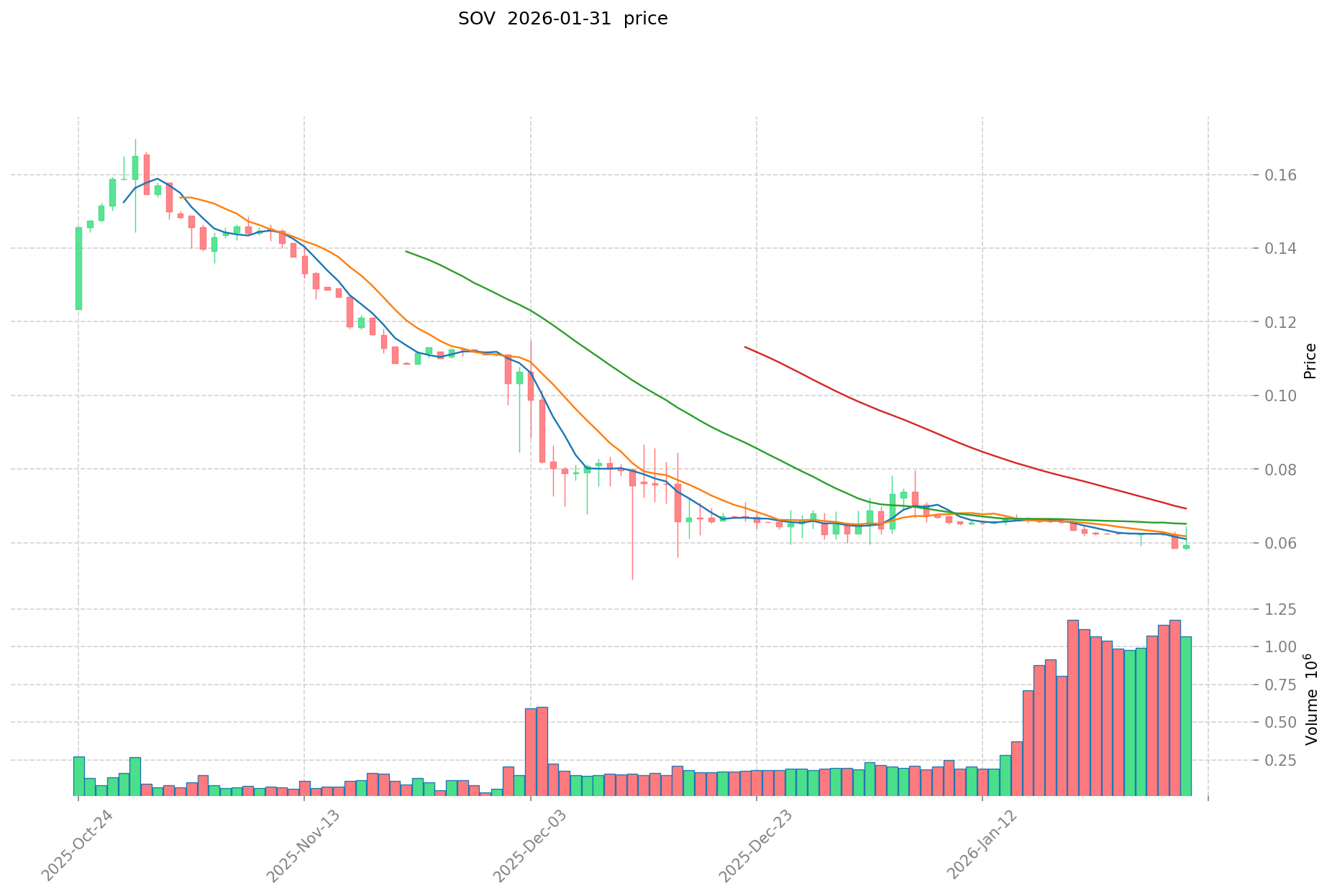
SOV reached a significant price point of $43.98 on October 7, 2021, driven by favorable market conditions during the broader cryptocurrency market expansion and increased interest in decentralized finance protocols built on Bitcoin.
The token experienced its lowest price of $0.01002593 on December 19, 2025, influenced by challenging market conditions and broader cryptocurrency market adjustments.
These price movements reflect shifts in market sentiment, evolving adoption patterns, and various external factors affecting the cryptocurrency sector. Recent price trends show a -7.67% change over 24 hours, with the token trading at $0.05931 as of the latest update.
Click to view current SOV market price
On-Chain Metrics
- Holder Count: 2,355 addresses (indicating user distribution and adoption)
- 24-Hour Trading Volume: $64,430.45 (reflecting current market activity)
- Market Capitalization: $2,916,929.20 (representing the current market valuation of circulating tokens)
Sovryn Ecosystem Applications and Partners
Core Use Cases
Sovryn's ecosystem supports multiple applications:
- DeFi: Sovryn protocol itself provides decentralized lending and margin trading on Bitcoin.
- Bitcoin DeFi Infrastructure: The platform enables non-custodial financial services directly on Bitcoin networks.
Strategic Partnerships
Sovryn operates on the Rootstock (RSK) network, leveraging Bitcoin's security for smart contract functionality.
These partnerships provide a solid foundation for Sovryn's ecosystem expansion.
Controversies and Challenges
Sovryn faces the following challenges:
- Technical Issues: Scalability limitations inherent to Bitcoin-based systems
- Regulatory Risks: Evolving DeFi regulations across different jurisdictions
- Competition Pressure: Competition from Ethereum-based DeFi protocols and emerging Layer 2 solutions
These issues have sparked discussions within the community and market, driving Sovryn's continuous innovation.
Sovryn's community demonstrates active participation, with 2,355 holders supporting the protocol.
On X platform, related posts and hashtags (such as #Sovryn) generate regular engagement.
Protocol updates and new feature releases have energized community enthusiasm.
Sentiment on X shows mixed perspectives:
- Supporters praise Sovryn's Bitcoin-native DeFi approach and non-custodial features, viewing it as "DeFi for Bitcoin maximalists".
- Critics focus on price volatility and liquidity challenges.
Recent trends indicate varied sentiment reflecting broader market conditions.
Trending Topics
X users discuss Sovryn's regulatory positioning, Bitcoin DeFi adoption, and protocol development,
showcasing both its transformative potential and obstacles toward mainstream adoption.
- Official Website: Visit Sovryn's official site for features, use cases, and latest updates.
- X Updates: On X platform, Sovryn maintains an active presence using @SovrynBTC,
with posts covering technical upgrades, community events, and protocol news.
Sovryn Future Roadmap
- Ongoing Development: Continuous enhancement of lending protocols and trading infrastructure, improving user experience and security
- Ecosystem Goals: Expansion of Bitcoin DeFi applications and user base
- Long-term Vision: Becoming the primary DeFi infrastructure for Bitcoin
How to Participate in Sovryn?
- Purchase Options: Buy SOV on supported exchanges including Gate.com
- Storage Solutions: Store securely using compatible wallets that support Ethereum and Rootstock networks
- Participate in Governance: Engage in community decisions through governance mechanisms
- Build the Ecosystem: Visit Sovryn's GitHub to develop applications or contribute code
Summary
Sovryn redefines Bitcoin-based DeFi through smart contract technology, providing non-custodial lending, margin trading, and decentralized financial services.
Its engaged community, robust resources, and Bitcoin-native approach distinguish it in the cryptocurrency landscape.
Despite facing regulatory uncertainties and technical scalability challenges, Sovryn's innovative spirit and clear development path position it as a notable player in decentralized Bitcoin finance.
Whether you're a newcomer or experienced participant, Sovryn offers interesting opportunities in the Bitcoin DeFi space.
FAQ
What is Crypto SOV (Store of Value)? What are its core characteristics?
Crypto SOV refers to cryptocurrencies functioning as long-term value storage tools. Core characteristics include predictable monetary policy, minimal inflation rate, and scarcity. SOV assets serve as hedge instruments, with those featuring the lowest inflation rates most likely to succeed as dominant value stores in the crypto ecosystem.
Which is more suitable between Bitcoin and Ethereum for the definition of SOV?
Bitcoin is the primary SOV, designed specifically as a store of value with fixed supply. Ethereum serves multiple functions but increasingly acts as SOV through staking and reducing supply, making both valid SOV assets with different characteristics.
What is the difference between Crypto SOV, stablecoins, and payment coins?
Crypto SOV features hard supply caps ensuring scarcity-driven value, while stablecoins and payment coins are freely issued and pegged to fiat or assets. SOV prioritizes monetary properties through immutable limits.
Why do some people consider Bitcoin the best SOV asset?
Bitcoin is viewed as the best SOV asset due to its complete decentralization, fixed supply of 21 million coins, and strong inflation resistance. It operates without government or institutional control, protecting financial sovereignty and transaction freedom, embodying Sound Money principles.
SOV crypto assets require strong security, stable value appreciation potential, and broad market adoption to serve as effective value storage tools. Additionally, they need sufficient transaction volume, limited supply mechanisms, and institutional recognition to maintain long-term purchasing power and utility.
What are the risks and advantages of SOV in cryptocurrency investment?
SOV offers growth potential through its tokenomics and DeFi ecosystem. Risks include price volatility, regulatory uncertainty, and market competition. Investors should evaluate token distribution transparency and long-term sustainability before participating.
* The information is not intended to be and does not constitute financial advice or any other recommendation of any sort offered or endorsed by Gate.