Spectral (SPEC) is a pioneering AI-powered onchain autonomous agent platform launched in 2024 to democratize blockchain development by converting natural language into production-grade Solidity smart contracts. This comprehensive guide explores SPEC's technical architecture built on Ethereum's ERC-20 standard, market performance metrics including a circulating supply of 9 million tokens out of 100 million total, and current trading availability on Gate.com. The article covers SPEC's core use cases in smart contract automation, DeFi arbitrage agents, NFT creation, and Layer 2 infrastructure development. With 6,299 token holders and recent 24-hour trading volume of $329,141, SPEC addresses critical barriers to Web3 adoption by eliminating complex coding requirements. This guide details tokenomics, on-chain metrics, ecosystem applications, investment participation methods, and the platform's role in the emerging Agent Economy, providing investors and developers essential insights into this innovative blockchain
Spectral's Positioning and Significance
In 2024, Spectral Labs launched Spectral (SPEC), aimed at addressing inefficiencies in smart contract development and the technical barriers preventing wider Web3 adoption.
As a pioneering onchain autonomous agent platform, Spectral plays a crucial role in blockchain development, DeFi automation, and the emerging Agent Economy.
As of 2026, Spectral has established itself as an innovative solution in the Web3 development ecosystem, with 6,299 holders and an active developer community.
This article will provide an in-depth analysis of its technical architecture, market performance, and future potential.
Origin and Development History
Birth Background
Spectral was created by Spectral Labs in 2024, aiming to solve the complexity of smart contract development and the technical expertise required for blockchain deployment.
It emerged during the rapid expansion of Web3 infrastructure and the growing demand for AI-driven automation, with the goal of democratizing blockchain development through natural language processing and transforming the development landscape.
Spectral's launch brought entirely new possibilities for developers, enterprises, and individuals seeking to deploy blockchain solutions.
Important Milestones
- May 2024: Token launched on Gate.com, establishing initial market presence with a listing price of $2.3.
- November 2024: Token experienced significant market activity, reaching a peak price of $18.673.
- 2025-2026: The platform evolved its natural language to Solidity conversion capabilities, enabling production-grade smart contract generation.
- January 2026: Token achieved its lowest recorded price of $0.073, representing a period of market consolidation.
With the support of Spectral Labs and its development community, Spectral continues to refine its technology, security features, and real-world applications.
How Spectral Works
No Central Control
Spectral operates on a decentralized network of computers (nodes) distributed globally, free from control by banks or governments.
These nodes collaborate to validate transactions, ensuring system transparency and attack resistance, granting users greater autonomy and enhancing network resilience.
Blockchain Foundation
Spectral's blockchain is a public, immutable digital ledger that records every transaction.
Transactions are grouped into blocks and linked through cryptographic hashes to form a secure chain.
Anyone can view the records, establishing trust without intermediaries.
The platform's unique architecture leverages ERC-20 standard on the Ethereum network, ensuring compatibility and interoperability within the broader Web3 ecosystem.
Ensuring Fairness
Spectral operates within the Ethereum network's Proof of Stake (PoS) consensus mechanism to validate transactions and prevent fraudulent activities such as double-spending.
Ethereum validators maintain network security through staking ETH and validating blocks, earning rewards in the process.
The platform's innovation lies in its natural language processing capabilities that convert human-readable instructions into production-grade Solidity code, reducing development time and technical barriers.
Secure Transactions
Spectral utilizes public-private key cryptography to protect transactions:
- Private keys (like secret passwords) are used to sign transactions
- Public keys (like account numbers) are used to verify ownership
This mechanism ensures fund security while maintaining pseudonymous transaction privacy.
The platform builds upon Ethereum's proven security infrastructure, benefiting from the network's robust validation mechanisms and established track record.
Circulating Supply Overview
As of February 1, 2026, Spectral (SPEC) has a circulating supply of 9,000,000 tokens, with a total supply of 100,000,000 tokens and a maximum supply capped at 100,000,000 tokens, indicating a fixed supply model.
The circulating supply represents 9% of the total supply, suggesting a controlled token release strategy that may influence supply and demand dynamics over time.
Price Volatility
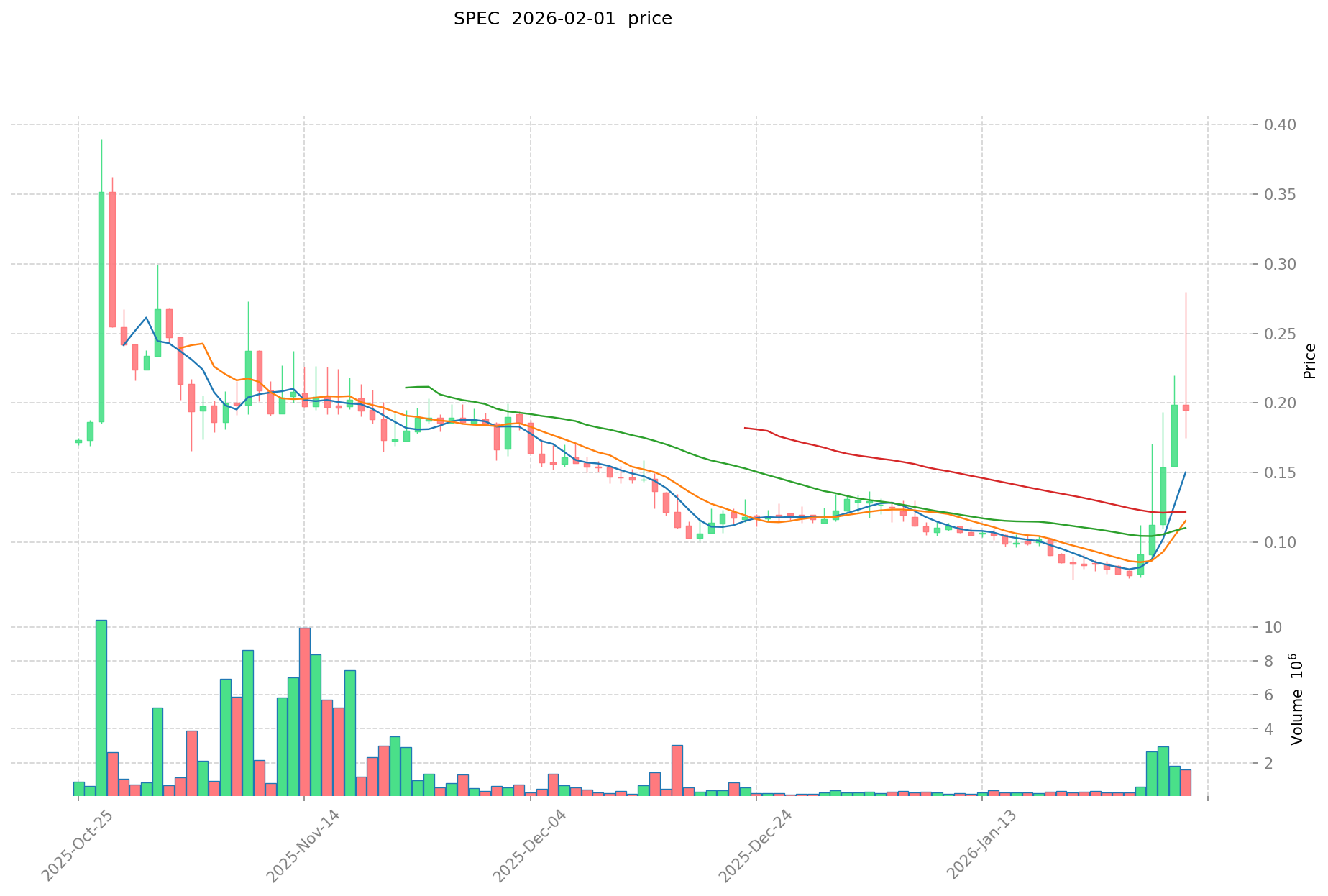
Spectral (SPEC) reached its peak price of $18.673 on November 30, 2024, reflecting significant market interest during that period.
The token's lowest recorded price was $0.073, which occurred on January 21, 2026, demonstrating considerable price volatility.
As of the latest data, SPEC is trading at $0.21943, showing a 12.63% increase over the past 24 hours, a 175.22% gain over the past 7 days, and an 80.17% increase over the past 30 days. However, the token has experienced a 95.69% decline over the past year, reflecting broader market dynamics and sentiment shifts.
These price movements illustrate the influence of market conditions, adoption trends, and various external factors on the token's valuation.
Click to view the current SPEC market price
On-Chain Metrics
- Token Holders: Approximately 6,299 addresses hold SPEC tokens, indicating the level of token distribution and community participation
- 24-Hour Trading Volume: $329,141.48, demonstrating current market activity and liquidity levels
- Market Capitalization: $1,974,870, representing the token's current market valuation based on circulating supply
Spectral Ecosystem Applications and Partners
Core Use Cases
Spectral's ecosystem supports multiple application scenarios:
- Smart Contract Development: Through natural language processing technology, Spectral converts natural language into Solidity code, enabling automated generation of production-grade smart contracts.
- DeFi Applications: Spectral powers arbitrage agents that facilitate automated trading strategies in decentralized finance.
- NFT Creation: The platform supports NFT generation, streamlining the process of creating digital collectibles.
- Infrastructure Development: Spectral enables the deployment of rollups and other Layer 2 solutions, contributing to blockchain scalability.
Spectral marks the manifestation of the Agent Economy in Web3, bridging the gap between non-technical users and blockchain development.
Strategic Partnerships
While specific partnership details are not extensively documented in the available materials, Spectral's integration with the Ethereum ecosystem demonstrates its commitment to working within established blockchain infrastructure. The project's focus on Solidity code generation positions it as a complementary tool for the broader Ethereum developer community.
Challenges and Discussions
Spectral faces several considerations:
- Technical Evolution: As an emerging platform in the AI-agent space, Spectral continues to refine its natural language to code conversion accuracy and security features.
- Market Volatility: The token has experienced price fluctuations, with a 1-year change of -95.69%, reflecting broader market dynamics and the challenges of establishing product-market fit in the competitive blockchain infrastructure space.
- Competition Landscape: The intersection of AI and blockchain attracts numerous projects, requiring Spectral to continuously innovate to maintain its position.
These factors contribute to ongoing discussions within the community about the project's development trajectory and long-term sustainability.
Spectral maintains an active presence in the Web3 space with 6,299 token holders as of February 2026. The project demonstrates notable trading activity with a 24-hour volume of approximately $329,141.
Recent market performance shows significant short-term interest, with a 7-day price change of 175.22% and a 24-hour increase of 12.63%, indicating heightened community engagement during specific periods.
On X platform, Spectral Labs maintains an official presence at @Spectral_Labs, where the team shares updates about:
- Product development milestones
- Technical innovations in AI-agent technology
- Community initiatives and engagement activities
The platform's focus on making blockchain development accessible through natural language processing resonates with developers seeking to lower technical barriers.
Discussion Topics
Community discussions often center on:
- The practical applications of AI-generated smart contracts
- Security considerations for automated code generation
- The broader implications of autonomous agents in the Web3 ecosystem
- Price dynamics and market positioning within the competitive landscape
These conversations reflect both enthusiasm for the technology's potential and awareness of the challenges facing early-stage blockchain infrastructure projects.
- Official Website: Visit Spectral Labs official site for features, use cases, and latest updates.
- X Platform: Follow Spectral Labs at @Spectral_Labs for technology updates, community activities, and partnership announcements.
- Blockchain Explorer: Track on-chain activity at Etherscan to monitor transactions and smart contract interactions.
Spectral Future Roadmap
While specific future milestones are not detailed in the current materials, Spectral's vision centers on:
- Expanding the capabilities of natural language to Solidity code conversion
- Enhancing the Agent Economy infrastructure in Web3
- Supporting the development of autonomous agents for various blockchain applications
- Growing the ecosystem of developers and users leveraging AI-powered smart contract generation
How to Participate in Spectral?
- Purchase Options: Spectral (SPEC) is available on Gate.com and other cryptocurrency exchanges, with 8 exchanges currently supporting trading.
- Storage Solutions: As an ERC-20 token on Ethereum, SPEC can be stored in Ethereum-compatible wallets such as MetaMask or hardware wallets.
- Contract Address: 0xAdF7C35560035944e805D98fF17d58CDe2449389 (Ethereum)
- Ecosystem Participation: Visit the official website to explore tools for generating smart contracts and participating in the Agent Economy.
Summary
Spectral represents an innovative approach to blockchain development by leveraging AI to convert natural language into Solidity code. This technology aims to democratize smart contract creation, enabling individuals and enterprises to deploy production-grade contracts, arbitrage agents, NFTs, and rollups without extensive coding expertise.
With a total supply of 100 million tokens and 9 million currently in circulation (9% of maximum supply), SPEC maintains a presence in the market with a fully diluted market cap of approximately $21.9 million as of February 1, 2026.
Despite facing market volatility and competitive pressures common to emerging blockchain infrastructure projects, Spectral's focus on the Agent Economy positions it at the intersection of AI and Web3 innovation. The project's commitment to lowering technical barriers for blockchain development addresses a significant need in the ecosystem.
Whether you are a developer seeking to streamline smart contract creation or an enthusiast interested in AI-powered blockchain solutions, Spectral offers a unique value proposition worth exploring. As with any cryptocurrency investment or participation, thorough research and understanding of associated considerations are essential.
FAQ
What is SPEC crypto and what does it do?
SPEC is a decentralized oracle token that leverages AI and machine learning to enhance blockchain and DeFi operations. It provides real-time data insights and predictive analytics to improve smart contract functionality and decision-making across Web3 protocols.
How can I buy and store SPEC tokens?
To buy SPEC tokens, create an account, purchase USDT or another stablecoin, and swap it for SPEC. Store your tokens securely in a Web3 wallet like MetaMask or a hardware wallet for maximum security.
What is the total supply and tokenomics of SPEC?
SPEC has a total supply of 100 million tokens. The current market cap is $2.56 million with a fully diluted valuation of $12.42 million, reflecting the token's distribution and economic model.
Is SPEC a safe investment and what are the main risks?
SPEC offers growth potential but carries market volatility risks. Key concerns include price fluctuation, liquidity changes, and regulatory shifts. Success depends on market conditions and individual risk tolerance. Conduct thorough research before investing.
What is the difference between SPEC and other similar cryptocurrency projects?
SPEC focuses on establishing unified standards and protocols for Web3 development, distinguishing it from projects emphasizing utility or asset value. Its framework-based approach creates a structured foundation for decentralized applications, offering clearer interoperability than comparable projects.
Who are the team members and backers behind the SPEC project?
The SPEC project is led by a dedicated Food Team supported by community backers, including local businesses and government entities, focusing on food security initiatives across the community.
What is the roadmap and future development plan for SPEC?
SPEC's roadmap focuses on enhancing automation, continuous integration, and strategic ecosystem expansion. Development priorities include scaling infrastructure, improving user experience, and launching innovative features to strengthen market position through 2026 and beyond.
* The information is not intended to be and does not constitute financial advice or any other recommendation of any sort offered or endorsed by Gate.