SQUID is a meme token launched on Binance Smart Chain in 2021, inspired by Netflix's Squid Game series, designed to bridge entertainment IP with blockchain gaming through a play-to-earn model. After the original token collapsed, the community initiated a rescue effort, relaunching with a new contract via Gate.com's 1:1 conversion. As of January 2026, SQUID maintains 101,813 holders and 800 million tokens in circulation with a market cap of $2.85 million. Operating on BSC's Proof of Staked Authority consensus, SQUID ensures secure, transparent transactions through BEP-20 standard implementation. The article covers SQUID's positioning and development history, technical infrastructure, market performance including historical price volatility, ecosystem applications, community engagement, and participation methods. SQUID exemplifies both cryptocurrency risks and community resilience, offering valuable insights into meme coin dynamics and decentralized recovery initiatives within evolving crypto ecosystems.
SQUID's Positioning and Significance
In 2021, the SQUID development team launched Squid Game (SQUID), initially positioned as a meme token on the Binance Smart Chain (BSC) inspired by the popular Netflix series of the same name. The project aimed to address entertainment and engagement gaps in the cryptocurrency space by introducing a play-to-earn gaming model.
As a meme-driven community token, SQUID operates within the gaming and entertainment sectors of the crypto ecosystem. Following a community-led rescue initiative after the original token's collapse, the project was restructured with a new contract provided by squidao.org, with Gate.com supporting the transition through a 1:1 token conversion.
As of January 2026, SQUID maintains a presence in the crypto market with 101,813 holders and a circulating supply of 800,000,000 tokens. The project continues to evolve under community governance, representing lessons learned in tokenomics and community resilience.
Origin and Development History
Birth Background
Squid Game was created by its development team in 2021, emerging during the height of the Netflix series' global popularity. The project sought to capitalize on meme culture and entertainment-based token models while promising to deliver a play-to-earn gaming experience.
It emerged within the 2021 meme token boom on BSC, with the goal of bridging entertainment IP with blockchain gaming. The token's launch reflected the intersection of pop culture and cryptocurrency experimentation, targeting entertainment enthusiasts and speculative traders.
Important Milestones
- October 2021: Initial token launch on Binance Smart Chain with BEP-20 standard implementation
- November 2021: Experienced significant volatility, reaching a peak price before collapsing
- Post-2021: Community-led rescue initiative implemented, with Gate.com facilitating 1:1 conversion to new token contract
- 2022-2026: Continued operation under revised tokenomics and community governance structure
Under community governance and the squidao.org framework, SQUID has focused on rebuilding trust through transparency and sustainable development practices.
How SQUID Works
No Central Control
SQUID operates on the Binance Smart Chain, a decentralized network of nodes distributed globally, removing reliance on traditional centralized authorities.
These nodes collaborate to validate transactions, ensuring system transparency and resistance to single points of failure, empowering users with greater autonomy while enhancing network resilience.
Blockchain Core
SQUID's blockchain infrastructure leverages BSC's public, immutable digital ledger that records every transaction.
Transactions are grouped into blocks and linked through cryptographic hashing to form a secure chain. Anyone can view these records, establishing trust without intermediaries.
The BEP-20 token standard provides compatibility with the broader BSC ecosystem, enabling integration with wallets, exchanges, and decentralized applications.
Ensuring Fairness
SQUID relies on BSC's Proof of Staked Authority (PoSA) consensus mechanism, which combines elements of Proof of Stake and Proof of Authority to validate transactions and prevent fraudulent activities such as double-spending.
Validators on BSC maintain network security through staking and block production, receiving rewards for their participation. This approach offers improved energy efficiency and higher transaction throughput compared to traditional Proof of Work systems.
Secure Transactions
SQUID utilizes public-private key cryptography to protect transactions:
- Private keys (similar to secret passwords) are used to sign transactions
- Public keys (similar to account numbers) are used to verify ownership
This mechanism ensures fund security while transactions maintain pseudonymous privacy characteristics typical of blockchain systems. The BEP-20 standard implementation ensures compatibility with standard wallet security features including multi-signature support where applicable.
Circulation Overview
As of January 31, 2026, the circulating supply of SQUID is 800,000,000 tokens, with a total supply of 800,000,000 tokens, representing a fixed supply model with 100% of tokens already in circulation.
The token operates on the Binance Smart Chain (BSC) with a BEP-20 standard, with all tokens already released to the market. The complete circulation indicates no additional token issuance mechanisms are currently active.
Price Fluctuations
SQUID reached a notable price level of $0.251228 on November 19, 2021, during a period of heightened market interest in meme tokens and media-related cryptocurrency projects.
The token's lowest recorded price was $0.00000896, occurring on March 24, 2025, reflecting broader market corrections and shifts in meme token sentiment.
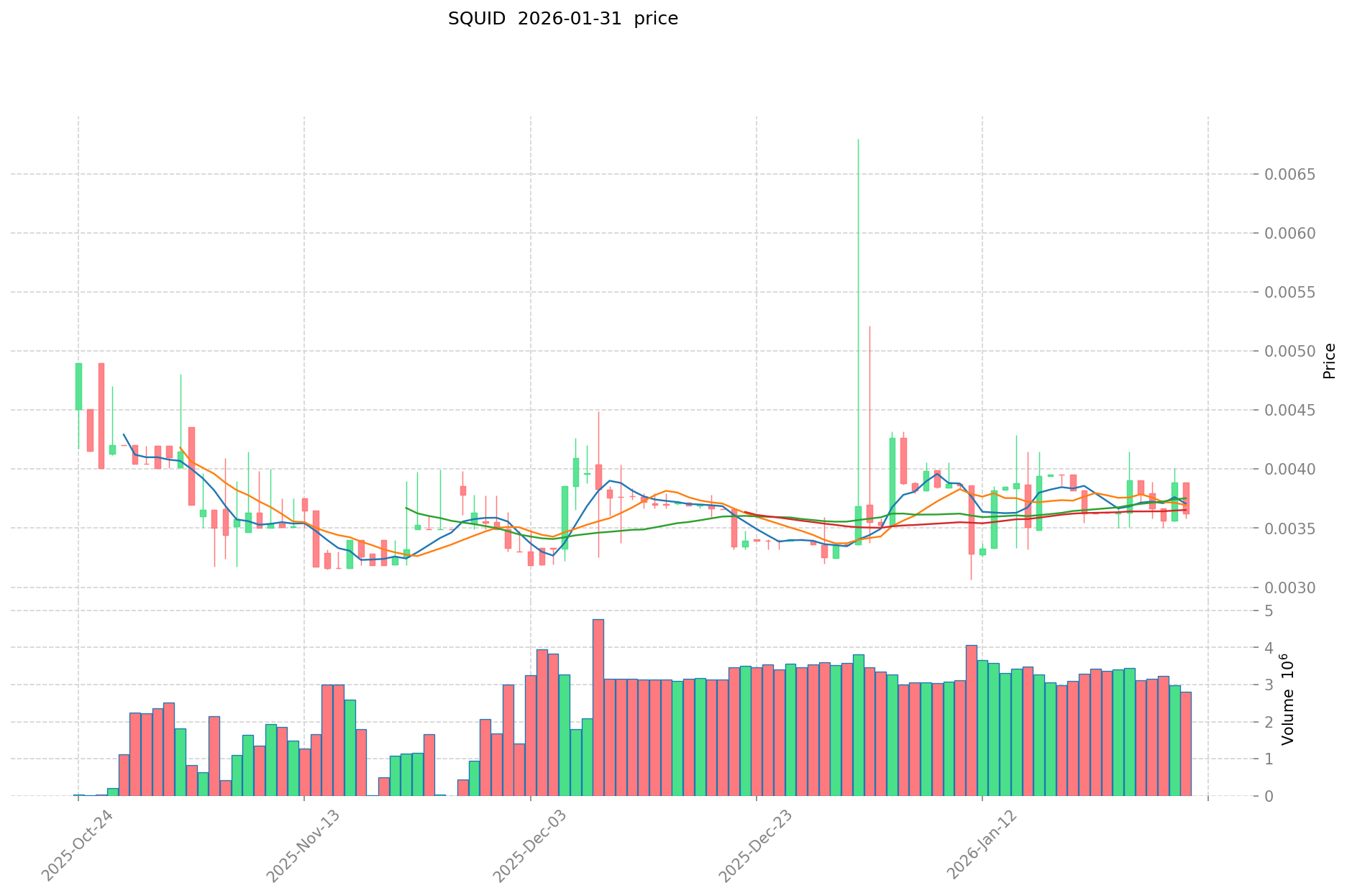
These price movements illustrate the volatility characteristic of meme tokens, influenced by market sentiment, community engagement, and broader cryptocurrency market trends. Over the past year, SQUID has experienced a price decline of approximately 25.67%, while showing a 6.11% increase over the past 30 days.
Click to view current SQUID market price
On-Chain Metrics
- Holder Count: 101,813 addresses (indicating community distribution and adoption levels)
- 24-Hour Trading Volume: $10,777.54 (reflecting current market activity and liquidity)
- Market Capitalization: $2,847,200 (representing 0.000095% market dominance in the cryptocurrency sector)
SQUID Ecosystem Applications and Partners
Core Use Cases
SQUID's ecosystem is centered around its roots as a meme coin on the Binance Smart Chain (BSC). The token was initially launched with the promise of developing a play-to-earn game inspired by the popular Netflix series of the same name. Following a community-led rescue initiative, the token has been relaunched with new contract code to ensure improved security and community governance.
Strategic Partnerships
As of the available information, specific strategic partnerships have not been disclosed. The project's focus remains on community-driven development and restoring trust within its ecosystem following its relaunch.
Controversies and Challenges
SQUID has faced significant challenges:
- Historical Incident: The original token experienced a dramatic collapse after surging thousands of times in value, leading to substantial losses for holders. This incident sparked widespread discussion about security and transparency in meme coin projects.
- Community Recovery: Token holders initiated a community self-rescue effort, working with Gate.com to relaunch the token with a 1:1 conversion using new contract code provided by squidao.org.
- Market Volatility: The token has experienced considerable price fluctuations, with a 24-hour change of -8.48% and a one-year decline of -25.67%.
- Trust Restoration: Rebuilding community confidence remains an ongoing challenge following the original token's collapse.
These challenges have prompted the community to focus on transparency and improved governance structures.
SQUID maintains an active community with approximately 101,813 holders as of January 31, 2026. The token's presence on the Binance Smart Chain enables efficient transactions and community participation.
The SQUID community maintains activity on X platform through their official handle. Community discussions often center around:
- Recovery and rebuilding efforts following the relaunch
- Price movements and market dynamics
- Future development plans and governance decisions
Popular Topics
X users frequently discuss SQUID's journey from collapse to community-led recovery, highlighting both the risks inherent in meme coin investments and the resilience of decentralized communities in addressing challenges.
- Official Website: Visit SQUID's official site for updates and community resources.
- White Paper: Access the SQUID whitepaper for detailed information about the project's vision and technical structure.
- X Platform: Follow SQUID's official X account @SquidCto for community updates and announcements.
- Blockchain Explorer: View transactions and contract details on BSCScan.
SQUID Future Roadmap
Specific detailed roadmap milestones have not been provided in the available materials. The project's immediate focus appears to be on:
- Stabilizing the token economy following the relaunch
- Building community trust through transparent governance
- Developing the originally promised play-to-earn gaming platform
How to Participate in SQUID?
- Purchase Options: SQUID is available for trading on Gate.com
- Storage Solutions: Store SQUID securely using BSC-compatible wallets such as MetaMask or Trust Wallet
- Community Engagement: Participate in community discussions through official social media channels
- Contract Details: The token operates on BSC with the contract address 0x87230146E138d3F296a9a77e497A2A83012e9Bc5
Summary
SQUID represents a unique case study in the cryptocurrency space, demonstrating both the risks and resilience within decentralized communities. Following a significant setback with the original token, the community-led recovery effort has resulted in a relaunched token with improved security measures. With a circulating supply of 800 million tokens and a current market cap of approximately $2.85 million, SQUID continues to operate as a meme coin on the Binance Smart Chain. While the project faces ongoing challenges in restoring trust and achieving its original vision of a play-to-earn gaming platform, the active community of over 100,000 holders demonstrates continued interest. Whether you are exploring meme coins or interested in community-driven recovery projects, SQUID offers insights into the evolving dynamics of cryptocurrency ecosystems.
FAQ
What is Crypto SQUID and how does it work?
Crypto SQUID is a cross-chain liquidity router enabling users to swap assets between different blockchains. It identifies the most efficient paths for asset transfers and is built on Axelar Network for seamless interoperability across chains.
What is the purpose and use case of SQUID token?
SQUID token serves as an in-game currency within its gaming platform ecosystem. It facilitates in-game transactions and rewards for players participating in the platform's gaming activities and entertainment features.
Is SQUID a legitimate project and what are the risks associated with it?
SQUID is a legitimate cryptocurrency project. Main risks include high market volatility, potential price fluctuations, and regulatory uncertainties across different jurisdictions that may impact its value and operations.
How can I buy and store SQUID tokens?
You can purchase SQUID tokens on centralized exchanges using debit/credit cards, bank transfers, or peer-to-peer trading. Store them securely in your exchange wallet or transfer to a personal crypto wallet for enhanced security.
What is the difference between SQUID and other gaming or entertainment-focused cryptocurrencies?
SQUID distinguishes itself through its integrated play-to-earn mechanism, allowing users to earn tokens directly by participating in games. Unlike traditional gaming cryptocurrencies focusing on financial transactions, SQUID embeds earning opportunities into actual gameplay, creating a more immersive and rewarding gaming experience for participants.
What is the tokenomics and supply of SQUID?
SQUID has a maximum supply of 88,000,000 tokens. The tokenomics structure includes deflationary mechanisms designed to support long-term value retention and community-driven governance participation throughout the ecosystem.
* The information is not intended to be and does not constitute financial advice or any other recommendation of any sort offered or endorsed by Gate.