SSV Network is a decentralized validator technology protocol addressing security challenges in Ethereum staking through Secret Shared Validators (SSV) technology. Evolved from Blox in 2021, it eliminates single points of failure by distributing validator keys across multiple non-trusting operators. The network features a fixed circulating supply of 14.7 million tokens, trading on 28 exchanges including Gate with dynamic market valuations. SSV Network provides fault-tolerant staking infrastructure, enhanced security through cryptographic key splitting, and transparent on-chain operations. With 7,150 token holders and active community engagement, it serves as critical infrastructure for Ethereum's decentralization. Despite market volatility and technical complexity challenges, SSV Network continues advancing distributed validator adoption and ecosystem expansion.
SSV Network's Positioning and Significance
In 2021, the SSV Network team launched SSV Network (SSV), aiming to address the security challenges and centralization risks in Ethereum staking validation.
As a decentralized validator technology protocol utilizing Secret Shared Validators (SSV) technology, SSV Network plays a critical role in Ethereum staking and validator infrastructure.
As of 2026, SSV Network has become an important component of the Ethereum staking ecosystem, with an active developer community and ongoing protocol development.
This article will provide an in-depth analysis of its technical architecture, market performance, and future potential.
Origin and Development History
Birth Background
SSV Network evolved from Blox (CDT) and was created by its development team in 2021, aiming to solve security vulnerabilities and single-point-of-failure risks in traditional Ethereum validator operations.
It emerged during the rapid growth phase of Ethereum 2.0 staking, with the goal of providing a secure and robust method to split validator keys across untrusted nodes or operators to transform the current state.
The launch of SSV Network brought new possibilities for Ethereum stakers and validator operators.
Important Milestones
- 2021: Brand upgrade from Blox (CDT) to SSV Network (SSV), with token conversion at a ratio of 100 CDT = 1 SSV.
- Ongoing: Continuous optimization of the Secret Shared Validators technology to enhance distributed validator key management security.
- Development Phase: Ecosystem expansion with increasing adoption by staking service providers and institutional validators.
With support from the SSV Network community and foundation, SSV Network continues to optimize its technology, security, and real-world applications.
How Does SSV Network Operate?
No Central Control
SSV Network operates on a decentralized network of computers (nodes) distributed globally, free from control by banks or governments.
These nodes collaborate to validate transactions, ensuring system transparency and attack resistance, granting users greater autonomy and improving network resilience.
Blockchain Core
SSV Network's blockchain is a public, immutable digital ledger that records every transaction.
Transactions are grouped into blocks and linked through cryptographic hashes to form a secure chain.
Anyone can view the records, establishing trust without intermediaries.
The distributed validator technology further enhances network security and decentralization.
Ensuring Fairness
SSV Network utilizes Secret Shared Validators (SSV) technology to validate transactions and prevent fraud such as double-spending.
Validator operators maintain network security by running distributed validator nodes and managing split validator keys, earning SSV rewards.
Its innovation includes enhanced security through multi-operator validator key distribution and reduced single-point-of-failure risks.
Secure Transactions
SSV Network uses public-private key cryptography to protect transactions:
- Private key (like a secret password) is used to sign transactions
- Public key (like an account number) is used to verify ownership
This mechanism ensures fund security while maintaining transaction pseudonymity.
The protocol's distributed validator key management adds an additional security layer, preventing validator key compromise through multi-operator secret sharing.
Circulating Supply Overview
As of January 19, 2026, SSV Network's circulating supply stands at 14,699,173.1 tokens, with a total supply of 14,699,173.1 tokens. The circulating supply represents 100% of the total supply, indicating that all tokens are currently in circulation. SSV Network originated from a brand upgrade of Blox (CDT), with tokens distributed at a ratio of 100 CDT = 1 SSV.
Price Volatility
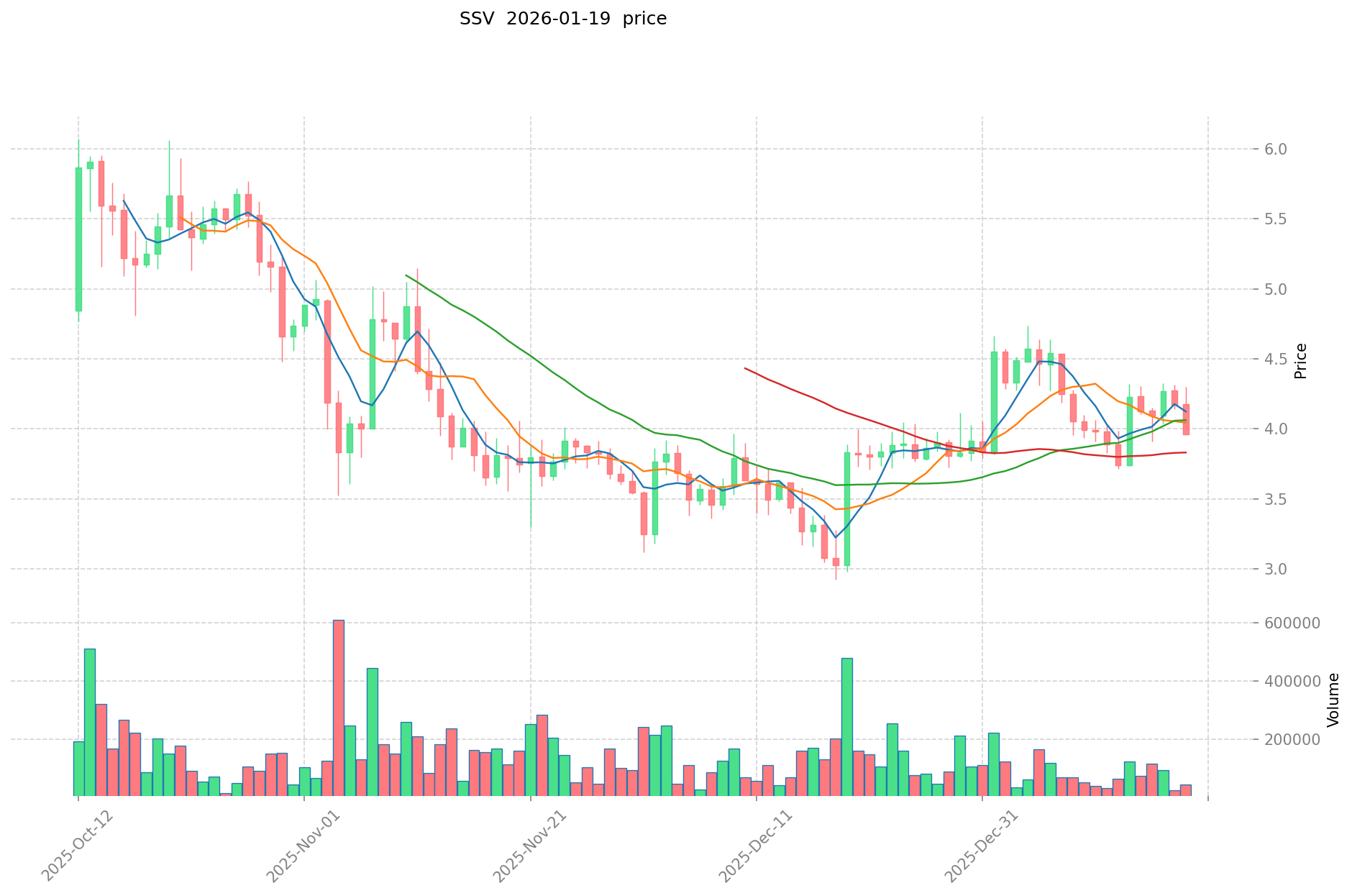
SSV Network reached a notable price point of $65.82 on March 25, 2024, driven by favorable market conditions during that period. The token experienced its lower price point of $2.65 on October 11, 2025, reflecting broader market adjustments and changing sentiment in the cryptocurrency sector. These price movements demonstrate the dynamic nature of the token's valuation in response to market forces and ecosystem developments.
Click to view current SSV market price
On-Chain Metrics
- Token Holders: 7,150 addresses hold SSV tokens, indicating the current level of distribution across the network
- Exchange Listings: The token is available on 28 different exchanges, providing accessibility for users
- 24-Hour Trading Volume: $255,543.49, reflecting recent market activity
- Market Capitalization: $54,019,461.14, representing the current valuation based on circulating supply
SSV Network Ecosystem Applications and Partners
Core Use Cases
SSV Network's ecosystem supports multiple applications:
- Ethereum Staking Infrastructure: SSV Network provides distributed validator technology (DVT), enabling secure validator key management across multiple non-trusting operators.
- Decentralized Staking Solutions: The network facilitates fault-tolerant validator operations, reducing single points of failure in ETH staking.
Strategic Partnerships
SSV Network has established collaborations with various stakeholders in the Ethereum ecosystem, enhancing its technical capabilities and market presence.
These partnerships provide a solid foundation for SSV Network's ecosystem expansion.
Controversies and Challenges
SSV Network faces the following challenges:
- Technical Complexity: Implementation of distributed validator technology requires sophisticated coordination mechanisms
- Market Competition: Other staking infrastructure solutions compete for validator adoption
- Network Effects: Building sufficient operator diversity remains an ongoing effort
These issues have sparked discussions within the community and market, driving SSV Network's continuous innovation.
SSV Network's community demonstrates active participation, with a circulating supply of 14.7 million SSV tokens.
On X platform, related posts and hashtags (such as #SSV) generate regular engagement.
Technical developments and validator adoption milestones have energized community enthusiasm.
Sentiment on X shows varied perspectives:
- Supporters praise SSV Network's distributed validator technology and contribution to Ethereum's decentralization, viewing it as essential infrastructure for secure staking.
- Critics focus on price volatility and technical complexity of implementation.
Recent trends reflect mixed sentiment amid broader market conditions.
Popular Topics
X users discuss SSV Network's validator economics, operator incentives, and role in Ethereum's staking landscape,
showcasing both its transformative potential and challenges in achieving widespread adoption.
- Official Website: Visit SSV Network Official Site for features, use cases, and latest updates.
- X Updates: On X platform, SSV Network maintains an active presence at @ssv_network,
with posts covering technical upgrades, community events, and ecosystem developments.
SSV Network Future Roadmap
- Ongoing Development: Continued enhancement of distributed validator technology, improving network resilience and operator experience
- Ecosystem Goals: Expand validator adoption and operator network diversity
- Long-term Vision: Establish SSV as critical infrastructure for Ethereum staking decentralization
How to Participate in SSV Network?
- Purchase Channels: Buy SSV on Gate.com and other cryptocurrency exchanges
- Storage Solutions: Securely store SSV using compatible wallets
- Governance Participation: Engage in community governance through SSV's governance mechanisms
- Ecosystem Building: Visit developer documentation to explore integration opportunities
Summary
SSV Network leverages distributed validator technology to redefine Ethereum staking infrastructure, offering enhanced security, fault tolerance, and decentralization.
Its active community, technical innovation, and market presence position it uniquely in the cryptocurrency landscape.
Despite facing market volatility and technical implementation challenges, SSV Network's commitment to advancing Ethereum's staking infrastructure ensures its relevance in decentralized technology's future.
Whether you're new to crypto or an experienced participant, SSV Network merits attention and consideration.
FAQ
What is Crypto SSV? What are its core functions?
Crypto SSV is a sophisticated multi-signature wallet with consensus layer functionality. It operates as a middleware between beacon nodes and validator clients, enabling distributed validator operations and enhanced security through key splitting and multi-party computation.
What role does SSV play in the Ethereum ecosystem? Why is SSV needed?
SSV provides decentralized staking infrastructure for Ethereum, enabling secure and reliable validator operations. SSV is essential for protecting the network from malicious attacks and ensuring the stability of consensus mechanisms through distributed validator technology.
How to participate in SSV Staking? What are the risks and returns?
Participate by holding SSV tokens in compatible wallets. Stake them through official protocols to earn staking rewards. Risks include market volatility and validator penalties. Returns vary based on network participation rates and validator performance.
What is the difference between SSV and other staking services or Layer 2 solutions?
SSV differentiates through decentralized secret-shared validator technology for ETH staking. Unlike traditional staking services, SSV eliminates single points of failure and validator centralization. Compared to Layer 2 solutions, SSV focuses on staking infrastructure rather than scaling, offering distributed validation with enhanced security and censorship resistance.
What is SSV's tokenomics model? How to obtain SSV tokens?
SSV features a fixed total supply with allocations for team, investors, and community. Tokens are acquired through authorized exchanges or direct purchases from developers. SSV is actively traded on major platforms.
What are the advantages of operating validators with SSV compared to solo operation?
SSV enhances security by splitting validator keys across multiple operators, eliminating single points of failure. It increases decentralization and improves network resilience while reducing operational complexity for individual validators.
* The information is not intended to be and does not constitute financial advice or any other recommendation of any sort offered or endorsed by Gate.