STARL is a decentralized metaverse and NFT token launched on Ethereum in 2021, designed to bridge centralized and decentralized content discovery. The project features a community-owned ecosystem with virtual space exploration, NFT trading, and blockchain-based governance through STARL token holders. Operating on Ethereum's Proof of Stake consensus, STARL offers secure transactions and decentralized control without central authorities. With approximately 39,536 token holders and 99.79% circulation ratio, the token enables users to participate in metaverse experiences, NFT auctions, and community decisions. Despite facing market volatility and competition challenges, STARL distinguishes itself through its innovative space-themed virtual world and community-driven governance model. Investors can purchase STARL on Gate and other platforms to engage with this evolving blockchain ecosystem.
STARLINK's Positioning and Significance
In 2021, the STARLINK team launched STARLINK (STARL), aiming to address the fragmentation between centralized and decentralized worlds in information retrieval.
As a decentralized virtual space metaverse and NFT project on the Ethereum blockchain, STARLINK plays a key role in bridging traditional search engines with blockchain-based content discovery.
As of 2026, STARLINK has developed into a community-owned metaverse ecosystem, with an active user base and ongoing development efforts.
This article will provide an in-depth analysis of its technical architecture, market performance, and future potential.
Origin and Development History
Birth Background
STARLINK was created by its development team in 2021, aiming to solve the difficulty users face in accessing decentralized world content through traditional search engines.
It emerged during the metaverse and NFT boom, with the goal of providing borderless search capabilities that integrate both centralized and decentralized content.
STARLINK's launch brought new possibilities to users seeking unified access to on-chain data, trading information, and blockchain resources.
Important Milestones
- 2021: Project launched on Ethereum, establishing its position as a community-governed metaverse ecosystem.
- Ongoing: Continuous development of virtual space games, NFT auctions, and metaverse features including virtual satellites and spacecraft trading.
With support from its community, STARLINK continues to expand its ecosystem and enhance its search and metaverse capabilities.
How STARLINK Works
No Central Control
STARLINK operates on the Ethereum blockchain, a decentralized network of computers (nodes) distributed globally, free from control by banks or governments.
These nodes collaborate to validate transactions, ensuring the system remains transparent and resistant to attacks, granting users greater autonomy and enhancing network resilience.
Blockchain Core
STARLINK's blockchain is a public, immutable digital ledger that records every transaction.
Transactions are grouped into blocks and linked through cryptographic hashes to form a secure chain.
Anyone can view the records, establishing trust without intermediaries.
As an ERC-20 token on Ethereum, STARLINK benefits from the network's established security and smart contract capabilities.
Ensuring Fairness
STARLINK relies on Ethereum's Proof of Stake (PoS) consensus mechanism to validate transactions and prevent fraudulent activities such as double-spending.
Validators maintain network security through staking ETH and running nodes, earning rewards for their participation.
The mechanism emphasizes energy efficiency and high transaction throughput.
Secure Transactions
STARLINK utilizes public-private key cryptography to protect transactions:
- Private keys (like secret passwords) are used to sign transactions
- Public keys (like account numbers) are used to verify ownership
This mechanism ensures fund security while maintaining pseudonymous transaction privacy.
As an ERC-20 token, STARLINK benefits from Ethereum's established security infrastructure and wallet compatibility.
Circulation Overview
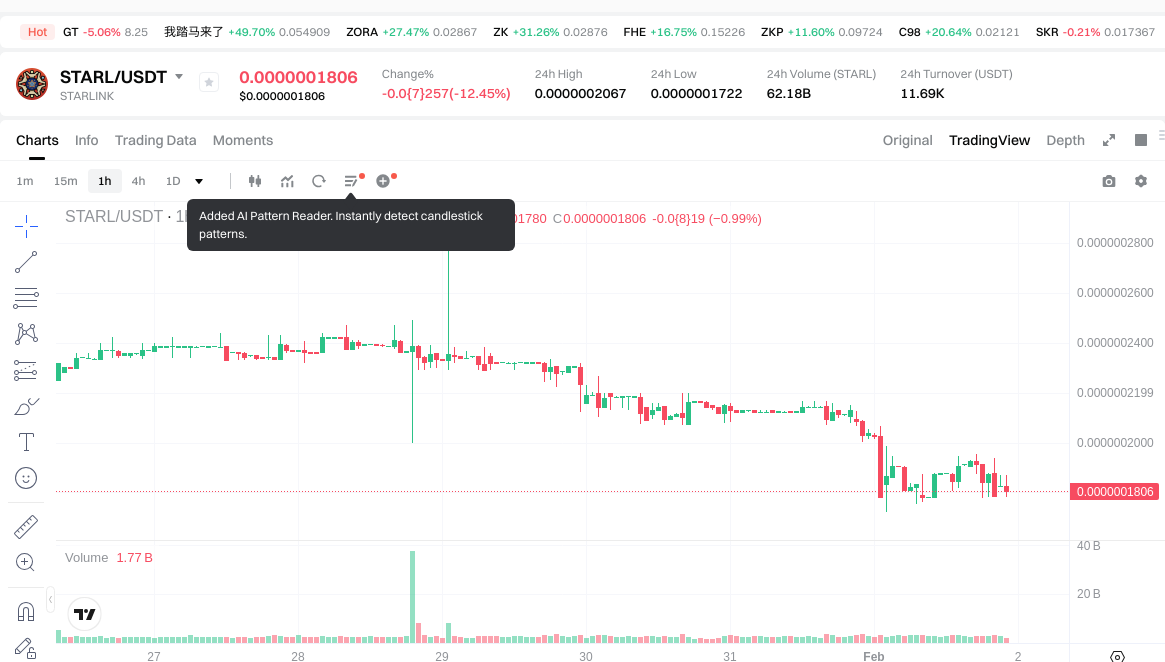
As of 01 February 2026, STARLINK's circulating supply stands at 9,979,138,259,325.838 tokens, with a total supply of 10,000,000,000,000 tokens. The maximum supply is capped at 10,000,000,000,000 tokens, establishing a fixed supply model. The circulation ratio reaches 99.79%, indicating that nearly all tokens have entered market circulation. The market capitalization to fully diluted valuation ratio stands at 99.79%, suggesting minimal future dilution risk.
Price Volatility
STARLINK reached its all-time high of $0.00008821 on 25 November 2021. The token's lowest price was $0.000000148142, recorded on 02 July 2021. As of 01 February 2026, the current trading price is $0.0000001806, representing a significant decline from its peak levels. Over the past year, the token has experienced a -75.51% price change, with recent shorter-term movements showing -26.95% over 30 days and -23.9% over 7 days. These fluctuations reflect broader market dynamics and shifting investor sentiment in the cryptocurrency sector.
Click to view current STARL market price
On-Chain Metrics
- Holders: Approximately 39,536 addresses hold STARLINK tokens, indicating the distribution across the user base
- 24-hour Trading Volume: $11,654.28, reflecting current market activity levels
- Market Dominance: 0.000066% of the total cryptocurrency market capitalization
STARLINK Ecosystem Applications and Partnerships
Core Use Cases
STARLINK's ecosystem supports multiple applications:
- Metaverse & Virtual Space: The project focuses on decentralized virtual space exploration, enabling users to participate in immersive experiences within a community-owned metaverse environment.
- NFT Marketplace: STARLINK facilitates NFT auctions and trading, allowing users to buy and sell virtual satellites, spacecraft, and satellite land, creating a unique digital asset economy.
- Social & Gaming: The platform integrates social networking features with space exploration games, enabling users to trade daily necessities in virtual space and explore the universe through interactive experiences.
Strategic Cooperation
As a community-driven project on the Ethereum blockchain, STARLINK's ecosystem is built around its governance token STARL, which serves as the foundation for all platform activities. The project's decentralized nature emphasizes community ownership and participation in shaping the metaverse's future.
Controversies and Challenges
STARLINK faces several challenges:
- Market Volatility: The token has experienced notable price fluctuations, with a 75.51% decline over the past year and recent short-term drops of 10.16% in 24 hours.
- Competition Pressure: The metaverse and NFT gaming sector has become increasingly competitive, with numerous projects vying for user attention and market share.
- Liquidity Concerns: With a 24-hour trading volume of approximately $11,654, the project faces challenges in maintaining robust market liquidity.
These factors have prompted ongoing discussions within the community about sustainability and growth strategies.
Fan Enthusiasm
STARLINK's community maintains an active presence, with approximately 39,536 token holders participating in the ecosystem. The project has established a footprint across multiple platforms, fostering engagement around its metaverse vision and NFT initiatives.
Sentiment on X displays varied perspectives:
- Supporters highlight STARLINK's innovative approach to combining metaverse experiences with NFT functionality, viewing it as a pioneering project in virtual space exploration.
- Critics express concerns about price volatility and the project's ability to deliver on its ambitious roadmap amid market challenges.
Recent trends indicate mixed sentiment, reflecting broader market conditions affecting metaverse and gaming tokens.
Hot Topics
X users actively discuss STARLINK's market performance, development progress, and its position within the evolving metaverse landscape, examining both opportunities and obstacles in its path toward mainstream adoption.
- Official Website: Visit STARLINK Official Website for features, use cases, and latest updates.
- X Updates: On X platform, STARLINK maintains an active presence through @starlinketh, sharing updates about platform developments, community activities, and ecosystem news.
- Contract Information: STARLINK (STARL) is deployed on the Ethereum blockchain with contract address 0x8e6cd950ad6ba651f6dd608dc70e5886b1aa6b24, which can be verified on Etherscan.
How to Participate in STARLINK?
- Purchase Channels: STARL tokens are available for trading on Gate.com and other supporting platforms.
- Storage Solutions: Store STARL securely using Ethereum-compatible wallets such as MetaMask or hardware wallets.
- Participate in Governance: As STARL serves as the governance token for the STARLINK metaverse ecosystem, holders can participate in community decisions and platform development.
- Ecosystem Building: Explore opportunities to engage with the metaverse, participate in NFT trading, or contribute to the virtual space economy.
Summary
STARLINK represents an innovative approach to combining blockchain technology with metaverse experiences, offering features such as virtual space exploration, NFT trading, and community-driven governance through the STARL token. The project's focus on creating a decentralized virtual universe distinguishes it within the broader crypto gaming and metaverse sector.
While facing challenges including market volatility and competitive pressures, STARLINK's unique vision of space-themed virtual experiences and its community-owned structure provide a foundation for potential growth. The project appeals to users interested in metaverse applications, NFT collecting, and virtual world exploration.
Whether you're new to metaverse projects or an experienced participant, STARLINK offers opportunities to engage with an evolving ecosystem at the intersection of blockchain technology and virtual reality experiences.
FAQ
What is crypto STARL and what is its main purpose?
Crypto STARL is a utility token within the Starlink ecosystem, designed to fuel network operations and enable transactions. Its main purpose is to facilitate payments and provide user incentives, making it essential for ecosystem participation and growth.
How can I buy or acquire STARL tokens?
You can acquire STARL tokens by visiting a cryptocurrency platform, creating an account, and using supported payment methods like bank transfer or credit card. Complete identity verification, deposit funds, and execute your purchase order.
What is the total supply and current market cap of STARL?
STARL has a total supply of 997.13 million tokens with a circulating supply equal to total supply. The current market cap varies based on real-time price movements and market conditions.
Which blockchain network does STARL operate on?
STARL operates on the Ethereum blockchain network. It was launched in 2021 as an ERC-20 token, leveraging Ethereum's robust infrastructure for secure and efficient transactions.
What are the key features and use cases of STARL?
STARL is the governance token for the community-owned decentralized virtual space project. Key features include community-driven decision-making, ecosystem participation, and virtual space management. Use cases encompass decentralized governance, ecosystem applications, and community empowerment within the STARL ecosystem.
Who are the team members and developers behind STARL?
The STARL team includes Woof Decentra as token creator, Moe Larson as concept creator, and Shahid Ahmad as metaverse and game producer/advisor.
What are the potential risks and considerations before investing in STARL?
STARL faces regulatory challenges in space operations, limited liquidity as a private asset, market volatility, and intense competition. Early-stage investment carries elevated risk. Investors should assess their risk tolerance and conduct thorough research before committing capital.
How does STARL differ from other similar cryptocurrency projects?
STARL stands out through its decentralized governance model and community-driven development approach. It pioneered early collaborations with major entities and prioritizes community management, distinguishing it from traditional cryptocurrency projects that rely on centralized control.
* The information is not intended to be and does not constitute financial advice or any other recommendation of any sort offered or endorsed by Gate.