Steem is a blockchain-based social media platform launched in 2016, revolutionizing content creation through decentralized monetization. This comprehensive guide explores Steem's technical architecture powered by Delegated Proof-of-Stake consensus, enabling fee-free transactions and rapid block generation. Discover how the platform rewards creators through its Proof-of-Brain algorithm, connects multiple applications like Steemit and DTube, and maintains an active community. Learn current market metrics—circulating supply of 537.1M tokens and market cap of $34.3M—alongside Steem's ecosystem partnerships. This article addresses creator monetization challenges, regulatory considerations, and competitive dynamics while providing actionable guidance for purchasing STEEM on Gate.com and participating in the decentralized social media revolution.
Steem's Positioning and Significance
In 2016, Steemit Inc. and the Steem community launched Steem (STEEM), aiming to address the lack of monetization mechanisms for content creators on traditional social media platforms and the inefficiency of reward distribution.
As an open-source blockchain protocol designed for social content storage and token distribution based on the Proof-of-Brain algorithm, Steem plays a critical role in decentralized social media and content monetization.
As of 2026, Steem has established itself as a blockchain protocol supporting multiple user-facing applications, with a presence across platforms including busy.org, d.tube, dlive.io, steemit.com, and dsound.audio.
This article will provide an in-depth analysis of its technical architecture, market performance, and future potential.
Origin and Development History
Birth Background
Steem was created by the Steem development team in 2016, aiming to solve the problem that content creators on traditional social platforms cannot directly earn rewards from their contributions, as well as the centralization issues in content distribution and monetization.
It was born during the rise of blockchain technology and growing concerns about social media centralization, with the goal of enabling users to earn cryptocurrency rewards by sharing valuable content and curating others' contributions.
Steem's launch brought new possibilities to content creators, social media participants, and developers seeking decentralized alternatives.
Important Milestones
- 2016: Mainnet launched, implementing rapid transaction processing with three-second block times and fee-free transactions.
- Development phase: The Smart Media Token (SMT) protocol was proposed to allow entrepreneurs, developers, and community builders to launch their own customizable tokens on the Steem blockchain.
- Ecosystem expansion: Multiple decentralized applications were deployed on Steem, including video platforms (d.tube, dlive.io), audio platforms (dsound.audio), and social content platforms (busy.org, steemit.com).
- Ongoing development: The blockchain continued to evolve with support for storing user content, social information, account data, and JSON metadata.
With support from the Steem community and ecosystem developers, Steem has continued to optimize its technology, security, and real-world applications.
How Does Steem Work?
No Central Control
Steem operates on a decentralized network of computers (nodes) distributed globally, free from control by banks or governments.
These nodes collaborate to validate transactions, ensuring system transparency and attack resistance, granting users greater autonomy and enhancing network resilience.
Blockchain Core
Steem's blockchain is a public, immutable digital ledger that records every transaction.
Transactions are grouped into blocks and linked through cryptographic hashes to form a secure chain.
Anyone can view the records, establishing trust without intermediaries.
The protocol utilizes a three-second block generation mechanism and the Delegated Proof-of-Stake (DPoS) algorithm to further enhance performance.
Ensuring Fairness
Steem employs Delegated Proof-of-Stake (DPoS) to validate transactions and prevent fraudulent activities such as double-spending.
Witnesses (block producers) maintain network security through operating nodes and producing blocks, earning STEEM rewards in return.
Its innovation includes high transaction throughput, three-second block times, and fee-free transactions.
Secure Transactions
Steem uses public-private key cryptography to protect transactions:
- Private keys (like secret passwords) are used to sign transactions
- Public keys (like account numbers) are used to verify ownership
This mechanism ensures fund security while maintaining pseudonymous transaction privacy.
Additionally, the protocol supports various account authority levels and recovery mechanisms to enhance user security.
Circulation Overview
As of January 21, 2026, Steem's circulating supply is 537,126,753.956 tokens, with a total supply of 537,451,384.863 tokens. The maximum supply is uncapped (∞), indicating an inflationary token model.
New tokens enter the market through the blockchain's proof-of-brain algorithm and delegated proof-of-stake consensus mechanism, which influences its supply and demand dynamics.
Price Volatility
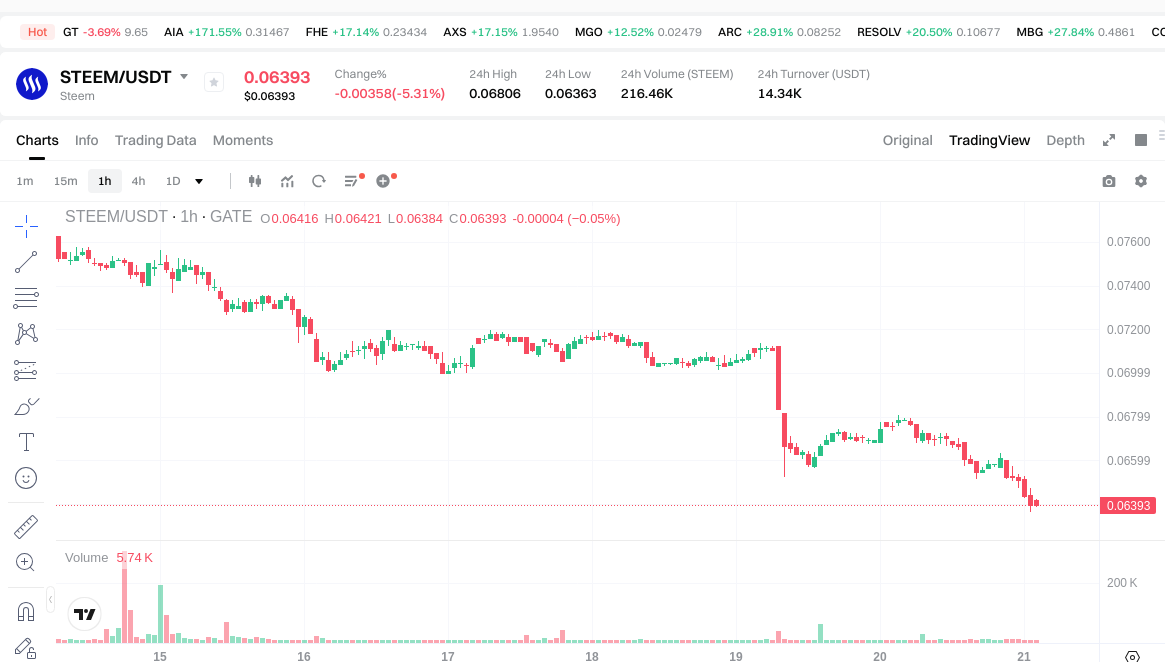
Steem reached a notable price level of $8.19 on January 3, 2018, during a period of broader cryptocurrency market expansion.
Its lowest price point of $0.060275 occurred on December 19, 2025, reflecting market correction periods and broader industry adjustments.
These fluctuations demonstrate the impact of market sentiment, adoption trends, and external factors on token valuation.
Click to view current STEEM market price
On-Chain Metrics
- 24-Hour Trading Volume: $14,360.60 (indicating network trading activity)
- Market Capitalization: $34,290,171.97 (reflecting current market valuation)
- Circulating Supply Ratio: 99.94% of total supply (demonstrating high token distribution)
Steem Ecosystem Applications and Partners
Core Use Cases
Steem's ecosystem supports multiple applications:
- Content Creation Platforms: steemit.com, busy.org, and d.tube provide decentralized social media and content sharing capabilities.
- Media and Entertainment: dlive.io and dsound.audio drive innovation in live streaming and audio content distribution.
Strategic Partnerships
Steem has established collaborations with various platforms within its ecosystem, enhancing its technical capabilities and market influence.
These partnerships provide a solid foundation for Steem's ecosystem expansion.
Controversies and Challenges
Steem faces the following challenges:
- Technical Issues: Scalability considerations as the network grows
- Regulatory Risks: Evolving cryptocurrency regulations across different jurisdictions
- Competitive Pressure: Competition from other blockchain platforms in the social media and content creation space
These issues have sparked discussions within the community and market, while also driving Steem's continued innovation.
Steem's community remains active with a circulating supply of 537,126,753.956 tokens.
On X platform, related posts and hashtags (such as #Steem) appear regularly.
Platform developments and community initiatives continue to energize the ecosystem.
Sentiment on X shows varied perspectives:
- Supporters praise Steem's decentralized content creation model and Proof-of-Brain algorithm, viewing it as an innovative approach to social media monetization.
- Critics focus on market volatility and platform adoption challenges.
Recent trends reflect ongoing discussions about the platform's value proposition.
Hot Topics
X users discuss Steem's content monetization model, community governance, and platform sustainability,
showcasing both its transformative potential and the hurdles toward mainstream adoption.
- Official Website: Visit Steem Official Website for features, use cases, and latest developments.
- X Updates: On X platform, Steem uses @SteemNetwork, with posts covering technical updates, community activities, and ecosystem news.
- Community Forums: Active discussions take place on steemit.com and busy.org.
Steem Future Roadmap
- Upcoming Development: The Smart Media Token (SMT) protocol aims to enable entrepreneurs, developers, and community builders to launch customizable tokens on the Steem blockchain
- Ecosystem Goals: Expand support for diverse content creation applications and community-driven platforms
- Long-term Vision: Establish a robust infrastructure for tokenized content creation and social media applications
How to Participate in Steem?
- Purchase Channels: Acquire STEEM on Gate.com and other supported exchanges
- Storage Solutions: Use compatible wallets to securely store your STEEM tokens
- Participate in Governance: Engage with the community through various Steem-based platforms
- Build the Ecosystem: Visit GitHub repositories at github.com/steemit to contribute code or develop applications
Summary
Steem leverages blockchain technology to redefine content creation and social media, offering transparency, decentralization, and creator monetization.
Its active community, diverse applications, and innovative approach distinguish it in the cryptocurrency space.
Despite facing regulatory uncertainties and competitive challenges, Steem's innovative spirit and clear development trajectory position it as a notable player in decentralized social media technology.
Whether you're a newcomer or an experienced participant, Steem offers opportunities for engagement and contribution.
FAQ
Steem is a blockchain platform rewarding users for creating and curating content. It operates through delegated proof-of-stake consensus, allowing content creators to earn STEEM tokens based on community engagement. The platform combines social networking with cryptocurrency incentives, enabling direct monetization of user-generated content and community participation.
How can I earn cryptocurrency rewards by posting and engaging on Steem?
On Steem, you earn rewards by creating quality content and voting on posts. Your earnings come from the reward pool, distributed based on community engagement and upvotes. Active participation in posting and curation generates STEEM and SBD tokens directly to your account.
Steem is the blockchain protocol powering content creation. Steemit is the flagship social media platform built on Steem. Other Steem-based platforms include DTube for video and Busy for blogging, each offering unique features while leveraging the same underlying blockchain infrastructure.
How do I create an account on Steem and start earning STEEM tokens?
Visit Steem's official website and sign up with your email or username. Complete identity verification, then create your wallet. Start posting quality content, engage with the community, and earn STEEM tokens through votes and rewards.
What are the main risks and security considerations when using Steem?
Key risks include account security vulnerabilities, private key management, smart contract exploits, and network consensus attacks. Users must secure private keys carefully, enable two-factor authentication, verify transactions on official platforms, and stay informed about protocol updates to mitigate potential losses.
How is STEEM different from other cryptocurrencies like Bitcoin or Ethereum?
STEEM is a blockchain-based social media platform with built-in token rewards. Unlike Bitcoin's focus on payments or Ethereum's smart contracts, STEEM incentivizes content creation and community engagement through its native token system.
* The information is not intended to be and does not constitute financial advice or any other recommendation of any sort offered or endorsed by Gate.