Lido Staked Ether (stETH) revolutionizes Ethereum staking through innovative liquid staking, enabling users to earn rewards while maintaining asset liquidity without infrastructure maintenance. Ranking as the 9th largest cryptocurrency with $27.74 billion market capitalization and 292,522 holders, stETH addresses critical challenges in Ethereum 2.0 staking by allowing flexible participation at any amount. This comprehensive guide explores stETH's decentralized architecture, where professional validators secure the network and users receive stETH tokens representing staked ETH plus accumulated rewards updated daily. The protocol integrates seamlessly across major DeFi platforms on Gate and other leading exchanges, offering diverse application scenarios from yield farming to derivatives trading. Despite facing regulatory uncertainties and competition from alternative solutions like rETH and cbETH, stETH's market leadership, active community governance, and transparent ecosystem position it as a transformative f
Lido Staked Ether's Positioning and Significance
In 2020, the Lido team launched Lido Staked Ether (stETH), aiming to address the illiquidity and inflexibility challenges faced by Ethereum 2.0 stakers.
As a liquid staking solution for Ethereum, Lido Staked Ether plays a critical role in the DeFi and staking ecosystems.
As of 2026, Lido Staked Ether has become the 9th largest cryptocurrency by market capitalization, with a market cap of approximately $27.74 billion and over 292,522 holders, supported by an active developer community.
This article will provide an in-depth analysis of its technical architecture, market performance, and future potential.
Origin and Development History
Birth Background
Lido Staked Ether was created by the Lido team in 2020, aiming to solve the liquidity problems and asset lock-up issues associated with Ethereum 2.0 staking.
It emerged during the transition period of Ethereum's shift to Proof-of-Stake consensus, with the goal of enabling users to stake any amount of ETH while maintaining liquidity and earning staking rewards without the need to maintain infrastructure.
The launch of Lido Staked Ether brought new possibilities to Ethereum stakers and DeFi participants.
Key Milestones
- 2020: Lido protocol launched, enabling liquid staking for Ethereum 2.0 with the introduction of stETH token.
- 2021-2023: Rapid ecosystem expansion, with stETH becoming widely integrated across major DeFi protocols and applications.
- 2024-2025: Continued growth in adoption, with the token reaching over 292,522 holders and maintaining its position among top cryptocurrencies.
- 2026: Currently ranks 9th by market capitalization with approximately 8.89 million stETH in circulation.
With the support of the Lido DAO community and development team, Lido Staked Ether continues to optimize its protocol security, efficiency, and real-world applications.
How Lido Staked Ether Works?
Decentralized Infrastructure
Lido Staked Ether operates through a decentralized network of node operators who validate transactions on the Ethereum blockchain, removing dependence on centralized custodians.
These distributed operators collaborate to secure staked ETH and process staking rewards, ensuring system transparency and resilience while empowering users with greater control over their assets.
Liquid Staking Mechanism
Lido's protocol allows users to stake any amount of ETH and receive stETH tokens in return at a 1:1 ratio.
stETH represents the staked ETH plus accumulated staking rewards, functioning as a liquid token that can be traded, transferred, or used in DeFi applications while the underlying ETH remains staked.
This innovative approach solves the traditional staking problem of asset lock-up, enabling users to maintain liquidity while earning rewards.
The stETH balance updates daily to reflect accrued staking rewards, providing a seamless staking experience.
Validator Network and Security
Lido Staked Ether utilizes Ethereum's Proof-of-Stake (PoS) consensus mechanism through a curated set of professional node operators who validate transactions and secure the network.
These validators are selected by the Lido DAO and must meet strict performance and security standards.
Stakers receive rewards generated from Ethereum network validation activities, with Lido charging a fee that is split between node operators and the protocol treasury.
The system's innovation includes distributing stake across multiple validators to enhance decentralization and reduce risks.
Transaction Security and Token Standard
Lido Staked Ether implements robust security through Ethereum's cryptographic infrastructure and smart contract technology.
The stETH token is deployed on the Ethereum blockchain as an ERC-20 compatible token, utilizing standard public-private key cryptography:
- Private keys secure user ownership and authorize transactions
- Public keys enable transparent verification on the blockchain
The protocol undergoes regular security audits and implements multi-signature controls for critical operations.
Users maintain full custody of their stETH tokens, which can be held in standard Ethereum wallets and used across the DeFi ecosystem while representing their staked position.
Circulation Overview
As of January 13, 2026, Lido Staked Ether (STETH) has a circulating supply of 8,892,587 tokens, with a total supply of 8,892,610 tokens. The maximum supply is unlimited (∞), indicating an inflationary model that can expand based on staking activity on the Ethereum network.
STETH tokens enter circulation through Ethereum staking mechanisms via the Lido protocol, where users deposit ETH and receive STETH as a liquid staking derivative. The circulating supply accounts for approximately 99.9997% of the total supply, demonstrating near-complete token distribution.
Price Fluctuations
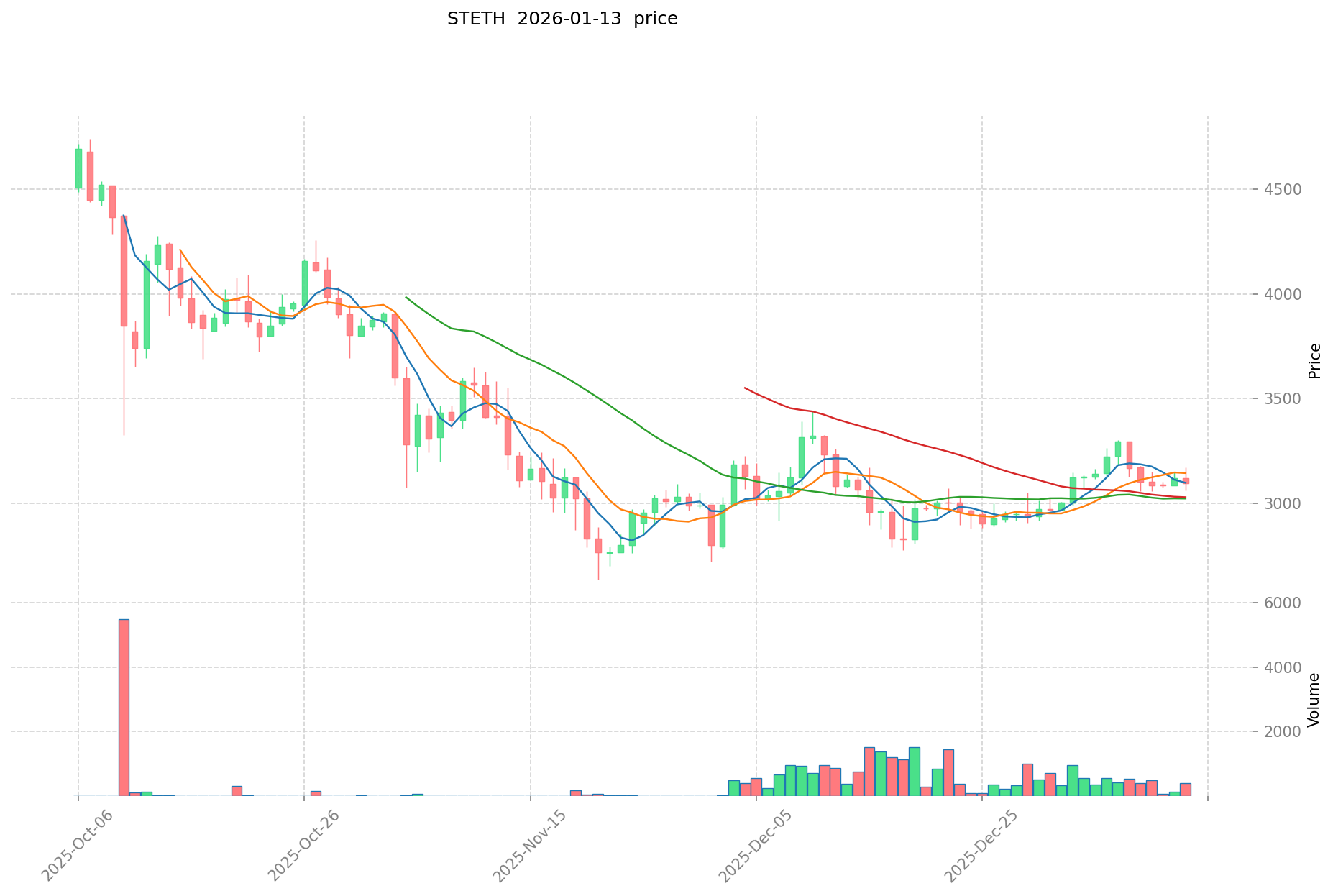
Lido Staked Ether reached a notable price level of $4,932.89 on August 25, 2025, driven by positive market sentiment and increased adoption of liquid staking solutions during a period of strong performance in the broader cryptocurrency market.
The lowest recorded price was $482.90, which occurred on December 22, 2020, during the early stages of Ethereum 2.0 staking implementation and amid broader market uncertainty.
Recent price trends show:
- 1-hour change: +0.25% (+$7.78)
- 24-hour change: -1.19% (-$37.57)
- 7-day change: -3.19% (-$102.79)
- 30-day change: +0.05% (+$1.56)
- 1-year change: -3.96% (-$128.63)
These fluctuations reflect changing market sentiment, Ethereum network developments, and evolving dynamics in the liquid staking sector.
Click to view current STETH market price
On-Chain Metrics
- 24-hour Trading Volume: $1,222,763.12 (indicating active market participation)
- Holder Addresses: 292,522 addresses (reflecting widespread user adoption)
- Market Capitalization: $27.74 billion (demonstrating significant market presence)
- Circulating Market Cap to Fully Diluted Valuation Ratio: 100% (indicating nearly complete token distribution)
Lido Staked Ether Ecosystem Applications and Partners
Core Use Cases
Lido Staked Ether's ecosystem supports multiple applications:
- DeFi: Integrated with leading decentralized finance protocols, providing liquidity staking solutions.
- Ethereum Applications: Powers various Ethereum-based protocols and applications, enabling flexible asset utilization.
Strategic Partnerships
Lido Staked Ether has established collaborations within the Ethereum ecosystem, enhancing its technical capabilities and market influence.
These partnerships provide a solid foundation for stETH's ecosystem expansion.
Controversies and Challenges
Lido Staked Ether faces the following challenges:
- Technical Issues: Dependency on Ethereum network performance and staking infrastructure
- Regulatory Risks: Uncertainty surrounding staking services regulation across different jurisdictions
- Competition Pressure: Emergence of alternative liquid staking solutions and competing protocols
These issues have sparked discussions within the community and market, while also driving continuous innovation for stETH.
Fan Enthusiasm
Lido Staked Ether's community demonstrates strong vitality, with 292,522 holders supporting the ecosystem.
On X platform, related posts and hashtags (such as #Lido or #stETH) frequently trend.
Factors such as protocol updates and Ethereum network developments energize the community.
Sentiment on X shows diverse perspectives:
- Supporters praise stETH's liquid staking benefits, decentralization characteristics, considering it an important innovation in Ethereum staking.
- Critics focus on concentration risks, smart contract vulnerabilities, or centralization concerns.
Hot Topics
X users actively discuss stETH's role in DeFi, staking centralization debates, and withdrawal mechanisms,
showcasing both its transformative potential and challenges toward mainstream adoption.
- Official Website: Visit Lido Finance for features, use cases, and latest updates.
- X Updates: Lido Finance actively engages on X platform via @lidofinance,
with posts covering protocol upgrades, community initiatives, and ecosystem news.
- Technical Resources: Explore the GitHub repository for development documentation and code contributions.
How to Participate in Lido Staked Ether?
- Purchase Channels: Acquire stETH through Gate.com and other major platforms
- Storage Solutions: Securely store using compatible Ethereum wallets supporting ERC-20 tokens
- Participate in Governance: Engage in community decisions through governance platforms
- Build the Ecosystem: Access developer documentation to contribute to protocol development
Summary
Lido Staked Ether redefines Ethereum staking through innovative liquid staking solutions, providing flexibility, liquidity, and accessibility.
Its active community, rich resources, and market presence distinguish it in the cryptocurrency landscape.
Despite facing regulatory uncertainties and technical challenges, stETH's innovative approach and clear value proposition position it importantly in decentralized finance's future.
Whether you are a newcomer or experienced participant, Lido Staked Ether deserves attention and engagement.
FAQ
What is stETH (Staked Ether)? How does it differ from ETH?
stETH is a staking derivative token representing staked ETH that earns rewards. Unlike regular ETH, stETH maintains liquidity while generating staking yields, allowing users to trade it while earning passive income from Ethereum validation.
How to obtain stETH? What is the staking yield rate?
Stake ETH on Lido platform to obtain stETH. Current annual staking yield is approximately 3.03% APY, which may fluctuate based on network conditions and validator performance.
What are the risks of stETH? How is its liquidity?
stETH faces smart contract risks and liquidity constraints. Its price can deviate from ETH due to market selling pressure and limited decentralized exchange depth. However, it maintains fundamental value backed by ETH redemption post-merge, making depegging unlikely for long-term holders.
What can stETH be used for? What are its application scenarios?
stETH can be used in liquidity pools, lending platforms, yield farming, and derivatives trading. It can also be swapped with ETH and other assets seamlessly.
What is the difference between stETH and other liquid staking derivatives such as rETH and cbETH?
stETH, rETH, and cbETH are all liquid staking derivatives representing staked ETH and rewards, but issued by different protocols. stETH (Lido) offers the largest liquidity and ecosystem integration. rETH (Rocket Pool) emphasizes decentralization. cbETH (Coinbase) provides institutional-grade security. Key differences lie in their staking mechanisms, fee structures, and DeFi composability.
How to exchange stETH back to ETH? How long does redemption take?
To exchange stETH for ETH, submit a withdrawal request through Lido. Processing typically takes 1-5 days. Once processed, you can claim your ETH.
* The information is not intended to be and does not constitute financial advice or any other recommendation of any sort offered or endorsed by Gate.