StakeStone (STO) is a decentralized omnichain liquidity infrastructure protocol addressing liquidity fragmentation across multiple blockchain ecosystems. This comprehensive guide explores StakeStone's technical architecture, market performance, and ecosystem applications within the evolving DeFi landscape. With a market capitalization of $18.57 million and active presence across multiple exchanges including Gate.com, StakeStone demonstrates significant market traction among cryptocurrency investors. The article examines key metrics including circulating supply, price performance, and on-chain data while analyzing core use cases in cross-chain liquidity distribution. It also addresses technical challenges, regulatory considerations, and community sentiment surrounding this innovative DeFi infrastructure solution. Whether you're exploring DeFi opportunities or seeking omnichain liquidity solutions, this guide provides essential insights into StakeStone's positioning and potential in decentralized finance.
StakeStone's Positioning and Significance
In the evolving landscape of decentralized finance, StakeStone (STO) emerged as a decentralized omnichain liquidity infrastructure protocol, designed to address liquidity fragmentation and inefficient capital distribution across multiple blockchain ecosystems.
As a pioneering omnichain liquidity solution, StakeStone plays a critical role in DeFi infrastructure, facilitating efficient liquidity flows across an increasingly modular and multi-chain environment.
As of 2026, StakeStone has established itself within the crypto ecosystem, with a market capitalization of approximately $18.57 million and an active presence across 25 exchanges. The project maintains an engaged community with 407 token holders.
This article will provide an in-depth analysis of its technical architecture, market performance, and future potential.
Origin and Development Timeline
Background
StakeStone was created to solve the challenges of liquidity acquisition, distribution, and utilization in fragmented blockchain ecosystems.
It emerged during the expansion of multi-chain DeFi environments, with the goal of delivering efficient, sustainable, and organic liquidity flows that adapt to modular blockchain architectures.
StakeStone's launch brought new possibilities for DeFi protocols and users seeking seamless cross-chain liquidity access.
Key Milestones
- January 2025: Token launched on Gate.com and other exchanges, enabling trading access across multiple platforms.
- The protocol's ecosystem continues to expand with support for cross-chain liquidity infrastructure.
With support from its development team and community, StakeStone continues to optimize its technical capabilities, security measures, and real-world applications.
How StakeStone Works
Decentralized Architecture
StakeStone operates on a decentralized network spanning multiple blockchain ecosystems, independent of centralized financial institutions or governmental control.
This distributed architecture ensures system transparency, resilience against attacks, and grants users greater autonomy over their liquidity assets.
Blockchain Foundation
StakeStone's infrastructure leverages blockchain technology as a transparent, immutable digital ledger that records liquidity transactions and movements.
Transactions are organized into blocks and cryptographically linked to form a secure chain.
Anyone can verify records without requiring intermediaries, establishing trustless interactions.
The protocol's omnichain architecture enhances performance by enabling liquidity to flow seamlessly across different blockchain networks.
Network Security
StakeStone implements robust security mechanisms to validate transactions and prevent fraudulent activities such as double-spending.
Network participants maintain system integrity through protocol validation and liquidity provision, receiving STO token incentives for their contributions.
The innovation lies in efficient cross-chain liquidity coordination and sustainable reward mechanisms.
Secure Transactions
StakeStone utilizes cryptographic technology to protect transactions:
- Private keys (similar to secret passwords) are used to authorize transactions
- Public keys (similar to account numbers) are used to verify ownership
This mechanism ensures asset security while maintaining pseudonymous transaction privacy.
The protocol implements additional security features through smart contract auditing and multi-layer validation processes.
Circulation Overview
As of January 23, 2026, StakeStone (STO) has a circulating supply of 225,333,333 tokens, with a total supply of 1,000,000,000 tokens and a maximum supply capped at 1,000,000,000 tokens. The circulating supply represents approximately 22.53% of the total supply, indicating a relatively controlled release mechanism. The token distribution model impacts its supply-demand dynamics across multiple blockchain ecosystems.
Price Fluctuations
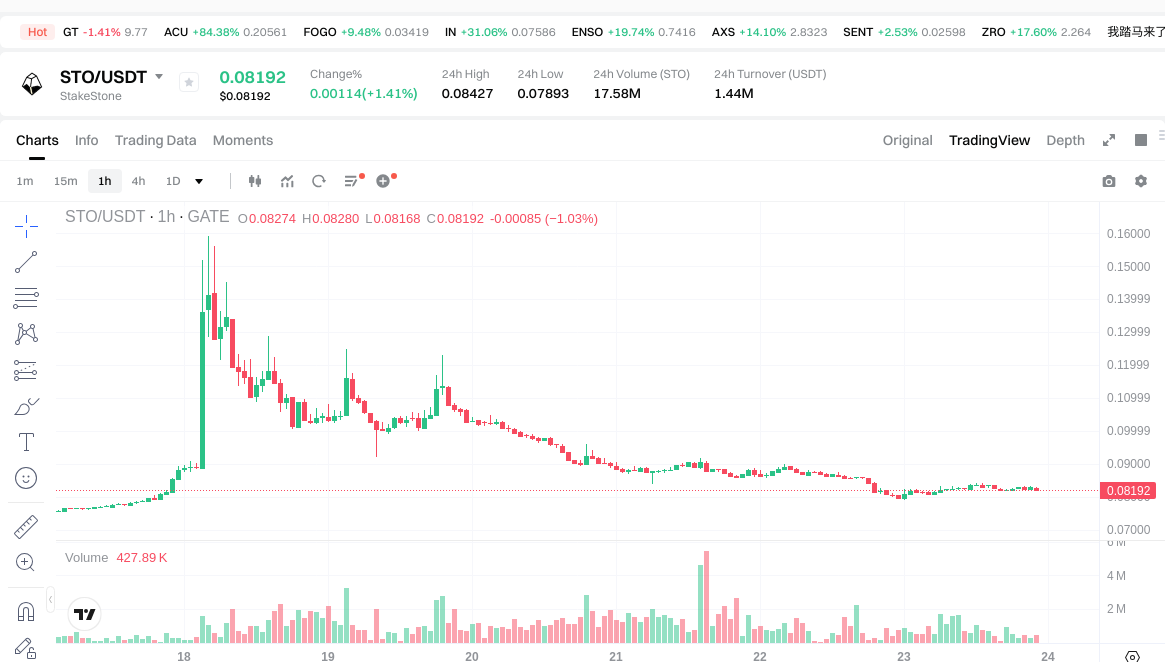
StakeStone reached its all-time high price of $0.2365 on May 2, 2025, driven by strong market interest in decentralized omnichain liquidity infrastructure solutions. Its lowest recorded price was $0.0526, which occurred on April 7, 2025, reflecting early-stage market volatility and price discovery phases.
Recent price movements show mixed signals: the token experienced a 2.89% increase over the past 24 hours, reaching $0.08242, and demonstrated a 8.41% gain over the past 7 days. However, the 30-day performance reflects a -26.44% decline, while the 1-year view shows a 33.81% increase, illustrating varying market sentiment across different timeframes.
Click to view the current STO market price
On-Chain Metrics
- 24-Hour Trading Volume: Approximately $1.43 million, demonstrating active market participation and liquidity
- Market Capitalization: $18.57 million, representing the current circulating value
- Fully Diluted Market Cap: $82.42 million, reflecting potential future valuation at maximum supply
- Active Holders: 407 addresses currently holding the token, indicating the size of the token holder community
- Supported Networks: StakeStone operates across multiple chains including Ethereum (ERC20) and BNB Smart Chain (BEP20), facilitating cross-chain liquidity infrastructure
StakeStone Ecosystem Applications and Strategic Partners
Core Use Cases
StakeStone's ecosystem supports diverse applications across the DeFi landscape:
- Liquidity Infrastructure: StakeStone provides decentralized omnichain liquidity solutions, enabling efficient liquidity distribution across multiple blockchain networks.
- Cross-Chain Integration: The protocol facilitates seamless asset flow between different chains, supporting the modular DeFi ecosystem's evolving needs.
Strategic Collaborations
StakeStone operates as a foundational liquidity infrastructure protocol designed to serve the broader blockchain ecosystem.
These partnerships and integrations provide a solid foundation for StakeStone's ecosystem expansion.
Challenges and Considerations
StakeStone faces several challenges in the evolving DeFi landscape:
- Technical Complexity: Maintaining efficient liquidity flows across multiple chains requires sophisticated infrastructure.
- Market Competition: Operating in a competitive environment with other liquidity protocols and infrastructure solutions.
- Regulatory Environment: Navigating the evolving regulatory landscape for DeFi protocols.
These issues have sparked discussions within the community and market, while also driving StakeStone's continuous innovation.
StakeStone's community demonstrates growing interest, with the token reaching 407 holders as of the latest data.
On X platform, discussions around StakeStone and related topics appear regularly among DeFi enthusiasts.
The protocol's omnichain liquidity infrastructure approach has attracted attention from the DeFi community.
Sentiment on X shows mixed perspectives:
- Supporters praise StakeStone's innovative liquidity infrastructure and cross-chain capabilities, viewing it as a solution for multi-chain DeFi challenges.
- Observers monitor price performance and ecosystem development progress as key indicators.
Recent trends reflect typical market dynamics with price fluctuations influencing sentiment.
Popular Topics
X users discuss StakeStone's liquidity infrastructure approach, cross-chain functionality, and DeFi integration potential,
showcasing both its innovative positioning and the challenges of building foundational DeFi infrastructure.
- Official Website: Visit StakeStone Official Site for features, use cases, and latest updates.
- Documentation: StakeStone Docs provides detailed information about the protocol's technical architecture, objectives, and vision.
- X Updates: StakeStone maintains an active presence on X platform via @Stake_Stone,
sharing updates on protocol developments, community initiatives, and ecosystem news.
How to Participate in StakeStone?
- Purchase Options: Acquire STO on Gate.com and other supporting exchanges
- Storage Solutions: Store securely using compatible wallets like MetaMask or hardware wallets
- Ecosystem Participation: Explore StakeStone's liquidity infrastructure and DeFi integrations
- Developer Resources: Visit the documentation portal to learn about building with StakeStone's protocol
Summary
StakeStone is redefining liquidity infrastructure through blockchain technology, offering decentralized, omnichain liquidity solutions for the evolving DeFi ecosystem.
Its innovative approach to cross-chain liquidity distribution and active development make it a notable project in the cryptocurrency space.
Despite facing competitive pressures and technical challenges, StakeStone's infrastructure-focused approach and clear mission position it as a relevant player in decentralized finance's future.
Whether you're new to DeFi or an experienced participant, StakeStone represents an interesting development in liquidity infrastructure worth monitoring.
FAQ
What is a Security Token Offering (STO) and how does it differ from an ICO?
An STO is a regulated token sale backed by real assets or company equity, offering legal protections. Unlike ICOs, which are largely unregulated utility tokens, STOs comply with securities laws, providing investors greater security and legitimacy.
What are the main advantages of STO compared to traditional securities offerings?
STOs offer faster settlement, lower costs, enhanced transparency through blockchain, 24/7 trading, fractional ownership accessibility, automated compliance, and global market reach without intermediaries.
How are STOs regulated and what compliance requirements do they need to meet?
STOs are regulated as securities in most jurisdictions. They must comply with securities laws, undergo KYC/AML verification, obtain regulatory approval, maintain transparent disclosures, and follow anti-fraud requirements to protect investors and ensure legal operation.
What types of assets can be tokenized as security tokens?
Security tokens can represent equities, bonds, real estate, commodities, and fund shares. They digitize traditional financial assets, enabling fractional ownership, faster settlement, and increased liquidity while maintaining regulatory compliance and investor protections.
What are the risks and challenges involved in investing in STOs?
STO investments face regulatory uncertainty, limited liquidity, market volatility, and issuer default risks. Investors should conduct thorough due diligence on underlying assets, understand jurisdiction-specific compliance requirements, and assess counterparty reliability before committing capital.
STOs use smart contracts to tokenize securities on blockchain. Ethereum, Polygon, and Tezos are commonly used platforms. They enable compliance through built-in restrictions, automated settlement, and transparent ownership records.
* The information is not intended to be and does not constitute financial advice or any other recommendation of any sort offered or endorsed by Gate.