Storj is a decentralized cloud storage platform launched in 2014 that addresses inefficiencies and security vulnerabilities in traditional centralized cloud storage providers. Operating on a distributed network of storage nodes worldwide, Storj enables users to store encrypted data securely while maintaining complete privacy control through end-to-end encryption and zero-knowledge architecture. The platform's innovative approach utilizes erasure coding and client-side encryption, with storage node operators earning STORJ tokens based on performance metrics. As of 2026, Storj demonstrates strong market presence with over 104,825 token holders and availability on Gate and 39 other exchanges. This comprehensive guide explores Storj's technical architecture, market performance metrics, ecosystem applications, and practical participation methods. Whether you're seeking secure data storage alternatives or opportunities to earn tokens through node operation, Storj presents a compelling opportunity within the decentr
Storj's Positioning and Significance
In 2014, Shawn Wilkinson and the Storj Labs team launched Storj (STORJ), aiming to address inefficiencies and security vulnerabilities in traditional centralized cloud storage.
As a decentralized cloud storage platform focused on censorship resistance and enhanced data privacy, Storj plays a key role in data storage and decentralized infrastructure.
As of 2026, Storj has established itself as a prominent player in the decentralized storage sector, with over 104,825 token holders and an active developer community.
This article will provide an in-depth analysis of its technical architecture, market performance, and future potential.
Origin and Development History
Birth Background
Storj was created by Shawn Wilkinson and the founding team in 2014, aiming to solve the problems of centralized control, data privacy concerns, and high costs associated with traditional cloud storage providers.
It emerged during the early expansion of blockchain technology and growing concerns about data sovereignty, with the goal of providing users with secure, decentralized, and cost-effective data storage through distributed networks.
The launch of Storj brought new possibilities for individuals and enterprises seeking alternatives to traditional cloud storage solutions.
Major Milestones
- 2017: Token migration from Counterparty to Ethereum, establishing STORJ as an ERC-20 token to improve accessibility and integration.
- 2019: Launch of Storj V3 network, implementing significant performance improvements and node operator incentive mechanisms.
- 2021: Network expansion with storage capacity reaching multiple petabytes and growing adoption by enterprises.
- 2023: Continued ecosystem development with enhanced network reliability and storage node distribution across global regions.
With support from the Storj Labs team and a global community of storage node operators, Storj continues to optimize its technology, security protocols, and real-world applications.
How Storj Works
Decentralized Architecture
Storj operates on a distributed network of storage nodes run by individuals and organizations worldwide, eliminating reliance on centralized cloud providers.
These nodes collectively store encrypted data fragments, ensuring system transparency and resilience while giving users greater control over their data and reducing single points of failure.
Distributed Storage Technology
Storj's network functions as a distributed storage layer where files are encrypted, split into fragments, and distributed across multiple independent nodes.
Each data fragment is replicated across different geographical locations, creating redundancy and ensuring availability.
Anyone can participate as a storage node operator, earning STORJ tokens for providing storage capacity and bandwidth.
The platform utilizes erasure coding and client-side encryption to enhance data security and retrieval efficiency.
Network Coordination
Storj employs a reputation-based system combined with economic incentives to ensure reliable storage and retrieval operations.
Storage node operators maintain network integrity by providing consistent uptime, bandwidth, and storage space, earning STORJ token rewards based on performance metrics.
The system incorporates automatic node vetting and statistical quality monitoring to maintain service reliability.
Secure Data Management
Storj implements end-to-end encryption where data is encrypted on the client side before being uploaded:
- Private encryption keys (controlled exclusively by users) secure data access
- Public node addresses facilitate distributed storage coordination
This architecture ensures that only data owners can decrypt and access their files, maintaining strong privacy guarantees.
Additional security features include multi-region redundancy, automated repair mechanisms, and zero-knowledge architecture where storage node operators cannot access file contents.
Circulation Overview
As of January 23, 2026, Storj's circulating supply stands at 143,787,438.7 STORJ tokens, with a total supply of 424,999,998 tokens. The maximum supply is marked as unlimited (∞), indicating a potential inflationary model without a hard cap. The current circulation ratio represents approximately 28.76% of the total supply, suggesting that a substantial portion of tokens remains to be released into the market. This gradual release mechanism may influence the token's supply-demand dynamics over time.
Price Fluctuations
Storj reached its historical high price of $3.81 on March 28, 2021, during a period characterized by broader market momentum in the cryptocurrency sector. Conversely, the token recorded its lowest price of $0.05024 on March 13, 2020, reflecting challenging market conditions during that timeframe.
Recent price trends show varied performance across different timeframes:
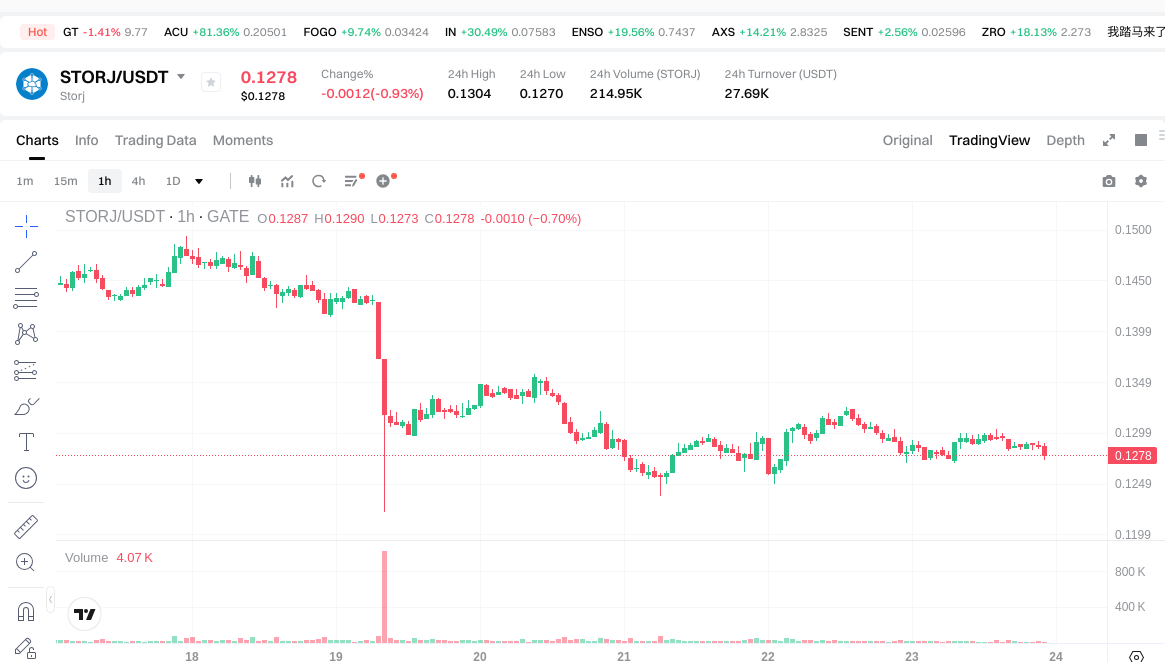
- 1-Hour Change: -0.38% (decrease of approximately $0.000492)
- 24-Hour Change: -0.07% (decrease of approximately $0.000090)
- 7-Day Change: -12.55% (decrease of approximately $0.0185)
- 30-Day Change: +14.89% (increase of approximately $0.0167)
- 1-Year Change: -71.91% (decrease of approximately $0.33)
The 24-hour price range spans from $0.127 to $0.1304, with the current price at $0.1289. These fluctuations reflect ongoing market dynamics, investor sentiment, and broader trends affecting decentralized cloud storage platforms.
Click to view the current STORJ market price
On-Chain Metrics
- Holder Count: Approximately 104,825 addresses hold STORJ tokens, indicating a distributed ownership structure across the network.
- Trading Volume (24H): $28,401.36, reflecting the daily trading activity and liquidity levels in the market.
- Market Capitalization: $18,534,200.85, representing the total value of circulating tokens at the current price.
- Fully Diluted Valuation: $54,782,499.74, calculated based on the total supply, providing insight into the potential market value if all tokens were in circulation.
- Market Dominance: 0.0017%, indicating Storj's share relative to the total cryptocurrency market capitalization.
- Exchange Listings: Available on 40 different exchanges, providing multiple access points for trading activity.
Storj Ecosystem Applications and Partners
Core Use Cases
Storj's ecosystem supports various applications:
- Decentralized Cloud Storage: Storj Network provides secure, encrypted data storage across a distributed network of nodes, enabling users to store files without relying on centralized providers.
- Data Privacy Solutions: The platform empowers individuals and enterprises to maintain control over their data through end-to-end encryption and decentralized architecture.
Strategic Partnerships
Storj has established collaborations to enhance its technical capabilities and market presence.
These partnerships provide a solid foundation for Storj's ecosystem expansion.
Challenges and Concerns
Storj faces several challenges:
- Technical Hurdles: Maintaining network reliability and ensuring consistent node availability across a distributed storage infrastructure.
- Competitive Pressure: Competition from traditional cloud storage providers and emerging decentralized storage solutions.
These issues have sparked discussions within the community and market, driving Storj's continuous innovation.
Storj's community demonstrates notable activity, with approximately 104,825 token holders participating in the ecosystem.
On X platform, related posts and hashtags (such as #STORJ) generate ongoing discussions.
Sentiment on X shows diverse perspectives:
- Supporters praise Storj's decentralized architecture, enhanced security, and privacy features, viewing it as a viable alternative to traditional cloud storage.
- Critics focus on price volatility and market competition.
Recent trends reflect mixed sentiment influenced by broader market conditions.
Popular Topics
X users frequently discuss Storj's decentralized storage model, data privacy advantages, and token utility,
showcasing both its transformative potential and challenges in achieving mainstream adoption.
- Official Website: Visit Storj Official Site to learn about features, use cases, and latest developments.
- Whitepaper: The Storj Whitepaper details its technical architecture, objectives, and vision.
- X Updates: On X platform, Storj maintains an active presence through @storj,
with posts covering platform updates, storage network developments, and community initiatives.
Storj Future Roadmap
- Ongoing Development: Continuous improvements to storage reliability, network performance, and user experience
- Ecosystem Goals: Expanding adoption among enterprises and individual users seeking decentralized storage solutions
- Long-term Vision: Establishing Storj as a leading decentralized cloud storage infrastructure
How to Participate in Storj?
- Purchase Options: Acquire STORJ on Gate.com and other supported exchanges
- Storage Solutions: Securely store STORJ using compatible wallets that support ERC-20 tokens
- Network Participation: Consider running a storage node to contribute bandwidth and storage capacity to the network
- Ecosystem Building: Visit the Storj GitHub repository to explore development opportunities or contribute code
Summary
Storj leverages blockchain technology to reimagine cloud storage, offering enhanced privacy, security, and decentralized data management.
Its active community of over 100,000 token holders, available resources, and operational network distinguish it within the cryptocurrency space.
Despite facing market volatility and competitive challenges, Storj's innovative approach and commitment to decentralized storage position it as a noteworthy project in the distributed technology landscape.
Whether you're a newcomer or experienced participant, Storj presents opportunities worth exploring in the decentralized storage sector.
FAQ
What is STORJ? What are its core functions?
STORJ is a decentralized cloud storage platform that enables users to rent unused hard drive space. Its core function is providing secure, efficient, and cost-effective data storage through a peer-to-peer network, allowing anyone to become a storage node operator and earn STORJ tokens for contributing storage resources.
What are the advantages of STORJ compared to traditional cloud storage such as AWS and Google Cloud?
STORJ offers decentralized storage with lower costs through peer-to-peer networks, enhanced privacy and security via encryption, no vendor lock-in, and incentivized node operators. Users maintain full control over data while benefiting from redundancy and availability across distributed nodes.
How to buy and store STORJ tokens?
Purchase STORJ on major cryptocurrency exchanges using fiat or other cryptocurrencies. Store tokens in secure wallets like hardware wallets for long-term security, or hot wallets for convenient trading. Ensure you control your private keys for maximum safety.
What are the roles of Farmers and Clients in the STORJ network?
Farmers provide storage space and bandwidth to the network, earning STORJ tokens as rewards. Clients purchase storage services, uploading and retrieving data securely across the distributed network infrastructure.
How are STORJ's security and data privacy protection mechanisms?
STORJ employs end-to-end encryption, decentralized storage architecture, and Shamir Secret Sharing to protect data. Users control encryption keys, ensuring privacy. Data is distributed across multiple nodes, preventing single points of failure. Regular security audits and cryptographic verification ensure integrity and security.
What are the development prospects and market application scenarios of the STORJ project?
STORJ enables decentralized cloud storage with strong growth potential. Key applications include enterprise data backup, content delivery, and Web3 infrastructure. The platform benefits from increasing demand for privacy-focused storage solutions and blockchain adoption, positioning it for significant market expansion in distributed computing.
* The information is not intended to be and does not constitute financial advice or any other recommendation of any sort offered or endorsed by Gate.