This comprehensive guide explores STX, the native cryptocurrency of Stacks network launched in 2017 to enable smart contracts and decentralized applications on Bitcoin. STX operates through innovative Proof of Transfer (PoX) consensus mechanism, leveraging Bitcoin's security while providing scalability solutions for DeFi, NFTs, and Web3 infrastructure. The article examines STX's technical architecture, market performance with current pricing at $0.3902 and market cap of $711.34 million, and thriving ecosystem featuring projects like ALEX and Gamma. It addresses key challenges including regulatory considerations and technical evolution, while highlighting community engagement and future roadmap developments. Whether for investors seeking Bitcoin Layer-2 exposure or developers building decentralized applications, this guide provides essential insights into STX's role in reshaping programmable Bitcoin infrastructure, available on Gate and other major exchanges.
Stacks' Positioning and Significance
In 2017, Blockstack PBC launched Stacks (STX), aiming to address centralized data control, privacy concerns, and limited user sovereignty over digital assets.
As a Bitcoin Layer for smart contracts and decentralized applications, Stacks plays a key role in DeFi, NFTs, and decentralized internet infrastructure.
As of 2026, Stacks has established itself as a notable player in the Bitcoin ecosystem, with an active developer community and growing application ecosystem.
This article will provide an in-depth analysis of its technical architecture, market performance, and future potential.
Origin and Development History
Background
Stacks was created by Blockstack PBC in 2017, aiming to solve centralized control of user data, content censorship, and lack of digital asset ownership.
It emerged during the blockchain technology boom and growing concerns about internet privacy, with the goal of empowering users with full control over their data and enabling a truly decentralized internet.
The launch of Stacks brought new possibilities for developers building user-owned applications and users seeking data sovereignty.
Key Milestones
- 2018: Mainnet launch, implementing Proof of Transfer (PoX) consensus mechanism enabling Bitcoin-secured smart contracts.
- 2021: Major upgrade introduced Stacks 2.0, bringing improved smart contract capabilities through the Clarity programming language.
- 2024: Price reached $3.86 during a period of increased adoption in the Bitcoin ecosystem.
- Recent years: Ecosystem expansion with DeFi protocols and NFT platforms growing on the network.
With community and foundation support, Stacks continues to optimize its technology, security, and real-world applications.
How Does Stacks Work?
No Central Control
Stacks operates on a decentralized network of computers (nodes) distributed globally, independent of banks or government control.
These nodes collaborate to validate transactions, ensuring system transparency and attack resistance, granting users greater autonomy and enhancing network resilience.
Blockchain Core
Stacks' blockchain is a public, immutable digital ledger that records every transaction.
Transactions are grouped into blocks and linked through cryptographic hashing to form a secure chain.
Anyone can view the records, establishing trust without intermediaries.
The architecture features a three-layer structure: blockchain layer, peer-to-peer network, and data layer, further enhancing functionality.
Ensuring Fairness
Stacks employs Proof of Transfer (PoX) to validate transactions and prevent fraud such as double-spending.
Miners and Stackers maintain network security through mining activities and STX token staking, earning STX and Bitcoin rewards respectively.
Its innovation includes leveraging Bitcoin's security while enabling smart contract functionality.
Secure Transactions
Stacks uses public-private key cryptography to protect transactions:
- Private keys (similar to secret passwords) are used to sign transactions
- Public keys (similar to account numbers) are used to verify ownership
This mechanism ensures fund security while maintaining transaction pseudonymity.
The platform features built-in privacy where application data (such as photos, messages, health records) is encrypted by default, preventing applications from viewing, accessing, or tracking user activities.
Circulating Supply Overview
As of January 14, 2026, Stacks' circulating supply stands at 1,823,012,605.95 STX tokens, with a total supply of 1,823,012,605.95 and a maximum supply of 1,818,000,000 tokens. The current circulating supply exceeds the stated maximum supply by approximately 0.28%, indicating the supply model is approaching its cap. The token distribution mechanism operates through the network's Proof of Transfer (PoX) consensus mechanism, which influences the supply-demand dynamics of the token ecosystem.
Price Volatility
Stacks reached its historical high price of $3.86 on April 1, 2024, driven by favorable market conditions and increased adoption of its decentralized application ecosystem. The token's lowest recorded price was $0.04559639, occurring on March 13, 2020, during broader cryptocurrency market downturns and early-stage project development challenges. These price movements reflect evolving market sentiment, adoption patterns, and broader ecosystem developments.
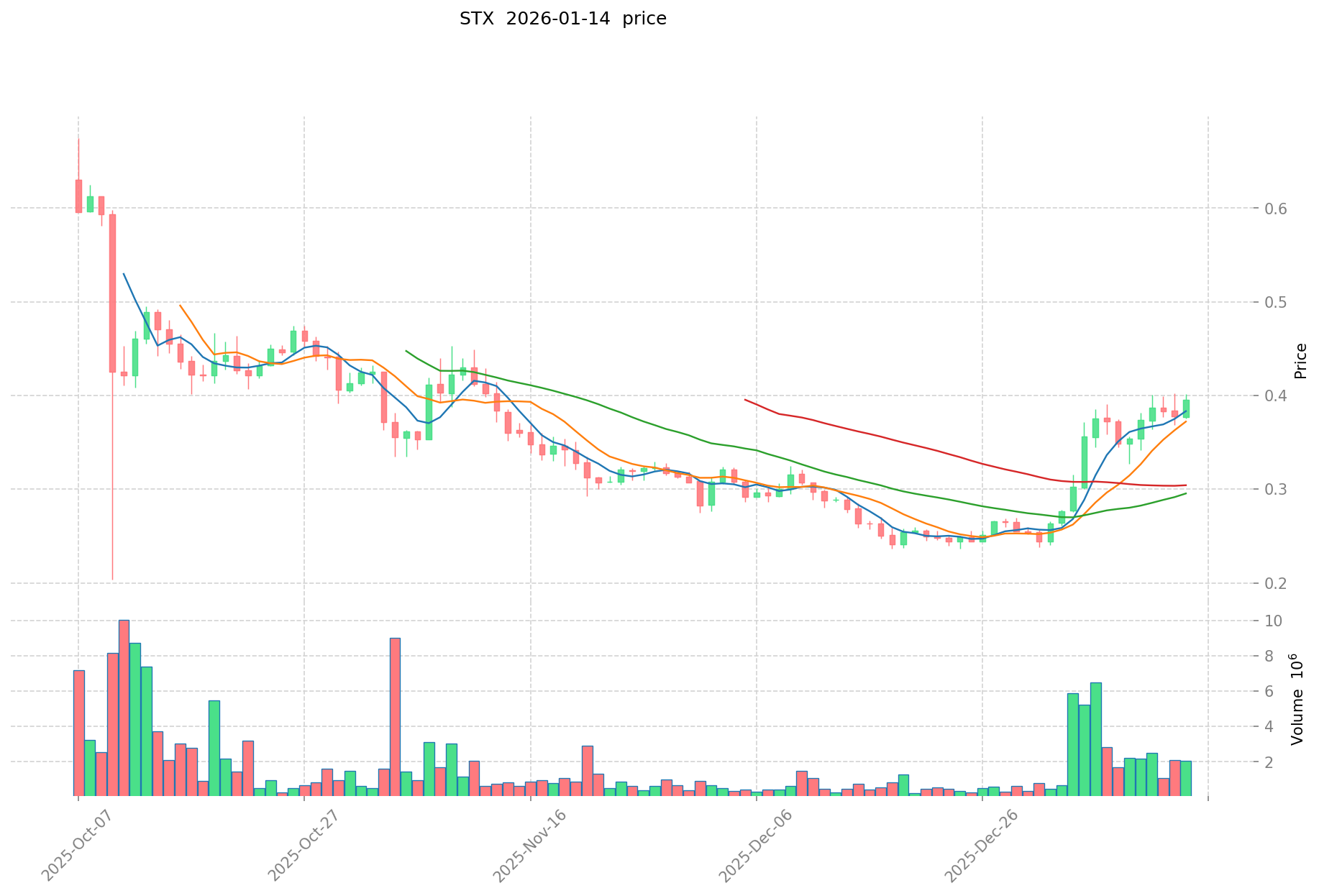
Recent price trends show:
- 1-hour change: -0.51% (decline of $0.002)
- 24-hour change: -0.28% (decline of $0.001)
- 7-day change: +7.39% (increase of $0.027)
- 30-day change: +38.3% (increase of $0.108)
- 1-year change: -73.24% (decline of $1.068)
The current trading price is $0.3902, with 24-hour trading volume reaching $1,868,677.45. The token's market capitalization stands at approximately $711.34 million, representing about 0.020% market dominance in the cryptocurrency sector.
Click to view current STX market price
On-Chain Metrics
- 24-hour Trading Volume: $1.87 million (indicating active market participation)
- Market Cap to Fully Diluted Valuation Ratio: 100% (showing circulating supply closely matches maximum supply)
- Exchange Availability: Listed on 34 cryptocurrency exchanges (demonstrating broad market accessibility)
Stacks Ecosystem Applications and Partners
Core Use Cases
Stacks' ecosystem supports multiple applications:
- DeFi: Projects like ALEX and Arkadiko provide decentralized lending and trading capabilities.
- NFTs and Digital Assets: Platforms such as Gamma and Tradeport drive innovation in digital collectibles and NFT marketplaces.
- Web3 Infrastructure: Stacks enables developers to build decentralized applications with enhanced privacy and user data ownership.
Strategic Partnerships
Stacks has established collaborations with various blockchain projects and technology providers to enhance its technical capabilities and expand its ecosystem.
These partnerships provide a solid foundation for Stacks' ecosystem expansion and interoperability within the broader blockchain landscape.
Controversies and Challenges
Stacks faces the following challenges:
- Technical Considerations: Ongoing development of scalability solutions and transaction throughput optimization
- Regulatory Environment: Navigating evolving cryptocurrency regulations across different jurisdictions
- Competitive Landscape: Differentiation in a growing field of smart contract platforms and Layer-2 solutions
These issues have sparked discussions within the community and market, while also driving Stacks' continuous innovation and development.
Stacks' community demonstrates significant activity, with growing adoption of its decentralized applications and Bitcoin-anchored smart contract capabilities.
On X platform, related posts and hashtags (such as #STX and #Stacks) frequently generate engagement, contributing to ongoing discussions about Bitcoin DeFi and decentralized applications.
Factors such as protocol upgrades, new application launches, and ecosystem developments have energized community participation.
Sentiment on X shows varied perspectives:
- Supporters praise Stacks' Bitcoin-anchored security model, Clarity smart contract language, and focus on user data ownership, viewing it as "bringing smart contracts to Bitcoin" and "enabling true decentralized applications".
- Critics focus on market volatility, technical complexity, and adoption challenges.
Recent trends reflect growing interest in Bitcoin-layer solutions and decentralized application development.
Popular Topics
X users actively discuss Stacks' Proof-of-Transfer consensus mechanism, Bitcoin integration, and privacy-focused application development,
showcasing both its innovative potential and the path toward broader adoption.
- Official Website: Visit Stacks Official Website for features, use cases, and latest updates.
- Blockchain Explorer: Track transactions and network activity at Stacks Explorer.
- X Updates: On X platform, Stacks maintains an active presence through @Stacks,
with posts covering protocol upgrades, ecosystem developments, and community initiatives, generating substantial engagement.
- Community Forum: Join discussions at Stacks Forum for technical discussions and governance proposals.
- Developer Resources: Access documentation and tools at Stacks GitHub for building decentralized applications.
Stacks Future Roadmap
- Ongoing Development: Implementation of Nakamoto Release and improved transaction finality, enhancing network security and performance
- Ecosystem Goals: Expansion of decentralized applications and developer tooling to support broader adoption
- Long-term Vision: Establishing Bitcoin as a programmable smart contract platform while maintaining its security properties
How to Participate in Stacks?
- Purchase Options: STX is available on Gate.com and other cryptocurrency exchanges
- Storage Solutions: Use compatible wallets supporting Stacks blockchain for secure storage
- Participate in Governance: Engage through stacking mechanisms and community proposals to contribute to network decisions
- Build on Ecosystem: Visit developer documentation to create decentralized applications using Clarity smart contract language
Summary
Stacks redefines blockchain capabilities through its Bitcoin-anchored architecture, offering smart contract functionality, enhanced privacy, and user data ownership.
Its active community, comprehensive resources, and innovative approach position it uniquely in the cryptocurrency space.
Despite facing regulatory considerations and technical evolution, Stacks' commitment to innovation and clear development direction secure its role in the future of decentralized technology.
Whether you are a newcomer or experienced participant, Stacks offers compelling opportunities for engagement and exploration in Bitcoin-powered decentralized applications.
FAQ
What is STX? What are the features and uses of Stacks coin?
STX is the native token of Stacks network, enabling smart contracts and Bitcoin settlement. It's used for transaction fees, governance, and Stacking rewards. STX bridges Bitcoin and decentralized applications.
What is the relationship between STX and Bitcoin? Why is STX called Bitcoin's Layer 2?
STX is Bitcoin's Layer 2 solution built on top of Bitcoin to enhance transaction speed and reduce fees. It enables smart contracts and DeFi applications while inheriting Bitcoin's security, solving Bitcoin's scalability limitations.
How to buy and store STX tokens? Which exchanges offer trading?
Purchase STX through major crypto exchanges using fiat or crypto. Store tokens in a personal wallet for security control. STX is tradable on multiple platforms with significant daily trading volume.
What is STX's mining mechanism? How to earn rewards through Proof of Transfer (PoX)?
STX uses Proof of Transfer (PoX) consensus. Stackers lock STX tokens to participate and earn Bitcoin rewards. This mechanism ties STX security to Bitcoin while providing passive income opportunities for participants.
What are the risks of investing in STX? How is the price volatility and market outlook?
STX faces market volatility and regulatory risks. Price fluctuates significantly driven by market sentiment and policy changes. Long-term prospects remain promising as Bitcoin Layer 2 solutions gain adoption, positioning STX for potential growth.
What are the main use cases of STX? What DApps and projects exist in the ecosystem?
STX powers decentralized applications and smart contracts on Bitcoin, particularly in DeFi. Key ecosystem projects include Stacks 2.0 infrastructure, lending protocols, and various DeFi platforms building Bitcoin-native financial services.
* The information is not intended to be and does not constitute financial advice or any other recommendation of any sort offered or endorsed by Gate.