This comprehensive guide explores Sonic, a high-performance EVM-compatible Layer 1 blockchain platform launched by Sonic Labs in 2024 to address DeFi scalability and liquidity fragmentation. The article examines Sonic's technical architecture, including its 10,000 transactions-per-second capacity, sub-second finality, and secure Sonic Gateway bridge to Ethereum. It covers market performance metrics, ecosystem applications, strategic positioning in the competitive blockchain landscape, and community sentiment across social platforms. The guide outlines core use cases in decentralized finance and cross-chain interoperability, analyzes challenges including market volatility and competition, and provides practical guidance for participation through Gate and other exchanges. Whether you are a developer, investor, or DeFi enthusiast, this resource offers essential insights into Sonic's infrastructure capabilities and ecosystem opportunities.
Sonic's Positioning and Significance
In 2024, the Sonic Labs team launched Sonic (S), aiming to address limitations in DeFi infrastructure, including scalability bottlenecks and liquidity fragmentation across blockchain ecosystems.
As an EVM-compatible Layer 1 platform optimized for DeFi applications, Sonic plays a critical role in decentralized finance and cross-chain asset management.
As of 2026, Sonic has established itself as a high-performance blockchain infrastructure provider, featuring 10,000 transactions per second processing capacity and sub-second finality with an active developer ecosystem.
This article provides an in-depth analysis of its technical architecture, market performance, and future potential.
Origin and Development History
Background
Sonic was created by Sonic Labs in 2024, aiming to solve scalability constraints and liquidity inefficiencies that have historically limited DeFi growth.
It emerged during the maturation phase of blockchain technology, with the objective of providing developers with robust infrastructure and users with efficient, secure DeFi experiences.
The launch of Sonic brought new possibilities to DeFi protocols and cross-chain asset management.
Key Milestones
- 2024: Mainnet launch, achieving 10,000 TPS throughput and sub-second transaction finality.
- 2024: Introduction of Sonic Gateway, a secure bridge to Ethereum enabling enhanced liquidity flow and asset security between ecosystems.
- 2025: Integration with major DeFi protocols, with ecosystem applications experiencing significant growth.
- 2025: Price reached $1.03 on January 5, marking a significant milestone in market recognition.
With support from Sonic Labs and its developer community, Sonic continues to refine its technology, security infrastructure, and real-world applications.
How Does Sonic Work?
Decentralized Control
Sonic operates on a globally distributed network of nodes, independent of centralized banking or governmental control.
These nodes collaboratively validate transactions, ensuring system transparency and attack resistance while granting users greater autonomy and enhancing network resilience.
Blockchain Foundation
Sonic's blockchain serves as a public, immutable digital ledger that records every transaction.
Transactions are grouped into blocks and linked through cryptographic hashing to form a secure chain.
Anyone can view the records, establishing trust without intermediaries.
As an EVM-compatible platform, Sonic enables seamless deployment of Ethereum-based smart contracts while delivering enhanced performance.
Maintaining Consensus
Sonic employs a Byzantine Fault Tolerance-based consensus mechanism to validate transactions and prevent fraudulent activities such as double-spending.
Validators maintain network security through node operation and transaction validation, earning S token rewards.
Its innovations include achieving 10,000 TPS with sub-second finality, significantly improving upon traditional blockchain performance metrics.
Secure Transactions
Sonic utilizes public-private key cryptography to protect transactions:
- Private keys (similar to secret passwords) are used to sign transactions
- Public keys (similar to account numbers) are used to verify ownership
This mechanism ensures fund security while maintaining pseudonymous transaction privacy.
The Sonic Gateway bridge incorporates additional security layers for cross-chain asset transfers between Sonic and Ethereum networks.
Circulating Supply Overview
As of January 16, 2026, Sonic's circulating supply stands at 2,880,000,000 tokens, with a total supply of 3,222,625,000 tokens. The coin operates under an uncapped maximum supply model, indicating a potential inflationary mechanism. Currently, approximately 74.04% of the total supply is in circulation, with the market cap to fully diluted valuation ratio reflecting this distribution.
Price Fluctuations
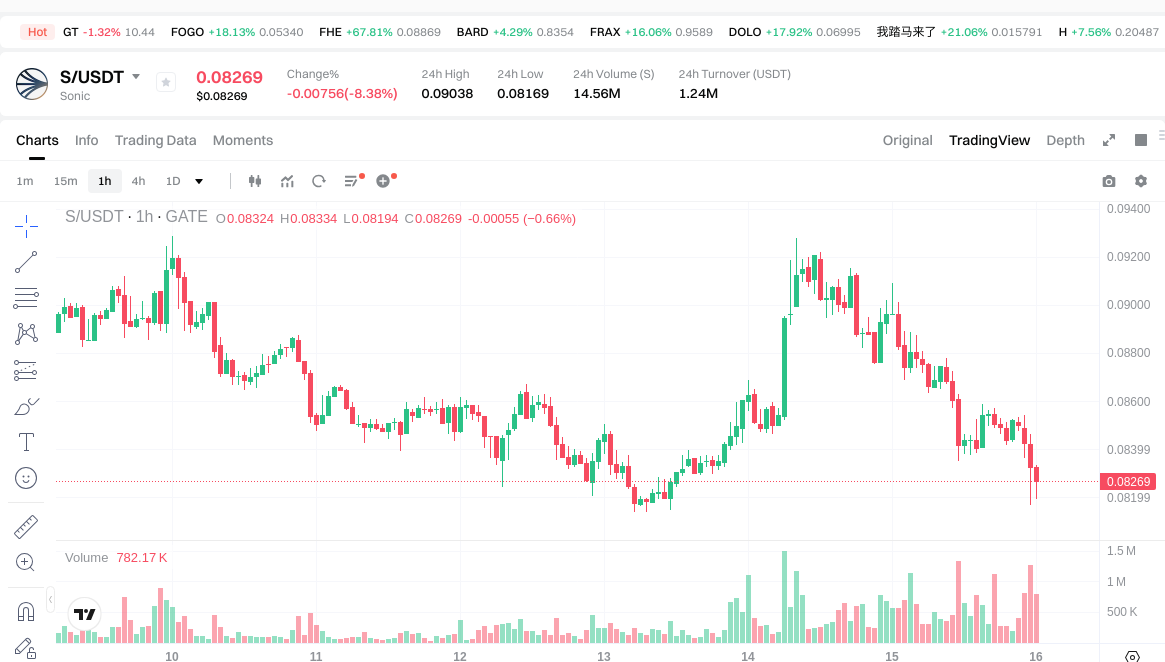
Sonic reached its peak price of $1.03 on January 5, 2025, driven by initial market enthusiasm following its launch as an EVM Layer 1 platform. The token experienced its lowest recorded price of $0.067 on December 24, 2025, reflecting broader market corrections and competitive pressures within the Layer 1 ecosystem. As of the latest update, Sonic trades at $0.082, showing short-term volatility with a 24-hour decline of approximately 8.95% and a 7-day decrease of around 8.83%. These fluctuations illustrate the dynamic nature of market sentiment, adoption rates, and the competitive landscape in the DeFi infrastructure sector.
Click to view current S market price
On-chain Metrics
While specific real-time on-chain metrics are subject to network activity fluctuations, Sonic's infrastructure is designed to support 10,000 transactions per second (TPS) with sub-second finality. The platform includes the Sonic Gateway, a secure bridge to Ethereum that enhances liquidity and asset security for DeFi applications. The trading volume over the past 24 hours reached approximately $1.25 million, indicating ongoing market participation. The token is currently listed on 54 exchanges, providing multiple avenues for liquidity and price discovery.
Sonic Ecosystem Applications and Partners
Core Use Cases
Sonic's ecosystem supports multiple applications:
- DeFi: The platform provides an attractive infrastructure for decentralized finance applications, offering decentralized trading and liquidity solutions with its 10,000 TPS capability and sub-second finality.
- Cross-chain Interoperability: Sonic Gateway serves as a secure bridge to Ethereum, enabling enhanced liquidity and asset security for cross-chain operations.
Strategic Partnerships
While specific partnership details are not provided in the available materials, Sonic's infrastructure capabilities position it to collaborate with projects requiring high-performance blockchain solutions.
These potential partnerships could provide a solid foundation for Sonic's ecosystem expansion.
Controversies and Challenges
Sonic faces the following challenges:
- Technical Considerations: Maintaining 10,000 TPS performance while ensuring network decentralization and security
- Market Competition: Competition from established Layer 1 platforms such as Ethereum and other high-performance chains
- Price Volatility: The token has experienced significant price fluctuations, with a notable decline from its higher levels
These issues have sparked discussions within the community and market, while also driving Sonic's continuous innovation.
Sonic's community demonstrates activity across various channels. The project maintains an active presence on social media platforms, particularly through its official X account.
As of January 16, 2026, the token is listed on 54 exchanges, indicating growing market interest and accessibility.
Sentiment on X presents varied perspectives:
- Supporters praise Sonic's high throughput, sub-second finality, and secure bridge to Ethereum, viewing it as a competitive DeFi infrastructure platform.
- Critics focus on price volatility and market performance challenges, noting the token's decline from earlier levels.
Recent trends show mixed sentiment amid broader market conditions.
Trending Topics
X users actively discuss Sonic's technical capabilities, DeFi potential, and market positioning, showcasing both its innovative infrastructure and the challenges of gaining mainstream adoption in a competitive landscape.
- Official Website: Visit Sonic Labs for features, use cases, and latest updates.
- Blockchain Explorer: Sonic Scan provides detailed on-chain data and transaction information.
- X Updates: On X platform, Sonic uses @SonicLabs to stay active, sharing updates about technical developments, community activities, and ecosystem news.
Sonic Future Roadmap
While specific timeline details are not provided in the materials, Sonic's infrastructure is designed to:
- Continue enhancing its high-performance capabilities with 10,000 TPS and sub-second finality
- Expand DeFi ecosystem applications through its attractive incentive programs
- Strengthen cross-chain connectivity via the Sonic Gateway bridge to Ethereum
How to Participate in Sonic?
- Purchase Options: Buy S tokens on Gate.com and other supporting exchanges
- Storage Solutions: Use EVM-compatible wallets such as MetaMask for secure storage
- Ecosystem Exploration: Visit the official website to explore DeFi opportunities and platform features
- Developer Resources: Access technical documentation to build applications on Sonic's infrastructure
Summary
Sonic, through its blockchain technology, has positioned itself as a high-performance EVM Layer 1 platform, offering 10,000 TPS, sub-second finality, and secure cross-chain bridging.
Its focus on DeFi infrastructure, technical capabilities, and market presence make it notable in the cryptocurrency space.
Despite facing challenges such as market volatility and competition, Sonic's technical innovation and clear infrastructure advantages position it as a platform worth monitoring in the decentralized technology landscape.
Whether you are a newcomer or an experienced participant, Sonic presents opportunities worth exploring.
FAQ
What is Crypto S and how does it work?
Crypto S is a digital asset operating on blockchain technology, enabling secure peer-to-peer transactions. It functions as both a currency for payments and an investment vehicle. The system uses cryptographic protocols to ensure transaction security and asset ownership verification.
What are the main use cases and benefits of Crypto S?
Crypto S enables fast, low-cost transactions with enhanced security and transparency. Key uses include cross-border payments, smart contracts, and decentralized finance. Benefits include reduced fees, improved efficiency, and greater control over assets.
How can I buy or acquire Crypto S?
You can acquire Crypto S through peer-to-peer transfers, staking rewards, or purchasing via crypto payment platforms using credit/debit cards or bank transfers. Check official channels for recommended purchase methods.
What are the risks and security considerations for Crypto S?
Crypto S faces cybersecurity threats from insecure private key storage, market volatility, and regulatory uncertainty. Implement strong security practices, use hardware wallets, and enable two-factor authentication to mitigate risks effectively.
How does Crypto S compare to other cryptocurrencies or blockchain projects?
Crypto S leverages Proof of Stake for enhanced scalability and energy efficiency, delivering faster transaction speeds and lower fees than Bitcoin's Proof of Work model. It combines security with accessibility, positioning itself as a practical alternative for modern blockchain applications.
* The information is not intended to be and does not constitute financial advice or any other recommendation of any sort offered or endorsed by Gate.