Swash is a decentralized data monetization platform launched in 2021 that empowers users to earn passive income from their data while maintaining privacy. Built on blockchain technology, Swash eliminates centralized control and enables fair compensation through SWASH tokens. The platform operates a privacy-preserving ecosystem where users share browsing data via browser extension, while businesses access ethical data for research and development. With approximately 995 million tokens in circulation across Ethereum and Polygon networks, Swash serves data monetization, marketplace, and developer application use cases. Despite market volatility and adoption challenges, the platform represents an innovative Web3 solution for reshaping how individuals participate in the data economy. Users can purchase SWASH tokens on Gate and engage directly through the Swash browser extension.
Swash's Positioning and Significance
In 2021, the Swash team launched Swash (SWASH), aiming to address data ownership inequality and inefficient data monetization.
As a data economy ecosystem empowering users through privacy-preserving data sharing, Swash plays a key role in decentralized data markets and Web3 infrastructure.
As of 2026, Swash has established itself as a data monetization platform with an active community of holders and participants in the data economy.
This article will provide an in-depth analysis of its technical architecture, market performance, and future potential.
Origin and Development History
Birth Background
Swash was created by its founding team in 2021, aiming to solve data exploitation by centralized platforms and lack of user compensation for personal data.
It emerged during the Web3 and decentralized data movement, with the goal of enabling individuals to earn income from their data while preserving privacy and transforming the current landscape.
Swash's launch brought new possibilities for individuals, businesses, and developers seeking fair data exchange.
Important Milestones
- 2021: Platform launch on October 29, introducing privacy-preserving data sharing mechanisms.
- Ongoing development: Expansion of the ecosystem with tools and services for data aggregation and monetization.
- Community growth: The platform has attracted 2,320 holders participating in the data economy ecosystem.
With support from its community and development team, Swash continues to optimize its technology, security, and real-world applications.
How Does Swash Work?
No Central Control
Swash operates on a decentralized infrastructure where users maintain control over their data, eliminating dependence on centralized platforms or data brokers.
This distributed approach ensures transparency and resistance to manipulation, granting users greater autonomy and enhancing network resilience.
Blockchain Foundation
Swash's ecosystem leverages blockchain technology to create a transparent and immutable record of data sharing transactions.
The system enables secure data exchange without intermediaries, building trust through cryptographic verification.
Users can participate in the data economy knowing their contributions are verifiably recorded on-chain.
Ensuring Fairness
Swash implements mechanisms to ensure fair compensation for data contributors while maintaining privacy standards.
Participants earn SWASH tokens by sharing their data through the platform's tools and services.
The system's innovation includes privacy-preserving technologies that allow data monetization without compromising user anonymity.
Secure Transactions
Swash utilizes cryptographic techniques to protect user data and transactions:
- Private keys secure user accounts and authorize data sharing
- Public addresses enable transparent verification of token distributions
This mechanism ensures data security while transactions maintain appropriate privacy levels for participants in the data economy.
The platform incorporates additional security features to protect user privacy throughout the data sharing process.
Circulating Supply Overview
As of February 01, 2026, Swash's circulating supply stands at 994,960,022.36 tokens, with a total supply of 1,000,000,000 tokens. The circulating supply represents approximately 99.93% of the total supply, indicating that the token distribution is approaching completion. The maximum supply is capped at 995,675,233.84 tokens, establishing a fixed supply model that may contribute to scarcity dynamics over time.
Price Fluctuations
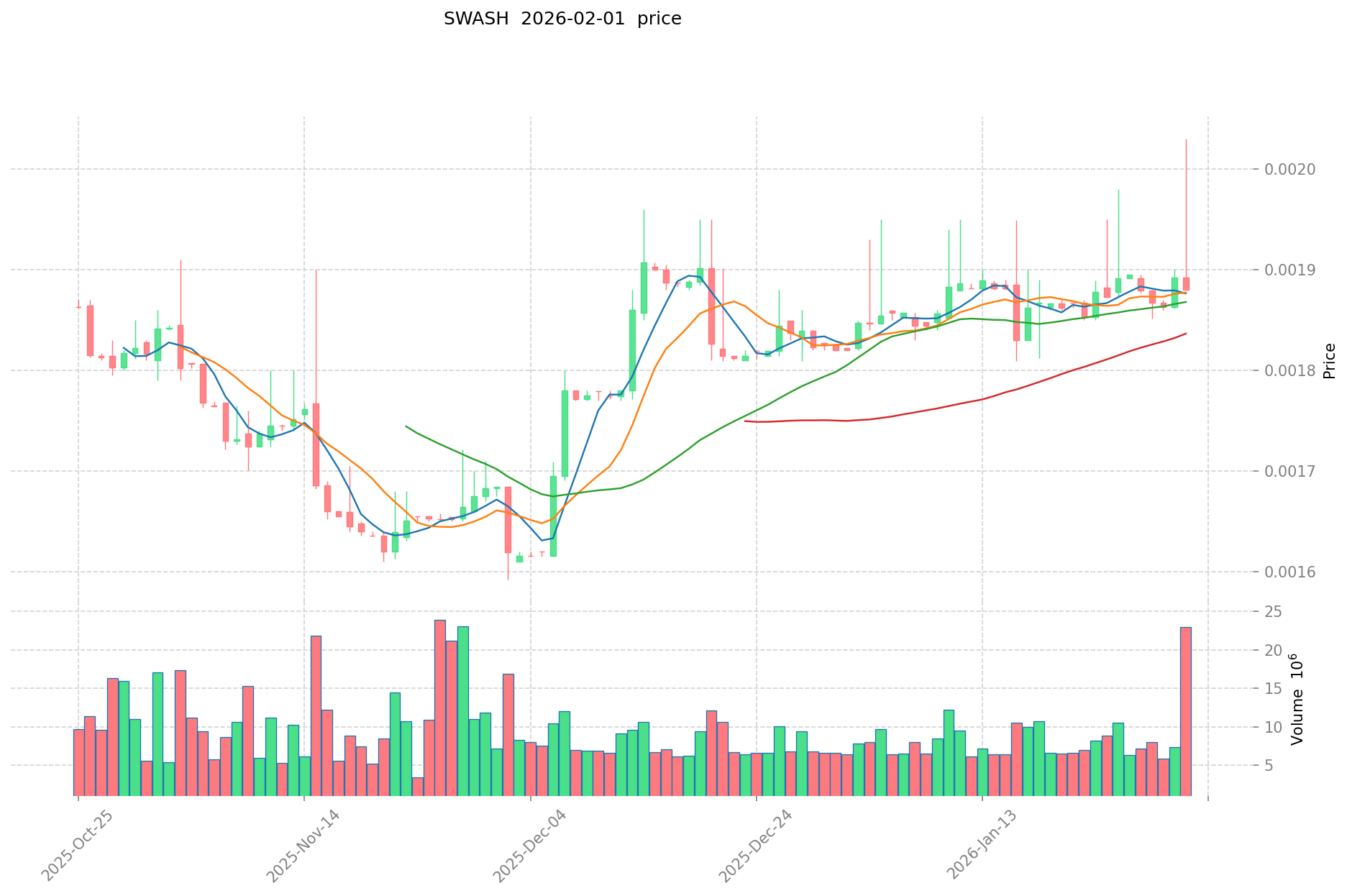
Swash reached its peak price of $0.95025 on October 31, 2021, during a period of heightened interest in data economy and privacy-focused blockchain projects. The token experienced its lowest recorded price of $0.00159234 on December 02, 2025, reflecting broader market challenges and shifting sentiment in the cryptocurrency sector. As of the current reporting period, SWASH trades at $0.00196, showing a 24-hour price increase of 3.81% and a 7-day gain of 3.17%. However, the token has experienced a year-over-year decline of 62.89%, illustrating the volatility characteristic of digital asset markets. These price movements reflect various factors including market sentiment, adoption trends, and external market conditions.
Click to view current SWASH market price
On-chain Metrics
- Market Capitalization: Approximately $1.95 million (reflecting current valuation)
- 24-Hour Trading Volume: $16,246.48 (indicating current market activity)
- Token Holders: 2,320 addresses (demonstrating community distribution)
- Market Dominance: 0.000070% (representing position within the broader cryptocurrency market)
Swash Ecosystem Applications and Partnerships
Core Use Cases
Swash's ecosystem supports multiple applications centered around data economy:
- Data Monetization: Users can share browsing and online activity data through Swash's browser extension, earning passive income while maintaining privacy.
- Data Marketplace: Businesses and developers access high-quality, ethically-sourced data for market research, product development, and analytics within a compliant framework.
Strategic Collaborations
Swash operates within a collaborative framework that enables developers to build data economy systems. The platform emphasizes sustainable and compliant data access for enterprises, providing a foundation for ecosystem expansion through its tools and services architecture.
Controversies and Challenges
Swash faces several challenges in the evolving data economy landscape:
- Market Competition: The data monetization space includes various platforms competing for user adoption and enterprise partnerships.
- Price Volatility: The token has experienced significant fluctuations, with current trading levels substantially below previous periods.
- User Adoption: Converting traditional internet users to active data contributors requires ongoing education and incentive optimization.
These challenges drive continuous innovation in Swash's approach to data sharing and privacy preservation.
Swash has built a growing community with 2,320 token holders as of February 2026. The platform's approach to data ownership and monetization has attracted users interested in earning from their digital footprint while maintaining control over personal information.
Discussions around Swash on social platforms reflect diverse perspectives:
- Supporters emphasize Swash's privacy-preserving data sharing model and passive income potential, viewing it as a solution to centralized data exploitation.
- Critics focus on token price performance and market adoption challenges, questioning the scalability of the data monetization model.
Recent market data shows the token trading at $0.00196 with a 24-hour increase of 3.81%.
Hot Topics
Community discussions frequently address sustainable data economy models, privacy technology implementation, and tokenomics related to data value distribution, highlighting both the transformative potential and adoption barriers in mainstream data markets.
- Official Website: Visit Swash Official Site for features, use cases, and latest updates.
- X Updates: Swash maintains an active presence on X platform at @swashapp, sharing updates about technology development, community initiatives, and ecosystem growth.
- GitHub: Technical documentation and open-source contributions are available at Swash GitHub.
Swash Future Roadmap
- Ecosystem Development: Expanding the collaborative framework for developers to build data economy applications
- Privacy Technology: Enhancing security protocols to strengthen user data protection while enabling value monetization
- Long-term Vision: Establishing a comprehensive data economy ecosystem where individuals, businesses, and developers can participate equitably in data value creation
How to Participate in Swash?
- Purchase Options: SWASH tokens are available on Gate.com
- Storage Solutions: Tokens can be stored in compatible wallets supporting ERC-20 tokens (Ethereum network) or Polygon network addresses
- Ecosystem Participation: Install the Swash browser extension to begin contributing data and earning rewards
- Developer Engagement: Access development resources through official channels to build data economy applications
Summary
Swash represents an innovative approach to data economy, offering privacy-preserving monetization, ethical data access for businesses, and a collaborative development framework. With approximately 995 million tokens in circulation and deployment on both Ethereum and Polygon networks, the platform provides infrastructure for individuals to earn from their data contributions.
Despite facing market volatility and adoption challenges, Swash's focus on sustainable data sharing and user privacy positions it as a noteworthy project in the decentralized data economy space. Whether you're interested in data monetization, privacy technology, or building data-driven applications, Swash offers various participation opportunities in reshaping how digital information creates and distributes value.
FAQ
What is SWASH and how does it work?
SWASH is a decentralized data monetization platform that rewards users for sharing their browsing data and online activity. Users earn SWASH tokens by installing the browser extension, which anonymously collects data that's sold to researchers and marketers, creating value for participants in the Web3 ecosystem.
What are the main features and use cases of SWASH token?
SWASH token powers Swash Ads, Data Union, Compute, DAO governance, Earn, and Intelligence. It enables brands to advertise, users to monetize data ownership, researchers to conduct surveys, and community members to vote on protocol decisions.
How can I buy or earn SWASH tokens?
You can buy SWASH tokens through various platforms via deposit methods like Pix. Alternatively, earn SWASH by participating in the Swash ecosystem, completing tasks, or staking your tokens for rewards.
What is the difference between SWASH and other crypto projects?
SWASH is built on the Data Union DAO protocol, a unique framework shared by six other data unions. Unlike typical crypto projects, SWASH focuses on data exchange and monetization, allowing users to earn rewards by sharing their data through a decentralized ecosystem.
Is SWASH a safe investment? What are the risks?
SWASH offers potential returns through data monetization, but carries crypto market volatility risks. Research thoroughly and invest only what you can afford to lose. Market conditions fluctuate significantly.
What is the tokenomics and supply of SWASH?
SWASH has a total supply of 1 billion tokens. As a native utility token, it powers the ecosystem with various use cases including governance, rewards, and cross-platform functionality.
Who are the team members and backers behind SWASH?
Swash is led by Arion, founded by Erik Joosten in 1994. The primary backers are Arion and its founder Erik Joosten, who established the company with a mission to innovate in the data monetization space.
What is the roadmap and future plans for SWASH?
SWASH plans to launch enhanced versions of sApps including sAd, sAdvisory, and sAirdrop, while upgrading sCompute infrastructure. Future roadmap focuses on improving data monetization functionality and user experience across the platform ecosystem.
* The information is not intended to be and does not constitute financial advice or any other recommendation of any sort offered or endorsed by Gate.