Syndicate (SYND) is a breakthrough innovation in smart sequencer technology launched in 2025, addressing high costs and lack of programmability in blockchain networks. This comprehensive guide explores how Syndicate transforms rollups and sequencers into programmable smart contracts, delivering 100x cost reduction compared to traditional solutions. With a market cap of approximately $25.46 million and presence on Gate and 14 other exchanges, Syndicate demonstrates early-stage adoption in the Layer 2 infrastructure space. The article covers Syndicate's technical architecture, decentralized operational model, tokenomics with 478.7 million circulating tokens, and real-world applications for developers. Perfect for blockchain developers and investors seeking to understand next-generation scalable infrastructure and application-network layer innovation.
Syndicate's Position and Significance
In 2025, Syndicate launched Syndicate (SYND), aiming to address high costs and lack of programmability at the blockchain network level.
As a breakthrough innovation in smart sequencer technology, Syndicate plays a key role in the rollup ecosystem and application-network layer.
As of 2026, Syndicate has emerged as a significant player in the rollup infrastructure space, with a market cap of approximately $25.46 million and an active development community.
This article will provide an in-depth analysis of its technical architecture, market performance, and future potential.
Origin and Development History
Birth Background
Syndicate was created by its founding team in 2025, aiming to solve the lack of programmability and high operational costs in rollup sequencers.
It emerged during the rapid expansion of Layer 2 solutions and rollup technology, with the goal of transforming rollups and sequencers into smart contracts to reduce costs by 100x and change the existing paradigm.
The launch of Syndicate brought new possibilities for developers building at the application-network layer.
Important Milestones
- 2025: Mainnet launched on January 20, 2025, achieving the transformation of sequencers into programmable smart contracts.
- 2025: Token reached all-time high of $1.2835 on September 23, 2025.
- 2026: As of January 22, 2026, the project maintains 918 token holders and is listed on 15 exchanges.
With community and foundation support, Syndicate continues to optimize its technology, security, and real-world applications.
How Syndicate Works
No Central Control
Syndicate operates on a decentralized network of computers (nodes) distributed globally, free from control by banks or governments.
These nodes collaborate to validate transactions, ensuring the system remains transparent and attack-resistant, granting users greater autonomy and enhancing network resilience.
Blockchain Core
Syndicate's blockchain is a public, immutable digital ledger that records every transaction.
Transactions are grouped into blocks and linked through cryptographic hashing to form a secure chain.
Anyone can view the records, establishing trust without intermediaries.
The Smart Sequencer and Smart Rollup technology further enhances performance by bringing programmability to the network level.
Ensuring Fairness
Syndicate employs its innovative architecture to validate transactions and prevent fraud such as double-spending.
Network participants maintain security by running nodes and participating in the sequencer operations, receiving SYND rewards.
Its innovation includes dramatically reduced costs and enhanced programmability at the infrastructure layer.
Secure Transactions
Syndicate uses public-private key cryptography to protect transactions:
- Private key (like a secret password) is used to sign transactions
- Public key (like an account number) is used to verify ownership
This mechanism ensures fund security while transactions maintain appropriate privacy levels.
The platform is built on the ERC-20 standard on the Ethereum blockchain, leveraging established security practices.
Circulation Overview
As of January 22, 2026, Syndicate's circulating supply stands at 478,700,000 tokens, with a total supply of 1,000,000,000 SYND. The maximum supply is capped at 1,000,000,000 tokens, representing a fixed supply model.
The circulating supply represents approximately 59.12% of the total supply, with new tokens entering the market according to the project's distribution schedule. The controlled release mechanism influences the token's supply-demand dynamics.
Price Volatility
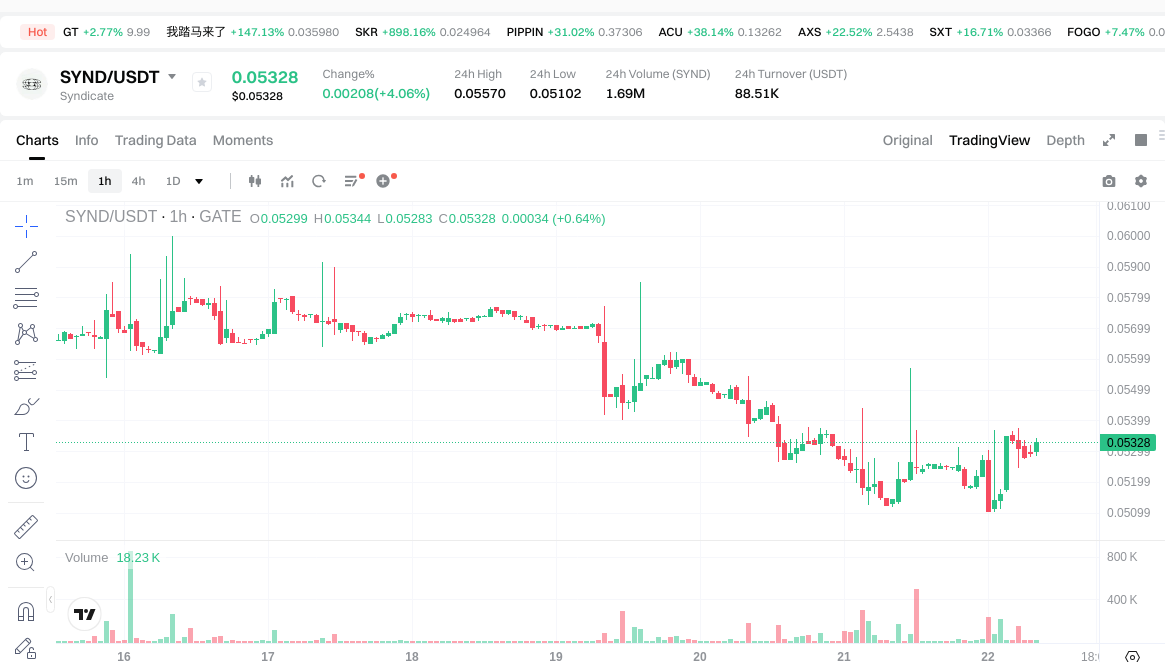
Syndicate experienced its peak valuation on September 23, 2025, reaching $1.2835 during a period of heightened market activity and ecosystem development. The token demonstrated considerable growth from its initial trading phase as adoption momentum built within its target market segments.
The lowest recorded price was $0.05102, observed on January 21, 2026, reflecting broader market adjustments and consolidation patterns. This fluctuation occurred just one day prior to the current date, indicating recent volatility in trading activity.
These price movements reflect evolving market sentiment, adoption patterns, and the broader cryptocurrency market environment. The current trading price of $0.05319 represents a 3.8% increase over the past 24 hours, though the token has experienced a -9.77% decline over the past 7 days and a -7.9% decrease over the past 30 days.
Click to view the current SYND market price
On-Chain Metrics
- Holder Count: 918 addresses (indicating the current distribution of token ownership across the network)
- 24-Hour Trading Volume: $88,279.98 (demonstrating recent market liquidity and trading activity)
- Market Capitalization: $25,462,053 (representing the current market valuation based on circulating supply)
Syndicate Ecosystem Applications and Partners
Core Use Cases
Syndicate's ecosystem supports transformative applications in blockchain infrastructure:
- Developer Infrastructure: Smart Rollups and Smart Sequencers provide programmable network-level infrastructure, enabling developers to build custom application-network layers with significantly reduced operational costs.
- Cost Optimization: The platform offers 100x cost reduction compared to traditional rollup solutions, making blockchain development more accessible and economically viable.
Strategic Collaborations
While specific partnership details were not extensively documented in available materials, Syndicate's technical architecture positions it as an infrastructure layer that can integrate with various blockchain ecosystems and development tools.
Challenges and Considerations
Syndicate faces several industry-standard challenges:
- Technical Complexity: Implementing smart sequencers at the network level requires sophisticated engineering and ongoing optimization
- Market Competition: The Layer 2 and rollup infrastructure space includes numerous established solutions competing for developer adoption
- Adoption Curve: Converting traditional rollup implementations to smart contract-based sequencers represents a paradigm shift that may require education and time
These factors drive continuous innovation within the Syndicate ecosystem and broader community discussions about next-generation blockchain architecture.
Syndicate maintains an active presence across multiple platforms. The project's X (formerly Twitter) account at @syndicateio serves as a primary communication channel with the community.
The token's market performance shows notable activity, with 24-hour trading volume reaching approximately $88,279 and a circulating supply of 478.7 million SYND tokens representing 59.12% of the total supply.
Market Sentiment Analysis
Market sentiment around Syndicate reflects typical cryptocurrency volatility patterns:
- Short-term movements: The token showed a 3.8% increase over 24 hours and 0.62% gain in the past hour
- Recent trends: A 7-day decline of 9.77% and 30-day decrease of 7.9% indicate recent market adjustments
- Trading activity: With 15 exchanges listing SYND and 918 token holders, the project demonstrates growing but early-stage adoption
Key topics of interest within the Syndicate community likely include:
- The innovative approach to combining rollups with smart contract functionality
- Cost reduction potential compared to traditional Layer 2 solutions
- Implementation strategies for smart sequencers
- Future applications of programmable network infrastructure
- Official Website: Visit Syndicate's official site for comprehensive information about features, use cases, and latest developments.
- Whitepaper: The Syndicate Litepaper details the technical architecture, objectives, and vision for Smart Rollups with Smart Sequencers.
- X Platform: Syndicate maintains an active presence on X through @syndicateio, sharing updates about technical developments, community activities, and ecosystem growth.
- Blockchain Explorer: Track SYND token transactions and smart contract activity on Etherscan.
Syndicate Future Roadmap
While specific timeline details were not provided in available materials, Syndicate's development direction focuses on:
- Advancing Smart Rollup technology to enhance programmability at the network level
- Expanding the ecosystem of applications built on Smart Sequencers
- Demonstrating cost efficiency improvements in real-world implementations
- Growing developer adoption of the programmable network infrastructure
How to Participate in Syndicate?
- Purchase Options: SYND tokens are available on Gate.com and 14 other cryptocurrency exchanges
- Storage Solutions: As an ERC-20 token on Ethereum, SYND can be stored in compatible wallets that support Ethereum-based assets
- Contract Address: 0x1bab804803159ad84b8854581aa53ac72455614e (Ethereum mainnet)
- Ecosystem Engagement: Visit the official documentation and website to explore development opportunities and technical specifications
Summary
Syndicate represents an innovative approach to blockchain infrastructure by transforming rollups and sequencers into programmable smart contracts. The project's focus on network-level programmability and substantial cost reduction positions it as a potential catalyst for the next wave of application-network layer innovation.
With a circulating market cap of approximately $25.46 million and presence across 15 exchanges, Syndicate demonstrates early-stage market adoption. The token launched in January 2025 with a total supply of 1 billion SYND tokens.
Despite facing common industry challenges including technical complexity and competitive market dynamics, Syndicate's novel architectural approach and clear value proposition in cost reduction make it a project worth monitoring in the evolving Layer 2 and rollup infrastructure space.
Whether you're a blockchain developer interested in programmable network infrastructure or an investor exploring emerging Layer 2 solutions, Syndicate offers a unique perspective on the future of scalable blockchain architecture.
FAQ
What is SYND crypto and what does it do?
SYND is a blockchain-based cryptocurrency designed to facilitate decentralized transactions and ecosystem governance. It enables users to participate in network validation, access DeFi protocols, and earn rewards through staking mechanisms while supporting community-driven development initiatives.
How can I buy and store SYND tokens?
You can purchase SYND tokens on major cryptocurrency exchanges through fiat or crypto payment methods. For storage, use hardware wallets like Ledger or Trezor for maximum security, or reputable custodial wallets for convenience and accessibility.
What is the total supply and tokenomics of SYND?
SYND has a maximum total supply of 1 billion tokens. The tokenomics feature a deflationary mechanism with quarterly burns, community rewards allocation, and strategic reserves for development and partnerships.
Is SYND a safe investment and what are the risks?
SYND offers strong fundamentals with active development and community support. Like all cryptocurrencies, it carries market volatility risks. Conduct thorough research before investing. Potential rewards correlate with market adoption and ecosystem growth.
What blockchain network does SYND operate on?
SYND operates on the Ethereum blockchain network, leveraging its robust infrastructure and security features to ensure reliable token transactions and smart contract functionality within the Web3 ecosystem.
How does SYND compare to other similar cryptocurrency projects?
SYND stands out with its innovative tokenomics, efficient blockchain architecture, and strong community governance. Unlike competitors, SYND offers superior transaction speeds, lower fees, and unique value propositions through its decentralized ecosystem, making it a compelling choice for users seeking advanced Web3 solutions.
* The information is not intended to be and does not constitute financial advice or any other recommendation of any sort offered or endorsed by Gate.