Trusta.AI is a decentralized identity verification platform leveraging blockchain technology to establish trusted infrastructure for both human and artificial intelligence in crypto ecosystems. This comprehensive guide explores its technical architecture built on BEP-20 and Linea standards, market performance metrics including 3,078 token holders and $6.68M market cap, and core applications in identity verification and credit systems. The article details Trusta.AI's development milestones, security mechanisms using cryptographic protocols, and ecosystem partnerships driving adoption. Readers will understand how to participate through Gate.com, analyze on-chain metrics, and evaluate community sentiment on social platforms. Whether you're analyzing technical indicators or exploring decentralized identity solutions, this guide provides essential insights into Trusta.AI's role in shaping AI-blockchain convergence and future mainstream adoption challenges.
Trusta.AI (TA) Positioning and Significance
In the era of artificial intelligence, Trusta.AI (TA) was launched to address trust and identity verification challenges in both AI and cryptocurrency ecosystems.
As a trusted identity network platform, Trusta.AI plays a critical role in establishing universal credit systems for all forms of intelligence—human and artificial.
As of 2026, Trusta.AI has positioned itself within the crypto market with a circulating supply of 180 million tokens and an active holder base of 3,078 participants.
This article provides an in-depth analysis of its technical framework, market performance, and future potential.
Origin and Development History
Background of Creation
Trusta.AI was created to solve identity verification and trust establishment issues in the convergence of AI and cryptocurrency.
It emerged during the rapid evolution of AI technology and blockchain adoption, aiming to create a reliable identity infrastructure that serves both human users and artificial intelligence systems.
The launch of Trusta.AI brought new possibilities for trust-based interactions in decentralized environments.
Key Milestones
- 2025: Token launched on Gate.com on September 2nd with an initial price of $0.1.
- 2025: Achieved deployment on BSC and Linea networks, enabling cross-chain functionality.
- 2025: Price reached an all-time high of $0.3854 on September 2nd.
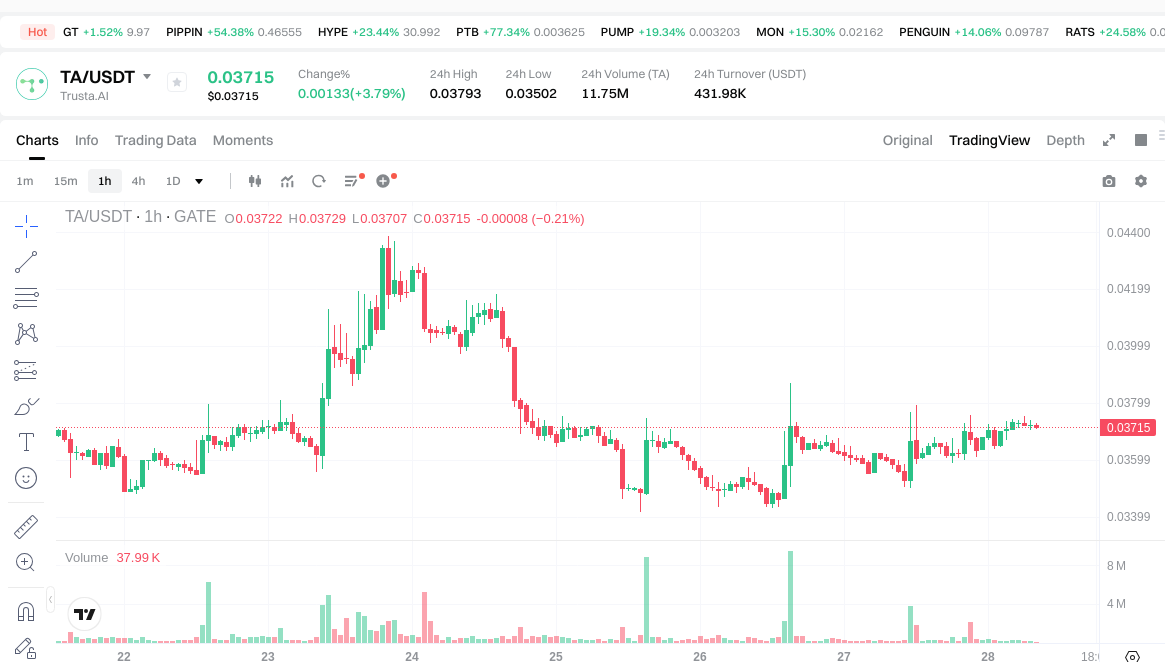
- 2026: As of January 28th, the token trades at approximately $0.03713 with a 24-hour trading volume of $432,307.
With support from its development community and early adopters, Trusta.AI continues to refine its technology and expand real-world applications in identity verification.
How Trusta.AI Works
Decentralized Architecture
Trusta.AI operates within decentralized networks, eliminating reliance on centralized authorities for identity verification.
The distributed infrastructure enables transparent validation of identity credentials while maintaining user privacy and system resilience against single points of failure.
Blockchain Foundation
Trusta.AI's infrastructure leverages blockchain technology as a transparent and immutable ledger for recording identity verification activities.
Transactions and identity attestations are grouped into blocks and secured through cryptographic hashing.
Anyone can verify records without requiring intermediaries, establishing trust through technological transparency.
The platform operates on BEP-20 (BSC) and Linea standards, enabling multi-chain compatibility and enhanced accessibility.
Security Mechanisms
Trusta.AI employs cryptographic security protocols to protect identity data:
- Private keys secure user identity credentials and authorization signatures
- Public verification mechanisms enable credential validation without exposing sensitive information
This framework ensures data security while maintaining appropriate levels of privacy for identity verification processes.
The system incorporates additional security layers designed to prevent unauthorized access and maintain data integrity across the network.
Circulation Overview
As of January 28, 2026, Trusta.AI has a circulating supply of 180,000,000 tokens, with a total supply of 1,000,000,000 tokens, representing a circulation ratio of approximately 18%. The maximum supply is capped at 1,000,000,000 tokens, establishing a fixed supply model.
The current token distribution influences supply and demand dynamics within the market. The circulating tokens represent a portion of the total allocation designed to support ecosystem growth and community participation.
Price Fluctuations
Trusta.AI reached a notable price level of $0.3854 on September 2, 2025, driven by factors such as increased market interest in AI-related blockchain projects and growing adoption of decentralized identity solutions.
The lowest recorded price was $0.01652, occurring on October 10, 2025, influenced by broader market corrections and adjustments in the cryptocurrency sector.
These price movements reflect evolving market sentiment, adoption trends, and various external factors affecting the AI and cryptocurrency sectors.
Click to view the current TA market price
On-Chain Metrics
- Token holders: Approximately 3,078 addresses (indicating community distribution)
- 24-hour trading volume: $432,307.53 (reflecting current market activity)
- Market capitalization: $6,683,400 (representing circulating supply valuation)
- Fully diluted valuation: $37,130,000 (based on maximum supply)
The project operates on multiple blockchain networks, with contract deployments on BSC and Linea, utilizing BEP-20 and Linea standards for token implementation.
Trusta.AI Ecosystem Applications and Partners
Core Use Cases
Trusta.AI's ecosystem supports multiple applications:
- Identity Verification: Trusta.AI provides decentralized identity verification solutions for both human and AI entities.
- Credit System: The platform establishes a universal credit infrastructure for crypto and AI applications.
Strategic Partnerships
Trusta.AI collaborates with partners in the blockchain and AI sectors to enhance its technical capabilities and market reach.
These partnerships provide a solid foundation for Trusta.AI's ecosystem expansion.
Controversies and Challenges
Trusta.AI faces the following challenges:
- Technical Hurdles: Building a comprehensive identity network that serves both human and AI intelligence
- Market Competition: Competing with established identity verification solutions in the crypto space
These issues have sparked discussions within the community and market, while also driving Trusta.AI's continuous innovation.
Trusta.AI's community shows growing interest, with 3,078 token holders as of January 28, 2026.
On X platform, relevant posts and hashtags (such as #TrustaAI) generate engagement.
The platform's development updates and identity verification features have attracted community attention.
Sentiment on X displays mixed perspectives:
- Supporters praise Trusta.AI's focus on trusted identity infrastructure and AI-crypto integration, viewing it as a promising solution for the evolving digital identity landscape.
- Critics focus on market volatility and the competitive nature of the identity verification sector.
Recent trends indicate interest in AI-powered blockchain solutions.
Popular Topics
X users discuss Trusta.AI's identity verification approach, AI integration, and its role in establishing credit systems,
showcasing both its transformative potential and the challenges of mainstream adoption.
- Official Website: Visit Trusta.AI website for features, use cases, and latest updates.
- Whitepaper: Trusta.AI Whitepaper details its technical architecture, objectives, and vision.
- X Updates: On X platform, Trusta.AI maintains an active presence at @TrustaLabs,
with posts covering platform developments, community activities, and partnership announcements.
Trusta.AI Future Roadmap
- Ecosystem Goals: Expand the trusted identity network to serve broader AI and crypto applications
- Long-term Vision: Become a foundational infrastructure for identity verification in the AI era
How to Participate in Trusta.AI?
- Purchase Options: Buy TA on Gate.com and other supported exchanges
- Storage Solutions: Use compatible wallets supporting BEP-20 and Linea networks for secure storage
- Engage with Ecosystem: Follow official channels for updates on identity verification services and platform development
- Build on Platform: Visit developer documentation to explore integration opportunities
Summary
Trusta.AI is redefining identity verification through blockchain technology, offering a trusted network for both human and AI intelligence.
Its growing community, clear vision, and focus on AI-crypto convergence position it within the decentralized identity sector.
Despite facing technical challenges and market competition, Trusta.AI's innovative approach and development roadmap give it a meaningful role in the future of decentralized identity technology.
Whether you are new to crypto or an experienced participant, Trusta.AI presents an interesting project to follow.
FAQ
What is Crypto Technical Analysis (Crypto TA)?
Crypto TA is an analysis method that predicts future market trends using historical price and trading volume data. It employs charts and indicators to identify patterns and trading opportunities in cryptocurrency markets.
What are the commonly used indicators in cryptocurrency technical analysis?
Common crypto TA indicators include Moving Average (MA), Relative Strength Index (RSI), MACD, Bollinger Bands, and Stochastic Oscillator (KD). These tools help traders identify trends, momentum, and potential price movements in the market.
How to use candlestick charts for cryptocurrency trading decisions?
Candlestick charts display open, close, high, and low prices. Green candles indicate price increases, red candles indicate decreases. Analyze wicks to identify support and resistance levels. Combine candlestick patterns with volume and other technical indicators for informed trading decisions.
How accurate is technical analysis in cryptocurrency trading?
Technical analysis in crypto trading shows varying accuracy, depending on market sentiment and trading volume. Indicators like RSI and moving averages are commonly effective, but results aren't always reliable due to high market volatility.
What is the difference between technical analysis and fundamental analysis in cryptocurrency?
Technical analysis uses charts and indicators to predict price movements based on historical data. Fundamental analysis evaluates a project's underlying value, technology, and team. Technical analysis is short-term focused; fundamental analysis is long-term focused.
How do beginners learn and apply cryptocurrency technical analysis?
Start by mastering candlestick charts and K-lines, then learn key indicators like moving averages, RSI, and MACD. Use TradingView for practice, analyze trading volume and price trends, combine multiple indicators for confirmation, and practice consistent pattern recognition to identify entry and exit points.
* The information is not intended to be and does not constitute financial advice or any other recommendation of any sort offered or endorsed by Gate.