Tars AI (TAI) is a modular AI-driven Web3 infrastructure platform launched by the Tars Protocol team in 2024, designed to address scalability challenges and AI integration barriers in blockchain development. Operating on decentralized networks with blockchain-core technology, TAI offers modular solutions, AI-driven automation, and comprehensive BaaS (Blockchain-as-a-Service) capabilities. As of January 2026, TAI has established significant market presence with over 71,000 token holders and listings on Gate and 12 other exchanges. The article provides in-depth analysis of TAI's technical architecture, market performance metrics, ecosystem applications, and current challenges including price volatility (91.79% annual decline). This comprehensive guide explores TAI's position in the AI-powered blockchain sector, investment opportunities, storage solutions, and future potential for Web3 developers and crypto participants seeking innovative infrastructure solutions.
Tars AI's Positioning and Significance
In 2024, the Tars Protocol team launched Tars AI (TAI), aiming to address challenges in Web3 infrastructure scalability and AI integration barriers.
As a modular AI-driven Web3 infrastructure platform, Tars AI plays a key role in decentralized application development and blockchain-as-a-service solutions.
As of 2026, Tars AI has established itself as an emerging player in the AI-powered blockchain infrastructure sector, with over 71,000 token holders and an active development community.
This article will provide an in-depth analysis of its technical architecture, market performance, and future potential.
Origin and Development History
Birth Background
Tars AI was created by the Tars Protocol team in 2024, aiming to solve the complexity of Web3 infrastructure deployment and the lack of AI integration in blockchain applications.
It emerged during the convergence of artificial intelligence and blockchain technology, with the goal of providing projects with accessible, scalable AI solutions and comprehensive blockchain-as-a-service capabilities to transform the landscape.
The launch of Tars AI brought new possibilities to Web3 developers and projects seeking streamlined infrastructure solutions.
Important Milestones
- May 2024: Token launch on Gate.com, establishing initial market presence with a starting price of $0.01.
- December 2024: Price reached an all-time high of $0.495, reflecting growing market interest in AI-driven Web3 infrastructure.
- 2025-2026: Ecosystem expansion with the token holder base growing to over 71,000 participants.
Under the support of the Tars Protocol development team and community, Tars AI continues to optimize its technology, security, and real-world applications.
How Tars AI Works?
No Central Control
Tars AI operates on a decentralized computer network (nodes) distributed globally, independent of banks or government control.
These nodes collaborate to validate transactions, ensuring system transparency and attack resistance, granting users greater autonomy and enhancing network resilience.
Blockchain Core
Tars AI's blockchain serves as a public, immutable digital ledger recording every transaction.
Transactions are grouped into blocks and linked through cryptographic hashes to form a secure chain.
Anyone can view the records, establishing trust without intermediaries.
The platform's modular infrastructure design further enhances performance and scalability for Web3 applications.
Ensuring Fairness
Tars AI utilizes the SPL (Solana Program Library) standard on the Solana blockchain to validate transactions and prevent fraudulent activities such as double-spending.
Network participants maintain system security through transaction validation and network operation, supporting the integrity of the infrastructure platform.
Its innovation includes leveraging Solana's high-performance blockchain for efficient transaction processing.
Secure Transactions
Tars AI employs public-private key cryptography to protect transactions:
- Private keys (similar to secret passwords) are used to sign transactions
- Public keys (similar to account numbers) are used to verify ownership
This mechanism ensures fund security while transactions maintain transparency inherent to blockchain technology.
The platform's architecture supports secure integration of AI services within the Web3 ecosystem.
Circulation Overview
As of January 24, 2026, Tars AI has a circulating supply of 691,685,195 TAI tokens, with a total supply of 1,000,000,000 TAI tokens (fixed maximum supply). The circulating supply represents approximately 69.17% of the total supply.
Price Fluctuation
Tars AI reached a notable price level of $0.495 on December 13, 2024, influenced by market dynamics and adoption trends during that period. Its lowest recorded price was $0.01, occurring on May 2, 2024, reflecting early-stage market conditions and valuation adjustments.
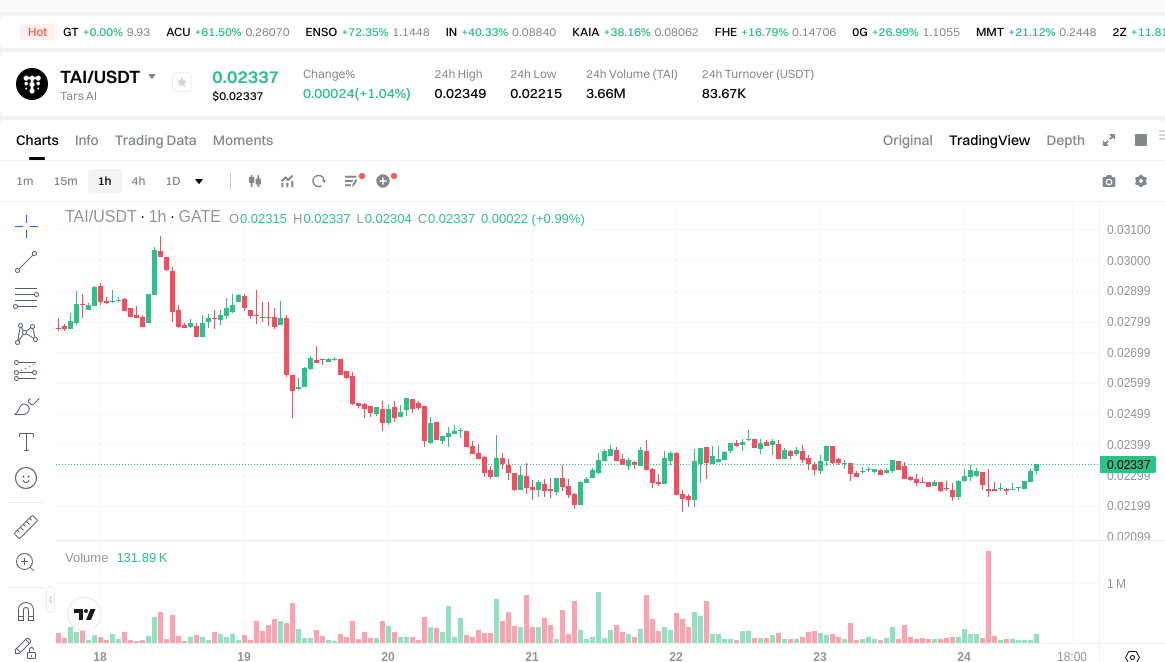
Recent price trends show varied performance across different timeframes:
- 1-hour change: -0.13% (decline of $0.00003024)
- 24-hour change: -0.43% (decline of $0.00010032)
- 7-day change: -18.35% (decline of $0.00522070)
- 30-day change: +18.16% (increase of $0.00357022)
- 1-year change: -91.79% (decline of $0.25971762)
These fluctuations reflect evolving market sentiment, technological developments, and broader industry trends affecting AI-driven Web3 infrastructure platforms.
Click to view the current TAI market price
On-Chain Metrics
- Holder Count: 71,757 addresses (indicating user participation and token distribution)
- 24-hour Trading Volume: $84,070.16 (reflecting current market activity)
- Market Capitalization: $16,067,847.08 (representing the total value of circulating tokens)
- Fully Diluted Valuation: $23,230,000.00 (projected valuation at maximum supply)
Tars AI Ecosystem Applications and Partners
Core Use Cases
Tars AI's ecosystem supports various applications:
- AI-Driven Solutions: TARS Protocol provides cutting-edge artificial intelligence solutions integrated with blockchain technology, enabling intelligent automation and data processing.
- BaaS (Blockchain-as-a-Service): The platform offers one-stop blockchain infrastructure services, facilitating modular Web3 development and deployment.
Strategic Collaborations
While specific partnership details are not extensively documented in available materials, TARS Protocol's modular infrastructure approach positions it to integrate with various Web3 projects and AI service providers.
These potential collaborations provide a foundation for TAI's ecosystem expansion.
Controversies and Challenges
Tars AI faces several challenges:
- Technical Issues: Scaling AI-driven blockchain solutions while maintaining performance efficiency
- Market Competition: Competition from established AI and blockchain platforms in the rapidly evolving Web3 space
- Price Volatility: Significant price fluctuations, with the token experiencing approximately 91.79% decline over one year
These issues have sparked discussions within the community and market, while also driving TARS Protocol's continuous innovation.
Tars AI's community demonstrates active participation, with 71,757 token holders as of January 2026.
The token is listed on 13 exchanges, indicating growing market accessibility.
The project maintains presence on social media platforms, particularly through its official Twitter account.
Sentiment on social platforms shows mixed perspectives:
- Supporters highlight TAI's AI-driven infrastructure capabilities and modular Web3 solutions, viewing it as an innovative approach to blockchain scalability.
- Critics focus on significant price corrections and market volatility, with the token trading substantially below its historical high.
Recent trends indicate cautious sentiment following the token's decline from its December 2024 peak.
Trending Topics
Social media users discuss TAI's price volatility, AI integration potential, and Web3 infrastructure development,
revealing both its transformative possibilities and obstacles toward mainstream adoption.
- Official Website: Visit Tars AI Website for features, use cases, and latest updates.
- Documentation: TARS Protocol Documentation provides detailed technical architecture, objectives, and vision.
- Twitter Updates: On Twitter, Tars AI actively engages through @tarsprotocol,
posting about technical developments, community initiatives, and platform updates.
Tars AI Future Roadmap
While specific roadmap details are not extensively available in current materials, the project's focus remains on:
- Enhancing AI-driven blockchain infrastructure capabilities
- Expanding BaaS offerings for Web3 projects
- Building a comprehensive modular ecosystem for decentralized applications
How to Participate in Tars AI?
- Purchase Channels: TAI is available on Gate.com and 12 other exchanges
- Storage Solutions: As a Solana-based token (SPL standard), use compatible wallets such as Phantom or Solflare for secure storage
- Contract Address: Hax9LTgsQkze1YFychnBLtFH8gYbQKtKfWKKg2SP6gdD on Solana blockchain
- Ecosystem Building: Visit TARS Documentation to explore development opportunities
Summary
Tars AI leverages blockchain and artificial intelligence to redefine Web3 infrastructure, offering modular solutions, AI-driven automation, and comprehensive BaaS services.
Its growing holder base, multi-exchange presence, and innovative technology position it as a noteworthy project in the crypto space.
Despite facing market volatility and competitive pressures, TAI's focus on AI-blockchain integration and clear technological direction give it potential significance in the future of decentralized technology.
Whether you're a newcomer or experienced participant, Tars AI presents opportunities worth monitoring and exploring.
FAQ
What is TAI crypto and what is its main purpose?
TAI is a decentralized cryptocurrency designed to provide secure, fast, and low-cost transactions on blockchain networks. Its main purpose is enabling peer-to-peer value transfer while supporting smart contract functionality and decentralized finance applications within the Web3 ecosystem.
How do I buy and store TAI cryptocurrency?
You can purchase TAI through peer-to-peer transactions or direct transfers. Store TAI securely in a personal wallet with private keys, such as hardware wallets or reputable digital wallets that support the TAI token.
What are the risks and benefits of investing in TAI?
Benefits: TAI offers exposure to innovative blockchain technology with potential for significant growth as adoption increases. Risks: market volatility, regulatory uncertainty, and technology risks. Success depends on project execution and market conditions.
How does TAI differ from other cryptocurrencies like Bitcoin or Ethereum?
TAI offers enhanced scalability and lower transaction costs compared to Bitcoin and Ethereum. While Bitcoin focuses on decentralized payments and Ethereum on smart contracts, TAI combines high-speed processing with efficient consensus mechanisms, enabling faster transactions and broader blockchain applications.
What is the current market price and total supply of TAI tokens?
TAI token's market price fluctuates based on real-time demand and supply dynamics. The total supply is fixed at its genesis amount. For current accurate pricing, check real-time market data sources. TAI maintains its supply model as defined in its tokenomics.
* The information is not intended to be and does not constitute financial advice or any other recommendation of any sort offered or endorsed by Gate.