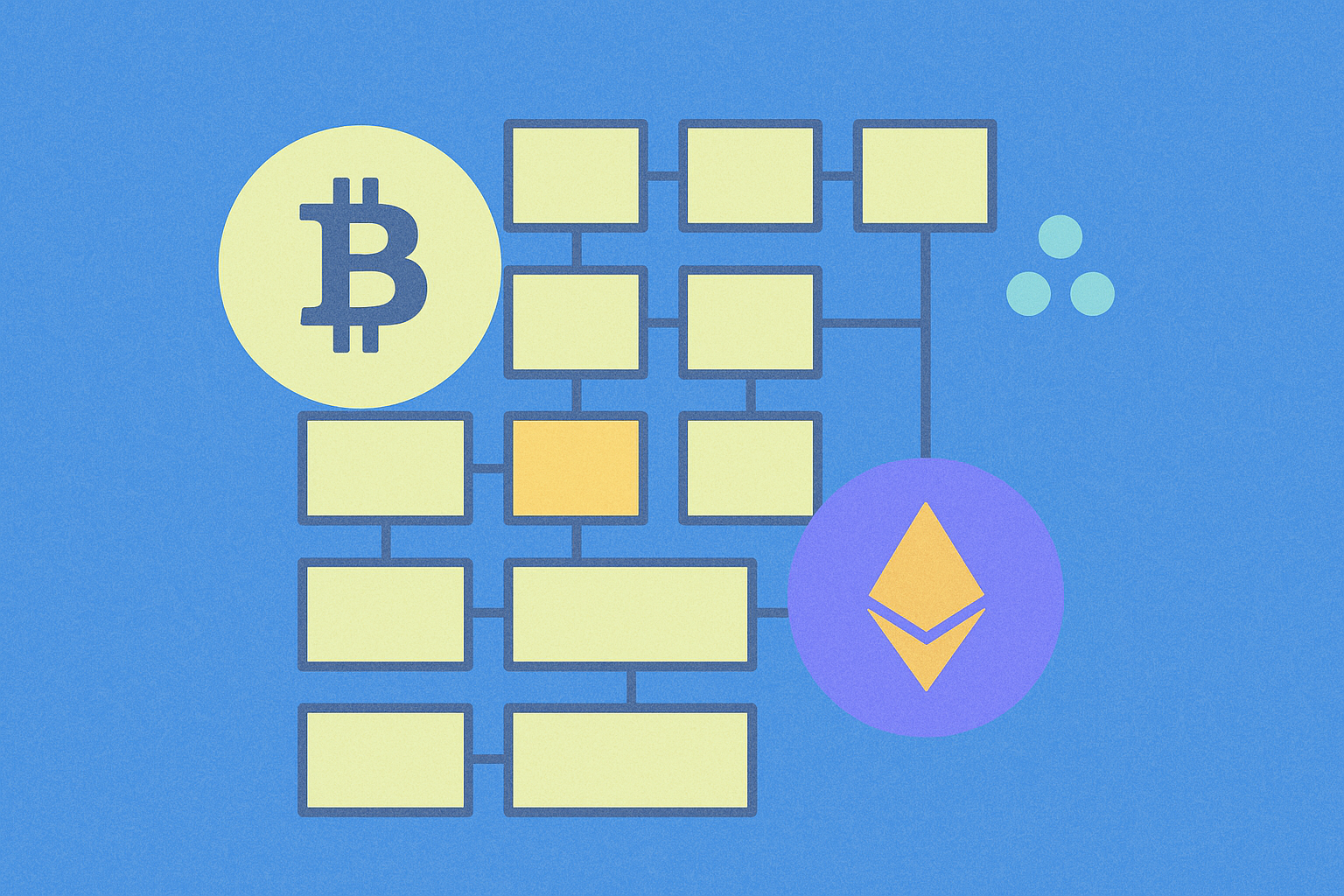
This illustrated guide makes blockchain technology easy to understand for beginners. It covers key concepts such as nodes, mining, cryptography, consensus mechanisms, and the fundamentals of Web3 and crypto assets. Even readers without a technical background can follow this complete guide.
Core Concepts of Blockchain
Blockchain is an innovative technology that records transactions within a network into data bundles called "blocks." Each block contains detailed transaction information, and blocks are linked sequentially to form a chain, ensuring the permanent storage of data. This chain of interconnected blocks is why the technology is called "blockchain."
Blockchain is also known as Distributed Ledger Technology (DLT), and its defining characteristic is the absence of a central server or administrator. Every user in the network shares and mutually verifies an identical ledger, ensuring the reliability and transparency of information. This structure makes it extremely difficult for any single administrator to commit fraud or alter data arbitrarily.
Blockchain operates on a decentralized network where all nodes (devices) connect as equals. There is no central authority; each node stores some or all data and communicates with other nodes. In traditional banking, a central server manages all transactions. In contrast, every blockchain participant retains transaction records and validates them among peers, ensuring trust across the network.
This approach substantially enhances fault tolerance. Even if certain nodes fail or come under external attack, the network as a whole remains operational. Because all nodes hold identical information, any attempt to alter data is quickly detected through inconsistencies, exposing fraudulent activity. This transparency and robustness make blockchain technology a focus across industries, beginning with finance.
Nodes and Their Functions
Nodes are the computers or devices that participate in a blockchain network. Each node stores blockchain data and plays a critical role in validating new transactions. All nodes operate on equal terms, and without a central administrator, the reliability and security of the network depend on every node.
When a new transaction occurs, each node receives it and executes a validation process to confirm its legitimacy. This includes checking whether the sender has enough balance, verifying the digital signature, and ensuring no double-spending occurs. Through these checks, all transactions are accurately recorded, maintaining the integrity of blockchain data.
There are two main types of nodes: full nodes and light nodes. Full nodes store the entire blockchain and validate every transaction, enhancing network security but requiring significant storage and computing power. Light nodes store only essential data and validate specific transactions.
Blockchain Types
Blockchain comes in three primary types, each with distinct uses and characteristics.
Public blockchains are open networks anyone can join. Bitcoin and Ethereum are typical examples, delivering complete transparency and decentralization. All transactions are public and verifiable, making the system highly trustworthy. However, public blockchains face challenges like slower processing speeds and higher energy consumption.
Private blockchains are closed networks managed by specific organizations or companies. Participation is permission-based, and the existence of an administrator enables fast processing and efficient operation. These are suitable for enterprise supply chains or internal audit systems but offer less decentralization and require trust in the administrator.
Consortium blockchains are operated collectively by multiple organizations. Managed by industry groups or alliances, they blend features of public and private blockchains. By increasing trust among participants while preserving a level of decentralization, these networks are used for interbank settlements and cross-company data sharing.
Block Structure
A block is the basic unit that aggregates multiple transactions. Each block contains the previous block’s hash, the hash of new transaction data, a timestamp, and a nonce value. These elements link blocks together, making it extremely difficult to alter historical data.
Blocks are divided into a block header and block body. The block header holds metadata such as the previous block’s hash, Merkle root, timestamp, difficulty target, and nonce. The block body contains the actual transaction data. This structure allows for efficient data management and rapid verification.
Hash Value
A hash value is a unique output generated using a hash function that converts data of any length into a fixed-length value. Blockchain relies on cryptographic hash functions like SHA-256, and each block includes the previous block’s hash, cryptographically securing the entire chain.
One important property of hash functions is that even a minor change in input data results in a completely different hash value. For example, "hello" and "Hello" produce entirely different hashes, despite only a difference in capitalization. This characteristic ensures that any tampering with blockchain data is immediately detectable.
Hash functions are also one-way, meaning it is computationally impossible to reconstruct the original data from the hash value. This supports the high security and integrity of blockchain data.
Nonce
A nonce (number used once) is a value that’s used only once. In blockchain, the nonce is a key parameter in mining for finding a valid hash value.
Miners create new blocks by combining block header information with different nonce values to compute hashes. The resulting hash must satisfy network-defined criteria (such as a certain number of leading zeros). Miners increment the nonce and recalculate until they find a valid hash, at which point the new block is generated.
This process is known as "Proof of Work" and demands substantial computational resources. The miner who finds the correct nonce wins the right to add a new block to the blockchain and receives crypto asset rewards. This mechanism secures the network and prevents unauthorized blocks from being added.
Merkle Tree
A Merkle Tree is a data structure designed to efficiently manage and verify large sets of data. In blockchain, it organizes transaction data so that the inclusion of specific transactions in a block can be verified quickly and efficiently.
Merkle Trees hash each transaction, then pair and hash those pairs repeatedly to form a tree structure. This process continues until a single root hash (Merkle root) remains, which is stored in the block header and represents all transactions in the block.
The key benefit of Merkle Trees is that verification of a specific transaction’s inclusion requires only a subset of hash values (the Merkle path), not all transaction data. This enables light nodes to verify transactions quickly with minimal data, boosting blockchain scalability.
Cryptography Overview
Blockchain uses public-key cryptography to ensure transaction security and validity. This cryptographic method uses two keys: a public key, which is openly shared, and a private key, which is securely held by its owner.
When a transaction is initiated, the sender signs the data with their private key. The recipient uses the sender’s public key to verify the signature, confirming the transaction’s authenticity and that it has not been altered. This approach guarantees transaction validity and protects against fraud and tampering.
The security of public-key cryptography is based on mathematical one-way functions, making it practically impossible to derive the private key from the public key using current computing technology. As a result, blockchain provides robust security and a highly reliable transaction environment.
Digital Signatures
Digital signatures are essential for ensuring the integrity of transaction data and authenticating the sender. In blockchain, each transaction is signed with the sender’s private key, and recipients or other nodes verify the signature with the corresponding public key.
The process works as follows: The sender hashes the transaction data, encrypts the hash with their private key, and produces a digital signature. The recipient decrypts the signature with the sender’s public key to retrieve the original hash. The recipient then hashes the received transaction data and compares it to the decrypted hash. If they match, the data has not been altered and the sender is authenticated.
This framework guarantees transaction reliability and prevents impersonation and tampering. Digital signatures are a foundational technology for blockchain security, enabling safe crypto asset transactions.
Hash Functions
Hash functions convert input data of any length into a fixed-length hash value. In blockchain, cryptographic hash functions like SHA-256 (Secure Hash Algorithm 256-bit) are widely adopted.
Key features of hash functions include:
- Determinism: Identical input always yields the same hash value.
- Speed: Hash values can be generated quickly from the input data.
- One-wayness: It’s computationally infeasible to reconstruct the original data from the hash value.
- Collision resistance: The chance of different inputs producing the same hash is extremely low.
- Avalanche effect: Even a small change in input data causes a drastic change in the hash value.
In blockchain, since every block contains the previous block’s hash, altering a block’s data changes its hash and requires recalculating all subsequent hashes—a process requiring enormous computing power. This makes tampering with blockchain data virtually impossible.
Mnemonic Phrase
A mnemonic phrase is a set of words used to back up and restore a crypto asset wallet. It typically consists of 12 or 24 English words arranged in a specific order.
The mnemonic phrase serves as a seed for generating the wallet’s private key. When creating a wallet, a randomly generated mnemonic phrase is displayed, and users must keep it in a secure place. If the wallet is lost or a device fails, the mnemonic allows the user to restore access to their crypto assets on a new device.
Mnemonic phrases are generated based on the BIP39 (Bitcoin Improvement Proposal 39) standard, ensuring compatibility across different wallet applications. Users can use the same mnemonic in multiple wallets.
Security for mnemonic phrases is critical. If someone else obtains the phrase, they can steal all assets in the wallet. It is highly recommended to store the phrase safely offline, such as writing it down on paper and locking it in a safe.
Consensus Mechanisms
Blockchains use mechanisms to validate transactions and achieve network-wide agreement, known as consensus algorithms. These are crucial for determining which node’s proposals are valid in a decentralized environment. Key consensus mechanisms include Proof of Work (PoW) and Proof of Stake (PoS).
Proof of Work
Proof of Work (PoW) is a system where new blocks are generated by solving complex mathematical problems using computational power. Bitcoin uses PoW, with miners racing to find a hash value that meets specific requirements to add a block to the chain.
In PoW, miners combine block header information with nonce values to compute hashes. The resulting hash must meet the network’s difficulty target (usually a number of leading zeros). The first miner to find a valid hash adds the new block to the blockchain and earns crypto asset rewards.
The main advantage of PoW is security. Attacking the network would require controlling over 51% of the total computing power—a prohibitively costly endeavor. This keeps the network safe and reliable.
However, PoW also has drawbacks: it consumes massive amounts of electricity and impacts the environment. Mining requires high-performance hardware, leading to high energy use, while transaction speed is relatively slow and scalability remains a challenge.
Proof of Stake
Proof of Stake (PoS) is a consensus algorithm where the right to create blocks depends on the amount and duration of crypto assets held. The more and longer assets are staked, the greater the chance to generate the next block. Ethereum has recently shifted from PoW to PoS, achieving higher energy efficiency and better scalability.
In PoS, asset holders participate as validators by staking a certain amount of crypto assets. The network randomly selects a validator—based on the amount staked and other factors—to propose a new block, which is then validated by others. Honest validators receive rewards, while dishonest ones risk losing their staked assets (slashing).
PoS brings improved energy efficiency, faster processing, and better scalability compared to PoW. Staking also incentivizes network participation and encourages long-term holding.
One challenge of PoS is potential wealth concentration, as those with large holdings earn more rewards and may gain more influence over time. If initial staking is distributed unfairly, network decentralization could be compromised.
Other Consensus Algorithms
Besides PoW and PoS, blockchains employ other consensus algorithms for different needs.
Proof of Authority (PoA) uses a set of trusted, verified validators to authenticate transactions. Validators are individuals or organizations with publicly verified identities and high trust within the network. PoA enables fast and cost-effective transaction processing, making it popular for enterprise and private blockchains. While less decentralized than public networks, PoA delivers efficiency and reliability for certain use cases.
Delegated Proof of Stake (DPoS) allows stakeholders to vote for delegates who verify transactions. Token holders use their stake to elect representatives responsible for block generation and validation. DPoS improves network efficiency and throughput, enabling fast transactions; it is used by projects like EOS and TRON.
These mechanisms may be faster and more efficient than PoW or PoS, but the choice depends on network requirements and use cases. Consensus mechanism selection is critical for balancing performance, security, and decentralization in any blockchain.
How Bitcoin and Ethereum Work
All crypto asset transactions are conducted on blockchains, ensuring transparency and reliability and enabling direct, peer-to-peer transfers without intermediaries like banks. Below, we examine how Bitcoin and Ethereum, two leading crypto assets, work.
Bitcoin
Bitcoin was the first crypto asset to use blockchain technology, created in 2009 by an individual or group under the name Satoshi Nakamoto. The Bitcoin network has no central administrator, and all transactions are conducted peer-to-peer (P2P).
The Bitcoin blockchain creates a new block roughly every ten minutes, containing all transactions from the previous ten minutes. This interval is maintained through a difficulty adjustment mechanism, always targeting a ten-minute average.
Bitcoin mining uses PoW, where miners compete to solve difficult computational problems and find a valid hash for the next block. This requires vast trial and error. Once a miner discovers the correct hash, the block is added to the chain, and the miner receives newly minted bitcoins and transaction fees as a reward.
Bitcoin’s supply is capped at 21 million BTC, maintaining scarcity and supporting its value. In addition, a "halving" occurs approximately every four years, reducing mining rewards by half, slowing supply growth and limiting inflation.
Benefits of P2P Networks
Peer-to-peer (P2P) networks are decentralized systems where all nodes communicate as equals, eliminating the need for a central server. This structure delivers high fault tolerance and enables distributed data management.
P2P network benefits include:
- Fault tolerance: If one node fails, others compensate, keeping the network running.
- Censorship resistance: Without a central authority, it’s difficult for any party to censor or freeze transactions.
- Transparency: All transactions are recorded on the blockchain and can be verified by anyone, supporting high transparency.
- Low cost: No intermediaries are needed, so transaction fees remain low.
For example, in file sharing, using blockchain and P2P networks improves data security and reliability. With no reliance on central servers, censorship and deletion are difficult, protecting user privacy.
Ethereum
Ethereum is a platform built on blockchain, launched in 2015 by Vitalik Buterin. Its most significant innovation is smart contracts—programs that automatically execute when predefined conditions are met, automating agreements and transactions.
Recently, Ethereum underwent a major upgrade called "The Merge," transitioning from PoW to PoS. This reduced energy consumption by about 99.95%, making Ethereum far more energy-efficient and environmentally friendly. Scalability improvements are also anticipated, allowing for greater transaction capacity in the future.
Ethereum’s PoS consensus mechanism lets ETH holders become validators by staking at least 32 ETH. The more ETH staked, the higher the chance to propose a new block. Honest validators receive rewards, while those who act maliciously risk losing their stake (slashing). This system incentivizes honest behavior and secures the network.
Smart Contract Applications
Ethereum’s blockchain records both transactions and the outcomes of smart contract execution. Smart contracts are written in Solidity and run on the Ethereum Virtual Machine (EVM).
Examples of smart contract applications include:
- Decentralized Finance (DeFi): Automates lending, borrowing, and trading, enabling fast, low-cost financial services without intermediaries.
- Real estate transactions: Automatically transfers payment and ownership when contract terms are met, reducing the need for intermediaries and increasing transparency and efficiency with smart contracts.
- Supply chain management: Tracks products from production to delivery, automating verification and payment at each stage to prevent counterfeiting and improve transparency.
- NFTs (Non-Fungible Tokens): Manages digital art and collectibles on-chain, automating sales and royalty payments via smart contracts.
These applications enable the creation and operation of decentralized apps (dApps), driving innovation in finance, insurance, supply chains, entertainment, and more.
UTXO and Account Models
There are two main models for managing crypto assets on blockchains.
The UTXO (Unspent Transaction Output) model, used by Bitcoin, processes each transaction by consuming unspent outputs from prior transactions and creating new UTXOs. This model supports parallel processing and enhances privacy but makes complex transactions and smart contracts more difficult.
The Account Model, used by Ethereum, manages each user’s balance as an account—similar to a bank account—and updates balances on each transaction. It’s intuitive and simplifies smart contract implementation but makes parallel processing harder and can offer less privacy than the UTXO model.
Each approach reflects the design philosophy and intended use of the blockchain, greatly influencing asset management methods.
Governance and Forks
Blockchains use governance processes to decide on upgrades and changes. Because blockchains are decentralized, making changes requires community consensus.
Governance comes in two forms: on-chain, where protocol changes are voted on via the blockchain itself, and off-chain, where decisions are made through forums or social media and implemented by developers and the community.
When the community cannot agree, the network may split—a process called a fork. There are two types: hard forks and soft forks.
Hard forks change core protocol rules, making old and new versions incompatible and creating separate blockchains (e.g., Bitcoin Cash split from Bitcoin via a hard fork).
Soft forks are backward compatible, allowing gradual migration to new rules without splitting the network. Soft forks are often used to avoid network splits.
Bitcoin and Ethereum have undergone multiple forks to add improvements and features. Governance and forks are essential to blockchain evolution and adaptability.
The Blockchain Trilemma
The blockchain trilemma refers to the challenge of balancing three core properties: scalability, decentralization, and security. Maximizing all three at once is difficult; improving one can often compromise the others. Ethereum’s founder, Vitalik Buterin, introduced this concept.
Scalability
Scalability is a blockchain’s ability to handle large transaction volumes rapidly. High scalability is crucial for wide adoption and depends on increasing throughput and reducing fees.
For example, Bitcoin processes only about seven transactions per second, far fewer than Visa’s thousands per second, limiting its use as a mainstream payment solution.
Layer 2 solutions (like Lightning Network) and sharding (dividing and processing data in parallel) are being developed to enhance scalability.
Decentralization
Decentralization means the network is managed by many nodes instead of a single authority. More decentralization increases resistance to failure and censorship.
Ideally, anyone can join and support the network equally. However, increasing scalability by expanding block size or processing speed raises hardware requirements, making node operation harder for ordinary users. This can lead to centralization and less network diversity.
Security
Security refers to the network’s resilience against attacks and fraud. Strong cryptography and robust consensus mechanisms are key for security.
Security improves with more nodes and distributed computing power, making 51% attacks harder. But simplifying consensus or reducing node count for scalability can weaken security.
Addressing the Trilemma
Multiple approaches are being developed to solve the trilemma:
-
Layer 2 solutions: Process transactions off the main chain, recording only final results on-chain. This improves scalability while maintaining security and decentralization. Examples include Bitcoin’s Lightning Network and Ethereum’s Optimistic Rollup and ZK-Rollup.
-
Sharding: Splits blockchain data into fragments (shards) for parallel processing, boosting throughput. Ethereum 2.0 plans to implement sharding.
-
New consensus mechanisms: Innovations beyond PoW and PoS, like Directed Acyclic Graphs (DAG) and Byzantine Fault Tolerance (BFT) protocols.
-
Cross-chain technology: Enables interoperability between different blockchains, allowing specialization and high overall performance.
These advancements are helping blockchain overcome the trilemma, enabling broader, more practical adoption.
Market Outlook
According to market research, Japan’s blockchain market is expected to grow over 30% annually in the coming years, reaching several trillion yen. This rapid expansion is driven by adoption across industries beyond finance.
Globally, the blockchain market is also expanding quickly, with adoption in financial services, supply chains, healthcare, real estate, energy, government, and more. New segments such as DeFi and NFTs are growing rapidly, further expanding blockchain’s potential.
For example, as blockchain gains traction in decentralized energy trading, a major Japanese utility subsidiary has started a proof-of-concept for crypto asset mining in “container-type distributed data centers.” In Tochigi, surplus renewable energy is used for mining to stabilize supply, while similar facilities in Gunma automatically control mining equipment to maximize surplus solar energy use. This optimizes asset utilization and reduces the need for grid expansion.
In education, blockchain-based systems for certifying academic and professional credentials are being developed, making forgery nearly impossible and enabling quick, reliable verification by employers and institutions.
The Japanese government is also fostering blockchain adoption through policy, supporting R&D and pilot projects. Initiatives like the Digital Agency and the Basic Law on Digital Society have made blockchain and digital tech a national priority.
In healthcare, blockchain-based electronic medical records enable secure data management, with patients controlling access rights. This improves data sharing, healthcare quality, and cost efficiency.
In logistics and supply chains, blockchain is used to track product journeys, prevent counterfeiting, verify food safety, and authenticate eco-friendly products.
With such a wide range of use cases, blockchain is expected to become essential social infrastructure. As technology matures and regulations evolve, the blockchain market will continue to grow, spawning new business models and services.
Summary
Blockchain is a foundational technology for crypto assets. Distributed ledgers eliminate central authorities while providing high transparency and security. Each block records transaction data, and the chain structure makes tampering extremely difficult.
Blockchain’s defining features include:
- Decentralization: No central administrator; all nodes participate equally.
- Transparency: All transactions are recorded on-chain and can be verified by anyone.
- Immutability: Once recorded, data is nearly impossible to alter.
- Security: Advanced cryptography and consensus mechanisms ensure robust protection.
Blockchain is expected to drive innovation beyond finance, impacting supply chain management, healthcare, real estate, energy, education, government, and more. Smart contracts automate transactions and agreements, improving efficiency and transparency.
At the same time, challenges remain around scalability, energy consumption, and regulatory uncertainty. Layer 2 solutions and new consensus mechanisms are being developed to address these issues.
In the future, blockchain will likely become indispensable digital infrastructure, transforming business and daily life. As the technology evolves and gains wider acceptance, blockchain will become more practical and accessible.
FAQ
What is blockchain? Please explain the basic mechanism in simple terms.
Blockchain is a distributed ledger system where multiple nodes share and manage transaction data. Cryptography links blocks in a chain, making tampering extremely difficult. Blockchain offers transparency, resistance to tampering, and reliability, and is used in many fields including finance and logistics.
What is the relationship between blockchain and crypto assets (virtual currencies)?
Crypto assets are currencies issued and circulated using blockchain technology. Blockchain serves as a distributed ledger, providing the foundation for trust. Most crypto assets are built on this technology.
How does blockchain prevent tampering?
Each blockchain block contains the hash of the previous block. If a block is altered, its hash changes, requiring all subsequent blocks to be modified. This chain reaction makes tampering virtually impossible.
What is mining in blockchain, and what role does it play?
Mining is the process of verifying transactions and generating new blocks. It maintains network security, achieves distributed consensus, and prevents tampering. Miners provide computational power and receive rewards.
Why is it called "blockchain"?
The term "blockchain" comes from its structure: blocks of transaction data are linked chronologically by hashes, forming a chain of data.
What are some applications of blockchain technology beyond crypto assets?
Blockchain is used in healthcare for patient data management, pharmaceuticals for supply chains, financial services, real estate, and more. Its tamper-proof recordkeeping is valuable in any industry requiring trust and reliability.
Is blockchain really secure? What risks are there?
Blockchain is generally secure thanks to cryptography and decentralization, but risks include 51% attacks, routing attacks, and phishing. Using VPNs and antivirus software can help mitigate these risks.
* The information is not intended to be and does not constitute financial advice or any other recommendation of any sort offered or endorsed by Gate.