TokenFi is a no-code tokenization platform launched in 2023 by the Floki ecosystem team to democratize digital asset creation and overcome technical barriers in blockchain adoption. This comprehensive guide explores TokenFi's architecture, market position, and applications across decentralized finance and real-world asset (RWA) tokenization. The article covers TokenFi's dual-chain deployment on Ethereum and BSC, security mechanisms, and ecosystem partnerships, while analyzing its market performance including circulating supply of 3.37 billion tokens and trading availability on Gate and 20 other exchanges. Readers will discover core use cases in asset digitization, community engagement metrics showing 31,046 token holders, and practical guidance for purchasing TOKEN on Gate.com and securing holdings. Additionally, the guide addresses market challenges, competitive pressures, and TokenFi's strategic roadmap for expanding tokenization infrastructure. Whether you're a newcomer or experienced participant in crypto
TokenFi's Positioning and Significance
In 2023, the TokenFi team launched TokenFi (TOKEN), aiming to address barriers to entry in asset tokenization, including technical complexity and high development costs.
As an all-in-one tokenization platform enabling code-free token and asset launches, TokenFi plays a key role in blockchain infrastructure and real-world asset (RWA) tokenization.
As of 2026, TokenFi has established itself as a player in the growing tokenization sector, with over 31,000 token holders and an active community supporting its ecosystem development.
This article will provide an in-depth analysis of its technical architecture, market performance, and future potential.
Origin and Development History
Background
TokenFi was created by the Floki ecosystem team in 2023, aiming to solve the technical barriers and complexity preventing mainstream adoption of tokenization technology.
It emerged during a period of growing interest in real-world asset tokenization and blockchain utility, with the goal of democratizing token creation through intuitive, no-code tools.
TokenFi's launch brought new possibilities to entrepreneurs, businesses, and creators seeking to tokenize assets without blockchain expertise.
Key Milestones
- 2023: Official launch with WYSIWYG interface for token creation, targeting the projected $16 trillion tokenization market by 2030.
- 2024: Platform expansion and ecosystem growth, with TOKEN reaching wider exchange availability.
- 2025: Continued development of tokenization infrastructure and user base expansion across multiple blockchain networks.
With support from the Floki community and development foundation, TokenFi continues to refine its platform capabilities, security features, and practical applications.
How TokenFi Works
No Central Control
TokenFi operates as part of decentralized blockchain networks, eliminating dependence on centralized financial intermediaries.
The platform leverages distributed ledger technology to enable transparent, permissionless token creation and management, empowering users with direct control over their tokenized assets while enhancing system resilience.
Blockchain Foundation
TokenFi's infrastructure utilizes public blockchain technology with immutable transaction records.
The TOKEN contract is deployed on both Ethereum and BSC (BNB Smart Chain), allowing cross-chain compatibility and flexibility.
Each token creation and transaction is recorded on-chain, providing transparent, verifiable history accessible to all participants.
The multi-chain deployment strategy enhances accessibility and reduces transaction costs for users.
TokenFi implements smart contract-based validation mechanisms on Ethereum (PoS consensus) and BSC networks to ensure transaction integrity and prevent unauthorized modifications.
The platform's no-code interface abstracts technical complexity while maintaining the security standards of underlying blockchain protocols.
Token creators and holders benefit from the established security guarantees of Ethereum and BSC networks, including cryptographic validation and distributed consensus.
Secure Transactions
TokenFi utilizes public-private key cryptography to protect user assets:
- Private keys (secure passwords) authorize token operations and transactions
- Public keys (account identifiers) verify ownership and enable transparent interaction
This mechanism ensures fund security while transactions maintain pseudonymous characteristics inherited from the underlying blockchain networks.
The platform's WYSIWYG interface simplifies token management without compromising the cryptographic security standards of decentralized systems.
Circulation Overview
As of January 25, 2026, TokenFi's circulating supply stands at 3,375,430,196.92 TOKEN, with a total supply of 10,000,000,000 TOKEN, representing a fixed supply model with no additional inflationary mechanisms.
New tokens enter the market through the initial distribution mechanism, influencing supply-demand dynamics. The current circulation represents approximately 33.75% of the total supply, with the remaining tokens subject to release schedules that may affect future market liquidity.
Price Volatility
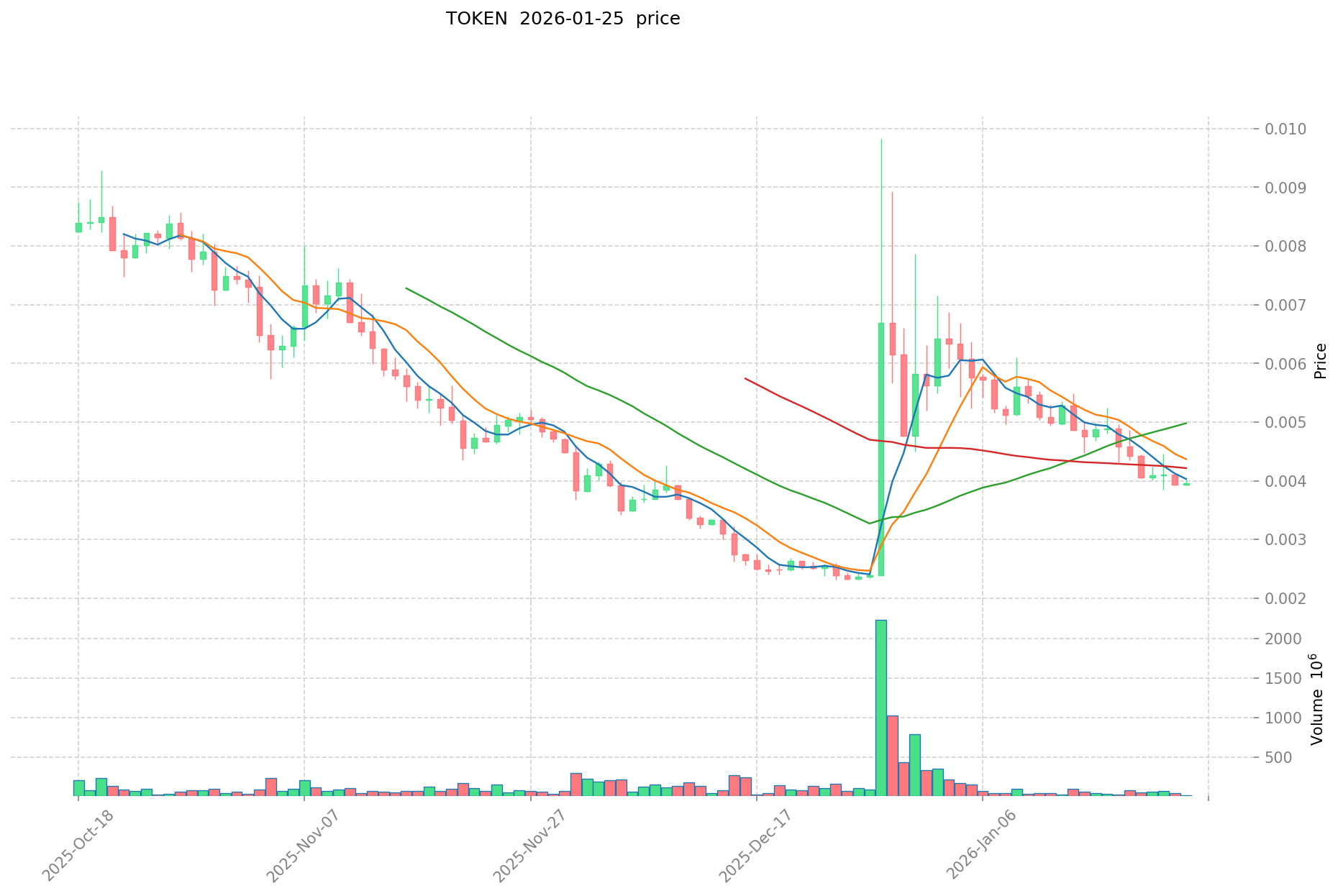
TokenFi reached its peak price of $0.24646 on March 26, 2024, driven by favorable market conditions during that period.
The token's lowest recorded price was $0.002316, occurring on December 24, 2025, reflecting broader market adjustments and changing sentiment within the tokenization sector.
These fluctuations demonstrate the interplay between market sentiment, adoption trends, and external factors affecting the tokenization industry.
Click to view the current TOKEN market price
On-Chain Metrics
- Holder Count: 31,046 addresses (indicating distribution across the user base)
- Trading Pairs: Available on 21 exchanges (reflecting market accessibility)
- Contract Deployment: Dual-chain presence on Ethereum and BSC networks
TokenFi Ecosystem Applications and Partners
Core Use Cases
TokenFi's ecosystem supports multiple applications:
- Tokenization Platform: TokenFi provides a WYSIWYG interface enabling users to launch tokens or tokenize assets without writing code, targeting the tokenization industry.
- Asset Digitization: The platform facilitates the creation and management of digital assets, contributing to innovations in blockchain-based asset representation.
Strategic Partnerships
TokenFi is part of the broader Floki ecosystem, leveraging synergies within this network to enhance its technological capabilities and market reach.
These partnerships provide a solid foundation for TokenFi's ecosystem expansion.
Controversies and Challenges
TokenFi faces the following challenges:
- Market Volatility: Price fluctuations remain a concern, with the token experiencing notable variations across different timeframes.
- Competitive Pressure: The tokenization and asset platform space includes numerous competitors offering similar no-code solutions.
- Adoption Hurdles: Achieving widespread adoption in the projected multi-trillion dollar tokenization industry requires overcoming technical and market barriers.
These issues have sparked discussions within the community and market, while also driving TokenFi's ongoing innovation efforts.
Fan Enthusiasm
TokenFi's community demonstrates engagement, with the token held by approximately 31,046 wallet addresses.
On X platform, related posts and hashtags (such as #TokenFi) generate discussions within the crypto community.
Factors such as market movements and platform developments contribute to community interest.
Sentiment on X shows varied perspectives:
- Supporters highlight TokenFi's accessibility and user-friendly tokenization capabilities, positioning it as a tool for democratizing asset creation.
- Critics focus on price volatility and the competitive landscape in the tokenization sector.
Recent trends indicate mixed sentiment influenced by broader market conditions.
Hot Topics
X users discuss TokenFi's position in the tokenization market, its technical approach to asset creation, and its potential role in the evolving digital asset landscape,
reflecting both opportunities and challenges in achieving mainstream adoption.
- Official Website: Visit TokenFi Official Site for features, use cases, and latest updates.
- X Updates: On X platform, TokenFi maintains an active presence through @tokenfi,
with posts covering topics such as platform developments, community activities, and ecosystem news.
TokenFi Future Roadmap
- Ongoing Development: Enhancing tokenization tools and expanding platform capabilities to improve user experience and functionality.
- Ecosystem Goals: Building a comprehensive infrastructure for token creation and asset digitization.
- Long-term Vision: Establishing TokenFi as a leading platform in the tokenization industry.
How to Participate in TokenFi?
- Purchase Channels: Acquire TOKEN on supported exchanges including Gate.com.
- Storage Solutions: Use compatible wallets such as MetaMask or hardware wallets for secure storage of ERC-20 and BEP-20 tokens.
- Explore the Platform: Visit TokenFi's official website to explore tokenization tools and features.
- Stay Informed: Follow TokenFi's social channels and community forums for updates and developments.
Summary
TokenFi leverages blockchain technology to simplify token creation and asset digitization, offering accessibility through its no-code platform.
Its position within the Floki ecosystem, multi-chain deployment (Ethereum and BSC), and focus on the tokenization sector distinguish it in the cryptocurrency space.
While facing market volatility and competitive pressures, TokenFi's platform-focused approach and development trajectory position it within the evolving asset tokenization landscape.
Whether you are a newcomer or experienced participant, TokenFi represents an accessible entry point into token creation and digital asset development.
FAQ
What is a Crypto Token (Crypto Token)? What is the difference between it and Bitcoin?
Crypto tokens are digital assets built on blockchain networks, representing value or utility. Unlike Bitcoin, which is a native cryptocurrency, tokens are created on existing blockchains like Ethereum. Tokens can represent ownership, access rights, or governance power, offering greater flexibility and use cases than Bitcoin's pure currency function.
What are the main types and uses of crypto tokens?
Crypto tokens include utility tokens(providing access to services), security tokens(representing assets), governance tokens(enabling voting rights), and payment tokens(used for transactions). Each serves distinct purposes in blockchain ecosystems.
How to buy and store crypto tokens?
Purchase tokens through peer-to-peer transfers or direct exchanges using fiat currency. Store them securely in private wallets(such as hardware wallets or software wallets)by safeguarding your private keys. Always enable two-factor authentication and backup recovery phrases to protect your assets.
What are the risks to pay attention to when investing in crypto tokens?
Crypto token investments carry volatility risk, liquidity risk, regulatory risk, and technology risk. Market prices fluctuate dramatically based on sentiment. Tokens may lack sufficient trading volume, making exits difficult. Regulatory changes can impact valuations. Smart contract vulnerabilities pose security threats. Diversification and due diligence are essential.
What is ERC-20 token? What are the main token standards?
ERC-20 is Ethereum's token standard enabling fungible token creation. Main standards include ERC-20 (fungible), ERC-721 (NFT), ERC-1155 (multi-token), and BEP-20 (BSC equivalent). Each defines smart contract rules for token transfers and balances.
What is the essential difference between tokens and cryptocurrencies?
Cryptocurrencies are independent digital currencies with their own blockchains, like Bitcoin and Ethereum. Tokens are digital assets built on existing blockchains, representing value or utility without their own chain infrastructure.
* The information is not intended to be and does not constitute financial advice or any other recommendation of any sort offered or endorsed by Gate.