Polytrade (TRADE) is a pioneering decentralized protocol launched in 2021 that bridges trade finance with blockchain technology, addressing inefficiencies in accounts receivable financing. This comprehensive guide explores how Polytrade operates across multiple blockchain networks including Ethereum, BSC, and Polygon, connecting borrowers, lenders, insurers, and investors seamlessly. The article covers Polytrade's technical architecture utilizing smart contracts and cryptographic security, market performance metrics including current pricing and trading volume on Gate exchange, and its innovative real-world asset tokenization approach. Additionally, it examines the ecosystem's strategic collaborations, community engagement across 3,885 token holders, current challenges including market volatility, and practical steps for participating in decentralized trade finance. Whether you are exploring DeFi solutions or seeking blockchain-based financing alternatives, Polytrade offers unique value in modernizing interna
Polytrade's Position and Significance
In 2021, Polytrade emerged as TRADE, aiming to address inefficiencies in accounts receivable financing and the disconnect between traditional finance participants and blockchain technology.
As a pioneering decentralized protocol bridging real-world asset financing with crypto markets, Polytrade plays a critical role in trade finance and DeFi integration.
As of 2026, Polytrade has established itself as an innovative platform connecting borrowers, lenders, insurers, and investors in the receivables financing space, serving over 3,885 token holders and maintaining an active presence across multiple blockchain networks.
This article provides an in-depth analysis of its technical architecture, market performance, and future potential.
Origin and Development History
Birth Background
Polytrade was created in 2021, designed to solve the fragmentation and inefficiency in accounts receivable financing, where small and medium enterprises struggle to access working capital quickly and affordably.
It emerged during the DeFi boom and growing interest in real-world asset tokenization, with the goal of providing seamless, low-interest financing services by connecting real-world borrowers with crypto lenders.
Polytrade's launch opened new possibilities for businesses seeking alternative financing solutions and crypto investors looking for yield opportunities backed by tangible assets.
Important Milestones
- 2021: Platform launch on Ethereum, introducing decentralized accounts receivable financing with insurance integration.
- Token deployment across multiple chains including ETH, BSC, and Polygon, enhancing accessibility and reducing transaction costs.
- Expansion of ecosystem connecting buyers, sellers, insurance providers, and investors through blockchain-based transparency and efficiency.
- Development of infrastructure bringing insured real-world assets to the crypto lending space.
With support from its development team and community, Polytrade continues to refine its platform, security protocols, and real-world application scope.
How Polytrade Works?
Decentralized Infrastructure
Polytrade operates on decentralized blockchain networks spanning Ethereum, BSC, and Polygon, removing reliance on traditional banking intermediaries.
These networks enable transparent verification of financing transactions, ensuring system integrity while granting participants greater control over their financial activities.
Blockchain Foundation
Polytrade leverages public blockchain ledgers to record all financing transactions immutably.
Transactions are grouped into blocks and cryptographically linked, creating a transparent and tamper-resistant record.
Anyone can verify transaction history, establishing trust without intermediaries.
Multi-chain deployment across Ethereum, BSC, and Polygon enhances accessibility and reduces operational costs.
Protocol Mechanism
Polytrade utilizes smart contracts to automate and verify receivables financing transactions.
The platform connects real-world borrowers with crypto lenders, with insurance providers offering risk mitigation.
Participants including borrowers, lenders, and insurers interact through protocol-governed processes, ensuring transparent terms and automated settlements.
The innovation lies in bridging traditional trade finance with blockchain efficiency and crypto liquidity.
Secure Transactions
Polytrade employs cryptographic security for all platform interactions:
- Private keys secure user wallets and authorize transactions
- Public addresses enable transparent verification of on-chain activities
This architecture ensures asset security while maintaining transaction transparency appropriate for regulated finance activities.
Smart contract-based automation reduces human error and enhances operational reliability.
Circulation Overview
As of January 29, 2026, Polytrade (TRADE) has a circulating supply of 100,000,000 tokens, with a total supply of 100,000,000 tokens, representing a 100% circulation ratio. The token follows a fixed supply model with no additional issuance planned.
Price Volatility
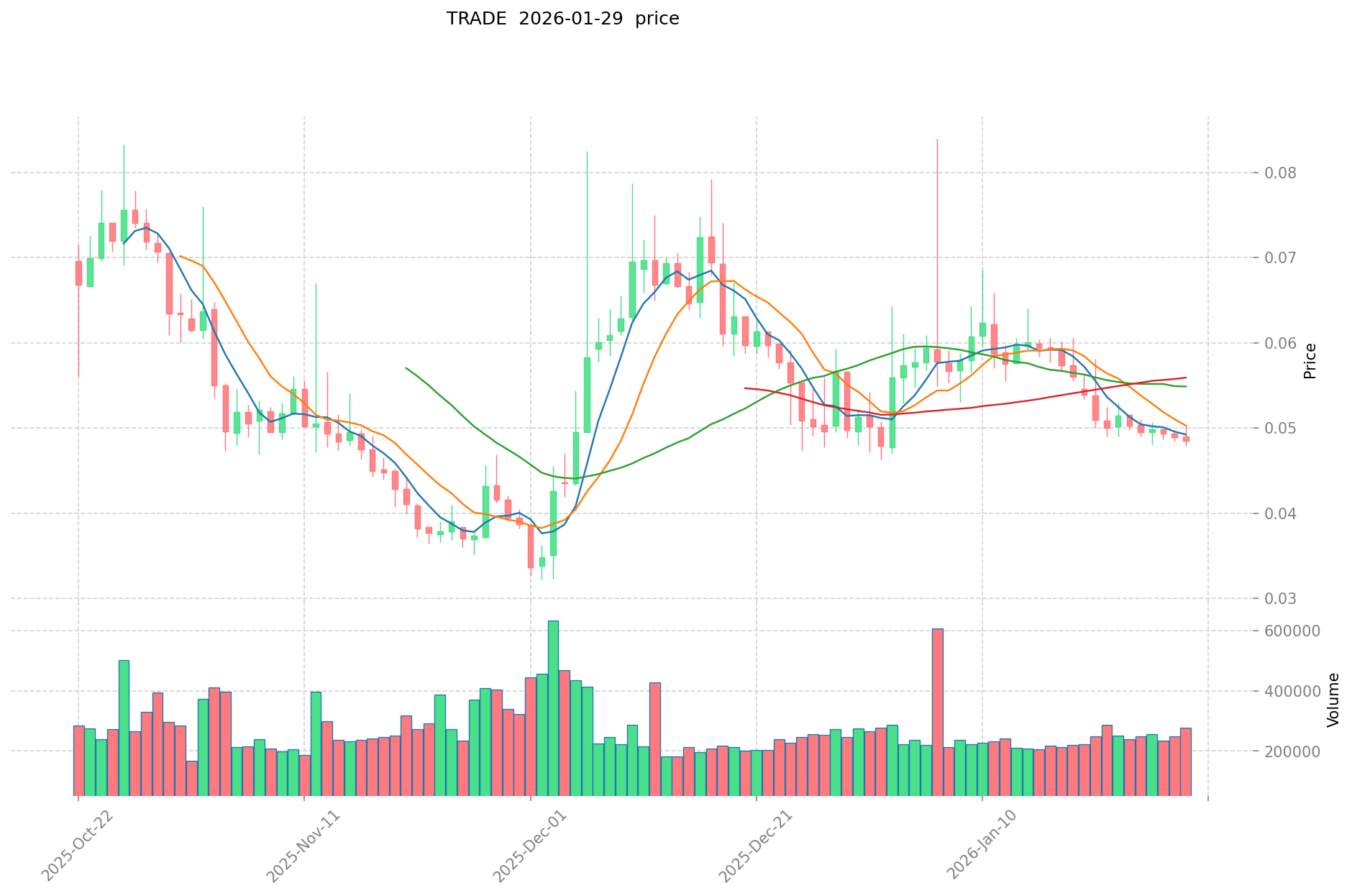
Polytrade (TRADE) reached a notable price level of $3.03 on April 1, 2024, driven by positive market momentum and growing interest in real-world asset tokenization solutions. The token experienced its lowest price point of $0.03285692 on December 3, 2025, influenced by broader market corrections and shifts in investor sentiment.
As of January 29, 2026, TRADE is trading at $0.04928, showing a 1.14% increase over the past 24 hours. The token has experienced mixed short-term performance with a 1.76% gain in the last hour, while facing a 2.4% decline over the past 7 days and a 2.11% decrease over the past 30 days. These fluctuations reflect evolving market sentiment, adoption trends, and external factors affecting the decentralized finance sector.
Click to view current TRADE market price
On-Chain Metrics
- Market Capitalization: $4,928,000 (representing 0.00015% market dominance)
- 24-Hour Trading Volume: $13,309.33 (indicating current market activity levels)
- Token Holders: 3,885 addresses (reflecting user base distribution)
- Exchange Listings: Available on 3 exchanges, providing accessibility for traders
Polytrade Ecosystem Applications and Strategic Partners
Core Use Cases
Polytrade's ecosystem supports multiple innovative applications in the trade finance sector:
- Trade Finance Solutions: Polytrade platform provides decentralized accounts receivable financing, connecting buyers, sellers, insurers, and investors for seamless transaction experiences.
- Real-World Asset Integration: The protocol brings insured real-world assets to the crypto ecosystem, offering borrowers low-interest and convenient financing services to unlock critical working capital.
Strategic Collaborations
Polytrade operates within a network that includes buyers, sellers, insurance companies, and investors, creating a comprehensive trade finance ecosystem. These partnerships provide a solid foundation for Polytrade's ecosystem expansion and enhance its capability to bridge traditional finance with blockchain technology.
Challenges and Obstacles
Polytrade faces several challenges in its development:
- Market Volatility: The token has experienced significant price fluctuations, with a one-year decline of approximately 89.87%
- Competitive Landscape: Operating in the evolving DeFi and trade finance space requires continuous innovation
- Adoption Barriers: Bridging traditional trade finance with blockchain technology presents ongoing educational and integration challenges
These issues have sparked discussions within the community and market, while also driving Polytrade's continuous innovation efforts.
Polytrade's community shows active participation, with the token holder count reaching 3,885 addresses. The project maintains a presence across multiple blockchain networks including Ethereum, BSC, and Polygon, demonstrating cross-chain accessibility. Current trading activity reflects $13,309.33 in 24-hour volume as of January 29, 2026.
Polytrade maintains an active presence on X platform through its official handle, where the community discusses developments in decentralized trade finance and accounts receivable solutions. The platform serves as a hub for updates on protocol improvements and ecosystem expansion.
Discussion Topics
X users engage with Polytrade regarding real-world asset tokenization, trade finance innovation, and DeFi integration, showcasing both the transformative potential of blockchain-based trade finance and the challenges of mainstream adoption in traditional finance sectors.
- Official Website: Visit Polytrade Official Site for features, use cases, and latest updates.
- X Platform: Polytrade actively engages with the community on X via @Polytrade_fin, sharing updates about protocol developments, trade finance innovations, and partnership announcements.
- Blockchain Explorers:
How to Participate in Polytrade?
- Purchase Options: TRADE token is available on Gate.com and other supported exchanges
- Storage Solutions: Store TRADE securely using compatible wallets that support Ethereum, BSC, or Polygon networks
- Ecosystem Exploration: Visit the official website to learn about participating in the decentralized trade finance ecosystem
- Network Selection: The token is deployed across multiple chains including Ethereum (0x6e5970dbd6fc7eb1f29c6d2edf2bc4c36124c0c1), BSC (0x6ba7a8f9063c712c1c8cabc776b1da7126805f3b), and Polygon (0x692AC1e363ae34b6B489148152b12e2785a3d8d6)
Summary
Polytrade leverages blockchain technology to transform accounts receivable financing, providing transparency, security, and efficient capital access for trade finance. Its focus on connecting traditional trade finance participants with decentralized protocols positions it uniquely in the crypto space.
With a fully circulating supply of 100 million tokens and presence across multiple blockchain networks, Polytrade demonstrates commitment to accessibility and cross-chain functionality. The platform's current market capitalization stands at approximately $4.93 million as of January 29, 2026.
Despite facing market volatility and adoption challenges, Polytrade's innovative approach to bringing insured real-world assets to the crypto ecosystem represents a meaningful contribution to DeFi and trade finance integration. Whether you are exploring DeFi solutions or interested in blockchain-based trade finance, Polytrade offers a unique value proposition worth monitoring.
FAQ
What is Crypto Trade?
Crypto trade refers to buying, selling, and exchanging cryptocurrencies or digital assets for other assets like fiat currencies or other cryptocurrencies. Traders participate in these transactions to exchange value, capitalize on price movements, and diversify their digital asset portfolios.
What is the difference between cryptocurrency trading and traditional stock trading?
Crypto markets operate 24/7 with higher volatility and trading volume, while stock markets have fixed trading hours on weekdays. Crypto offers faster settlement, lower entry barriers, and decentralized nature compared to traditional stocks.
How do I start trading cryptocurrencies? What steps are required?
Register on a reputable trading platform with transparent fees. Complete account verification and identity verification. Deposit funds into your account. Select your desired cryptocurrency and place your first trade order to begin trading.
What are the main risks of cryptocurrency trading? How can I reduce them?
Main risks include extreme price volatility, hacking, exchange fraud, and regulatory changes. To minimize risk, keep only trading amounts on exchanges and store majority assets in secure personal wallets. Stay informed on regulatory updates and use hardware wallets for long-term holdings.
What are 24-hour trading and leverage trading?
24-hour trading refers to transactions completed within 24 hours. Leverage trading allows you to borrow funds to execute larger trades, with interest calculated hourly. You can repay anytime based on actual borrowing duration, making it flexible but higher risk.
What are common trading pairs and exchanges in cryptocurrency trading?
Common trading pairs include BTC/USD, ETH/USD, and BTC/LTC. Major platforms offer spot and derivatives trading with high liquidity. Popular pairs involve Bitcoin, Ethereum, and stablecoins paired against fiat currencies or other cryptocurrencies for diverse trading opportunities.
* The information is not intended to be and does not constitute financial advice or any other recommendation of any sort offered or endorsed by Gate.