This comprehensive guide explores Uniswap, a leading decentralized exchange (DEX) and its governance token UNI, which has revolutionized DeFi since its 2020 launch. The article examines Uniswap's automated market making (AMM) protocol built on Ethereum, detailing how it eliminates intermediaries and enables permissionless token trading through liquidity pools. Readers will discover UNI's market performance, currently trading at $5.53 with 634+ million circulating tokens, alongside the protocol's technical architecture and security mechanisms. The guide covers ecosystem applications, community dynamics, and addresses key challenges including regulatory risks and scalability limitations. Whether you're a newcomer or seasoned investor, learn how to participate in Uniswap's governance and trading on Gate, plus explore the platform's vision as the leading decentralized exchange infrastructure globally.
Uniswap's Positioning and Significance
In 2020, Hayden Adams launched Uniswap (UNI), aiming to solve inefficiencies in decentralized token trading and high barriers to liquidity provision.
As the first automatic market making (AMM) protocol on Ethereum, Uniswap plays a critical role in the DeFi ecosystem.
As of 2026, Uniswap has become one of the leading decentralized exchanges with a market capitalization ranking around 37th, with over 66,000 token holders and an active developer community.
This article will provide an in-depth analysis of its technical architecture, market performance, and future potential.
Origin and Development History
Background of Inception
Uniswap was created by Hayden Adams in 2020, aiming to solve the inefficiency of centralized exchanges and the complexity of traditional order book models.
It emerged during the DeFi boom on Ethereum, with the goal of enabling permissionless, automated token trading through liquidity pools to transform the landscape.
The launch of Uniswap brought unprecedented possibilities to DeFi traders and liquidity providers.
Major Milestones
- 2020: Mainnet launch on Ethereum, implementing automated market making with constant product formula.
- 2021: Uniswap V3 upgrade introduced concentrated liquidity and multiple fee tiers, enhancing capital efficiency.
- 2021: UNI token distribution to early users, with price reaching historical peaks during the DeFi summer.
- 2024-2025: Ecosystem expansion with numerous protocol integrations and layer-2 deployments, significantly increasing trading volume.
With support from the Uniswap Foundation and community governance, Uniswap continues to optimize its technology, security, and real-world applications.
How Uniswap Works
No Central Control
Uniswap operates on a decentralized network of smart contracts deployed on the Ethereum blockchain, free from control by banks or centralized entities.
These smart contracts automatically execute trades based on predetermined algorithms, ensuring transparency and resistance to censorship, granting users greater autonomy and enhancing network resilience.
Blockchain Foundation
Uniswap's functionality is built on the Ethereum blockchain, a public and immutable digital ledger that records every transaction.
Transactions are grouped into blocks and linked through cryptographic hashes to form a secure chain.
Anyone can view these records, establishing trust without intermediaries.
The protocol utilizes liquidity pools where users deposit token pairs, enabling instant swaps through mathematical formulas rather than traditional order matching.
Ensuring Fairness
Uniswap relies on Ethereum's Proof of Stake (PoS) consensus mechanism to validate transactions and prevent fraudulent activities such as double-spending.
Ethereum validators maintain network security through staking ETH and validating blocks, receiving rewards in return.
The innovation lies in automated market making that allows anyone to become a liquidity provider, democratizing access to trading infrastructure.
Secure Transactions
Uniswap leverages public-private key cryptography to protect transactions:
- Private keys (similar to secret passwords) are used to authorize trades
- Public keys (similar to account numbers) are used to verify ownership
This mechanism ensures fund security while maintaining pseudonymous transaction privacy.
Additionally, the protocol implements smart contract audits and time-lock mechanisms to enhance security against exploits.
Circulation Overview
As of January 13, 2026, Uniswap's circulating supply stands at 634,678,361.83 UNI tokens, with a total supply of 899,758,420.04 UNI. The maximum supply is capped at 1,000,000,000 UNI, representing a fixed supply model. The circulating supply accounts for approximately 63.47% of the fully diluted market capitalization, indicating a significant portion of tokens already in circulation.
Price Volatility
Uniswap reached its all-time high price of $44.92 on May 3, 2021, during a period characterized by heightened market enthusiasm and increased institutional participation in decentralized finance protocols. The token's lowest recorded price was $1.03 on September 17, 2020, shortly after its initial launch when market awareness and adoption were still developing.
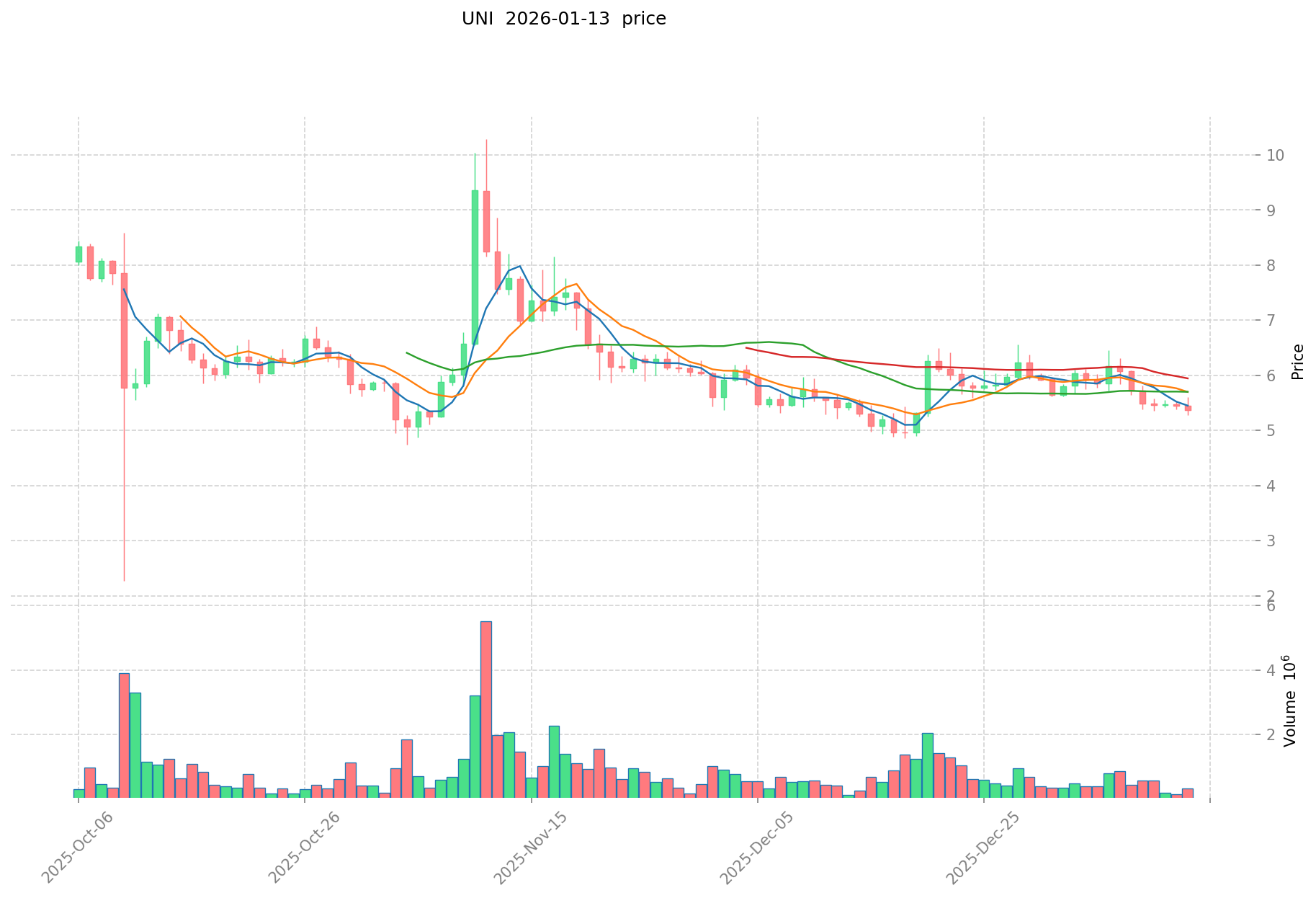
Recent price movements show mixed trends: the token experienced a 0.92% increase over the past hour and a 3.85% gain in the last 24 hours, trading at $5.53. However, broader timeframes reveal more challenging conditions, with a 10.24% decline over the past week and a substantial 59.48% decrease over the past year. The 24-hour trading range fluctuated between $5.28 and $5.53, reflecting ongoing market volatility influenced by evolving sentiment, regulatory developments, and broader cryptocurrency market dynamics.
Click to view current UNI market price
On-Chain Metrics
- Holder Count: Approximately 66,356 addresses hold UNI tokens, demonstrating community distribution and user participation in the protocol's governance structure
- Market Dominance: UNI maintains a 0.15% share of the total cryptocurrency market capitalization, positioning it as the 37th largest digital asset by market value
- Exchange Availability: The token is currently listed on 68 cryptocurrency exchanges, providing diverse liquidity options for traders and investors
Uniswap Ecosystem Applications and Partners
Core Use Cases
Uniswap's ecosystem supports multiple applications:
- DeFi: Uniswap itself, providing decentralized token swapping.
- Liquidity Provision: Users can become liquidity providers, earning trading fees from automated market making pools.
Strategic Partnerships
Uniswap has established collaborations to enhance its technical capabilities and market influence.
These partnerships provide a solid foundation for Uniswap's ecosystem expansion.
Controversies and Challenges
Uniswap faces the following challenges:
- Technical Issues: High gas fees during network congestion and scalability limitations on Ethereum
- Regulatory Risks: Increased scrutiny from regulatory bodies regarding DeFi protocols
- Competitive Pressure: The rise of other decentralized exchanges on alternative blockchains like Solana and BNB Chain
These issues have sparked discussions within the community and market, driving Uniswap's continuous innovation.
Fan Enthusiasm
Uniswap's community remains vibrant, with 66,356 token holders as of January 13, 2026.
On X platform, relevant posts and hashtags (such as #UNI) frequently trend.
Price movements and protocol upgrades ignite community enthusiasm.
Sentiment on X shows polarization:
- Supporters praise Uniswap's decentralized nature and trustless trading mechanism, considering it a cornerstone of DeFi innovation.
- Critics focus on high gas fees, transaction costs, and vulnerability to front-running attacks.
Recent trends show mixed sentiment influenced by market volatility.
Hot Topics
X users actively discuss Uniswap's governance proposals, fee structure changes, and regulatory uncertainties,
showcasing both its transformative potential and obstacles toward mainstream adoption.
- Official Website: Visit Uniswap Official Website for features, use cases, and latest updates.
- X Updates: On X platform, Uniswap actively uses @Uniswap,
with posts covering protocol upgrades, community events, and partnership announcements, generating significant engagement.
Uniswap Future Roadmap
- Ongoing Development: Continuous improvements to the automated market maker protocol and user experience
- Ecosystem Goals: Expanding support for more blockchain networks and token pairs
- Long-term Vision: Becoming the leading decentralized exchange infrastructure globally
How to Participate in Uniswap?
- Purchase Channels: Buy UNI on Gate.com and other cryptocurrency exchanges
- Storage Solutions: Securely store using wallets like MetaMask
- Participate in Governance: Engage in community decisions through Uniswap's governance system
- Build the Ecosystem: Visit developer documentation to build DApps or contribute to the protocol
Summary
Uniswap redefines decentralized trading through blockchain technology, offering transparency, security, and permissionless access.
Its active community, rich resources, and strong market performance make it stand out in the cryptocurrency space.
Despite facing regulatory challenges and technical bottlenecks, Uniswap's innovative spirit and clear development direction position it importantly in the future of decentralized technology.
Whether you are a newcomer or experienced player, Uniswap deserves attention and participation.
FAQ
What is UNI token and what is its purpose?
UNI is the governance token of Uniswap, a leading decentralized exchange on Ethereum. It enables token holders to vote on protocol changes, participate in governance decisions, and shape the platform's future development democratically.
How do I buy and trade UNI cryptocurrency?
You can purchase UNI by signing up on a crypto platform, adding a payment method, and placing an order. Once acquired, you can trade UNI on decentralized exchanges or hold it in your wallet for future transactions and governance participation.
What is Uniswap and how does UNI token relate to it?
Uniswap is a decentralized exchange platform enabling peer-to-peer trading of ERC-20 tokens. UNI is its governance token, rewarding liquidity providers and granting voting rights on protocol decisions.
What are the risks and security considerations when holding UNI?
Holding UNI involves market volatility, smart contract vulnerabilities, and private key management risks. Ensure secure wallet storage, enable two-factor authentication, and beware of phishing scams. Stay informed about regulatory changes affecting UNI tokens.
How does UNI compare to other decentralized exchange tokens?
UNI is Uniswap's governance token, leading in liquidity and trading volume among DEX tokens. It enables decentralized governance, allowing holders to vote on protocol changes. Compared to competitors, UNI stands out through its established ecosystem, superior user base, and stronger trading activity.
What is the total supply and tokenomics of UNI?
UNI has a total supply of 1 billion tokens. As of January 2026, approximately 753.77 million tokens are in circulation, with the remainder locked in vesting schedules and governance mechanisms.
Can I stake UNI tokens and earn rewards?
Yes, you can stake UNI tokens and earn rewards through Uniswap's staking mechanism. Stake your UNI to participate as a validator and generate passive income from staking rewards.
* The information is not intended to be and does not constitute financial advice or any other recommendation of any sort offered or endorsed by Gate.