USDC is a fully-collateralized stablecoin launched by Centre Consortium in 2018, maintaining a 1:1 peg with the US dollar and ranking as the 7th largest cryptocurrency with a $74.34 billion market cap. This comprehensive guide explores USDC's technical architecture, reserve-backed stability mechanisms, and multi-chain deployment across 17+ blockchain networks including Ethereum, Solana, and Arbitrum. Discover how USDC powers DeFi protocols, enables cross-border payments, and serves Web3 commerce while maintaining regulatory compliance. Learn about its 5.84 million holders, strategic partnerships, and transparent audit practices. Whether you're exploring cryptocurrency infrastructure or seeking reliable stablecoin solutions on Gate, this guide covers acquisition methods, practical applications, and key differences from competitors like USDT.
USD Coin's Position and Significance
In 2018, Centre Consortium (a collaboration between Circle and Coinbase) launched USD Coin (USDC), aiming to address instability and lack of transparency in the cryptocurrency market, as well as inefficiencies in cross-border payments.
As a fully-collateralized U.S. dollar-pegged stablecoin, USD Coin plays a crucial role in DeFi, digital payments, and cross-border remittances.
As of 2026, USD Coin has become a top 10 cryptocurrency by market capitalization, with a market cap of approximately $74.34 billion, a circulating supply of 74.34 billion USDC, and over 5.84 million holders. It is listed on 66 exchanges and maintains an active developer and institutional ecosystem.
This article will provide an in-depth analysis of its technical architecture, market performance, and future potential.
Origin and Development History
Birth Background
USD Coin was created by the Centre Consortium (founded by Circle and Coinbase) in 2018, aiming to solve volatility issues inherent in cryptocurrencies and provide a stable, transparent, and compliant digital dollar.
It emerged during the rapid expansion of blockchain technology and growing demand for stable digital assets, with the goal of providing a reliable medium of exchange and store of value for users, businesses, and institutions through full U.S. dollar reserves and regulatory compliance.
The launch of USD Coin brought new possibilities to digital payments, decentralized finance (DeFi), and global remittances.
Key Milestones
- 2018: USDC officially launched as an open-source stablecoin project by Centre, offering full collateralization and detailed financial transparency.
- Multiple years: Expanded to support multiple blockchain networks including Ethereum (ETH), Solana (SOL), Polygon (MATIC), Arbitrum (ARBEVM), Base (BASEEVM), Optimism (OPETH), Avalanche C-Chain (AVAX_C), BNB Smart Chain (BSC), Aptos (APT), NEAR, Sui, zkSync Era (ZKSERA), Hedera (HBAR), Monad (MON), XDC Network, and Polkadot Asset Hub (DOTSM), enhancing cross-chain interoperability.
- 2023: Maintained resilience during market volatility in March, with the price briefly reaching its all-time low of $0.877647 on March 11, demonstrating recovery mechanisms.
- 2024-2025: Continued ecosystem growth with widespread adoption across DeFi protocols, payment platforms, and institutional applications, maintaining position as a leading stablecoin.
- 2026: As of January 13, USDC maintains a market dominance of 2.28%, with a 24-hour trading volume of approximately $24.07 million and near-parity price stability around $1.00.
With support from Circle, banking partners, and audit teams, USD Coin continues to optimize its transparency, security, and real-world applications while operating within the framework of U.S. money transmission regulations.
How USD Coin Works
No Central Control
USD Coin operates on decentralized blockchain networks distributed globally, independent of control by any single bank or government entity.
These networks validate transactions through distributed nodes, ensuring system transparency and attack resistance, granting users greater autonomy and enhancing network resilience.
Blockchain Foundation
USD Coin's multi-chain infrastructure utilizes public, immutable digital ledgers that record every transaction.
Transactions are grouped into blocks and cryptographically linked through hash functions to form a secure chain.
Anyone can view transaction records, establishing trust without intermediaries.
USDC's multi-chain deployment across over 17 different blockchain networks including Ethereum, Solana, Polygon, and others enhances accessibility, transaction speed, and user choice.
Ensuring Stability
USD Coin adopts a reserve-backed collateralization model rather than traditional blockchain consensus for value stability.
Each USDC token is backed by equivalent U.S. dollar reserves held in regulated financial institutions, with regular attestations provided by independent auditors.
The underlying blockchains (such as Ethereum's PoS, Solana's PoH, etc.) validate transactions through their respective consensus mechanisms to prevent double-spending and maintain network integrity.
USDC's innovation includes operating within U.S. regulatory frameworks, providing detailed financial transparency, and partnering with multiple banking institutions and audit teams.
Secure Transactions
USD Coin uses public-private key cryptography to protect transactions:
- Private keys (similar to secret passwords) are used to sign transactions
- Public keys (similar to account numbers) are used to verify ownership
This mechanism ensures fund security while transactions maintain pseudonymous characteristics through blockchain addresses.
Additional security features include regulatory compliance, regular financial attestations, and integration with established banking infrastructure to ensure reserve backing and operational transparency.
Circulation Overview
As of January 13, 2026, USDC's circulating supply stands at 74,339,042,588.49 tokens, with a total supply of 74,336,429,902.58 tokens. The circulation ratio reaches approximately 100%, indicating that nearly all issued tokens are in active circulation.
USDC operates as a fully collateralized stablecoin pegged to the US dollar, with new tokens entering the market through a regulated issuance mechanism backed by equivalent USD reserves held in partner banking institutions. The token maintains transparency through regular audits and operates within the framework of US monetary circulation laws.
Price Dynamics
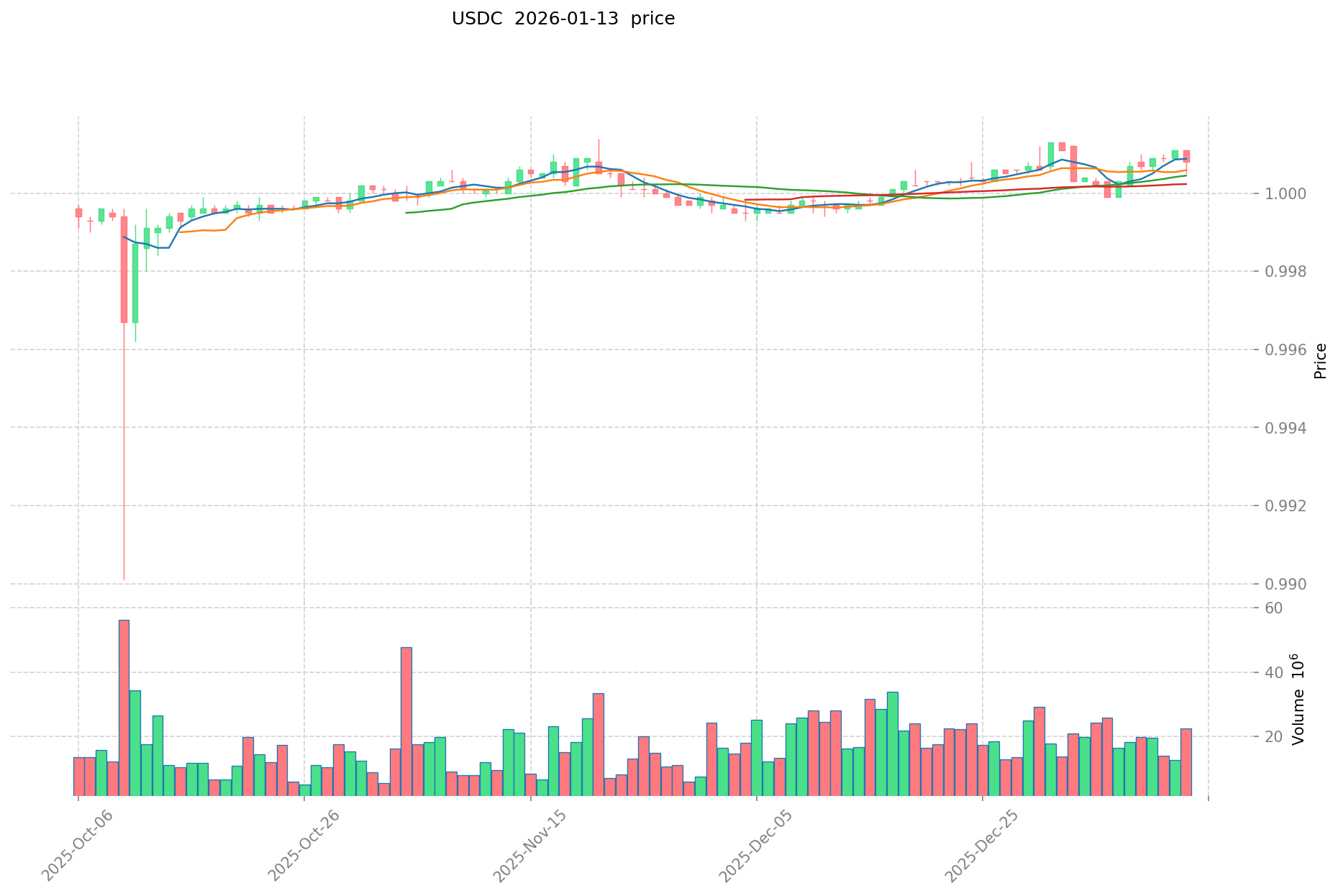
USDC reached a notable price level of $1.17 on May 8, 2019, during a period of heightened market activity and increasing demand for stablecoin liquidity in the crypto ecosystem.
The token experienced its lowest recorded price of $0.877647 on March 11, 2023, influenced by broader market volatility and temporary de-pegging events affecting stablecoin markets during that period.
Recent price performance shows stability with minor fluctuations: a -0.01% change over 1 hour, -0.03% over 24 hours, and positive movements of 0.09% over 7 days and 0.11% over 30 days. These movements reflect USDC's core function as a stable medium of exchange and store of value within the cryptocurrency ecosystem.
Click to view current USDC market price
On-chain Metrics
- 24-hour Trading Volume: Approximately 24.07 million USDC, demonstrating consistent market liquidity and active trading activity
- Token Holders: Over 5.84 million addresses hold USDC across multiple blockchain networks, reflecting widespread adoption and usage
- Multi-chain Deployment: USDC is deployed across 17 major blockchain networks including Ethereum, Arbitrum, Base, BSC, Avalanche, Polygon, Solana, and others, enabling cross-chain interoperability and accessibility
- Market Capitalization: $74.34 billion, ranking 7th among all cryptocurrencies with a market dominance of 2.28%
USDC Ecosystem Applications and Strategic Partners
Core Use Cases
USDC's ecosystem supports multiple applications across the crypto landscape:
- DeFi (Decentralized Finance): USDC serves as a primary liquidity source and trading pair on decentralized exchanges, enabling stable-value transactions and lending protocols.
- Cross-Chain Payments: Deployed across multiple blockchain networks including Ethereum, Solana, Arbitrum, Base, Polygon, and others, USDC facilitates seamless value transfer across diverse ecosystems.
- Web3 Commerce: As a dollar-pegged stablecoin, USDC provides price stability for merchants and consumers in the digital economy.
Strategic Partnerships
USDC operates under the Centre consortium framework, collaborating with banking institutions and audit teams to ensure transparency and compliance.
These partnerships provide a solid foundation for USDC's ecosystem expansion and regulatory adherence within the U.S. monetary transmission framework.
Challenges and Considerations
USDC faces several ongoing considerations:
- Regulatory Landscape: Operating within U.S. currency circulation laws requires continuous adaptation to evolving regulatory standards
- Market Competition: As one of multiple stablecoins in the market, USDC competes with other dollar-pegged tokens for market share
- Multi-Chain Complexity: Managing deployments across 17+ blockchain networks presents coordination and security challenges
These factors drive ongoing innovation and community engagement around USDC's development.
Holder Engagement
USDC demonstrates strong adoption with 5,843,307 holders across its various blockchain deployments.
The token maintains consistent usage with a 24-hour trading volume of $24.07 million as of January 13, 2026.
Multi-chain availability and transparent reserve practices contribute to sustained community trust.
On X platform, discussions around USDC reflect diverse perspectives:
- Supporters emphasize USDC's full collateralization, operational transparency, and regulatory compliance, viewing it as a reliable bridge between traditional finance and crypto markets.
- Observers note considerations around centralized control mechanisms and reserve custody arrangements.
Market sentiment generally reflects USDC's role as a stable-value instrument within the broader crypto ecosystem.
Key Discussion Topics
X users discuss USDC's regulatory positioning, reserve transparency, and multi-chain deployment strategy,
reflecting both its utility in crypto markets and considerations around stablecoin infrastructure.
- Official Website: Visit USDC Official Site for features, use cases, and current updates.
- Technical Documentation: The Centre Protocol provides architectural details and operational frameworks.
- X Activity: USDC's issuer Circle maintains active communication through @circlepay on X platform,
sharing updates on technical integrations, compliance developments, and ecosystem partnerships.
USDC Development Roadmap
- Ongoing Expansion: Continued integration across emerging blockchain networks to enhance accessibility and interoperability
- Transparency Initiatives: Maintaining detailed financial and operational disclosure practices
- Long-term Vision: Serving as infrastructure for digital dollar transactions across global payment systems
How to Participate with USDC?
- Acquisition: Purchase USDC on Gate.com and other cryptocurrency exchanges supporting USDC trading pairs
- Storage Options: Store USDC using compatible wallets such as MetaMask or hardware wallets supporting ERC-20 and other relevant standards
- Utilization: Use USDC for DeFi protocols, cross-border payments, or as a stable-value reserve within crypto portfolios
- Development Integration: Refer to blockchain-specific documentation for integrating USDC into applications
Summary
USDC represents a fully-collateralized stablecoin offering transparency, regulatory compliance, and multi-chain accessibility within the cryptocurrency ecosystem.
Its widespread adoption across 17+ blockchain networks, substantial holder base of over 5.8 million addresses, and commitment to operational transparency position it as significant infrastructure in digital finance.
While considerations around regulatory frameworks and centralized issuance remain topics of community discussion, USDC's transparent reserve practices and established compliance framework contribute to its role in connecting traditional finance with blockchain technology.
Whether you're exploring stablecoins for the first time or seeking reliable digital dollar infrastructure, USDC offers an established option worth understanding.
FAQ
What is USDC? What is its relationship with the US dollar?
USDC is a stablecoin fully backed by US dollar reserves. Each USDC token maintains a 1:1 value with the US dollar, designed to provide price stability in cryptocurrency transactions and serve as a reliable digital representation of fiat currency on blockchain networks.
What is the difference between USDC and USDT? Why choose USDC?
USDC is more transparent and regulated than USDT, backed by major institutions with monthly audits. USDT lacks transparency and has faced stability concerns. Choose USDC for enhanced security, regulatory oversight, and greater trust in the stablecoin market.
How to obtain and use USDC? Where can I buy it?
You can buy USDC on major cryptocurrency exchanges. USDC is a stablecoin pegged 1:1 to the US dollar, available on blockchain networks like Ethereum. Once purchased, you can hold it in wallets, trade it, or use it for payments and transactions across DeFi platforms.
How secure is USDC? Are funds protected?
USDC is backed by fully reserved USD assets held in regulated institutions, providing strong security. Your funds are protected through transparent attestations and smart contract audits. However, like all crypto assets, security depends on platform security and your personal account management.
What scenarios can USDC be used in? What are its practical applications?
USDC enables fast international remittances with minimal fees, facilitates cryptocurrency trading and conversions between digital assets, and supports stablecoin transactions across blockchain networks globally.
What are the differences of USDC on different blockchains?
USDC operates on 29 different blockchains including Ethereum, Solana, and Avalanche. Each network may have different transaction speeds, fees, and liquidity, but USDC maintains 1:1 USD parity across all chains. The underlying technology and bridge mechanisms vary by chain.
What are the risks to be aware of when holding USDC?
USDC carries issuer bankruptcy risk and potential currency devaluation. As a stablecoin, its value depends on the issuer's financial stability. Long-term holding risks remain uncertain.
* The information is not intended to be and does not constitute financial advice or any other recommendation of any sort offered or endorsed by Gate.