Decentralized USD (USDD) is a decentralized stablecoin launched by TRON DAO Reserve in 2022, designed to provide price stability and reliable settlement in cryptocurrency markets. This comprehensive guide explores USDD's technical architecture, algorithmic stabilization mechanisms, and market performance, highlighting its role in DeFi protocols and payment solutions. With over 457,511 holders and approximately $943.8 million market capitalization, USDD maintains its $1 peg through innovative incentive structures and reserve management. The article covers USDD's origin, blockchain foundation, ecosystem applications, community dynamics, and participation methods on Gate and other platforms. Despite facing regulatory and competitive challenges, USDD continues advancing as a decentralized settlement currency within the blockchain ecosystem.
Decentralized USD's Positioning and Significance
In 2022, the TRON DAO Reserve introduced Decentralized USD (USDD), aiming to address price volatility in cryptocurrency markets and the need for a stable settlement currency.
As a decentralized stablecoin with built-in stabilization mechanisms, Decentralized USD plays a key role in DeFi, payments, and value storage.
As of 2026, Decentralized USD has become a prominent stablecoin in the crypto ecosystem, with a market capitalization of approximately $943.8 million and over 457,511 holders.
This article will provide an in-depth analysis of its technical architecture, market performance, and future potential.
Origin and Development History
Birth Background
Decentralized USD was created by the TRON DAO Reserve in 2022, aiming to solve cryptocurrency price instability and the lack of reliable decentralized settlement options.
It emerged during the expansion of algorithmic stablecoins and demand for DeFi infrastructure, with the goal of providing a self-stabilizing digital dollar through internal incentive mechanisms and monetary policy.
Decentralized USD's launch brought new possibilities for crypto traders, DeFi participants, and cross-border payment users.
Important Milestones
- 2022: Mainnet launch on the TRON blockchain, implementing algorithmic stabilization mechanisms.
- 2023: Price stability improvements, with the all-time high reaching $1.052 in October.
- 2024: Ecosystem expansion with integration across multiple DeFi protocols.
- 2026: Maintained circulation of over 943 million tokens with a holder base exceeding 457,000 users.
With the support of TRON DAO Reserve and the broader TRON community, Decentralized USD continues to refine its stability mechanisms, security features, and real-world applications.
How Decentralized USD Works?
No Central Control
Decentralized USD operates on a decentralized network of computers (nodes) distributed globally, free from control by banks or governments.
These nodes collaborate to validate transactions, ensuring the system remains transparent and resistant to attacks, granting users greater autonomy and enhancing network resilience.
Blockchain Foundation
Decentralized USD's blockchain is a public, immutable digital ledger that records every transaction.
Transactions are grouped into blocks and linked through cryptographic hashes to form a secure chain.
Anyone can view the records, establishing trust without intermediaries.
The implementation on the TRON network provides enhanced transaction speed and lower costs.
Ensuring Stability
Decentralized USD employs algorithmic stabilization mechanisms combined with reserve management to maintain its peg to the US dollar and prevent price deviations.
The TRON DAO Reserve manages the backing assets and implements monetary policies to ensure price stability during market fluctuations.
Its innovation includes internal incentive structures and automated adjustment mechanisms designed to keep the value stable around $1.
Secure Transactions
Decentralized USD uses public-private key cryptography to protect transactions:
- Private keys (like secret passwords) are used to sign transactions
- Public keys (like account numbers) are used to verify ownership
This mechanism ensures fund security, while transactions maintain pseudonymous privacy on the blockchain.
Additional security is provided through the underlying TRON network's consensus mechanisms and smart contract protocols.
Circulation Overview
As of January 14, 2026, Decentralized USD (USDD) has a circulating supply of 943,802,255 tokens, with a total supply of 943,802,255 tokens. The maximum supply is unlimited (∞), indicating an inflationary model without a hard cap. The token operates with an internal incentive mechanism and corresponding monetary policy designed to enable self-stabilization during price fluctuations. Currently, the circulating supply represents approximately 9.44% of the fully diluted market capitalization, suggesting potential for future supply expansion.
Price Volatility
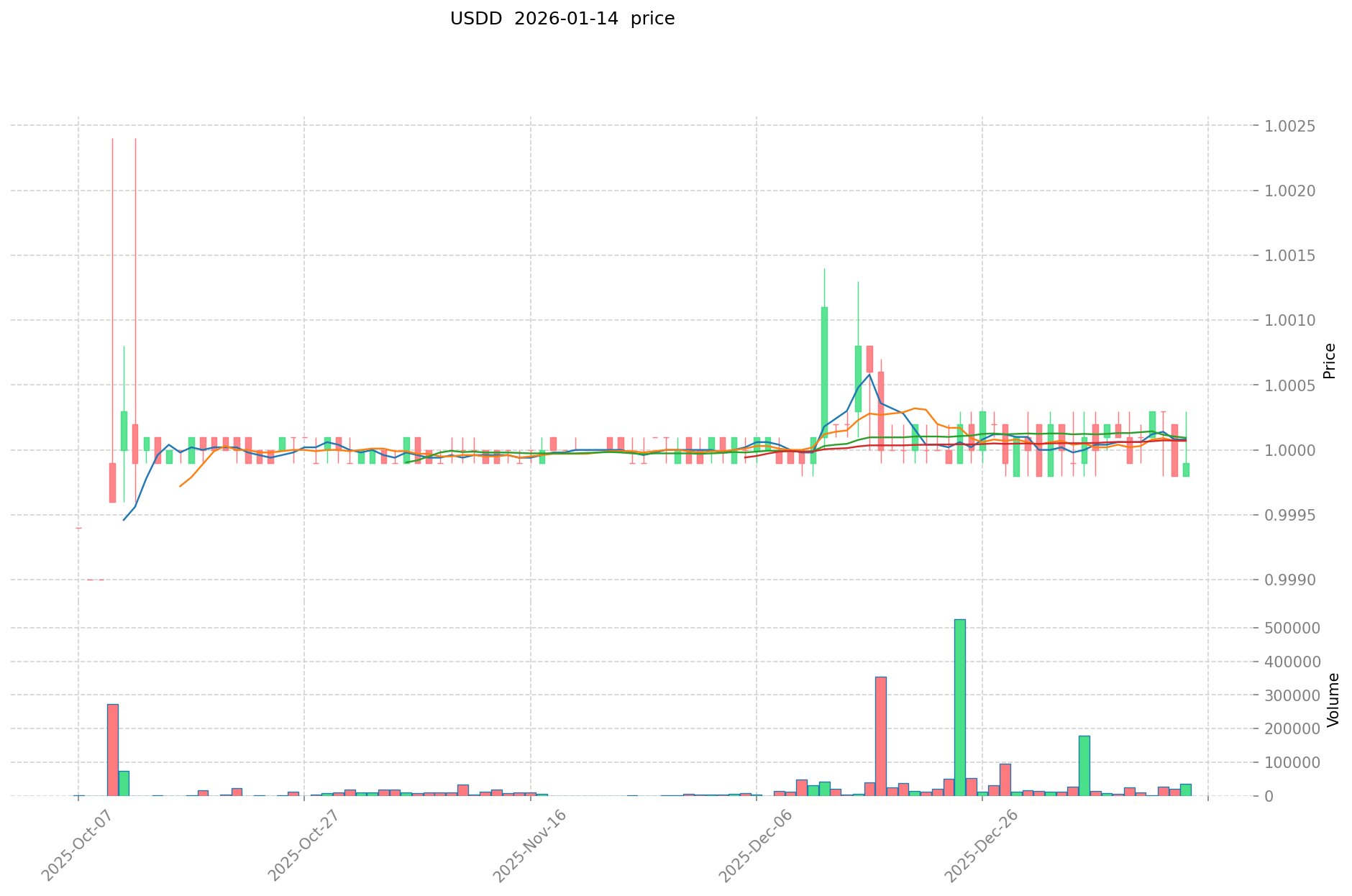
USDDD reached its all-time high of $1.052 on October 24, 2023, driven by favorable market conditions and increased adoption within the TRON ecosystem. The token experienced its lowest price of $0.928067 on June 20, 2022, reflecting broader crypto market volatility and initial price discovery dynamics following its launch. These fluctuations demonstrate the token's response to market sentiment, adoption trends, and external factors affecting stablecoin mechanisms. As of the latest data, USDD trades at approximately $1.00, maintaining relative stability consistent with its design as a decentralized stablecoin.
Click to view the current USDD market price
On-Chain Metrics
- 24-Hour Trading Volume: $30,768.60 (indicating ongoing market activity)
- Holder Addresses: 457,511 addresses (reflecting substantial user participation)
- Market Dominance: 0.027% of the total cryptocurrency market capitalization
Decentralized USD Ecosystem Applications and Partners
Core Use Cases
Decentralized USD's ecosystem supports multiple applications:
- Stablecoin Settlement: USDD provides price stability mechanisms for decentralized finance protocols, enabling reliable value transfer and settlement.
- DeFi Integration: USDD serves as a collateral asset in lending platforms, facilitating liquidity provision and yield generation.
Strategic Cooperation
Decentralized USD is issued by TRON DAO Reserve, leveraging the TRON blockchain infrastructure for its operations.
These partnerships provide a solid foundation for USDD's ecosystem expansion.
Challenges and Controversies
Decentralized USD faces the following challenges:
- Price Stability Concerns: Maintaining the dollar peg during market volatility remains a critical focus
- Regulatory Risks: Stablecoin regulations continue to evolve across different jurisdictions
- Competitive Pressure: Other stablecoins in the market create an increasingly competitive environment
These issues have sparked discussions within the community and market, while also driving continuous innovation for USDD.
Decentralized USD's community demonstrates notable activity, with 457,511 holders participating in the ecosystem.
On X platform, related posts and hashtags (such as #USDD) generate regular engagement.
Price stability and use case development continue to drive community interest.
Sentiment on X shows diverse perspectives:
- Supporters praise USDD's algorithmic stability mechanisms and diverse use cases, viewing it as a reliable decentralized settlement option.
- Critics focus on market volatility risks and algorithmic stability concerns.
Recent trends reflect ongoing discussion around stablecoin mechanisms and market adoption.
Trending Topics
X users actively discuss USDD's stability mechanisms, TRON ecosystem integration, and regulatory landscape,
showcasing both its potential for innovation and the challenges facing mainstream adoption.
- Official Website: Visit USDD Official Site for features, use cases, and latest updates.
- White Paper: USDD White Paper details its technical architecture, objectives, and vision.
- X Dynamics: On X platform, Decentralized USD maintains an active presence through @usddio,
with posts covering technical updates, ecosystem developments, and partnership announcements, generating substantial community engagement.
Decentralized USD Future Roadmap
- Ongoing Development: Enhancement of stability mechanisms and cross-chain compatibility, improving settlement efficiency and ecosystem integration
- Ecosystem Goals: Expanding adoption across DeFi protocols and payment solutions
- Long-term Vision: Establishing presence as a decentralized settlement currency within the blockchain ecosystem
How to Participate in Decentralized USD?
- Purchase Channels: Acquire USDD on Gate.com and other supporting exchanges
- Storage Solutions: Securely store using compatible wallets supporting TRON network
- Ecosystem Participation: Engage with TRON DAO Reserve governance mechanisms
- Ecosystem Building: Explore integration opportunities for DeFi protocols and payment applications
Summary
Decentralized USD leverages blockchain technology to provide a stablecoin solution, offering price stability, transparent mechanisms, and diverse use cases.
Its active community, comprehensive resources, and market presence position it within the stablecoin sector.
Despite facing regulatory considerations and competitive challenges, USDD's focus on stability mechanisms and clear development direction establish its role in the decentralized finance landscape.
Whether you are a newcomer or experienced participant, Decentralized USD represents an interesting project to follow and engage with.
FAQ
What is USDD? How does it work?
USDD is a decentralized stablecoin backed by assets including TRX, BTC, and USDT. It maintains its $1 peg through an algorithmic mechanism: when price deviates from $1, the protocol allows users to arbitrage by burning USDD tokens, gradually reducing supply to restore stability.
What is the difference between USDD and other stablecoins like USDT and USDC?
USDD emphasizes decentralized governance and community participation, distinguishing it from centralized stablecoins USDT and USDC. While USDT and USDC rely on traditional reserve backing, USDD offers a more decentralized structure with enhanced community involvement in protocol governance.
How is USDD's value guaranteed to remain stable at 1 USD?
USDD maintains its 1 USD stability through over-collateralization, where each USDD is backed by assets worth more than 1 USD. This mechanism protects it from market volatility and ensures price stability.
How to buy and use USDD?
Register on a crypto platform and complete identity verification. Purchase USDD using bank transfer or credit card. USDD is a stablecoin backed by real assets, ensuring stability. Use it for trading, transfers, or holding in your digital wallet.
What risks does USDD face? Is it safe?
USDD faces depegging, regulatory, competition, technical, market, and liquidity risks. Safety depends on implementation quality and regulatory oversight. Users should carefully assess their risk tolerance before participation.
Which blockchain networks is USDD available on?
USDD is available on Ethereum, BNB Chain, and TRON blockchain networks, providing multi-chain stablecoin accessibility for users.
* The information is not intended to be and does not constitute financial advice or any other recommendation of any sort offered or endorsed by Gate.