USDP (Paxos Standard) stands as the world's first regulated stablecoin, launched by Paxos in 2018 to address liquidity challenges and settlement inefficiencies in cryptocurrency trading. This comprehensive guide explores USDP's technical architecture built on Ethereum's ERC-20 standard, its market performance with 47.57 million circulating supply, and its role in institutional adoption across DeFi and payment solutions. With over 109,963 token holders and FDIC-insured USD reserves, USDP demonstrates strong regulatory compliance and transparent reserve management. The article examines USDP's ecosystem applications, competitive positioning against other stablecoins, community sentiment, and strategic partnerships, while addressing challenges including regulatory oversight and market competition. Discover how to purchase USDP on Gate and evaluate whether this compliance-first stablecoin aligns with your digital finance strategy.
Paxos (USDP) Positioning and Significance
In 2018, Paxos introduced Paxos Standard (USDP, formerly PAX), aiming to address liquidity challenges and settlement inefficiencies in cryptocurrency trading.
As the world's first regulated stablecoin, USDP plays a critical role in digital payments and asset trading.
As of 2026, USDP has established itself as a trusted USD-backed stablecoin in the digital asset ecosystem, with over 109,963 holders and an active presence across multiple exchanges.
This article will analyze its technical architecture, market performance, and future potential.
Origin and Development History
Background of Creation
USDP was created by Paxos in 2018, aiming to address the lack of regulated, transparent stablecoins and the need for instant settlement in crypto asset trading.
It emerged during the growing demand for compliant digital financial infrastructure, with the objective of providing a reliable digital alternative to cash through 1:1 USD backing.
The launch of USDP brought new possibilities for institutional and retail investors seeking regulated stablecoin solutions.
Key Milestones
- 2018: Launch as Paxos Standard (PAX), becoming the first regulated stablecoin supervised by the New York State Department of Financial Services.
- 2021: Rebranded from Paxos Standard (PAX) to Pax Dollar (USDP) on August 25, 2021, reflecting its evolution as a USD-pegged stablecoin.
- 2024: Reached an all-time high price of $1.502 in April, demonstrating market confidence during periods of volatility.
- 2026: Maintains a circulating supply of 47.57 million USDP with a market cap of approximately $47.57 million, serving users across the global crypto ecosystem.
With support from Paxos Trust Company and regulatory oversight, USDP continues to optimize its compliance framework, security measures, and real-world applications.
How USDP Works
No Central Control
USDP operates on the Ethereum blockchain, leveraging a decentralized network of nodes worldwide, free from control by any single bank or government entity.
These nodes collaborate to validate transactions, ensuring system transparency and resistance to attacks, while granting users greater autonomy and enhancing network resilience.
Blockchain Foundation
USDP's blockchain is a public, immutable digital ledger that records every transaction.
Transactions are grouped into blocks and linked through cryptographic hashing to form a secure chain.
Anyone can view the records, establishing trust without intermediaries.
As an ERC-20 token, USDP benefits from Ethereum's established infrastructure, enabling seamless transfers between wallets and integration with decentralized applications.
Ensuring Fairness
USDP relies on Ethereum's Proof of Stake (PoS) consensus mechanism to validate transactions and prevent fraudulent activities such as double-spending.
Validators maintain network security through staking ETH and running nodes, receiving rewards for their participation.
The ERC-20 standard ensures compatibility across the Ethereum ecosystem, while smart contracts govern the minting and redemption process, maintaining the 1:1 USD peg.
Secure Transactions
USDP employs public-private key cryptography to protect transactions:
- Private keys (like secret passwords) are used to sign transactions
- Public keys (like account numbers) verify ownership
This mechanism ensures fund security while transactions remain pseudonymous.
Additionally, USDP's reserves are held in FDIC-insured U.S. banks in segregated accounts, providing an extra layer of protection. As a trust company, Paxos acts as a qualified custodian, offering greater asset protection compared to many other stablecoins. The open-source nature of USDP's smart contracts, available on GitHub, allows for community verification and transparency.
Circulation Overview
As of 19 January 2026, Paxos (USDP) has a circulating supply of 47,569,455.21 tokens, with a total supply of 47,569,455.21 tokens. The maximum supply is unlimited, indicating a potentially inflationary model. New tokens enter the market through minting and burning mechanisms controlled by smart contracts, which are managed through a supply controller address. This process impacts the supply-demand dynamics of USDP in the market. The token operates on a 1:1 backing model with the US dollar, where each token is fully collateralized by corresponding USD reserves held in trust.
Price Fluctuations
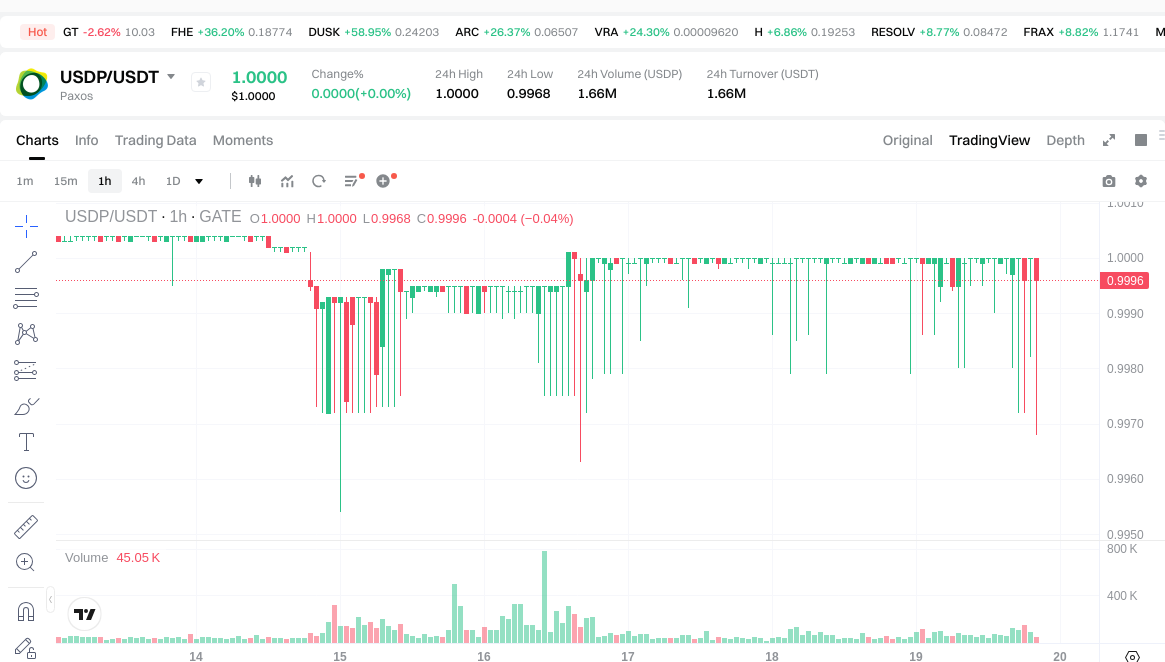
USDP reached a notable price point of $1.502 on 16 April 2024, driven by market conditions during that period. Its lowest recorded price was $0.9824 on 3 January 2024, reflecting market volatility and adjustments in the stablecoin ecosystem. As of the latest update on 19 January 2026, USDP is trading at approximately $1.00, maintaining its peg to the US dollar. Recent price movements show a -0.0072% change over 1 hour, 0% change over 24 hours, -0.04% over 7 days, +0.08% over 30 days, and -0.069% over 1 year. The 24-hour price range has been between $0.9968 and $1.00. These fluctuations reflect market sentiment, adoption trends, and the inherent characteristics of dollar-pegged stablecoins.
Click to view current USDP market price
On-Chain Metrics
- 24-Hour Trading Volume: $1,655,814.81 (indicating market activity)
- Token Holders: 109,963 addresses (reflecting user adoption)
- Market Capitalization: $47,569,455.21 (representing current market valuation)
- Fully Diluted Valuation: $47,569,455.21 (showing complete market value assessment)
- Market Dominance: 0.0014% (indicating relative position in the broader cryptocurrency market)
Paxos (USDP) Ecosystem Applications and Partners
Core Use Cases
Paxos (USDP) ecosystem supports various applications:
- DeFi: Integration with decentralized exchanges and lending platforms, providing stable value medium for trading and liquidity provision.
- Payment Solutions: Utilized in cross-border transactions and remittances, enabling instant settlements with US dollar parity.
Strategic Partnerships
Paxos has established collaborations with multiple FDIC-insured US registered banks, enhancing its custody and reserve management capabilities.
These partnerships provide a solid foundation for USDP's ecosystem expansion and regulatory compliance.
Controversies and Challenges
Paxos (USDP) faces the following challenges:
- Regulatory Oversight: Subject to supervision by the New York State Department of Financial Services, requiring ongoing compliance efforts
- Market Competition: Competition from other stablecoins in the rapidly evolving digital asset space
- Supply Dynamics: Fluctuating total supply based on market demand and redemption patterns
These issues have sparked discussions within the community and market, while also driving USDP's continuous development.
Paxos (USDP) maintains an active community, with approximately 109,963 token holders as of January 2026.
On X platform, related posts and hashtags frequently appear in cryptocurrency discussions.
Factors such as regulatory updates and partnership announcements generate community interest.
Sentiment on X demonstrates varied perspectives:
- Supporters praise USDP's regulatory compliance, full US dollar collateralization, and institutional-grade custody, viewing it as a reliable digital dollar alternative.
- Observers monitor supply changes, competitive positioning, and regulatory developments.
Recent trends indicate steady engagement within the stablecoin sector.
Trending Topics
X users discuss USDP's regulatory framework, reserve transparency, and role in institutional adoption,
showcasing both its stability features and considerations for mainstream integration.
- Official Website: Visit Paxos Standard website for features, use cases, and latest updates.
- White Paper: Paxos Standard whitepaper details its technical architecture, objectives, and vision.
- X Updates: On X platform, Paxos operates under @PaxosGlobal,
sharing content about regulatory developments, reserve reports, and ecosystem partnerships.
Paxos (USDP) Future Roadmap
- Ongoing Development: Continued focus on compliance infrastructure and reserve management optimization
- Ecosystem Goals: Expanding integration with institutional platforms and payment networks
- Long-term Vision: Serving as trusted digital dollar infrastructure for global financial systems
How to Participate in Paxos (USDP)?
- Purchase Channels: Acquire USDP on Gate.com and other supported platforms
- Storage Solutions: Use compatible Ethereum wallets such as MetaMask or hardware wallets for secure storage
- Developer Resources: Access Paxos GitHub repository for smart contract code and technical documentation
- Direct Exchange: Verified Paxos customers can purchase or redeem USDP directly through the company website
Summary
Paxos (USDP) represents a regulated approach to stablecoins, offering 1:1 US dollar backing, institutional custody, and regulatory compliance.
Its transparent reserve structure, verified partnerships, and steady market presence distinguish it in the stablecoin landscape.
Despite facing competitive pressures and evolving regulatory requirements, USDP's compliance-first approach and clear operational framework position it as a noteworthy option in digital dollar alternatives.
Whether you are new to stablecoins or an experienced participant, Paxos (USDP) merits consideration for its regulated structure and institutional-grade features.
FAQ
What is USDP? How does it differ from other stablecoins like USDC and USDT?
USDP is not a widely recognized stablecoin in the market. USDC and USDT are the dominant stablecoins, both pegged to the US dollar. USDC offers greater transparency with regular audits and regulatory oversight from authorities, while USDT is controlled by Tether Limited. USDC operates on multiple blockchains with clearer reserve backing, whereas USDT has faced scrutiny over transparency. For institutional users, USDC is increasingly preferred for its regulatory compliance and accountability.
How does USDP maintain price stability? What are its reserve assets?
USDP maintains stability through strict reserve backing, with reserves primarily held in US dollars. Each token is fully collateralized and regulated, ensuring reliable 1:1 USD parity through transparent reserve verification.
How to buy and use USDP? Which blockchain networks and exchanges are supported?
USDP can be purchased via credit or debit card through platforms like Nexo. As an ERC-20 token on Ethereum, USDP enables on-chain transfers, storage, and usage. It supports multiple blockchain networks and trading venues for seamless global transactions.
What are the risks of holding USDP? How secure is the issuer Paxos?
USDP carries market volatility and regulatory risks. Paxos, as a regulated issuer, maintains high security and compliance standards. USDP's stability depends on its USD peg and Paxos's operational integrity.
What are the application scenarios of USDP in DeFi? What can it be used for?
USDP is a stablecoin pegged to the US dollar, enabling lending, borrowing, trading, and liquidity provision in DeFi without price volatility. It reduces risk and facilitates seamless decentralized finance transactions.
* The information is not intended to be and does not constitute financial advice or any other recommendation of any sort offered or endorsed by Gate.