Vana is an EVM-compatible Layer 1 blockchain revolutionizing data ownership in the AI economy by enabling users to securely monetize personal data through Data Liquidity Pools and Data DAOs while maintaining privacy control. Launched in December 2024 on Gate, the $VANA token addresses the critical gap between data contributors and AI developers by creating a decentralized infrastructure for fair data compensation and transparent AI model training. With a market cap of approximately $73.77 million and expanding ecosystem participation, Vana combines Proof-of-Contribution mechanisms with privacy-preserving technology to establish a new asset class of tradable data tokens. This comprehensive guide explores Vana's technical architecture, market performance, real-world applications, and investment considerations for both newcomers and experienced cryptocurrency participants seeking exposure to the intersection of blockchain and artificial intelligence.
Vana's Positioning and Significance
In 2024, the Vana team launched Vana ($VANA), aiming to address the lack of data ownership and monetization opportunities for individuals in the AI economy.
As an EVM-compatible Layer 1 blockchain focused on transforming personal data into tradable financial assets, Vana plays a critical role in data monetization, AI training, and Web3 infrastructure.
As of 2026, Vana has established itself as an innovative player in the data economy and AI sectors, with a market capitalization of approximately $73.77 million and an active ecosystem of Data DAOs and developers.
This article will provide an in-depth analysis of its technical architecture, market performance, and future potential.
Origin and Development History
Birth Background
Vana was created by its founding team in 2024, aiming to solve the problem of centralized data control and lack of compensation for users whose data fuels AI models.
It emerged during the rapid expansion of AI technology and growing concerns about data privacy and ownership, with the goal of empowering users to securely monetize their private data while maintaining control and privacy.
Vana's launch brought new possibilities for individuals, data contributors, and AI developers seeking ethical data sources.
Major Milestones
- December 2024: Mainnet launch and listing on Gate.com, enabling users to trade VANA and participate in the data economy ecosystem.
- 2024-2025: Development of Data Liquidity Pools (DLPs) and Data DAOs, establishing the foundation for decentralized data aggregation and validation.
- 2025: Integration with various AI training platforms, demonstrating practical applications of user-owned data in model development.
- 2026: Continued ecosystem growth with expanding DLP participation and increasing adoption of Proof-of-Contribution mechanisms.
Supported by its community and Data DAO participants, Vana continues to refine its technology, security protocols, and real-world applications.
How Vana Works
No Central Control
Vana operates on a decentralized network of computers (nodes) distributed globally, free from control by banks or governments.
These nodes collaborate to validate transactions, ensuring system transparency and attack resistance, granting users greater autonomy and enhancing network resilience.
Blockchain Core
Vana's blockchain is a public, immutable digital ledger that records every transaction.
Transactions are grouped into blocks and linked through cryptographic hashes to form a secure chain.
Anyone can view the records, establishing trust without intermediaries.
As an EVM-compatible Layer 1, Vana supports smart contracts and decentralized applications while introducing specialized features for data management and validation.
Ensuring Fairness
Vana employs Proof-of-Contribution and validation mechanisms through Data Liquidity Pools to verify data contributions and transactions, preventing fraud and ensuring quality.
Validators and DLP participants maintain network security through data validation, staking, and governance activities, earning VANA token rewards.
Its innovation includes combining blockchain technology with privacy-preserving data aggregation, enabling AI training without compromising user privacy.
Secure Transactions
Vana uses public-private key cryptography to protect transactions:
- Private keys (similar to secret passwords) are used to sign transactions
- Public keys (similar to account numbers) are used to verify ownership
This mechanism ensures fund security, and transactions maintain pseudonymous privacy.
Additional security features include data encryption within DLPs and user-controlled data permissions, ensuring contributors retain ownership while enabling secure data sharing for AI applications.
Circulation Overview
As of January 18, 2026, VANA's circulating supply stands at 30,800,000 tokens, with a total supply of 120,000,000 tokens and a maximum supply capped at 120,000,000 tokens, representing a fixed supply model.
The circulating supply accounts for approximately 25.67% of the total supply, indicating a controlled token distribution mechanism.
The token serves as the foundation of the ecosystem, facilitating transactions, staking, and governance within the Vana network.
Price Volatility
VANA reached its peak price of $35.703 on December 17, 2024, driven by its initial listing momentum and market interest in data ownership and AI economy narratives.
The token experienced its lowest price of $1.174 on October 10, 2025, reflecting broader market corrections and sentiment shifts.
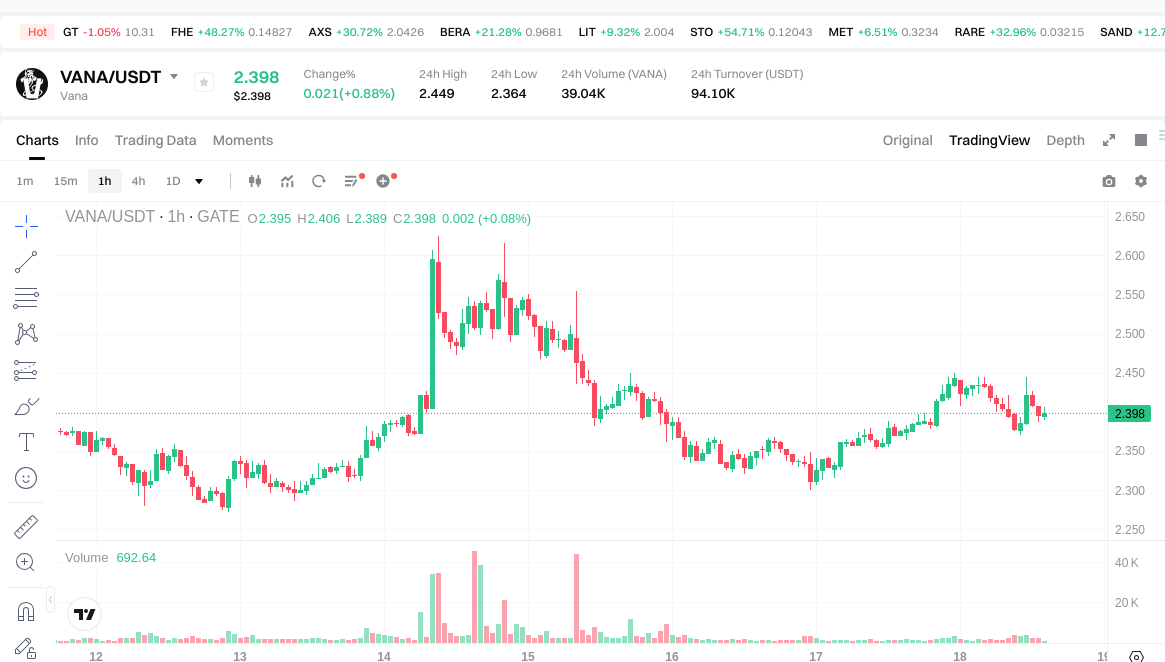
As of January 18, 2026, VANA is trading at $2.395, showing a 24-hour increase of 0.54% and a 7-day gain of 1.06%, while facing a 30-day decline of 9.5% and a 1-year decrease of 80.89% from its launch price.
These fluctuations demonstrate the token's sensitivity to market sentiment, adoption trends, and external factors affecting the broader cryptocurrency ecosystem.
Click to view current VANA market price
On-Chain Metrics
- 24-Hour Trading Volume: $93,677.86 (indicating current market activity levels)
- Market Capitalization: $73,766,000 (reflecting current network valuation)
- Fully Diluted Valuation: $287,400,000 (representing potential maximum market cap)
- Market Dominance: 0.0085% (showing relative position in the cryptocurrency market)
Vana Ecosystem Applications and Partnerships
Core Use Cases
Vana's ecosystem supports multiple applications:
- Data Monetization: Through Data DAOs (Decentralized Autonomous Organizations), enabling users to securely transform personal data into tradable financial assets.
- AI Model Training: Via Data Liquidity Pools (DLPs), facilitating AI development while preserving data privacy and user ownership.
Strategic Collaborations
While specific partnership details were not extensively documented in available materials, Vana's EVM compatibility positions it to integrate with various Web2 and Web3 entities. The platform's focus on bridging these ecosystems provides a foundation for potential future collaborations that could enhance its technical capabilities and market presence.
Controversies and Challenges
Vana faces several challenges:
- Technical Complexity: Balancing data privacy with AI model training requirements presents ongoing development considerations
- Market Competition: Operating in a competitive landscape with established blockchain platforms
- Adoption Hurdles: Building user trust in data monetization mechanisms while maintaining privacy standards
These considerations drive ongoing innovation within the Vana ecosystem.
Vana maintains an active community presence, with the platform available on multiple exchanges. The project's focus on transforming data ownership has attracted attention from both Web2 and Web3 communities.
Sentiment on X shows diverse perspectives:
- Supporters highlight Vana's innovative approach to data ownership and its potential to revolutionize the AI economy, viewing it as a bridge between traditional and decentralized systems.
- Observers monitor market performance and ecosystem development as the platform establishes itself.
Current discussions reflect interest in the project's unique value proposition around data monetization.
Popular Topics
X users discuss Vana's approach to data privacy, Proof-of-Contribution mechanisms, and its role in creating a new asset class of data tokens, showcasing both its transformative potential and the evolving nature of data ownership in blockchain.
- Official Website: Visit Vana Official Website for features, use cases, and latest updates.
- White Paper: Vana White Paper details its technical architecture, objectives, and vision.
- X Platform: Vana maintains an active presence on X via @withvana, sharing updates about technical developments, community activities, and ecosystem news.
- Block Explorer: Track transactions and network activity on Vanascan.
Vana Future Roadmap
- Ecosystem Expansion: Development of Data Liquidity Pools (DLPs) to support broader AI training applications
- Technical Enhancement: Continued optimization of Proof-of-Contribution mechanisms
- Long-term Vision: Establishing a new standard for data ownership and monetization in the AI economy
How to Participate in Vana?
- Purchase Options: VANA is available on Gate.com and other supporting exchanges
- Storage Solutions: As an EVM-compatible token, VANA can be stored in Ethereum-compatible wallets
- Governance Participation: Engage with Data DAOs to contribute to ecosystem decisions
- Ecosystem Building: Explore development opportunities within the Vana ecosystem to create data-focused applications
Summary
Vana redefines data ownership through blockchain technology, offering privacy-preserving data monetization, AI model training capabilities, and a new asset class of data tokens. Its innovative approach to bridging Web2 and Web3 through Data DAOs and the $VANA token creates unique value propositions in the cryptocurrency space. While facing challenges such as market competition and adoption considerations, Vana's focus on transforming personal data into financial assets positions it as a notable player in the intersection of blockchain and AI. Whether you're new to cryptocurrency or an experienced participant, Vana's approach to data ownership merits attention and exploration.
FAQ
What is VANA crypto and what is its main purpose?
VANA is a blockchain project enabling users to control their personal data while earning rewards for contributing it to train AI models. Its main purpose is creating a decentralized, privacy-focused AI ecosystem where data contributors maintain ownership and receive fair compensation.
How can I buy and store VANA tokens?
Purchase VANA tokens on major crypto exchanges, then store them in your personal wallet or exchange account. Popular storage options include hardware wallets for maximum security or exchange wallets for easy access.
What is the total supply and current market cap of VANA?
VANA has a total supply of 30.80 million tokens, with a current market cap of $84.16 million. This reflects strong growth in the AI-powered data ecosystem sector.
Who are the founders and team behind the VANA project?
VANA was co-founded by Filipino entrepreneurs Anna Kazlauskas and Art Abal, serving as the primary leaders driving the project's vision and development in the Web3 space.
What blockchain network does VANA operate on?
VANA operates on an EVM-compatible layer-1 blockchain. The $VANA token is its native cryptocurrency, used for staking, governance, and securing decentralized data transactions within the network.
What are the main use cases and features of VANA?
VANA uses Proof-of-Contribution and Data DAOs for secure data validation and aggregation. Its main use case is enhancing decentralized data integrity, supporting dApps requiring reliable data validation.
How does VANA differ from other cryptocurrency projects?
VANA distinguishes itself through innovative technology focused on personal data sovereignty and AI integration. It enables users to own and monetize their data while contributing to decentralized AI training, creating a unique value proposition that differentiates it from traditional cryptocurrency projects.
What are the risks and security considerations when investing in VANA?
VANA carries risks including price volatility, user adoption challenges, and competition. Regulatory changes and scalability issues may impact performance. Conduct thorough research before investing.
Where can I trade VANA and on which exchanges is it listed?
VANA is available for trading on multiple platforms with the highest trading volume on Binance Futures. KuCoin also offers VANA trading with strong liquidity. You can trade VANA against various stablecoins across 24 different exchanges.
What is the tokenomics and distribution model of VANA?
VANA has a total supply of 1 billion tokens. Distribution includes 50% for ecosystem development, 30% for community rewards, and 20% for initial liquidity. The token enables staking and governance participation within the VANA ecosystem.
* The information is not intended to be and does not constitute financial advice or any other recommendation of any sort offered or endorsed by Gate.