This comprehensive guide explores VeChain (VET), an enterprise-grade Layer-1 blockchain launched in 2015 to address supply chain opacity, counterfeiting, and transparency challenges. The article covers VeChain's technical architecture, including its dual-token model (VET and VTHO), delegated Proof-of-Stake consensus, and decentralized validation mechanisms. It examines current market performance with 14.49 million holders and discusses real-world applications across supply chain management, anti-counterfeiting, and IoT integration. Strategic partnerships with DNV, Walmart, and BCG validate its enterprise adoption. The guide also addresses regulatory considerations, competitive challenges, and VeChain's Renaissance roadmap introducing Ethereum compatibility. Whether for investors, developers, or businesses seeking blockchain-based supply chain solutions, this resource provides essential insights into VeChain's ecosystem, participation methods, and future potential in distributed ledger technology.
VeChain's Positioning and Significance
In 2015, Sunny Lu launched VeChain (VET), aiming to address supply chain opacity, counterfeiting issues, and lack of transparency in product authentication.
As an enterprise-grade Layer-1 blockchain optimized for real-world business applications, VeChain plays a crucial role in supply chain management, anti-counterfeiting, and IoT integration.
As of 2026, VeChain has established itself as a significant blockchain platform with enterprise partnerships spanning global corporations, boasting over 14.49 million holders and an active developer community.
This article will explore its technical architecture, market performance, and future potential.
Origin and Development History
Background
VeChain was created by Sunny Lu in 2015, aiming to solve supply chain transparency challenges, product counterfeiting, and trust issues in global commerce.
It emerged during the blockchain technology boom, with the goal of providing verifiable, immutable records for physical goods and enabling trustless business processes.
VeChain's launch brought new possibilities to enterprises seeking blockchain-based supply chain solutions.
Key Milestones
- 2017: Initial coin offering provided foundation for development and strategic backing from Fenbushi Capital.
- 2018: VeChainThor blockchain mainnet launched, establishing an efficient enterprise-grade Layer-1 network.
- 2018-2021: Strategic partnerships formed with DNV, Walmart, and Boston Consulting Group, validating real-world use cases.
- 2021: Market recognition expanded, with token price experiencing growth amid broader crypto market dynamics.
- 2024-2026: Renaissance roadmap implementation introduced Ethereum-compatible infrastructure, delegated Proof-of-Stake consensus, and dynamic VTHO tokenomics.
With support from strategic partners, enterprise clients, and the VeChain Foundation, VeChain continues to enhance its technology, security measures, and real-world applications.
How VeChain Works
Decentralized Control
VeChain operates on a distributed network of computers (nodes) located worldwide, independent of centralized banking or governmental control.
These nodes collaborate to validate transactions, ensuring system transparency and attack resistance while granting users greater autonomy and enhancing network resilience.
Blockchain Foundation
VeChain's blockchain serves as a public, immutable digital ledger recording every transaction.
Transactions are grouped into blocks and linked through cryptographic hashes to form a secure chain.
Anyone can view the records, establishing trust without intermediaries.
The platform's enterprise-grade architecture supports efficient data management and verification processes tailored for business applications.
Achieving Consensus
VeChain employs delegated Proof-of-Stake (dPoS) consensus mechanism to validate transactions and prevent fraudulent activities such as double-spending.
Authority Masternode operators maintain network security through staking VET tokens and running validator nodes, earning VTHO rewards for their participation.
Its innovation includes enhanced energy efficiency and optimized transaction throughput for enterprise requirements.
Secure Transactions
VeChain utilizes public-private key cryptography to protect transactions:
- Private keys (similar to secret passwords) are used to sign transactions
- Public keys (similar to account numbers) verify ownership
This mechanism ensures fund security while maintaining transparent yet pseudonymous transaction records.
The dual-token system (VET and VTHO) separates value storage from transaction costs, providing predictable operational expenses for enterprise users.
Circulation Overview
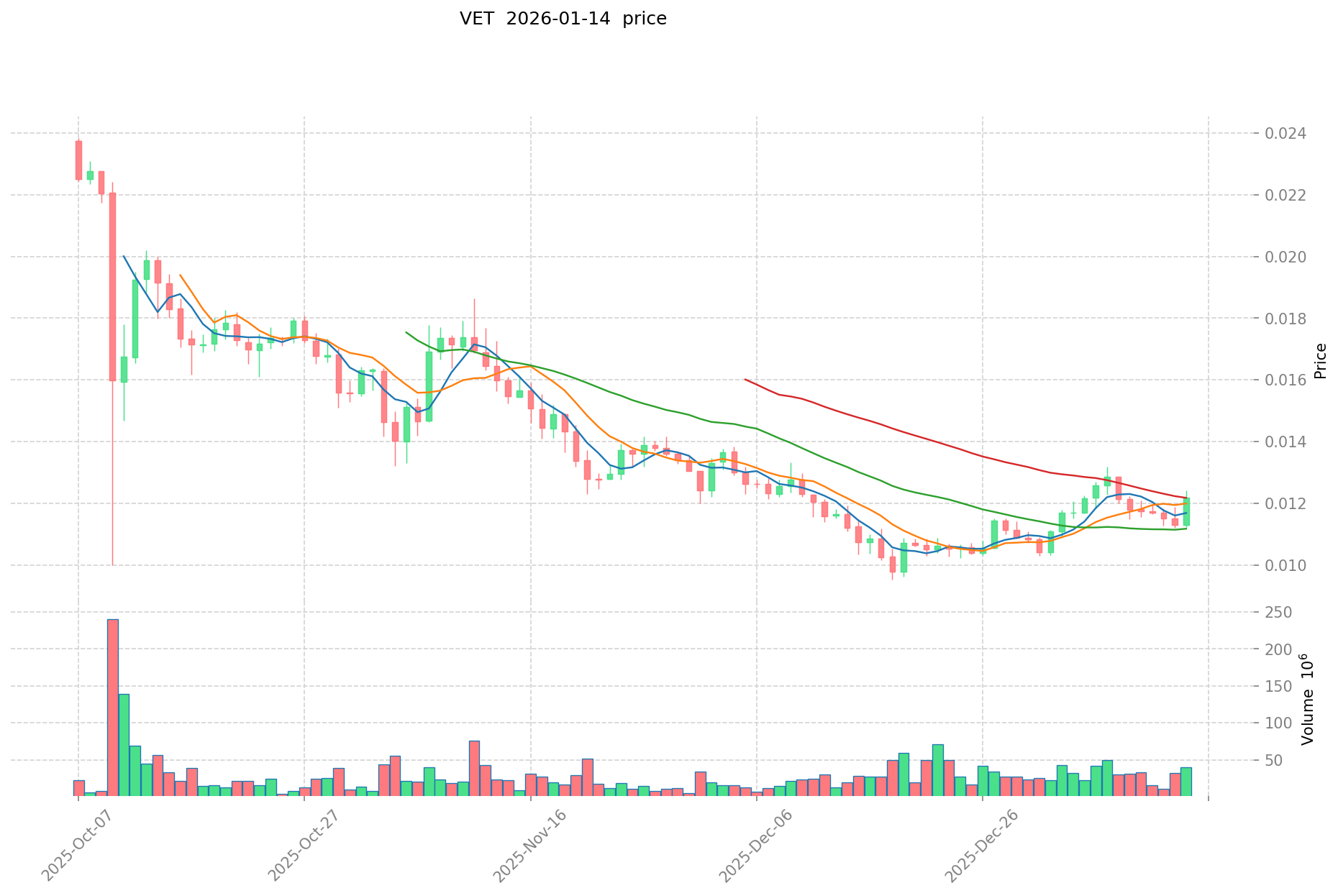
As of 14 January 2026, VET has a circulating supply of 85,985,041,177 tokens, with a total supply of 85,985,041,177 and a maximum supply of 86,712,634,466 tokens. The circulating supply represents approximately 99.16% of the maximum supply, indicating that the majority of tokens have already entered circulation.
Price Fluctuation
VET reached its historical high of $0.280991 on 19 April 2021, driven by increased market momentum and broader adoption trends in the blockchain industry during that period. Its lowest recorded price was $0.00191713 on 13 March 2020, coinciding with market volatility and macroeconomic uncertainty. These price movements reflect shifts in market sentiment, adoption dynamics, and external factors affecting the cryptocurrency sector.
Click to view current VET market price
On-Chain Metrics
- Holder Addresses: 14,490,614 (reflecting broad user participation in the VeChain network)
- Trading Volume (24H): $488,672.59 (indicating current market activity levels)
- Market Capitalization: $1,056,498,200.94 (representing VET's position in the cryptocurrency market)
VeChain Ecosystem Applications and Partnerships
Core Use Cases
VeChain's ecosystem supports multiple application scenarios:
- Supply Chain Management: VeChain provides blockchain-based solutions for supply chain transparency and anti-counterfeiting, enabling product traceability and authenticity verification.
- Enterprise Solutions: The VeChainThor blockchain serves as an enterprise-grade Layer-1 network, supporting real-world business applications across various industries.
Strategic Partnerships
VeChain has established collaborations with DNV, Walmart, and Boston Consulting Group (BCG), enhancing its technical capabilities and market influence.
These partnerships provide a solid foundation for VeChain's ecosystem expansion and validate its real-world application value.
Controversies and Challenges
VeChain faces the following challenges:
- Technical Hurdles: Continuous optimization of blockchain infrastructure and network performance
- Regulatory Considerations: Compliance with evolving regulatory frameworks, including alignment with EU MiCA standards
- Competitive Pressure: Competition from other blockchain platforms in the enterprise and supply chain sectors
These issues have sparked discussions within the community and market, while also driving VeChain's continuous innovation.
VeChain's community demonstrates notable activity, with the network supporting 14,490,614 holders.
On X platform, related posts and hashtags (such as #VeChain) generate regular engagement.
Factors such as technological upgrades and strategic partnerships contribute to community enthusiasm.
Sentiment on X presents diverse perspectives:
- Supporters praise VeChain's enterprise-grade infrastructure, real-world adoption, and sustainability initiatives, viewing it as a practical blockchain solution for business applications.
- Observers focus on market dynamics, technological developments, and ecosystem growth.
Trending Topics
X users actively discuss VeChain's Renaissance roadmap, Ethereum compatibility, dPoS consensus mechanism, and MiCA compliance,
showcasing both its transformative potential and the considerations involved in mainstream adoption.
- Official Website: Visit VeChain official website for features, use cases, and latest updates.
- White Paper: VeChain White Paper details its technical architecture, objectives, and vision.
- X Updates: On X platform, VeChain maintains an active presence through @vechainofficial,
with posts covering technological upgrades, ecosystem developments, and partnership announcements.
VeChain Future Roadmap
- Renaissance Strategy: Implementation of Ethereum-compatible infrastructure, delegated Proof-of-Stake (dPoS) consensus, dynamic VTHO tokenomics, and StarGate NFT staking system
- Ecosystem Goals: Continued expansion of real-world enterprise applications and enhanced cross-chain interoperability
- Long-term Vision: Positioning as a blockchain platform where real adoption, network utility, and sustainability converge to create long-term value
How to Participate in VeChain?
- Purchase Channels: Acquire VET on Gate.com and other supported exchanges
- Storage Solutions: Store VET securely using compatible wallet solutions
- Ecosystem Participation: Explore opportunities to engage with VeChain's enterprise-focused applications
- Developer Resources: Visit VeChain's GitHub repositories for development documentation and contribution opportunities
Summary
VeChain leverages blockchain technology to provide solutions for supply chain transparency and enterprise applications, offering traceability, authenticity verification, and sustainable business practices.
Its active community, comprehensive resources, and strategic partnerships position it distinctively in the cryptocurrency sector.
Despite facing regulatory considerations and competitive challenges, VeChain's innovation-driven approach and clear roadmap establish its relevance in the future of distributed ledger technology.
Whether you are a newcomer or an experienced participant, VeChain presents opportunities worth exploring and engaging with.
FAQ
What is VET (VeChain Token) and what does it do?
VET is the native token of VeChain blockchain, enabling transactions and smart contracts. It powers supply chain management solutions and facilitates value transfer across the network ecosystem.
How does VeChain (VET) technology work and what are its main features?
VeChain uses a dual-token model with VET and VTHO, operating on VeChainThor blockchain with Proof of Authority consensus. Key features include predictable costs, supply chain transparency, and enterprise-focused solutions for real-world business applications.
What are the real-world use cases and applications of VeChain?
VeChain powers supply chain transparency, food safety tracking, and enterprise asset management. Its blockchain ensures product authenticity, traceability, and data integrity across industries.
How is VET different from other cryptocurrencies like Bitcoin or Ethereum?
VET powers VeChainThor, a blockchain focused on enterprise supply chain management. Unlike Bitcoin's focus on payments or Ethereum's general computing, VET uses a dual-token model with VTHO for transaction fees. VET emphasizes business adoption and real-world applications through smart contracts and distributed ledger technology for supply chain transparency.
Where can I buy VET and how do I store it safely?
You can purchase VET on major crypto platforms. For safe storage, use reputable hardware wallets like Ledger or Trezor, or trusted custodial wallets. Always enable two-factor authentication and keep your private keys secure.
What are the risks and potential benefits of investing in VET?
Benefits: VET supports supply chain transparency and enterprise adoption, offering growth potential. Risks: market volatility, regulatory uncertainty, and competition from other blockchain solutions.
* The information is not intended to be and does not constitute financial advice or any other recommendation of any sort offered or endorsed by Gate.