VIRTUAL (Virtuals Protocol) is a decentralized AI protocol launched in 2024 that revolutionizes gaming by democratizing AI development and integration. This comprehensive guide explores how VIRTUAL connects AI contributors with game developers through SDK integration, enabling intelligent NPC deployment in gaming environments. Deployed on Base blockchain with Ethereum presence, VIRTUAL employs decentralized governance and blockchain consensus mechanisms to ensure transparent, secure interactions. As of January 2026, the protocol boasts 31,995 token holders and $698 million market capitalization, with the VIRTUAL token trading at $1.06. The article covers technical architecture, market performance, ecosystem applications, challenges, and participation methods on Gate exchange. Whether you're a developer seeking AI tools, investor exploring AI-gaming opportunities, or gaming enthusiast curious about blockchain integration, this guide provides essential insights into VIRTUAL's transformative potential in decentr
VIRTUAL's Positioning and Significance
In 2024, the Virtual Protocol team launched Virtuals Protocol (VIRTUAL), aiming to address challenges in integrating AI technology into gaming ecosystems and the lack of accessible AI development tools for game creators.
As a decentralized AI protocol designed specifically for gaming applications, Virtuals Protocol plays a key role in AI-powered gaming, GameFi, and metaverse development.
As of 2026, Virtuals Protocol has established itself as a significant player in the AI-gaming intersection, with over 31,000 token holders and an active developer community.
This article will provide an in-depth analysis of its technical architecture, market performance, and future potential.
Origin and Development History
Genesis Background
Virtuals Protocol was created by its development team in 2024, aiming to solve the barriers developers face in accessing and integrating AI capabilities into gaming environments, as well as democratizing AI development in the gaming industry.
It emerged during the convergence of AI technology advancement and blockchain gaming expansion, with the goal of providing accessible AI tools and creating a marketplace connecting AI contributors with game developers to transform the status quo.
The launch of Virtuals Protocol brought new possibilities to game developers, AI researchers, and gaming communities.
Major Milestones
- May 2024: Token launched with an initial price of $0.132, establishing the foundation for the ecosystem.
- July 2024: Token reached its lowest point at $0.01973, marking a period of market adjustment.
- January 2025: Achieved an all-time high of $5.1428, demonstrating strong market interest and adoption.
- 2025-2026: Ecosystem expanded with growing integration of AI gaming NPCs, including character implementations similar to popular gaming figures.
With support from its community and development foundation, Virtuals Protocol continues to optimize its technology, security features, and real-world applications.
How VIRTUAL Works
Decentralized Control
Virtuals Protocol operates on a decentralized network infrastructure, eliminating dependence on centralized gaming platforms or traditional AI service providers.
The distributed architecture ensures system transparency and resistance to single points of failure, granting users greater autonomy while enhancing network resilience.
Blockchain Foundation
Virtuals Protocol's blockchain serves as a public, immutable digital ledger recording all transactions and interactions.
Transactions are grouped into blocks and linked through cryptographic hashing to form a secure chain.
Anyone can verify records without intermediaries, establishing trustless collaboration.
The protocol is deployed on Base blockchain with an Ethereum presence, leveraging Layer 2 scalability and efficiency improvements.
Ensuring Fairness
Virtuals Protocol employs blockchain consensus mechanisms to validate transactions and maintain network integrity.
Network participants contribute to system security through staking and validation activities, earning VIRTUAL token rewards.
Its innovation includes creating a marketplace model that democratically connects AI supply (contributors) with demand (game developers), facilitated through SDK integration.
Secure Interactions
Virtuals Protocol utilizes public-private key cryptography to protect transactions:
- Private keys (similar to secret passwords) are used to authorize transactions
- Public keys (similar to account numbers) verify ownership and authenticity
This mechanism ensures asset security while maintaining pseudonymous transaction privacy.
The protocol provides SDKs enabling developers to securely integrate AI gaming NPCs into their applications while maintaining decentralized governance over the ecosystem.
Circulation Overview
As of January 14, 2026, VIRTUAL's circulating supply stands at 656,151,369.81 tokens, with a total supply of 1,000,000,000 tokens. The circulating supply represents approximately 65.62% of the total supply, indicating a fixed supply model with 1 billion tokens as the maximum cap.
The token distribution follows a gradual release mechanism, with tokens entering the market through established allocation protocols. This controlled release strategy helps maintain supply-demand equilibrium while supporting long-term ecosystem development.
Price Fluctuations
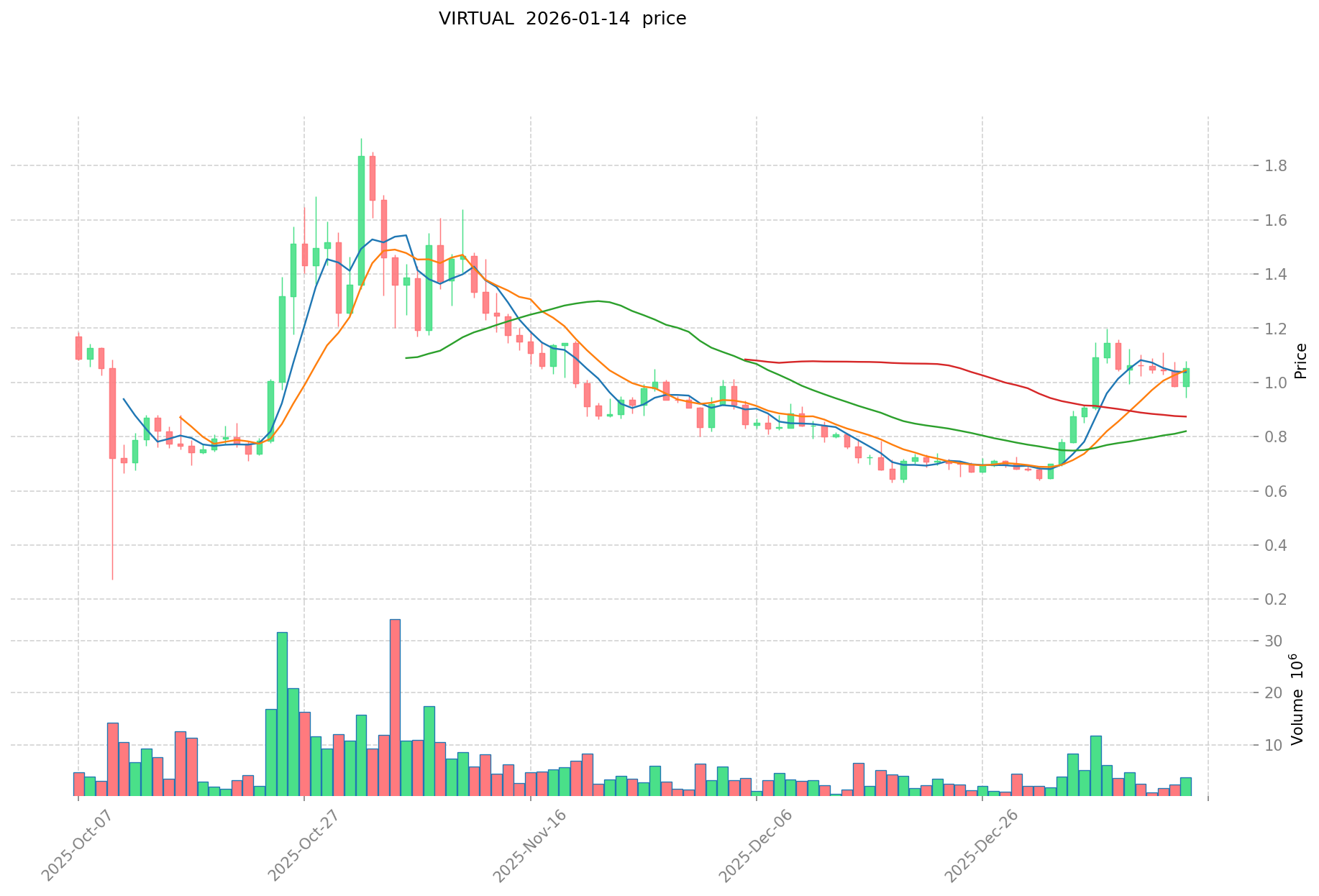
VIRTUAL reached a notable price level of $5.14 on January 2, 2025, driven by increased market interest and adoption momentum in the AI gaming sector. The token experienced its lowest price point at $0.0197 on July 5, 2024, during the early stages of market discovery.
Recent price movements demonstrate significant volatility patterns:
- 1-hour change: -1.75%
- 24-hour change: +6.12%
- 7-day change: -3.37%
- 30-day change: +35.64%
- 1-year change: -60.18%
The current trading price of $1.06 reflects ongoing market dynamics influenced by broader cryptocurrency trends, AI technology adoption rates, and gaming industry developments. These fluctuations illustrate the token's sensitivity to market sentiment, technological advancements, and ecosystem growth factors.
Click to view current VIRTUAL market price
On-chain Metrics
- Market Capitalization: $698,079,442 (representing 0.031% market dominance)
- Fully Diluted Valuation: $1,063,900,000
- 24-hour Trading Volume: $4,844,325
- Token Holders: 31,995 addresses (indicating growing community participation)
- Exchange Listings: Available on 44 trading platforms
- Market Cap to FDV Ratio: 65.62% (demonstrating current circulation relative to maximum supply)
VIRTUAL Ecosystem Applications and Partners
Core Use Cases
VIRTUAL's ecosystem supports multiple applications:
- Gaming AI Integration: Through SDKs provided by Virtuals Protocol, game developers can integrate AI-powered NPCs (such as Pikachu, John Wick, or Mikasa) into their games, delivering enhanced gaming experiences with intelligent character interactions.
- AI Marketplace: Virtuals Protocol operates as a library and marketplace connecting AI contributors with game developers, facilitating democratized AI development and deployment in gaming.
Strategic Partnerships
VIRTUAL continues to expand its ecosystem through collaboration with game developers and AI contributors.
These partnerships provide a solid foundation for VIRTUAL's ecosystem expansion.
Controversies and Challenges
VIRTUAL faces the following challenges:
- Market Competition: Competition from other blockchain gaming and AI platforms
- Technology Integration: Ensuring seamless SDK integration for diverse gaming environments
- Market Volatility: Price fluctuations affecting project development and adoption
These issues have sparked discussions within the community and market, while also driving VIRTUAL's continuous innovation.
VIRTUAL's community demonstrates significant activity, with 31,995 token holders as of January 2026.
On X platform, related posts and hashtags (such as #VIRTUAL) generate substantial engagement.
Price movements and ecosystem developments have ignited community enthusiasm.
Sentiment on X shows diverse perspectives:
- Supporters praise VIRTUAL's innovative approach to gaming AI and democratic AI development, viewing it as a bridge between AI technology and gaming applications.
- Critics focus on price volatility and market risks.
Recent trends indicate mixed sentiment influenced by market conditions.
Trending Topics
X users actively discuss VIRTUAL's AI integration capabilities, gaming ecosystem expansion, and token economics,
showcasing both its transformative potential and the challenges in achieving mainstream adoption.
- Official Website: Visit Virtuals Protocol Official Site for features, use cases, and latest developments.
- Whitepaper: VIRTUAL Whitepaper details its technical architecture, objectives, and vision.
- X Updates: On X platform, VIRTUAL maintains an active presence through @virtuals_io,
with posts covering technical updates, community activities, and ecosystem news, generating significant engagement.
VIRTUAL Future Roadmap
- Ecosystem Goals: Expand the AI gaming library and attract more developers to integrate VIRTUAL's AI solutions
- Long-term Vision: Become the leading platform for democratic AI in gaming
How to Participate in VIRTUAL?
- Purchase Options: Buy VIRTUAL on Gate.com and other supported exchanges
- Storage Solutions: Securely store using compatible wallets such as MetaMask for Base or Ethereum networks
- Ecosystem Building: Visit developer documentation to explore AI integration opportunities or contribute to the platform
Summary
VIRTUAL redefines gaming experiences through blockchain and AI technology, offering democratized AI development, seamless SDK integration, and innovative gaming applications.
Its active community, diverse resources, and market presence distinguish it within the cryptocurrency sector.
Despite facing market volatility and competitive pressures, VIRTUAL's innovative approach and clear development direction position it prominently in the future of decentralized gaming technology.
Whether you are a newcomer or experienced participant, VIRTUAL merits attention and engagement.
FAQ
What is virtual cryptocurrency and how does it differ from traditional money?
Virtual cryptocurrency is digital currency secured by cryptography operating on decentralized networks, unlike government-issued traditional money. Crypto offers lower fees and faster transactions but lacks central regulation, while fiat currency is centralized and heavily regulated by governments.
How does blockchain technology enable virtual cryptocurrencies to work?
Blockchain creates a decentralized ledger where transactions are validated through consensus mechanisms like proof of work or proof of stake. This ensures security, transparency, and prevents fraud without requiring a central authority.
What are the main uses and applications of virtual cryptocurrencies?
Virtual cryptocurrencies serve as investment assets, enable peer-to-peer transactions, and function as value stores. They power decentralized finance, facilitate cross-border payments, and support smart contract applications.
What are the security risks and benefits of using virtual cryptocurrencies?
Virtual cryptocurrencies offer decentralized control and fast transactions, but face risks including private key theft and hacking. Benefits include financial sovereignty and borderless transfers. Users must secure their private keys to mitigate security concerns effectively.
How do you buy, store, and trade virtual cryptocurrencies?
Purchase crypto through brokers or exchanges using fiat currency or other digital assets. Store securely in personal wallets for protection. Trade on platforms by exchanging cryptocurrencies or converting to fiat currency based on market prices.
What is the difference between virtual cryptocurrencies like Bitcoin and Ethereum?
Bitcoin uses Proof of Work consensus, while Ethereum uses Proof of Stake. Bitcoin focuses on payments with higher transaction fees, while Ethereum supports smart contracts with variable gas fees. Both use blockchain technology but serve different purposes.
* The information is not intended to be and does not constitute financial advice or any other recommendation of any sort offered or endorsed by Gate.