Victoria VR is a blockchain-powered virtual reality metaverse platform launched in 2021, enabling users to create, own, and monetize digital assets in immersive environments. This comprehensive guide explores its decentralized architecture built on Ethereum, market performance with 16.8 billion VR tokens in circulation, and ecosystem applications spanning GameFi and NFTs. As of 2026, the platform boasts over 13,000 token holders and an active creator community. The article examines Victoria VR's technological foundations, current market metrics trading on Gate, on-chain performance, community sentiment, and practical participation methods. Despite facing market volatility and competitive pressures, Victoria VR positions itself as an innovative platform for virtual reality enthusiasts and digital content creators seeking true ownership and decentralized experiences in the metaverse landscape.
Victoria VR's Positioning and Significance
In 2021, Victoria VR launched Victoria VR (VR), aiming to address limitations in immersive virtual experiences and user-generated content ownership.
As a virtual reality metaverse platform leveraging blockchain technology, Victoria VR plays a key role in virtual reality, NFTs, and user-generated content.
As of 2026, Victoria VR has established itself in the metaverse sector with over 13,000 holders and an active creator community.
This article will provide an in-depth analysis of its technical architecture, market performance, and future potential.
Origin and Development Journey
Birth Background
Victoria VR was created in 2021, aiming to solve the lack of true ownership and monetization in virtual worlds.
It emerged during the blockchain and metaverse technology boom, with the goal of providing users with immersive VR experiences while enabling content creators to own and monetize their creations to transform the status quo.
The launch of Victoria VR brought new possibilities to virtual reality enthusiasts and digital content creators.
Important Milestones
- 2021: Platform launch on Ethereum, implementing blockchain-based virtual world infrastructure.
- The project continues development with a fully circulating supply of 16.8 billion VR tokens, supporting ecosystem growth.
- Active creator rewards system introduced, providing regular compensation for work, voting, commenting, completing tasks, and staking VR tokens.
Under the support of its development team and community, Victoria VR continues to optimize its technology, security, and real-world applications.
How Victoria VR Works?
No Central Control
Victoria VR operates on a decentralized network of global computers (nodes), free from bank or government control.
These nodes collaborate to verify transactions, ensuring system transparency and attack resistance, granting users greater autonomy and improving network resilience.
Blockchain Core
Victoria VR's blockchain is a public, immutable digital ledger that records every transaction.
Transactions are grouped into blocks and linked through cryptographic hashes to form a secure chain.
Anyone can view the records, establishing trust without intermediaries.
The platform is built on Ethereum, leveraging its established infrastructure for security and interoperability.
Ensuring Fairness
Victoria VR operates on Ethereum's Proof of Stake (PoS) consensus mechanism to validate transactions and prevent fraud such as double-spending.
Validators maintain network security through staking and validating transactions, earning rewards in the process.
Its innovation includes integrating VR technology with blockchain ownership, creating an ecosystem where users can create, own, and monetize virtual assets.
Secure Transactions
Victoria VR uses public-private key cryptography to protect transactions:
- Private keys (similar to secret passwords) are used to sign transactions
- Public keys (similar to account numbers) are used to verify ownership
This mechanism ensures fund security while maintaining pseudonymous transactions.
The platform's smart contract functionality enables secure NFT minting and trading of virtual land and assets.
Circulation Overview
As of January 18, 2026, Victoria VR's circulating supply stands at 16,800,000,000 tokens, with a total supply of 16,800,000,000 VR tokens. The circulating supply represents 100% of the total supply, indicating that all tokens have been released into the market. This fixed supply model means no additional tokens will be minted, which may influence the long-term supply-demand dynamics of the asset.
Price Fluctuations
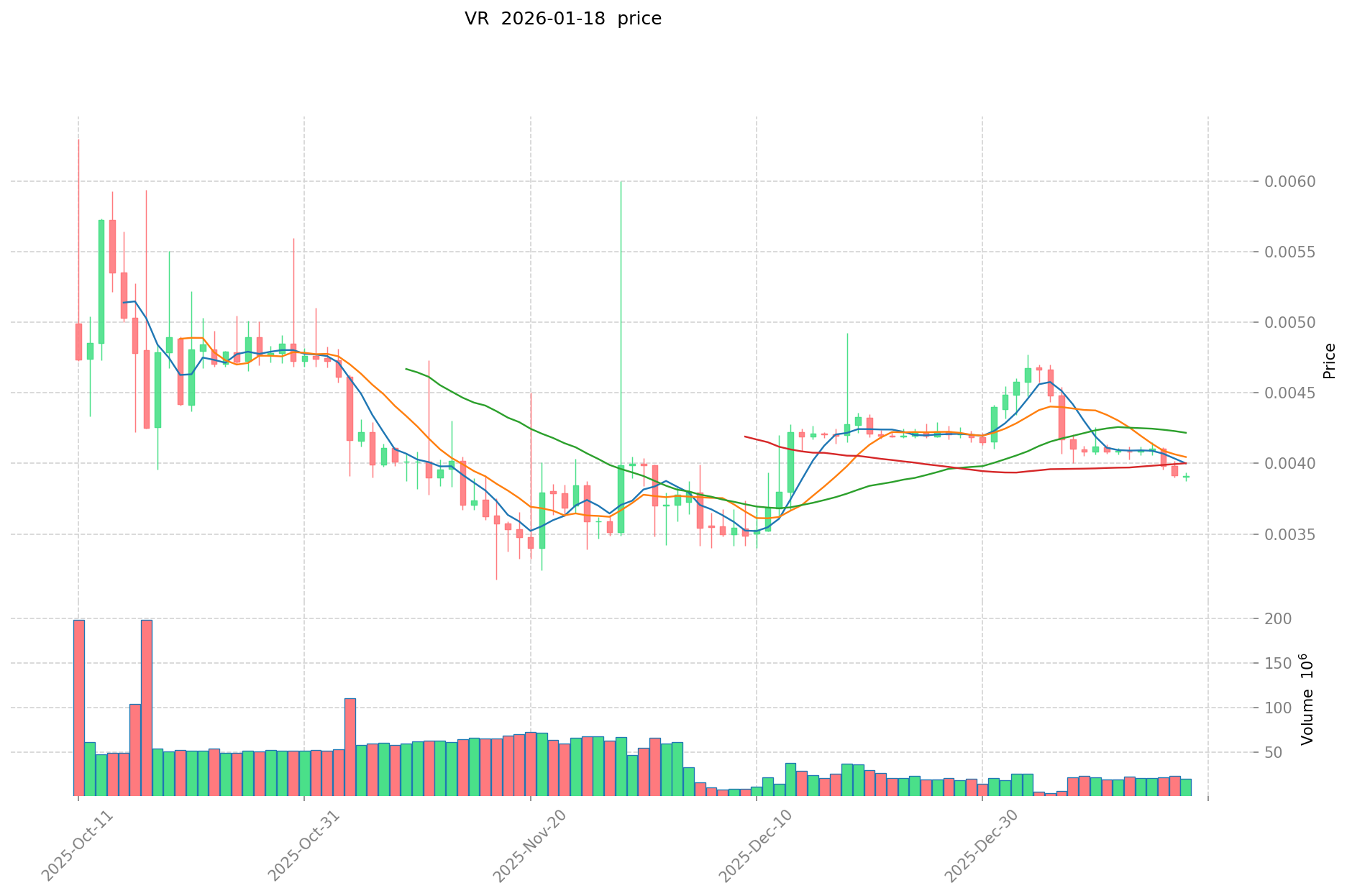
Victoria VR reached its peak price of $0.615957 on December 11, 2021, during a period of heightened interest in metaverse and virtual reality projects within the broader cryptocurrency market. The token experienced its lowest recorded price of $0.00222735 on September 6, 2025, reflecting broader market corrections and shifts in investor sentiment toward metaverse-related assets. As of the latest data, VR is trading at approximately $0.003907, showing a 24-hour price increase of 0.15% and a 1-hour gain of 0.059%. However, the token has experienced declines of -4.45% over the past week, -7.86% over the past month, and -74.039% over the past year, illustrating the volatility characteristic of cryptocurrency markets.
Click to view the current VR market price
On-Chain Metrics
- Market Capitalization: Approximately $65,637,600, representing 0.0019% of the total cryptocurrency market share
- 24-Hour Trading Volume: $82,816.94, indicating moderate trading activity
- Token Holders: Approximately 13,000 addresses hold VR tokens, reflecting the current level of user adoption
- Fully Diluted Valuation: $65,637,600, matching the market capitalization due to the complete circulation of all tokens
Victoria VR Ecosystem Applications and Partners
Core Use Cases
Victoria VR's ecosystem supports multiple applications:
- Virtual Reality & Metaverse: Victoria VR platform provides immersive virtual reality experiences where users can explore, create, and interact in a decentralized metaverse environment.
- GameFi & NFT: The platform enables digital asset creation and ownership, allowing users to build virtual spaces, mint NFTs, and participate in blockchain-based gaming experiences.
Strategic Partnerships
Victoria VR continues to develop its technological capabilities and expand its market presence through ecosystem collaborations.
These partnerships provide a solid foundation for Victoria VR's ecosystem expansion.
Controversies and Challenges
Victoria VR faces the following challenges:
- Market Volatility: The token has experienced significant price fluctuations, with a year-over-year decline of approximately 74%
- Competition Pressure: The emergence of competing metaverse platforms and blockchain ecosystems presents ongoing competitive dynamics
- Adoption Barriers: Converting virtual reality technology into mainstream adoption requires overcoming technical and accessibility hurdles
These issues have sparked discussions within the community and market, while also driving Victoria VR's continuous innovation.
Fan Enthusiasm
Victoria VR's community demonstrates active engagement, with approximately 13,000 token holders participating in the ecosystem.
On X platform, related posts and hashtags (such as #VictoriaVR) generate consistent community interaction.
The platform's user-generated content model and reward mechanisms have helped maintain community engagement.
Sentiment on X presents varied perspectives:
- Supporters praise Victoria VR's immersive virtual reality technology and user-creation capabilities, viewing it as a pioneering platform in the metaverse space.
- Critics focus on price performance concerns and competitive landscape challenges in the virtual reality sector.
Recent trends reflect the broader market sentiment toward metaverse and virtual reality projects.
Hot Topics
X users actively discuss Victoria VR's technological development, token utility, and metaverse ecosystem growth,
showcasing both its innovative potential and the challenges of achieving widespread adoption.
- Official Website: Visit Victoria VR Official Website for features, use cases, and latest updates.
- White Paper: Victoria VR Documentation details its technical architecture, objectives, and vision.
- X Updates: On X platform, Victoria VR maintains an active presence through @VictoriaVRcom,
with posts covering technological upgrades, community activities, and ecosystem developments, generating engagement from the community.
Victoria VR Future Roadmap
- Ecosystem Goals: Expanding the virtual reality metaverse with enhanced user-creation tools and improved platform capabilities
- Long-term Vision: Establishing a comprehensive decentralized virtual reality ecosystem where users can create, own, and monetize virtual experiences
How to Participate in Victoria VR?
- Purchase Options: VR tokens are available on Gate.com and select cryptocurrency exchanges
- Storage Solutions: Use compatible Ethereum wallets such as MetaMask or hardware wallets to securely store VR tokens
- Participate in Governance: Engage with the Victoria VR community through platform activities and ecosystem participation
- Build the Ecosystem: Visit the official documentation to explore development opportunities and contribute to the platform
Summary
Victoria VR leverages blockchain technology to create an immersive virtual reality metaverse, offering user-driven content creation, digital asset ownership, and decentralized experiences.
Its engaged community, comprehensive documentation, and innovative platform features position it within the virtual reality and metaverse sector.
Despite facing market volatility and competitive pressures, Victoria VR's focus on user empowerment and virtual world building maintains its presence in the decentralized technology landscape.
Whether you are new to virtual reality or an experienced participant, Victoria VR represents an interesting project in the metaverse space.
FAQ
What is Crypto VR? How does it differ from ordinary VR?
Crypto VR is a virtual reality platform integrating blockchain technology for decentralized gaming and social experiences. Unlike ordinary VR, Crypto VR enables user-owned digital assets, decentralized applications, and cryptocurrency rewards, giving users true ownership and earning opportunities within immersive virtual environments.
Crypto VR has practical applications in which areas?
Crypto VR enables immersive experiences across gaming, education, healthcare, and virtual commerce, allowing users to transact and interact in decentralized virtual environments with enhanced interactivity and engagement.
How to manage asset ownership and trading in Crypto VR?
In Crypto VR, asset ownership and transactions are secured through blockchain technology. Users can buy, sell, and trade virtual assets directly within the platform. Ownership is verified through cryptographic proofs, ensuring clear ownership rights and secure transfers.
What are the main risks and challenges of Crypto VR projects?
Crypto VR faces technical and security risks, including protocol development and preventing harmful code transmission across platforms. Main challenges involve cross-platform security and ensuring seamless user movement in virtual spaces.
ApeCoin, Decentraland, and Theta Network are prominent Crypto VR platforms worth attention. These projects offer unique virtual experiences and strong community support in the metaverse ecosystem.
How to start experiencing and participating in the Crypto VR ecosystem?
Download the Victoria VR client, create your account, and explore the virtual world. Participate in decentralized governance and earn rewards through ecosystem activities.
* The information is not intended to be and does not constitute financial advice or any other recommendation of any sort offered or endorsed by Gate.