Ambire Wallet is a non-custodial DeFi wallet launched in 2021 to simplify cryptocurrency accessibility and user experience. This comprehensive guide explores its innovative features including email authentication, automatic gas management, and hardware wallet integration. Discover how Ambire Wallet operates as a blockchain-based solution supporting multiple networks with Ethereum as a primary chain. The article analyzes market performance metrics, including current circulation of 688.98 million WALLET tokens and a circulating market cap of $7.25 million. Learn about ecosystem applications spanning DeFi integration and multi-chain support, community engagement with 8,916 token holders, and how to acquire and participate in governance through Gate exchange. Whether you're a crypto novice or experienced DeFi user, this guide provides essential insights into Ambire Wallet's role in mainstream Web3 adoption and its competitive position within the wallet infrastructure landscape.
Ambire Wallet's Positioning and Significance
In 2021, the Ambire team launched Ambire Wallet (WALLET), aiming to address challenges in cryptocurrency accessibility, user experience complexity, and gas fee management inefficiencies.
As a browser-based, non-custodial DeFi wallet with email authentication, Ambire Wallet plays a key role in decentralized finance (DeFi) and Web3 user onboarding.
As of 2026, Ambire Wallet has established itself as an innovative solution in the wallet infrastructure space, with 8,916 holders and an active development community.
This article will provide an in-depth analysis of its technical architecture, market performance, and future potential.
Origin and Development History
Birth Background
Ambire Wallet was created by the Ambire team in 2021, aiming to solve barriers to crypto adoption, including complex user interfaces, high gas fees, and security concerns for beginners.
It emerged during the DeFi boom and growing demand for accessible Web3 tools, with the goal of providing a user-friendly, secure wallet experience that bridges traditional and decentralized finance.
Ambire Wallet's launch brought new possibilities for both crypto novices and experienced DeFi users.
Key Milestones
- 2021: Platform launch, introducing email-based authentication and automatic gas management features.
- 2022: Token (WALLET) reached its all-time high of $0.199652 on February 4, driving ecosystem expansion.
- 2023: Continued development with hardware wallet support and human-readable transaction displays to enhance user protection.
- 2026: The project maintains governance functionality with WALLET token enabling community participation in protocol decisions.
Under the support of the Ambire development team and open-source community, Ambire Wallet continues to optimize its technology, security features, and real-world applications.
How Ambire Wallet Works
No Central Control
Ambire Wallet operates as a non-custodial solution, meaning users maintain full control of their private keys and assets without reliance on centralized entities.
The wallet integrates with decentralized networks across multiple blockchains, ensuring users have sovereignty over their funds while accessing DeFi protocols transparently.
This architecture provides greater autonomy and resilience against single points of failure.
Blockchain Foundation
Ambire Wallet supports multiple blockchain networks, with the WALLET token deployed on Ethereum (contract address: 0x88800092ff476844f74dc2fc427974bbee2794ae).
The wallet leverages blockchain technology to provide transparent, immutable transaction records that users can verify independently.
By supporting various chains, Ambire Wallet enables cross-chain asset management and interaction with diverse DeFi ecosystems.
Innovative Features
Ambire Wallet introduces several innovations to improve user experience:
- Email Authentication: Simplifies onboarding by allowing recovery and access through familiar email-based systems
- Automatic Gas Management: Optimizes transaction fees and allows users to pay network costs in stablecoins
- Hardware Wallet Integration: Supports external security devices for enhanced asset protection
- Human-Readable Transactions: Displays transaction details in clear language before signing, reducing the risk of malicious approvals
These features lower barriers to entry while maintaining security standards for advanced users.
Secure Transactions
Ambire Wallet employs industry-standard cryptographic protocols to protect user assets:
- Private Keys (controlled solely by users) authorize transactions and prove ownership
- Public Keys (blockchain addresses) receive funds and verify transaction authenticity
The wallet's open-source nature allows security audits and community verification. Additional security features include multi-signature capabilities and transaction simulation to prevent common attack vectors.
Users maintain full custody of their assets while benefiting from simplified interfaces that don't compromise security.
Circulation Overview
As of January 28, 2026, Ambire Wallet's circulating supply stands at 688,982,658.30 WALLET, with a total supply of 735,331,191.80 WALLET and a maximum supply capped at 1,000,000,000 WALLET. The current circulation ratio represents approximately 68.90% of the total supply. WALLET tokens serve dual purposes within the ecosystem: rewarding Ambire Wallet users and enabling governance participation. The distribution mechanism follows a structured approach designed to balance community incentives with long-term sustainability.
Price Volatility
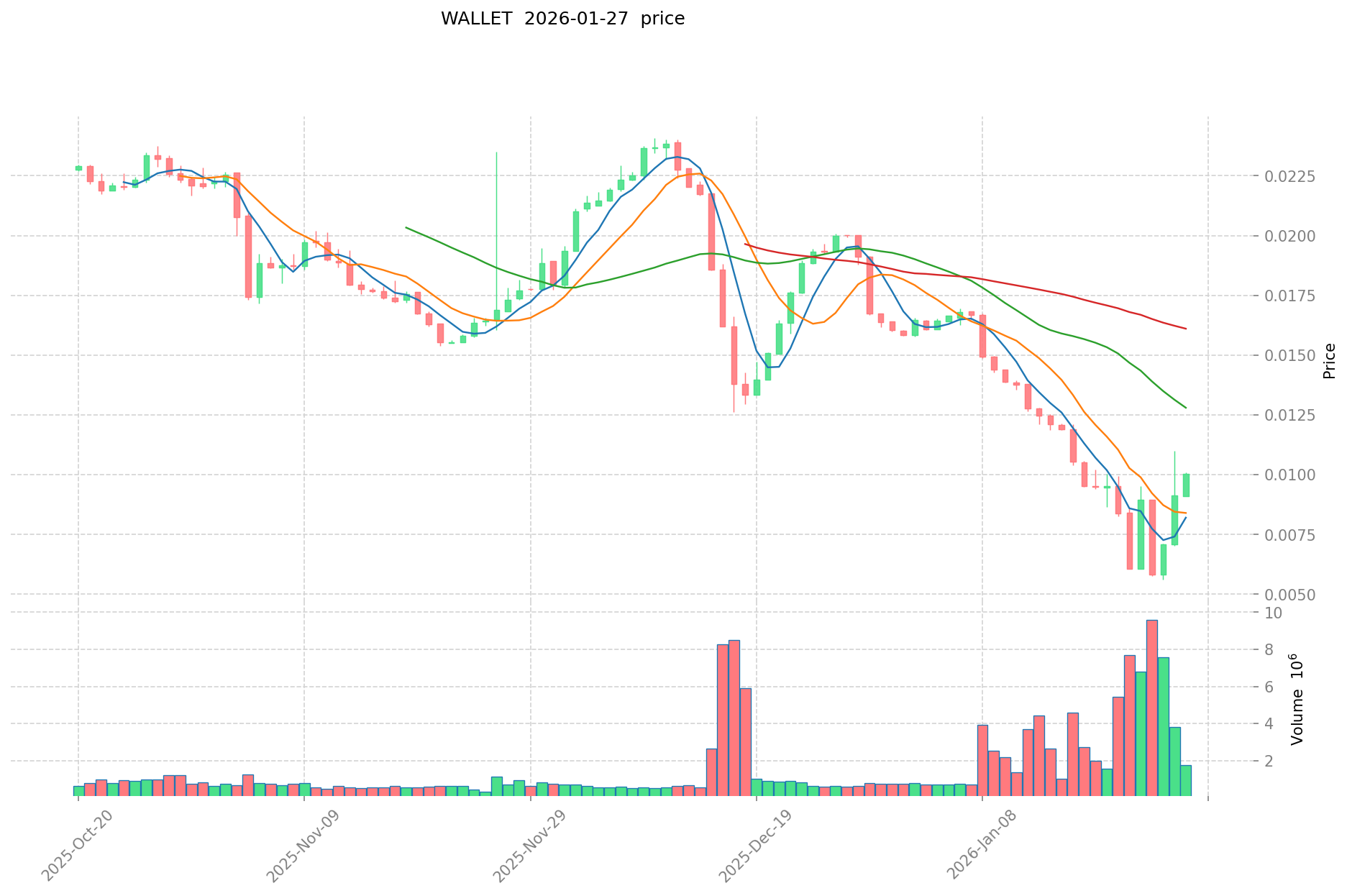
Ambire Wallet reached its historical peak price of $0.199652 on February 4, 2022, during a period of heightened interest in decentralized finance solutions and non-custodial wallet adoption. The token experienced its lowest valuation of $0.00329061 on September 6, 2023, reflecting broader market corrections and shifts in the cryptocurrency landscape. Recent price movements show notable volatility, with a 25.16% increase over the past 7 days, though the 30-day trend indicates a -44.94% decline. These fluctuations demonstrate the dynamic nature of market sentiment, user adoption patterns, and evolving competitive pressures within the Web3 wallet sector.
Click to view the current WALLET market price
On-Chain Metrics
- Holder Distribution: Approximately 8,916 addresses currently hold WALLET tokens, indicating the breadth of community participation
- Market Capitalization: The circulating market cap stands at approximately $7.25 million, with a fully diluted valuation of $7.73 million
- 24-Hour Trading Volume: Trading activity recorded $21,105.94 in volume, reflecting ongoing market interest
- Market Dominance: WALLET represents 0.00024% of the total cryptocurrency market capitalization
Ambire Wallet Ecosystem Applications and Partners
Core Use Cases
Ambire Wallet's ecosystem supports multiple applications:
- DeFi Integration: The wallet enables seamless interaction with decentralized finance protocols, providing decentralized trading and asset management capabilities.
- Multi-chain Support: Ambire Wallet facilitates cross-chain operations, supporting Ethereum and EVM-compatible networks for enhanced interoperability.
Strategic Partnerships
Ambire Wallet continues to expand its ecosystem through technical collaborations that enhance its platform capabilities.
These partnerships provide a solid foundation for Ambire Wallet's ecosystem expansion.
Challenges and Considerations
Ambire Wallet faces several challenges:
- Technical Development: Continuous innovation is required to maintain competitive features in the rapidly evolving wallet space.
- Regulatory Landscape: Navigating evolving cryptocurrency regulations across different jurisdictions.
- Market Competition: The presence of numerous wallet solutions in the Web3 space creates a competitive environment.
These factors drive ongoing discussion within the community and motivate continuous platform improvements.
Ambire Wallet's community demonstrates solid participation, with 8,916 token holders as of January 28, 2026.
On X platform, discussions around Ambire Wallet and the #WALLET token generate regular engagement.
Platform updates and feature releases contribute to community enthusiasm.
X platform sentiment shows diverse perspectives:
- Supporters highlight Ambire Wallet's user-friendly interface, email authentication, and gas management features, viewing it as an accessible entry point for both beginners and experienced users.
- Observers monitor price volatility and market performance as key indicators of project trajectory.
Recent trends reflect typical cryptocurrency market dynamics with price fluctuations.
Popular Topics
X users discuss Ambire Wallet's governance model, WALLET token utility, and user experience innovations,
showcasing both its potential for Web3 adoption and the challenges of wallet ecosystem development.
- Official Website: Visit Ambire Wallet Official Site for features, use cases, and latest updates.
- X Platform: Ambire Wallet maintains an active presence on X via @AmbireWallet,
sharing content about technical upgrades, community activities, and platform developments.
- GitHub Repository: Explore technical documentation and open-source code at AmbireTech GitHub.
Ambire Wallet Future Roadmap
- Ongoing Development: Continued enhancement of wallet functionality, security features, and user experience
- Ecosystem Goals: Expanding support for additional blockchain networks and DeFi integrations
- Long-term Vision: Establishing Ambire Wallet as an accessible gateway for mainstream Web3 adoption
How to Participate in Ambire Wallet?
- Acquisition: Purchase WALLET tokens on Gate.com
- Storage: Use Ambire Wallet itself or hardware wallet solutions for secure token storage
- Governance Participation: Engage in community governance through the WALLET token utility
- Ecosystem Development: Visit the GitHub repository to contribute to open-source development
Summary
Ambire Wallet leverages blockchain technology to redefine cryptocurrency wallet experiences, offering user-friendly features, email authentication, and comprehensive DeFi integration.
Its active community, open-source development, and focus on accessibility position it within the Web3 wallet landscape.
Despite facing competitive pressures and market volatility, Ambire Wallet's commitment to user experience and continuous innovation reflects its role in the evolving decentralized technology ecosystem.
Whether you're new to cryptocurrency or an experienced user, Ambire Wallet presents an option worth exploring.
FAQ
What is a crypto wallet and how does it work?
A crypto wallet is a digital tool that securely stores and manages your cryptocurrencies using public and private keys. Public keys allow others to send you crypto, while private keys give you access to your funds. Wallets come in various forms: software wallets on computers or phones, and hardware wallets as physical devices that store keys offline for enhanced security.
What are the different types of crypto wallets (hot wallet, cold wallet, hardware wallet)?
Hot wallets store cryptocurrencies online for convenient access, while cold wallets keep them offline for superior security. Hardware wallets are a type of cold wallet offering maximum protection through secure offline storage.
Is a crypto wallet safe? What are the security risks?
Crypto wallets are safe when properly secured. Main risks include account hijacking, phishing attacks, and malware. Protect yourself with strong passwords, two-factor authentication, and avoiding suspicious links.
How do I choose the right crypto wallet for my needs?
Select a wallet based on your security requirements, ease of use, and supported cryptocurrencies. Consider hardware wallets for maximum security, mobile wallets for convenience, or web wallets for accessibility. Ensure strong encryption and backup options.
What is the difference between a crypto wallet and a crypto exchange account?
A crypto wallet securely stores your cryptocurrencies for long-term ownership and control. A crypto exchange account facilitates buying, selling, and trading cryptocurrencies. Wallets prioritize security and self-custody, while exchanges enable active trading and liquidity.
How do I back up and recover my crypto wallet if I lose access?
Save your recovery phrase or private key in a secure location. With it, you can restore your wallet using any compatible wallet provider. Without it, non-custodial wallets cannot be recovered.
* The information is not intended to be and does not constitute financial advice or any other recommendation of any sort offered or endorsed by Gate.