This comprehensive guide explores XPR Network, a blockchain platform launched in 2020 to revolutionize cross-border payments through instant transactions, zero gas fees, and ISO 20022 compliance. The article examines XPR's decentralized architecture, delegated proof-of-stake consensus mechanism, and secure transaction infrastructure supporting multiple applications including cross-border payments, supply chain management, asset tokenization, and DeFi. As of January 2026, XPR Network serves over 27,719 token holders with a market capitalization exceeding $102 million, demonstrating a 158.61% one-year appreciation. The guide addresses market performance, ecosystem partnerships, competitive challenges, and community sentiment while providing practical investment guidance through Gate exchange. Designed for both blockchain newcomers and experienced investors, this resource offers actionable insights into XPR's technical capabilities, compliance positioning, and long-term enterprise adoption potential in the evolv
XPR Network's Positioning and Significance
In 2020, the XPR Network team launched XPR Network (XPR), aiming to address inefficiencies in cross-border payments, high transaction costs, and lack of on-chain identity verification.
As a blockchain platform with instant transactions, zero gas fees, and ISO 20022 compliance, XPR Network plays a crucial role in cross-border payments, supply chain management, asset tokenization, and DeFi.
As of 2026, XPR Network has established itself as a versatile blockchain solution for developers, entrepreneurs, and enterprises, with over 27,719 holders and an active developer community.
This article will provide an in-depth analysis of its technical architecture, market performance, and future potential.
Origin and Development History
Birth Background
XPR Network was created in 2020, aiming to solve challenges in cross-border payments, transaction efficiency, and digital identity verification.
It emerged during the blockchain technology boom, with the goal of providing instant, cost-effective transactions with on-chain identity verification to transform the current landscape.
XPR Network's launch brought new possibilities for developers, businesses, and financial institutions.
Key Milestones
- 2020: Mainnet launched on April 7, implementing instant transactions and zero gas fees.
- XPR Network achieved ISO 20022 standard alignment, enabling compliant trading and financial integration.
- The platform expanded its ecosystem with solutions across supply chain transparency, asset tokenization, and DeFi applications.
- As of 2026, the network supports over 27,719 holders and continues to grow its developer community.
With support from its robust developer community and enterprise partnerships, XPR Network continues to optimize its technology, security features, and real-world applications.
How XPR Network Operates
Decentralized Architecture
XPR Network operates on a decentralized network of computers (nodes) distributed globally, eliminating control by banks or governments.
These nodes collaborate to verify transactions, ensuring system transparency and attack resistance, granting users greater autonomy and enhancing network resilience.
Blockchain Foundation
XPR Network's blockchain is a public, immutable digital ledger that records every transaction.
Transactions are grouped into blocks and linked through cryptographic hashes to form a secure chain.
Anyone can view the records, establishing trust without intermediaries.
The platform's architecture enables instant transaction finality and eliminates gas fees, significantly improving user experience and transaction efficiency.
Consensus Mechanism
XPR Network employs a delegated proof-of-stake (DPoS) consensus mechanism to validate transactions and prevent fraudulent activities such as double-spending.
Block producers maintain network security through validating transactions and producing blocks, earning XPR rewards for their participation.
The innovation includes instant transaction confirmation and zero transaction fees, making it highly efficient for both small businesses and large enterprises.
Secure Transactions
XPR Network uses public-private key cryptography to protect transactions:
- Private keys (similar to secret passwords) are used to sign transactions
- Public keys (similar to account numbers) are used to verify ownership
This mechanism ensures fund security while transactions maintain transparency with on-chain identity verification.
The platform integrates WebAuth-based identity verification and supports compliant trading, providing an additional layer of security for users and enterprises.
Circulation Overview
As of January 17, 2026, XPR Network's circulating supply stands at 28,376,561,735.89 tokens, with a total supply of 31,357,007,247.29. The circulation ratio is approximately 90.50%, indicating that a significant portion of the total supply is already in active circulation. New tokens enter the market through the project's issuance mechanism, which influences its supply and demand dynamics.
Price Fluctuation
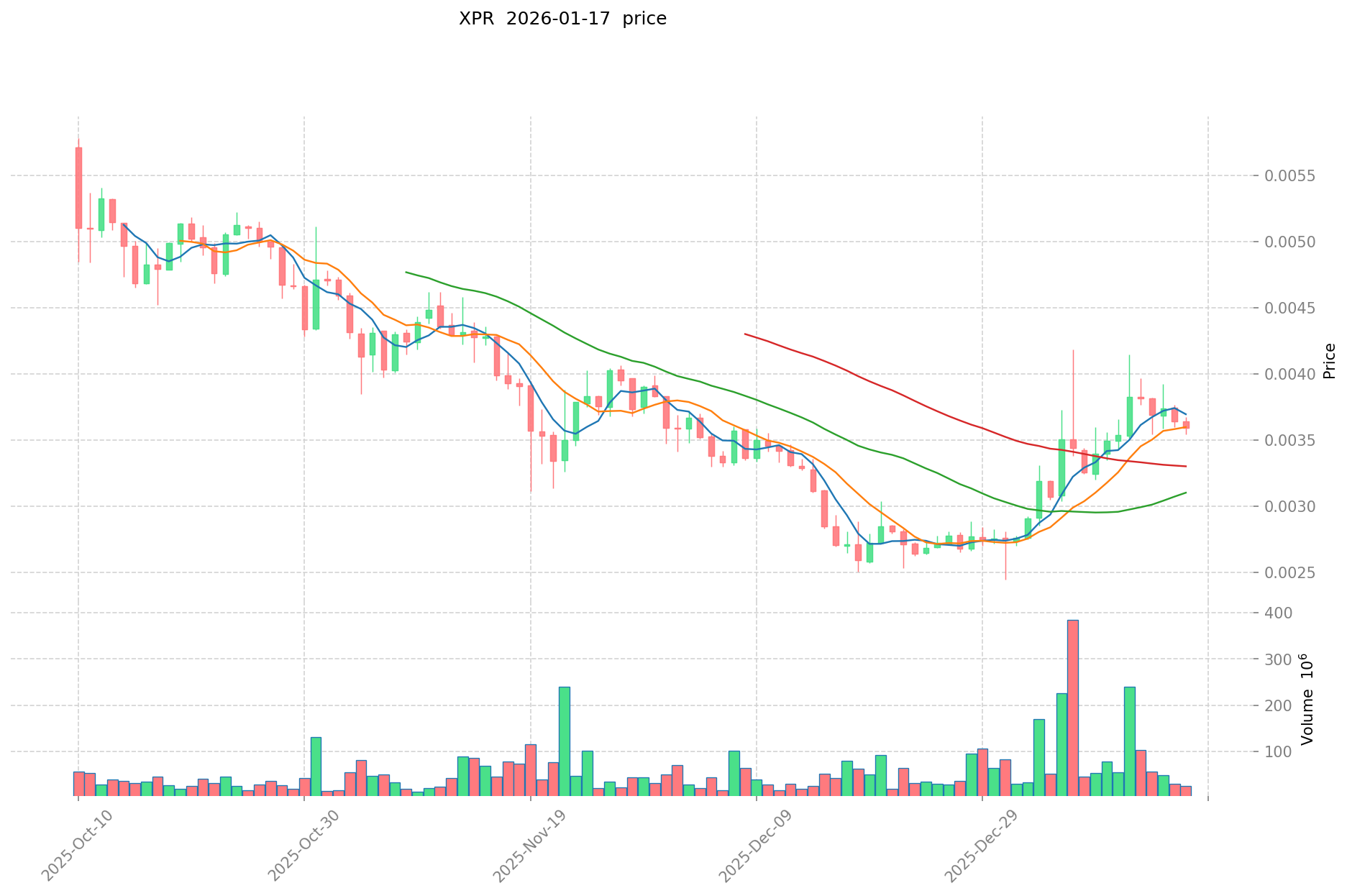
XPR Network reached its peak price of $0.100088 on April 27, 2020, driven by early market enthusiasm and initial adoption momentum. Its lowest recorded price was $0.00054716 on October 19, 2023, influenced by broader market downturns and sector-wide challenges. These fluctuations reflect evolving market sentiment, adoption trends, and external factors affecting the blockchain ecosystem.
As of January 17, 2026, XPR Network is trading at $0.0035973, showing a 1-hour increase of 0.32%, a 24-hour decrease of 0.33%, a 7-day gain of 4.03%, a 30-day surge of 32.89%, and a 1-year appreciation of 158.61%. The 24-hour trading range spans from $0.0035427 to $0.0036736.
Click to view the current XPR market price
On-Chain Metrics
- 24-Hour Trading Volume: Approximately $79,743.90 (indicating current market activity)
- Holder Count: 27,719 addresses (reflecting the breadth of community participation)
- Market Capitalization: $102,079,005.53 (representing the circulating value in the market)
- Fully Diluted Market Cap: $112,800,562.17 (projecting the value if all tokens were in circulation)
XPR Network Ecosystem Applications and Strategic Partners
Core Use Cases
The XPR Network ecosystem supports multiple applications across various industries:
- Cross-Border Payments: The platform enables instant international transactions with zero gas fees, providing efficient solutions for global remittances and business transfers.
- Supply Chain Management: XPR Network enhances transparency in supply chain operations through on-chain identity verification and real-time tracking capabilities.
- Asset Tokenization: The network facilitates the digitization of real-world assets, enabling compliant trading and expanding access to investment opportunities.
- DeFi Applications: XPR Network supports decentralized finance protocols, offering users secure and efficient financial services without intermediaries.
Strategic Partnerships
XPR Network has built a robust ecosystem through strategic collaborations that enhance its technical capabilities and market presence. The platform's compliance with ISO 20022 standards positions it favorably for financial integration with traditional banking systems. These partnerships provide a solid foundation for XPR Network's ecosystem expansion and adoption across multiple sectors.
Challenges and Controversies
XPR Network faces several challenges in its development:
- Market Competition: The blockchain space is increasingly competitive, with numerous platforms offering similar solutions for payments and enterprise applications.
- Adoption Barriers: Despite its technical advantages, achieving widespread adoption among enterprises and mainstream users remains an ongoing challenge.
- Regulatory Navigation: As the platform aims for financial integration and ISO 20022 compliance, navigating evolving cryptocurrency regulations across different jurisdictions presents continuous challenges.
These issues have sparked discussions within the community and the broader market, while also driving XPR Network's continuous innovation and improvement efforts.
XPR Network maintains an active community with approximately 27,719 token holders as of January 17, 2026. The platform's developer community plays a vital role in building and maintaining the ecosystem. On X platform, discussions around XPR Network and related hashtags generate consistent engagement, with community members actively sharing updates about the project's development and use cases.
Recent price performance, including a 32.89% increase over 30 days and a 158.61% gain over one year, has contributed to increased community enthusiasm and participation.
Sentiment on X regarding XPR Network shows a mix of perspectives:
- Supporters praise the platform's technical features, including instant transactions, zero gas fees, and on-chain identity verification, viewing it as a practical solution for enterprise blockchain applications.
- Observers monitor the project's progress in achieving its goals of financial integration and widespread adoption, while noting the competitive landscape in the blockchain industry.
Recent trends indicate growing interest in the platform's ISO 20022 compliance and its potential applications in cross-border payments and supply chain management.
Popular Discussion Topics
X users frequently discuss XPR Network's positioning in the enterprise blockchain space, its approach to compliance, and its potential for adoption in traditional financial systems. These conversations reflect both optimism about the platform's technical capabilities and realistic assessments of the challenges it faces in achieving mainstream adoption.
- Official Website: Visit XPR Network official website for features, use cases, and latest updates.
- X Activity: On X platform, XPR Network maintains an active presence through @protonxpr, sharing updates about technical developments, community activities, and partnership news, generating engagement from the community.
- Block Explorer: Track network activity and transactions at XPR Network Explorer.
- GitHub Repository: Review the project's open-source code and development progress at ProtonProtocol GitHub.
XPR Network Future Roadmap
- Ecosystem Growth: Continue expanding the developer community and increasing the number of applications built on the platform
- Enterprise Adoption: Focus on attracting businesses seeking compliant blockchain solutions for payments and supply chain management
- Financial Integration: Strengthen partnerships with traditional financial institutions through ISO 20022 compliance
- Long-Term Vision: Establish XPR Network as a preferred blockchain infrastructure for enterprise applications requiring instant transactions, zero fees, and on-chain identity verification
How to Participate in XPR Network?
- Purchase Options: XPR tokens are available on Gate.com and other cryptocurrency exchanges
- Storage Solutions: Store XPR tokens securely using compatible wallets, including support for Ethereum-based wallets for the ERC-20 version (contract address: 0xd7efb00d12c2c13131fd319336fdf952525da2af)
- Community Involvement: Join community discussions on Reddit at r/ProtonChain or follow updates on X and Facebook
- Ecosystem Building: Developers can access resources through the official website and GitHub repository to contribute to the ecosystem
Summary
XPR Network is redefining blockchain applications through its focus on instant transactions, zero gas fees, and on-chain identity verification. The platform offers practical solutions for cross-border payments, supply chain transparency, asset tokenization, and DeFi applications. Its ISO 20022 compliance positions it for potential integration with traditional financial systems.
With approximately 27,719 holders and a market capitalization exceeding $102 million as of January 17, 2026, XPR Network has established a presence in the cryptocurrency market. The token has shown notable price appreciation, with a 158.61% increase over one year and a 32.89% gain over 30 days.
While the platform faces challenges including market competition and adoption barriers, its technical capabilities and focus on compliance-oriented solutions distinguish it in the blockchain space. The active developer community and clear focus on enterprise applications provide a foundation for continued development.
Whether you are new to blockchain technology or an experienced participant, XPR Network offers opportunities to explore enterprise-focused blockchain solutions and participate in a growing ecosystem centered on practical, compliant digital transactions.
FAQ
What is XPR crypto and what does it stand for?
XPR, also known as Proton, is a blockchain-based digital payment system built on the EOS platform. It stands for Proton and aims to provide secure, transparent, and decentralized financial transactions with enhanced control and security over traditional payment systems.
What is the main purpose and use case of XPR cryptocurrency?
XRP is designed for payment providers to expand market reach, reduce foreign exchange costs, and enable faster cross-border payment settlements efficiently.
How can I buy and store XPR tokens?
Purchase XPR tokens through major crypto platforms, then store them in your personal crypto wallet or exchange account. For security, use hardware wallets for long-term holdings.
What is the total supply and current market cap of XPR?
XPR has a total supply of approximately 99,985,727,631 tokens. The current market cap is around $125.31 billion, calculated by multiplying the circulating supply by the current price per token.
Is XPR safe to invest in and what are the main risks?
XPR presents moderate investment opportunity with exposure to crypto market volatility. Key risks include regulatory changes, market fluctuations, and technology adoption challenges. Conduct thorough due diligence before investing.
How does XPR differ from other cryptocurrencies like Bitcoin or Ethereum?
XPR prioritizes fast, low-cost international money transfers versus Bitcoin and Ethereum's decentralized currency focus. It streamlines cross-border transactions with superior speed and efficiency.
* The information is not intended to be and does not constitute financial advice or any other recommendation of any sort offered or endorsed by Gate.