XRP is a purpose-built digital asset launched by Ripple Labs in 2012 to revolutionize cross-border payments through blockchain technology. As the 4th largest cryptocurrency by market capitalization with over 7.5 million holders, XRP delivers exceptional transaction finality in approximately 3 seconds at minimal costs around $0.0002 per transaction. This comprehensive guide explores XRP's decentralized consensus protocol, technical architecture, and critical role in global payment settlements and remittance services. The article examines market performance metrics including current trading dynamics, circulation data, and on-chain statistics, while detailing XRP's strategic partnerships and ecosystem applications. It addresses regulatory challenges and community sentiment across social platforms, providing insights into both opportunities and obstacles in XRP adoption. Whether you're a newcomer or experienced participant, this guide offers actionable information on purchasing XRP on Gate and participating in it
XRP's Positioning and Significance
In 2012, Ripple Labs launched XRP, aiming to address inefficiencies in cross-border payments and high transaction costs in traditional financial systems.
As a purpose-built digital asset for fast and cost-effective payments, XRP plays a critical role in global payment settlements and remittance services.
As of 2026, XRP has become the 4th largest cryptocurrency by market capitalization, with over 7.5 million holders and an active developer community.
This article will provide an in-depth analysis of its technical architecture, market performance, and future potential.
Origin and Development History
Birth Background
XRP was created by Ripple Labs in 2012, aiming to solve the inefficiencies of traditional cross-border payment systems, including slow settlement times and high transaction fees.
It emerged during the evolution of blockchain technology, with the goal of providing secure, fast, and cost-effective payment solutions to transform the financial landscape.
The launch of XRP brought new possibilities for financial institutions, payment providers, and individual users seeking efficient global money transfers.
Key Milestones
- 2012: XRP Ledger launched, achieving fast transaction finality of approximately 3 seconds and low costs of $0.0002 per transaction.
- 2013: Early adoption by payment service providers began expanding XRP's real-world use cases.
- 2017-2018: XRP experienced significant growth, with its ecosystem attracting institutional interest and partnerships.
- 2025: Price reached an all-time high of $3.65 on July 18, driven by market momentum and ecosystem development.
With support from Ripple Labs, the XRP Ledger Foundation, and a global developer community, XRP continues to enhance its technology, security, and practical applications.
How XRP Works
No Central Control
XRP operates on the decentralized XRP Ledger, a network of globally distributed nodes that function without control from banks or governments.
These nodes collaborate to validate transactions, ensuring system transparency and resistance to attacks, granting users greater autonomy and enhancing network resilience.
Blockchain Foundation
The XRP Ledger is a public, immutable digital ledger that records every transaction.
Transactions are grouped into blocks and secured through cryptographic hashing to form a tamper-resistant chain.
Anyone can view the records, establishing trust without intermediaries.
The ledger's unique consensus protocol enables high throughput of over 1,500 transactions per second while maintaining low costs and energy efficiency.
Ensuring Fairness
XRP employs a consensus protocol based on a Unique Node List (UNL) to validate transactions and prevent fraudulent activities such as double-spending.
Validators maintain network security by running nodes and participating in the consensus process, though they do not receive XRP rewards directly.
The innovation lies in its energy-efficient design and rapid settlement times, distinguishing it from traditional proof-of-work systems.
Secure Transactions
XRP uses public-private key cryptography to protect transactions:
- Private keys (similar to secret passwords) are used to sign transactions
- Public keys (similar to account numbers) are used to verify ownership
This mechanism ensures fund security while transactions maintain pseudonymity.
The XRP Ledger's design prioritizes speed, scalability, and carbon neutrality, making it suitable for high-volume payment applications.
Circulation Overview
As of January 13, 2026, XRP has a circulating supply of 60,699,967,552 tokens, with a total supply of 99,985,731,168 tokens and a maximum supply capped at 100,000,000,000 tokens. The circulating supply represents approximately 60.7% of the total supply, indicating a significant portion of tokens are already in circulation. The controlled release mechanism helps maintain supply-demand dynamics in the market. XRP operates on a deflationary model where transaction fees are permanently destroyed, gradually reducing the total supply over time.
Price Fluctuation
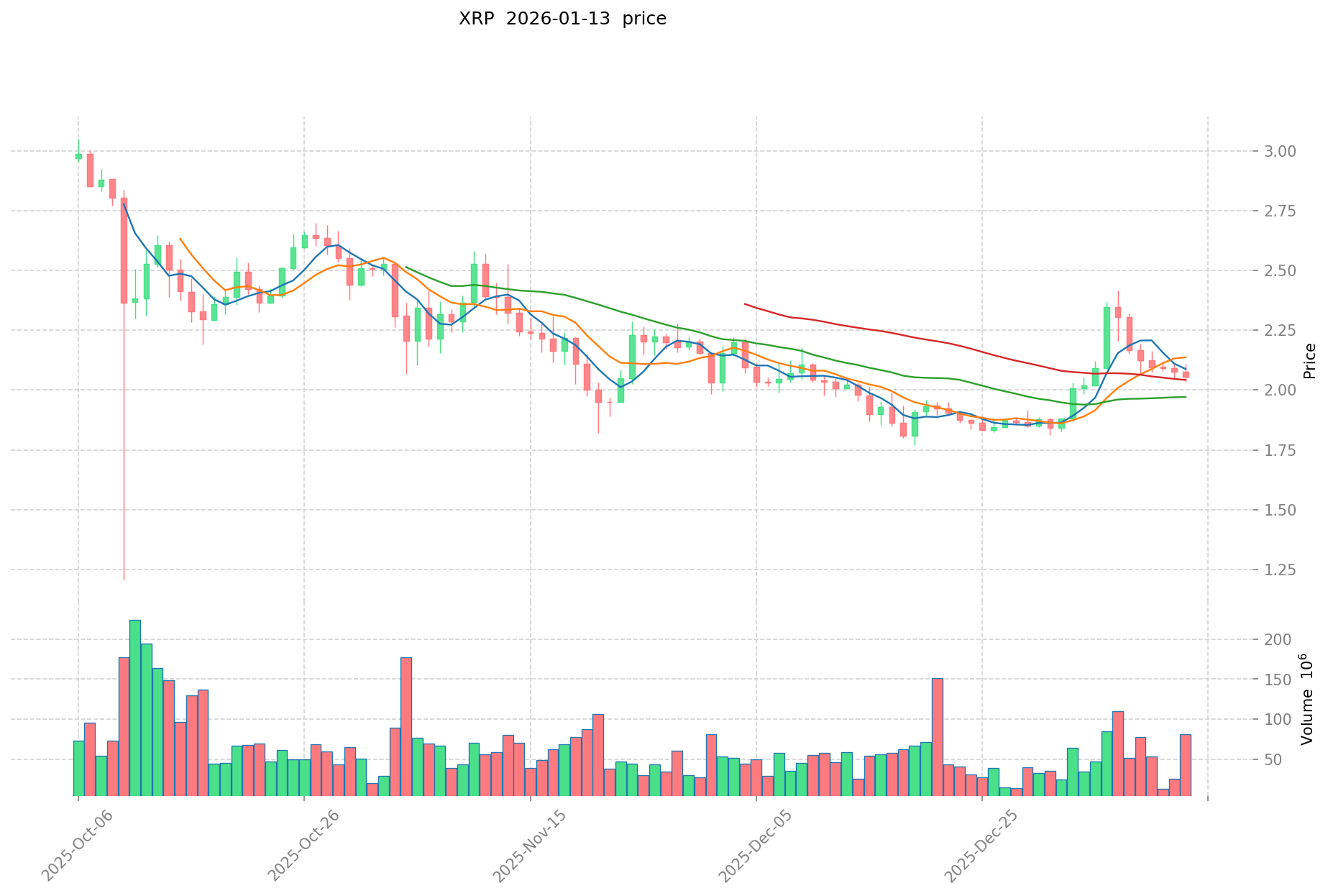
XRP reached an all-time high of $3.65 on July 18, 2025, driven by positive market sentiment and increased institutional interest in digital payment solutions. The lowest price of $0.00268621 occurred on May 22, 2014, during the early stages of the project when market awareness and adoption were limited. As of January 13, 2026, XRP is trading at $2.059, showing a -1% change over the past 24 hours. Recent price trends indicate a -13.23% decline over the past 7 days, while maintaining a 1.73% increase over the past 30 days. These fluctuations reflect changing market conditions, regulatory developments, and evolving adoption patterns in the cross-border payment sector.
Click to view current XRP market price
On-Chain Metrics
- 24-Hour Trading Volume: $152,160,665 (demonstrating active market participation and liquidity)
- Total Holder Addresses: 7,507,537 addresses (reflecting widespread user adoption and distribution)
- Market Capitalization: $124,981,233,189.57 (ranking 4th in the cryptocurrency market with a 6.33% market dominance)
- Fully Diluted Market Cap: $205,870,620,474.91 (representing the potential market value if all tokens were in circulation)
XRP Ecosystem Applications and Partners
Core Use Cases
XRP's ecosystem supports multiple applications:
- Cross-Border Payments: XRP facilitates fast and cost-effective international transactions, with settlement times of approximately 3 seconds and transaction costs around $0.0002.
- Liquidity Solutions: XRP serves as a bridge currency for financial institutions, enabling efficient liquidity management across different fiat currencies.
Strategic Partnerships
XRP has established collaborations with financial institutions and payment providers globally, enhancing its technical capabilities and market influence.
These partnerships provide a solid foundation for XRP's ecosystem expansion.
Controversies and Challenges
XRP faces the following challenges:
- Regulatory Risks: Ongoing discussions with regulatory bodies regarding its classification and compliance requirements
- Market Competition: Pressure from other blockchain solutions offering payment services
- Centralization Concerns: Community discussions regarding the distribution and control of XRP tokens
These issues have sparked discussions within the community and market, while also driving continuous innovation for XRP.
XRP's community remains vibrant, with 7,507,537 wallet holders as of January 13, 2026.
On X platform, related posts and hashtags (such as #XRP) frequently trend, generating significant engagement.
Factors such as technical developments and market movements continue to energize the community.
Sentiment on X shows diverse perspectives:
- Supporters praise XRP's fast transaction speeds, low costs, and carbon-neutral operations, viewing it as a practical solution for global payments.
- Critics focus on price volatility, regulatory uncertainties, and token distribution concerns.
Recent trends indicate varied sentiment patterns influenced by market conditions and regulatory developments.
Trending Topics
X users actively discuss XRP's regulatory landscape, adoption by financial institutions, and competition with other payment-focused cryptocurrencies,
showcasing both its transformative potential and the obstacles on its path to mainstream adoption.
- Official Website: Visit XRP official website for features, use cases, and latest updates.
- X Updates: On X platform, XRP maintains an active presence through @Ripple,
with posts covering technical upgrades, community activities, and partnership announcements, generating significant engagement.
How to Participate in XRP?
- Purchase Channels: Buy XRP on Gate.com and other major trading platforms
- Storage Solutions: Securely store XRP using compatible wallets that support XRP Ledger
- Explore Ecosystem: Visit developer documentation to learn about building on XRP Ledger
- Stay Informed: Follow official channels for updates on network developments and ecosystem growth
Summary
XRP redefines digital currency through blockchain technology, offering fast transactions, low costs, scalability, and environmental sustainability.
Its active community, extensive resources, and significant market presence distinguish it in the cryptocurrency space.
Despite facing regulatory uncertainties and market competition, XRP's innovative approach and clear technical advantages position it as a notable player in decentralized payment technology.
Whether you are a newcomer or an experienced participant, XRP merits attention and engagement.
FAQ
What is XRP and how does it differ from Bitcoin?
XRP is a digital currency on the Ripple network using a consensus protocol instead of mining. Unlike Bitcoin's proof-of-work system requiring specialized hardware, XRP validates transactions efficiently without energy-intensive mining operations.
How does XRP work and what is its use case in the financial industry?
XRP operates on the XRP Ledger, a blockchain using consensus validation instead of mining. It enables fast, low-cost cross-border payments and settlements between financial institutions, reducing transaction friction and improving efficiency in international money transfers.
Where can I buy XRP and how do I store it securely?
You can buy XRP on major cryptocurrency exchanges. For secure storage, use a hardware wallet like Ledger to protect your private keys. Transfer your XRP to the hardware wallet and manage it through the wallet's app for optimal security.
What are the risks and advantages of investing in XRP?
Advantages include potential high returns and widespread adoption in payment systems. Risks involve regulatory uncertainty, dependence on Ripple, and market volatility. Consider your risk tolerance before investing.
What is Ripple and what is the relationship between Ripple and XRP?
Ripple is a company developing payment protocols, while XRP is its native cryptocurrency. They are distinct entities: Ripple created XRP to enable fast, low-cost international transfers with 3-5 second settlements and near-zero fees.
* The information is not intended to be and does not constitute financial advice or any other recommendation of any sort offered or endorsed by Gate.