XRP is Ripple's native cryptocurrency designed to revolutionize cross-border payments with exceptional speed, minimal costs, and environmental efficiency. Launched in 2012, XRP operates on a decentralized blockchain delivering transactions in approximately 3 seconds at fees as low as $0.0002, supporting over 1,500 transactions per second while maintaining carbon neutrality. As the fifth-largest cryptocurrency by market capitalization ($124.56 billion), XRP serves institutional payment settlements and global remittances with an active community exceeding 7.5 million holders. This comprehensive guide explores XRP's technical architecture, market dynamics, ecosystem applications, and participation opportunities. Whether addressing regulatory challenges or competitive pressures, XRP's proven payment infrastructure and scalable technology remain central to its relevance in digital finance. Discover how to acquire, store, and engage with XRP on Gate.com and understand its transformative potential for modern financi
XRP's Positioning and Significance
In 2012, Ripple Labs launched XRP to address inefficiencies in cross-border payments and high transaction costs in traditional financial systems.
As a native digital asset built on an open-source public decentralized blockchain specifically designed for payments, XRP plays a critical role in global remittances and institutional payment settlements.
As of 2026, XRP has established itself as the fifth-largest cryptocurrency by market capitalization, with a market cap of approximately $124.56 billion and an active community of over 7.5 million holders.
This article will provide an in-depth analysis of its technical architecture, market performance, and future potential.
Origin and Development Timeline
Birth Context
XRP was created by Ripple Labs in 2012, aiming to solve inefficiencies in cross-border payments, long settlement times, and high transaction fees in traditional banking systems.
It emerged during a period of growing interest in blockchain technology following Bitcoin's success, with the goal of providing fast, cost-effective, and scalable payment solutions for financial institutions and individuals.
The launch of XRP brought transformative possibilities for the global payments industry and financial service providers.
Key Milestones
- 2012: XRP Ledger mainnet launched, achieving transaction speeds of approximately 3 seconds and extremely low fees of $0.0002 per transaction.
- 2013: XRP gained early adoption among payment service providers, demonstrating its utility in cross-border transactions.
- 2017: Market expansion saw XRP's price surge, reaching significant valuation milestones and attracting institutional attention.
- 2025: XRP reached a notable price point of $3.65 on July 18, reflecting strong market interest and ecosystem growth.
With support from Ripple Labs and a global community of developers and financial institutions, XRP continues to enhance its technology, security features, and real-world applications.
How XRP Works
Decentralized Control
XRP operates on a decentralized network of computers (nodes) distributed globally, independent of control by banks or governments.
These nodes collaborate to validate transactions, ensuring the system remains transparent and resistant to attacks, empowering users with greater autonomy and enhancing network resilience.
Blockchain Foundation
XRP's blockchain is a public, immutable digital ledger that records every transaction.
Transactions are grouped into blocks and linked through cryptographic hashing to form a secure chain.
Anyone can view the records, establishing trust without intermediaries.
The XRP Ledger's architecture enables high throughput of over 1,500 transactions per second (TPS) while maintaining carbon neutrality, making it exceptionally efficient for payment applications.
Ensuring Fairness
XRP utilizes a unique consensus protocol based on Byzantine Fault Tolerance (BFT) to validate transactions and prevent fraudulent activities such as double-spending.
Validator nodes maintain network security by reaching consensus on transaction validity through a distributed agreement process, without requiring energy-intensive mining.
Its innovations include faster settlement times, significantly lower energy consumption compared to Proof-of-Work systems, and high transaction throughput.
Secure Transactions
XRP employs public-private key cryptography to protect transactions:
- Private keys (similar to secret passwords) are used to sign transactions
- Public keys (similar to account numbers) are used to verify ownership
This mechanism ensures fund security while transactions maintain pseudonymous privacy.
The XRP Ledger's design includes built-in safeguards against spam and network attacks through transaction fee mechanisms and protocol-level security features.
Circulation Overview
As of January 13, 2026, XRP has a circulating supply of 60,699,967,552 tokens, with a total supply of 99,985,731,168 tokens and a maximum supply capped at 100,000,000,000 tokens. The token distribution follows a predetermined model, with approximately 60.7% currently in circulation. The circulating supply represents tokens that have been released into the market through various mechanisms, influencing the supply-demand dynamics of XRP.
Price Fluctuations
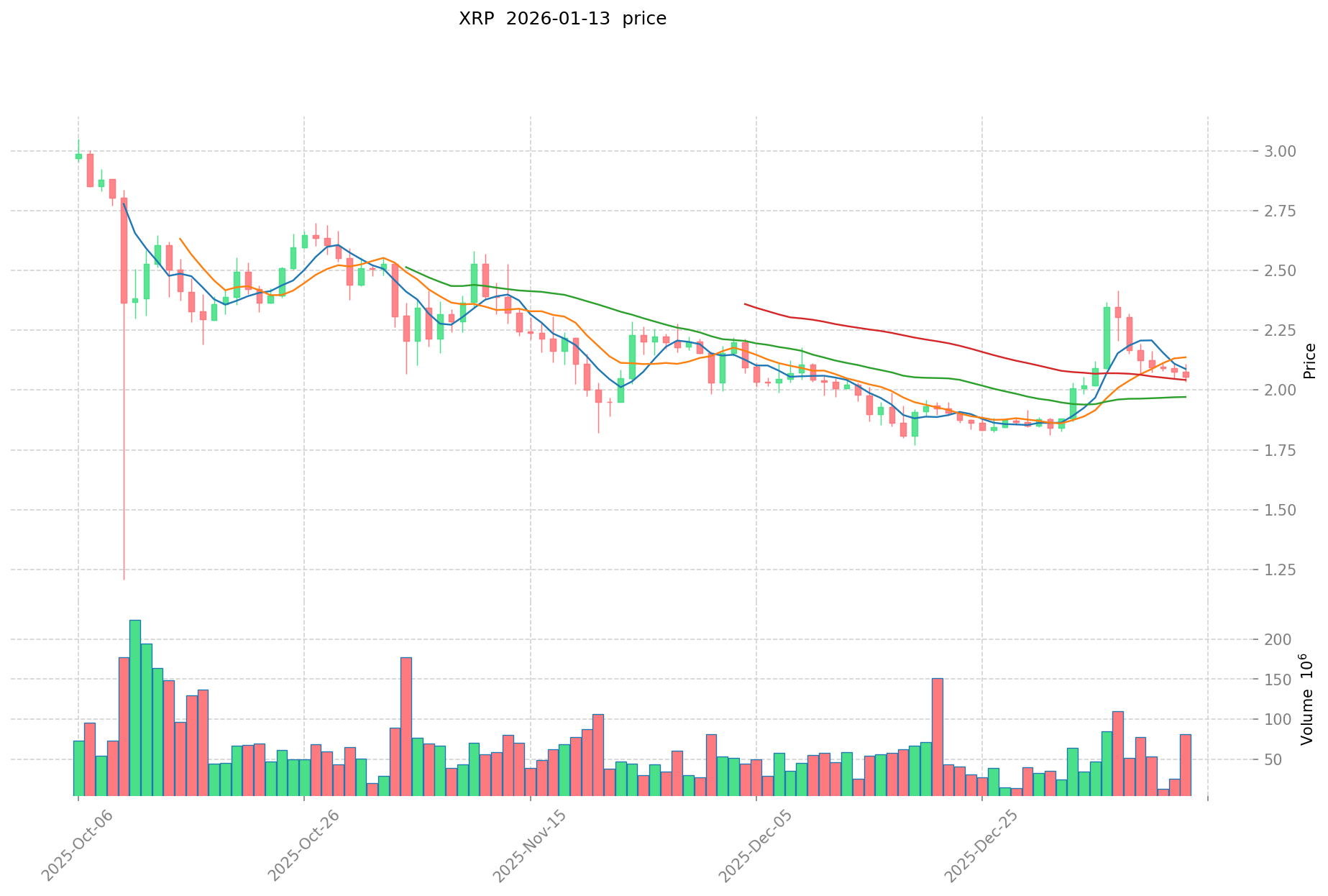
XRP reached an all-time high price of $3.65 on July 18, 2025, driven by favorable market conditions and increased adoption of blockchain-based payment solutions. Its lowest recorded price was $0.00268621, which occurred on May 22, 2014, during the early stages of the cryptocurrency market's development. As of January 13, 2026, XRP is trading at $2.052, showing a decline of 1.81% over the past 24 hours and 14% over the past week. These fluctuations reflect broader market sentiment, regulatory developments, and the evolving landscape of digital payment systems.
Click to view the current XRP market price
On-Chain Metrics
- 24-Hour Trading Volume: $143,376,759.97 (indicating active market participation)
- Holder Addresses: 7,507,537 accounts (demonstrating widespread distribution and user engagement)
- Market Capitalization: $124,556,333,416.70 (representing approximately 6.29% market dominance in the cryptocurrency sector)
XRP Ecosystem Applications and Partnerships
Core Use Cases
XRP's ecosystem supports multiple applications:
- Cross-Border Payments: XRP Ledger enables instant international settlements with transaction costs as low as $0.0002 per transaction.
- Liquidity Solutions: Financial institutions leverage XRP for on-demand liquidity in cross-border corridors, reducing pre-funded account requirements.
Strategic Partnerships
XRP has established collaborations with various financial institutions and payment service providers globally, enhancing its technology capabilities and market presence.
These partnerships provide a solid foundation for XRP's ecosystem expansion.
Controversies and Challenges
XRP faces the following challenges:
- Regulatory Uncertainty: Ongoing discussions regarding regulatory classification in various jurisdictions
- Market Competition: Competition from other payment-focused blockchain solutions and traditional financial infrastructure
- Network Adoption: Challenges in expanding use cases beyond payment corridors
These issues have sparked discussions within the community and market, while also driving XRP's continuous innovation.
XRP's community demonstrates significant activity, with over 7.5 million holders as of January 2026.
On X platform, related posts and hashtags (such as #XRP) frequently trend, generating substantial engagement.
Community enthusiasm has been influenced by various developments in the ecosystem.
Sentiment on X presents diverse perspectives:
- Supporters praise XRP's fast transaction speed (~3 seconds per transaction), low costs, and carbon-neutral design, viewing it as an efficient payment infrastructure.
- Critics focus on price volatility and market dynamics.
Recent trends reflect varied market sentiment patterns.
Popular Topics
X users actively discuss XRP's transaction efficiency, environmental sustainability, and adoption in financial services,
showcasing both its transformative potential and the path toward mainstream acceptance.
- Official Website: Visit XRP Ledger Official Site for features, use cases, and latest updates.
- X Updates: On X platform, Ripple uses @Ripple and maintains active engagement with the community,
covering technology updates, ecosystem developments, and partnership announcements.
- Community Forum: Join discussions at XRP Chat for community insights and conversations.
- Technical Resources: Explore GitHub repositories for developer documentation and code contributions.
How to Participate in XRP?
- Purchase Options: Acquire XRP on Gate.com and other major platforms
- Storage Solutions: Store securely using compatible wallets that support XRP Ledger
- Network Participation: Run validators or participate in XRP Ledger consensus
- Ecosystem Development: Access developer documentation at the official XRP Ledger site to build applications or contribute to the network
Summary
XRP, through its dedicated blockchain technology, has positioned itself as an efficient digital asset, offering fast transaction speeds (~3 seconds), minimal costs ($0.0002 per transaction), high scalability (1,500+ TPS), and carbon-neutral operations.
Its active community of over 7.5 million holders, comprehensive resources, and market presence contribute to its position in the cryptocurrency sector.
Despite facing regulatory discussions and competitive pressures, XRP's technical design and clear focus on payment efficiency maintain its relevance in decentralized technology.
Whether you are new to cryptocurrency or an experienced participant, XRP presents opportunities worth exploring.
FAQ
What is XRP and how does it work?
XRP is a cryptocurrency created by Ripple Labs for fast, low-cost global payments. It operates on the XRP Ledger blockchain, enabling efficient cross-border transactions with minimal fees and settlement times.
What is the difference between XRP and Bitcoin?
XRP is faster and cheaper for transactions, especially for international payments, while Bitcoin is slower and more energy-intensive due to mining. XRP uses a consensus algorithm, making it more sustainable than Bitcoin's proof-of-work mechanism.
How can I buy and store XRP?
Buy XRP through a cryptocurrency exchange using fiat or crypto. Transfer purchased XRP to a secure hardware wallet like Ledger for long-term storage. Use Ledger Live app to manage your XRP securely and conveniently.
What is Ripple and what is the relationship between Ripple and XRP?
Ripple is a company developing payment technology, while XRP is its native cryptocurrency. They are distinct entities: Ripple created XRP to enable fast, low-cost international money transfers with 3-5 second settlements and near-zero fees.
Is XRP a good investment? What are the risks?
XRP offers potential through Ripple's payment infrastructure and growing adoption. Main risks include regulatory uncertainty, centralization concerns, and market volatility. Consider your risk tolerance before investing.
How many XRP coins are in circulation and what is the total supply?
XRP has a total supply of 100 billion coins. Currently, over 59 billion XRP coins are in circulation as of January 2026.
* The information is not intended to be and does not constitute financial advice or any other recommendation of any sort offered or endorsed by Gate.