Tezos (XTZ) is a self-amending blockchain platform launched in 2017 to address governance challenges and protocol upgrades without hard forks. This comprehensive guide explores Tezos' innovative architecture powered by Liquid Proof-of-Stake consensus, on-chain governance mechanisms, and formal verification for smart contract security. The article examines XTZ's market performance, current valuation at $0.5844 as of January 2026, and ecosystem applications spanning DeFi, NFTs, and smart contract development. It covers strategic partnerships, active community engagement with over 20,481 token holders, and real-world use cases through platforms like Plenty DeFi and objkt.com. Readers will learn how to purchase XTZ on Gate, participate in governance voting, secure tokens in compatible wallets, and contribute to ecosystem development. Despite facing regulatory risks and competitive pressure, Tezos' unique self-amendment capability and transparent governance model position it as a significant Layer 1 blockchain for
Tezos's Position and Significance
In 2017, Arthur Breitman and Kathleen Breitman launched Tezos (XTZ), aiming to address blockchain governance challenges and the difficulty of protocol upgrades.
As a self-amending blockchain platform, Tezos plays a key role in decentralized governance, smart contracts, and digital asset management.
As of 2026, Tezos has established itself as a significant Layer 1 blockchain with over 1.07 billion circulating tokens and an active developer community.
This article will provide an in-depth analysis of its technical architecture, market performance, and future potential.
Origin and Development History
Birth Background
Tezos was created by Arthur and Kathleen Breitman in 2017, aiming to solve the challenge of blockchain protocol upgrades and on-chain governance without hard forks.
It emerged during the blockchain technology boom, with the goal of enabling seamless protocol evolution through formal verification and on-chain voting to transform the status quo.
The launch of Tezos brought new possibilities to blockchain developers and institutional adopters seeking stable, upgradable infrastructure.
Important Milestones
- 2018: Mainnet launch, implementing formal verification capabilities and on-chain governance mechanisms.
- 2020: Major protocol upgrades introduced improved consensus efficiency and reduced block times.
- 2021: Network activity surged, with the price reaching notable levels during the broader crypto market expansion.
- 2023: Ecosystem growth continued, with DeFi protocols and NFT platforms expanding on the network.
With support from the Tezos Foundation and a global community, Tezos continues to optimize its technology, security, and real-world applications.
How Does Tezos Work?
No Central Control
Tezos operates on a decentralized network of computers (nodes) distributed globally, free from control by banks or governments.
These nodes collaborate to verify transactions, ensuring system transparency and attack resistance, granting users greater autonomy and enhancing network resilience.
Blockchain Core
Tezos's blockchain is a public, immutable digital ledger that records every transaction.
Transactions are grouped into blocks, linked through cryptographic hashes to form a secure chain.
Anyone can view the records, establishing trust without intermediaries.
The network's self-amendment mechanism allows protocol upgrades without hard forks, further enhancing adaptability.
Ensuring Fairness
Tezos employs Liquid Proof-of-Stake (LPoS) to verify transactions and prevent fraudulent activities such as double-spending.
Validators (known as bakers) maintain network security through staking XTZ tokens and participating in the consensus process, earning XTZ rewards.
Its innovation includes on-chain governance that allows token holders to vote on protocol upgrades and formal verification for enhanced smart contract security.
Secure Transactions
Tezos uses public-private key cryptography to protect transactions:
- Private keys (like secret passwords) are used to sign transactions
- Public keys (like account numbers) are used to verify ownership
This mechanism ensures fund security, with transactions maintaining pseudonymous privacy.
The platform incorporates formal verification techniques that mathematically prove the correctness of smart contract code, enhancing security for decentralized applications.
Circulation Overview
As of January 14, 2026, Tezos (XTZ) has a circulating supply of 1,071,983,685.98 tokens, with a total supply of 1,092,042,705.68 tokens. The token operates under an inflationary model with no maximum supply cap.
The circulating supply represents approximately 98.16% of the total supply, indicating a high degree of token distribution. New tokens enter the market through Tezos' proof-of-stake consensus mechanism, where validators (known as "bakers") receive newly minted XTZ as rewards for securing the network and validating transactions. This issuance model influences the supply-demand dynamics by continuously introducing new tokens into circulation while incentivizing network participation.
Price Volatility
Tezos reached its all-time high price of $9.12 on October 4, 2021, during a period of broader cryptocurrency market expansion and increased institutional interest in proof-of-stake networks.
The token's lowest recorded price was $0.350476, which occurred on December 7, 2018, during a broader market downturn affecting the entire cryptocurrency sector.
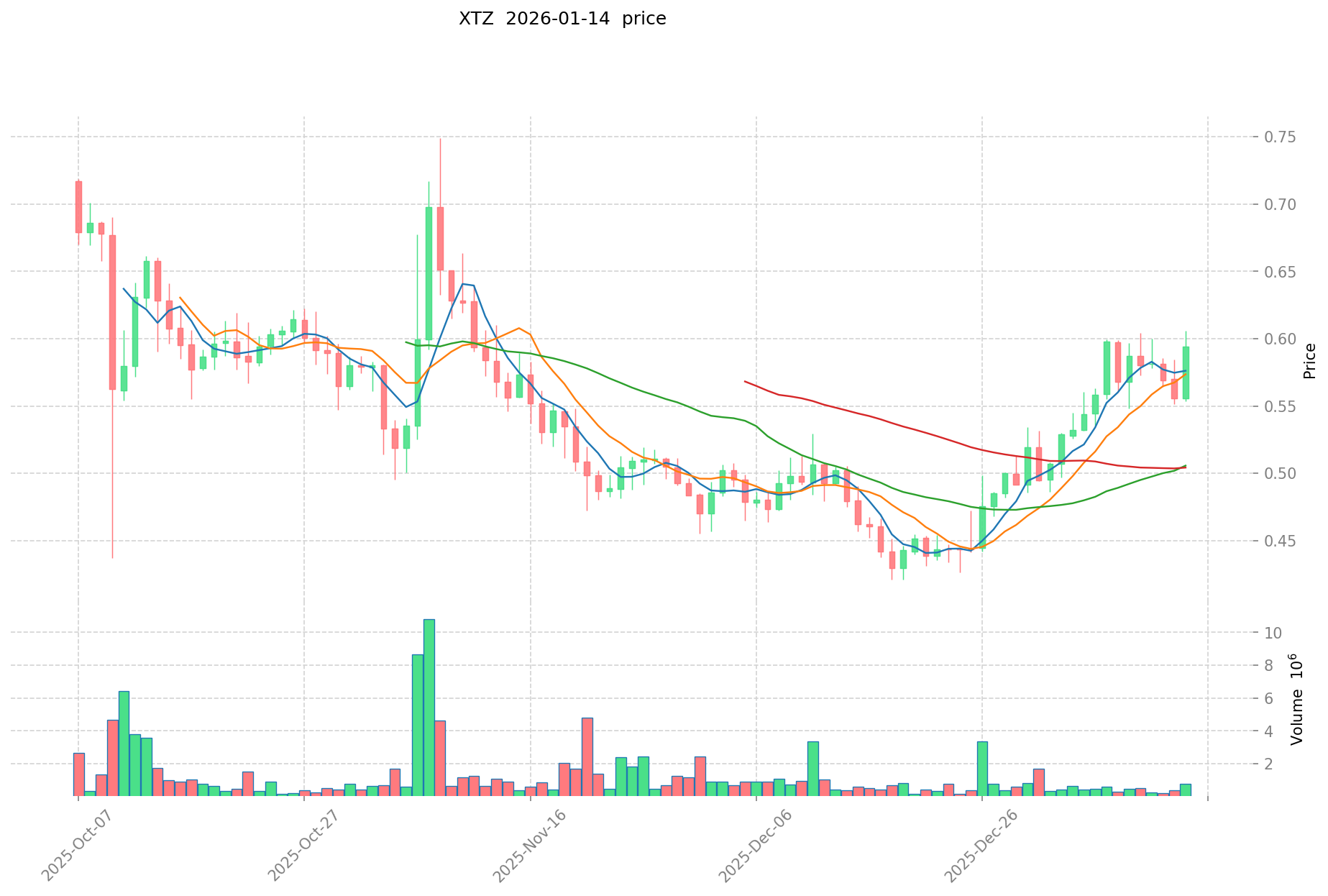
As of January 14, 2026, XTZ is trading at $0.5844, representing a 52.62% decline over the past year. Recent price movements show a 2.16% increase over 24 hours and a 21.02% gain over 30 days, reflecting evolving market sentiment and trading dynamics.
These price fluctuations demonstrate the impact of market cycles, adoption trends, and external factors on the token's valuation.
Click to view current XTZ market price
On-chain Metrics
- 24-hour Trading Volume: $482,457.30 (indicating active market participation)
- Active Holders: 20,481 addresses (reflecting user engagement with the network)
- Market Capitalization: $626,467,266.09 (representing the token's overall market valuation)
- Circulating Supply Ratio: 98.16% (demonstrating extensive token distribution)
Tezos Ecosystem Applications and Partnerships
Core Use Cases
Tezos' ecosystem supports multiple applications:
- DeFi: Projects like Plenty DeFi and Youves provide decentralized trading and synthetic asset issuance.
- NFT: Platforms such as objkt.com and Teia drive digital collectibles and creator economies.
- Smart Contract Development: Tezos' formal verification capabilities enable mathematically secure smart contract deployment.
Strategic Partnerships
Tezos has established collaborations with various organizations to enhance its technical capabilities and market influence.
These partnerships provide a solid foundation for Tezos' ecosystem expansion.
Controversies and Challenges
Tezos faces the following challenges:
- Technical Difficulties: Continuous optimization of network performance and user experience
- Regulatory Risks: Evolving global cryptocurrency regulatory frameworks
- Competitive Pressure: Competition from other blockchain platforms in the smart contract space
These issues have sparked discussions within the community and market, while also driving Tezos' continuous innovation.
Fan Enthusiasm
Tezos' community demonstrates notable activity, with over 20,481 token holders as of January 2026.
On X platform, related posts and hashtags (such as #Tezos and #XTZ) frequently trend.
Community engagement increases during protocol upgrades and ecosystem announcements.
Sentiment on X shows varied perspectives:
- Supporters praise Tezos' self-amendment mechanism, formal verification capabilities, and energy-efficient Proof-of-Stake consensus, considering it an innovative blockchain platform.
- Critics focus on price volatility and competition with other smart contract platforms.
Recent trends indicate mixed sentiment reflecting broader market conditions.
Hot Topics
X users actively discuss Tezos' governance model, protocol upgrades, and ecosystem development,
showcasing both its transformative potential and the challenges in achieving mainstream adoption.
- Official Website: Visit Tezos Official Website for features, use cases, and latest updates.
- Whitepaper: Tezos Whitepaper details its technical architecture, objectives, and vision.
- X Updates: On X platform, Tezos uses @tezos handle,
with posts covering protocol upgrades, community events, and ecosystem developments.
Tezos Future Roadmap
- Ongoing Development: Continuous protocol improvements through self-amendment mechanism
- Ecosystem Goals: Expanding DApp support and developer adoption
- Long-term Vision: Becoming a leading platform for secure, self-upgradable smart contracts
How to Participate in Tezos?
- Purchase Channels: Buy XTZ on Gate.com and other cryptocurrency exchanges
- Storage Solutions: Use Kukai Wallet or other compatible wallets for secure storage
- Participate in Governance: Engage in on-chain governance through Tezos' amendment process
- Build the Ecosystem: Visit Tezos GitHub to develop DApps or contribute code
Summary
Tezos redefines blockchain technology through its self-amendment mechanism, providing transparency, security, and formal verification capabilities.
Its active community, rich resources, and unique governance model distinguish it in the cryptocurrency space.
Despite facing regulatory uncertainty and market competition, Tezos' innovative approach and clear development path position it significantly in the future of decentralized technology.
Whether you are a newcomer or an experienced participant, Tezos merits attention and engagement.
FAQ
What is Tezos (XTZ) and how does it work?
Tezos (XTZ) is a self-amending blockchain platform that evolves through on-chain governance. Users can propose and vote on protocol upgrades directly on the network, prioritizing security and decentralization without requiring hard forks.
What are the main features and use cases of XTZ cryptocurrency?
XTZ features on-chain governance allowing holders to vote on protocol upgrades, an inflation-based funding model rewarding developers, and support for smart contracts and decentralized applications. Its self-amending blockchain enables decentralized evolution without hard forks.
How can I buy and store Tezos (XTZ) tokens?
Purchase XTZ on major cryptocurrency platforms, then transfer to a personal wallet for security. Alternatively, store directly in your exchange account. Hardware wallets offer maximum protection for long-term holding.
What is the difference between Tezos (XTZ) and other cryptocurrencies like Ethereum?
Tezos (XTZ) features on-chain governance and forkless upgrades, allowing the network to evolve without hard forks. Unlike Ethereum, Tezos uses a decentralized voting system where token holders directly decide protocol changes, ensuring smoother upgrades and stronger community consensus.
Is Tezos (XTZ) a safe and secure investment? What are the risks?
Tezos offers solid blockchain security through its proof-of-stake mechanism. Main risks include market volatility, regulatory changes, and competition. Like all crypto investments, XTZ requires careful consideration of your risk tolerance and investment goals.
What is the current market cap and price of XTZ?
As of January 14, 2026, XTZ has a market cap of $628.021 million and is trading at $9.27 per token.
How does Tezos governance and staking work?
Tezos governance allows bakers to submit proposals and vote on them. Voting power is based on staking balance. Proposals need 80% supermajority approval to pass. Bakers earn rewards by participating in consensus and governance.
* The information is not intended to be and does not constitute financial advice or any other recommendation of any sort offered or endorsed by Gate.