This comprehensive guide explores Symbol (XYM), a next-generation enterprise-focused blockchain platform launched by NEM Group in 2020. Symbol addresses critical challenges in business blockchain adoption, secure asset exchange, and digital interoperability through its decentralized architecture and robust consensus mechanism. As of 2026, with over 6.34 billion XYM in circulation, Symbol operates as a mature Layer 1 solution offering secure value exchange, asset tokenization, and decentralized management capabilities. The platform delivers practical business applications through its mosaic feature, enabling efficient asset creation at lower transaction costs than alternatives. Trading on Gate.com and other exchanges, XYM empowers node operators and network participants while supporting enterprise digital transformation. Whether exploring blockchain technology or seeking enterprise solutions, Symbol provides a reliable, transparent, and scalable ecosystem for decentralized asset management and business integra
Symbol's Position and Significance
In 2020, the NEM Group launched Symbol (XYM), aiming to address challenges in business blockchain adoption, asset exchange security, and interoperability.
As a next-generation open-source decentralized platform, Symbol plays a crucial role in enterprise blockchain applications, secure value exchange, and digital asset management.
As of 2026, Symbol has established itself as an enterprise-focused blockchain solution with proven technology, maintaining an active node network and a committed development community.
This article will provide an in-depth analysis of its technical architecture, market performance, and future potential.
Origin and Development History
Birth Background
Symbol was created by the NEM Group in 2020, aiming to solve limitations in enterprise blockchain adoption, secure asset exchange, and business-blockchain integration.
It emerged during the evolution of blockchain technology toward enterprise solutions, with the goal of providing a reliable and secure value exchange network that safely exchanges all assets and transforms the status quo.
The launch of Symbol brought new possibilities for businesses and organizations seeking blockchain integration.
Major Milestones
- 2020: Mainnet launch announced, implementing enhanced functionality, flexibility, and speed based on NEM's proven technology.
- 2021: Reached peak market valuation on March 24, demonstrating strong initial market interest.
- 2026: Currently operates with over 6.34 billion XYM in circulation, representing approximately 70.5% of maximum supply.
With support from the NEM community and development team, Symbol continues to optimize its technology, security, and real-world applications.
How Symbol Works?
Decentralized Control
Symbol operates on a decentralized network of computers (nodes) distributed globally, independent of banks or government control.
These nodes collaboratively validate transactions, ensuring system transparency and attack resistance, granting users greater autonomy and enhancing network resilience.
Blockchain Foundation
Symbol's blockchain is a public, immutable digital ledger that records every transaction.
Transactions are grouped into blocks, linked through cryptographic hashes to form a secure chain.
Anyone can view the records, establishing trust without intermediaries.
The platform's architecture enhances performance and supports various business use cases.
Ensuring Fairness
Symbol employs a consensus mechanism to validate transactions and prevent fraud such as double-spending.
Network participants maintain network security through node operation and receive XYM rewards.
Its approach emphasizes practical business application and network efficiency.
Secure Transactions
Symbol uses public-private key cryptography to protect transactions:
- Private keys (like secret passwords) are used to sign transactions
- Public keys (like account numbers) are used to verify ownership
This mechanism ensures fund security while maintaining transaction integrity.
The network architecture supports secure asset exchange and business-blockchain connections.
Circulation Overview
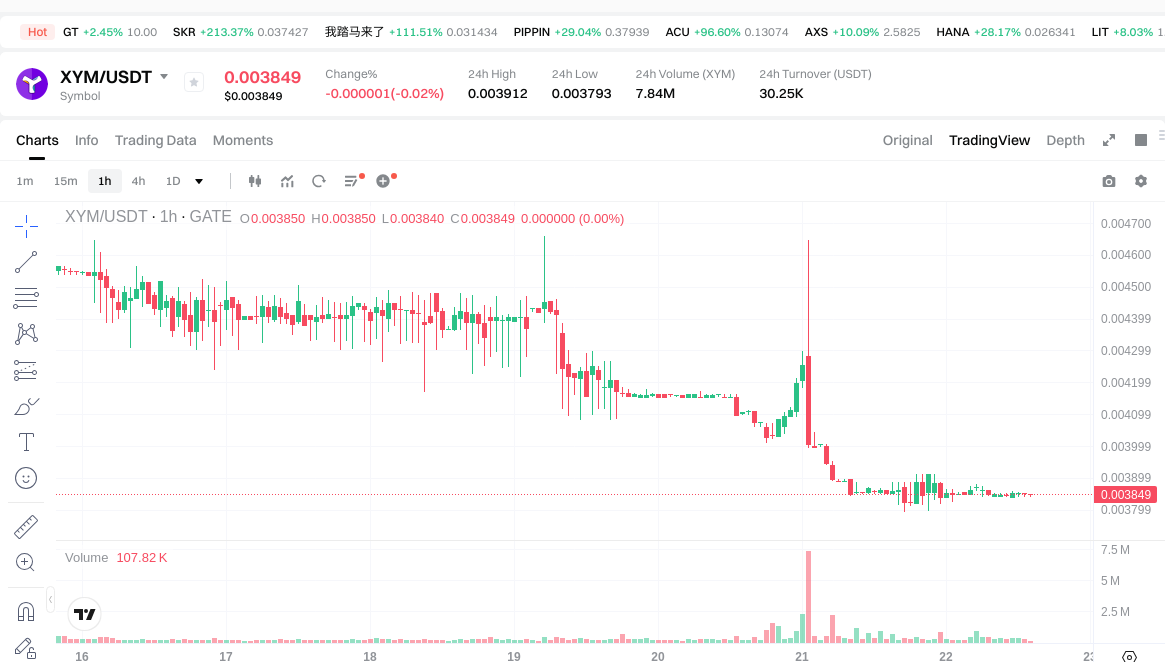
As of January 22, 2026, Symbol's circulating supply stands at 6,345,404,394.14 XYM tokens, with a total supply of 8,999,999,999 XYM tokens. The circulating supply represents approximately 70.5% of the maximum supply, indicating a relatively mature distribution phase. The native currency XYM functions within the Symbol public blockchain ecosystem to facilitate payment transactions and incentivize the public node network that processes and records transactions.
Price Fluctuations
Symbol reached its peak price of $0.726222 on March 24, 2021, during a period of broader market enthusiasm for blockchain platforms. The token experienced its lowest recorded price of $0.00371324 on November 5, 2025, reflecting challenging market conditions. As of January 22, 2026, XYM trades at $0.003842, showing price movements of -0.26% over 1 hour, -0.02% over 24 hours, -16.08% over 7 days, -25.90% over 30 days, and -73.92% over 1 year. These fluctuations demonstrate the impact of market sentiment, adoption trends, and external factors on the token's valuation.
Click to view current XYM market price
On-chain Metrics
- 24-hour Trading Volume: $30,265.69 (indicating current market activity levels)
- Market Capitalization: $24,379,043.68 (representing 0.0010% market dominance)
- Fully Diluted Valuation: $34,577,999.99 (projecting potential value at maximum supply)
Symbol Ecosystem Applications and Partners
Core Use Cases
Symbol's ecosystem supports multiple application scenarios:
- Enterprise Solutions: Symbol enables businesses to establish secure value exchange networks, providing decentralized asset management and transaction recording capabilities.
- Digital Asset Management: The platform facilitates secure exchange of various assets, driving innovation in cross-border payments and supply chain transparency.
Strategic Partnerships
Symbol has established its foundation for ecosystem expansion through its open-source framework and decentralized architecture.
These technological capabilities provide a foundation for Symbol's ecosystem development.
Challenges and Considerations
Symbol faces several challenges:
- Market Volatility: Price fluctuations remain a consideration for participants
- Competitive Landscape: The blockchain space continues to evolve with various platforms offering similar functionalities
- Adoption: Expanding real-world commercial applications requires ongoing effort
These factors contribute to ongoing discussions within the community and market, while driving Symbol's continuous development.
Symbol maintains an active community presence with its native currency XYM serving as the foundation for network operations.
On X platform, discussions around Symbol and related topics generate regular engagement.
The platform's technical features and use cases contribute to community interest.
Sentiment on X shows varied perspectives:
- Supporters highlight Symbol's security features and decentralized architecture, viewing it as a reliable platform for business applications.
- Observers focus on market dynamics and adoption progress.
Discussions reflect both opportunities and considerations for the platform's development.
Discussion Topics
X users discuss Symbol's technical capabilities, business applications, and market positioning,
reflecting both its potential and the considerations involved in blockchain adoption.
- Official Website: Visit Symbol Documentation for features, use cases, and latest updates.
- White Paper: Symbol Technical Reference details its technical architecture, objectives, and vision.
- X Presence: On X platform, Symbol maintains @thesymbolchain with updates covering technical developments, community activities, and platform news.
Symbol Future Roadmap
Symbol continues to develop its open-source platform with focus on enhancing functionality, flexibility, and ease of use for business applications.
How to Participate in Symbol?
- Purchase Channels: XYM is available on Gate.com and select exchanges
- Storage Solutions: Use compatible wallets that support Symbol network for secure storage
- Community Participation: Engage through official channels including GitHub and Reddit communities
- Ecosystem Building: Visit Symbol GitHub to access developer resources and contribute to the codebase
Summary
Symbol represents a next-generation blockchain platform designed for business applications, offering secure value exchange, asset management capabilities, and decentralized architecture.
Its open-source foundation, technical documentation, and community presence position it within the blockchain technology landscape.
While facing market dynamics and adoption considerations, Symbol's focus on business applications and technical reliability contribute to its role in decentralized technology development.
Whether you are new to blockchain or experienced in the space, Symbol offers opportunities for exploration and participation.
FAQ
What is XYM? What are its main functions and uses?
XYM is the native token of Symbol blockchain, a Layer 1 platform designed for enterprise asset tokenization and digital identity management. Its main functions include network security through staking, transaction fees, and enabling smart asset creation and management for businesses seeking decentralized solutions.
How to buy and store XYM tokens?
Purchase XYM through major cryptocurrency exchanges using fiat or crypto. Transfer tokens to a secure wallet supporting XYM, such as hardware wallets or official mobile wallets. Ensure you control private keys for maximum security and full ownership of your assets.
What are the differences between XYM and other cryptocurrencies like Bitcoin and Ethereum?
XYM (Symbol) is built on NEM blockchain, offering faster transactions and lower fees than Bitcoin. Unlike Ethereum's smart contracts focus, XYM emphasizes efficient asset creation and management through its unique mosaic feature, providing a more streamlined, enterprise-friendly blockchain solution.
What are the risks of investing in XYM?
XYM investment risks include market volatility, regulatory uncertainty in crypto sectors, liquidity fluctuations, technology development delays, and competitive market pressures. Price can fluctuate significantly based on market sentiment and adoption rates.
What are the development prospects and team background of Symbol (XYM) project?
Symbol (XYM) demonstrates strong fundamentals with an experienced development team from NEM ecosystem. The project focuses on enterprise blockchain solutions and digital asset management. With active community support and continuous protocol improvements, XYM is positioned for sustainable growth in the blockchain infrastructure sector.
What is XYM's total supply and inflation mechanism?
XYM has a total supply of 8.999.999.999 tokens with no inflation. The network uses a fixed supply model, ensuring scarcity and long-term value stability through its sustainable economic design.
* The information is not intended to be and does not constitute financial advice or any other recommendation of any sort offered or endorsed by Gate.